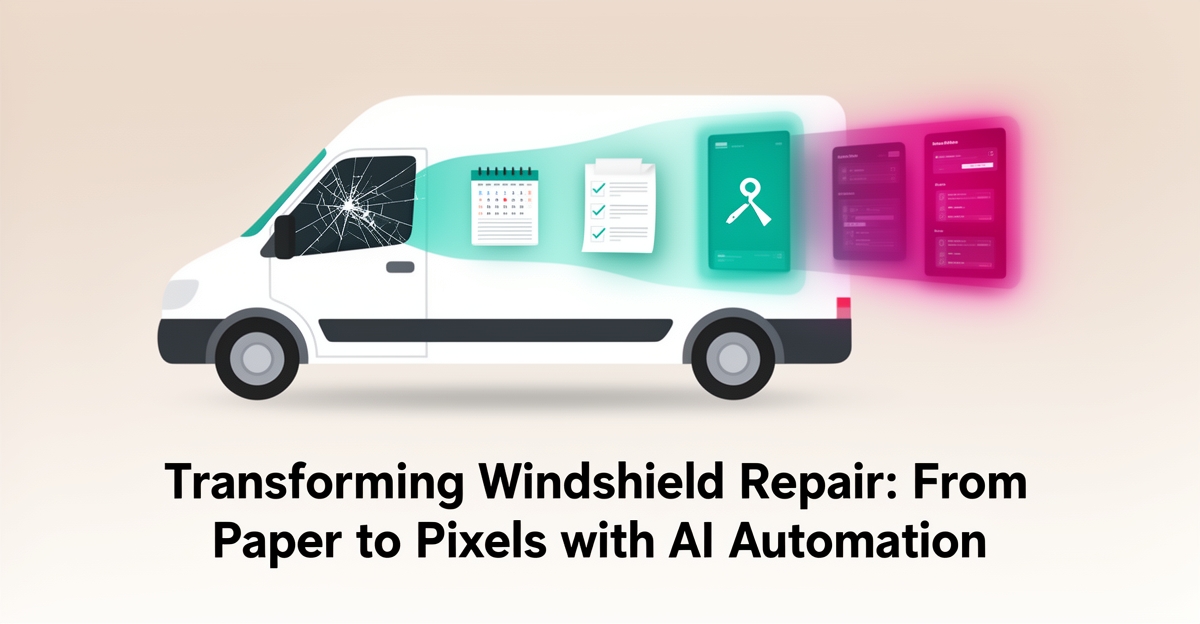
From Manual to AI: Transforming Service Booking and Repair Flow in Mobile Windshield Repair
Key Facts
- Manual booking entry, phone tag, and CRM updates typically consume 10–20 minutes per task in service businesses without automation
- Goal-oriented AI agents break tasks like "process a new windshield repair request" into sub-tasks without manual triggers at each step
- AI agents can analyze uploaded damage photos for initial assessment and recommend repair versus replacement instantly
- AI makes teams dramatically faster on the repetitive admin work that was always grunt work, so skilled people stay focused on repairs
- AIQ Labs has deployed 200+ multi-agent systems and runs 4 live SaaS products daily
- AI Employees can replace routine intake and dispatch coordination at roughly 80% less cost than a human hire
Hire a team member that works 24/7 — for less than a part-time wage.
AI receptionists, SDRs, dispatchers and 99+ roles. Trained on your business, fully managed.
Not sure where to start? Ask our AI planner
Paper Bookings and Manual Dispatch Are Bottlenecking Growth
Paper bookings and manual dispatch are bottlenecking growth in mobile windshield repair, creating friction at every stage of the service flow. Technicians and dispatchers waste valuable time on repetitive tasks like data entry, phone tag, and damage assessment instead of focusing on repairs. In most service businesses, manual research and CRM updates take 10–20 minutes per task—a burden that directly translates to service booking and dispatch in field services. This inefficiency limits how many jobs a team can handle daily, capping revenue potential without adding headcount.
The pain points are familiar: customers call or submit a form, triggering a cycle of phone tag to confirm details, followed by manual logging into scheduling systems, paper-based damage notes, and dispatcher-driven technician assignment. Each step requires human intervention, creating delays and opportunities for error. Traditional workflows force humans to initiate every step, while goal-oriented AI agents operate differently—breaking tasks like "process a new windshield repair request" into sub-tasks such as verifying customer info, checking technician availability, and routing the job. This shift eliminates the need for manual triggers at each stage.
Automating these repetitive steps doesn't just save time—it amplifies team capacity. Once AI agents handle intake and record-keeping, tasks that consumed 10–20 minutes typically compress to a few minutes with more consistent quality. For mobile windshield repair, this means dispatchers can stop juggling spreadsheets and start focusing on exceptions, complex routing, or customer follow-up. AI handles the grunt work: matching booking signals to CRM records, assessing damage via photo uploads, assigning the nearest qualified technician, and sending confirmations—all without human initiation.
- Eliminates most of the 10–20 minutes of manual data entry per booking
- Reduces research and CRM update time to a few minutes per task
- Enables goal-oriented automation instead of step-by-step scripting
- Supports human-in-the-loop review for quality control
- Scales without adding dispatch or admin headcount
By removing the manual bottlenecks in booking and dispatch, mobile windshield repair businesses can redirect human effort toward high-value activities like quality assurance, customer satisfaction, and complex repairs. AIQ Labs helps businesses make this shift by designing and deploying AI-driven service flows that integrate with existing tools, automate repetitive workflows, and maintain human oversight where it matters most—turning operational friction into scalable growth. For teams that want a managed starting point, AI Employees handle intake, follow-up, and dispatch coordination as managed AI staff.
Goal-Oriented AI Agents Replace Step-by-Step Scripts
The shift from rigid software to goal-oriented AI agents is redefining how service businesses handle complex workflows. Instead of following pre-programmed steps, these agents interpret a desired outcome—like completing a windshield repair booking—and autonomously determine the necessary actions. This approach moves beyond simple task automation to create adaptive systems that reason, plan, and execute across multiple business functions. AI agents break goals into sub-tasks, enabling them to handle intricate processes without human intervention at every stage.
For mobile windshield repair, this means an AI agent can take a goal such as "Process a new service request" and dynamically coordinate scheduling, damage assessment via image analysis, parts availability checks, and technician dispatch. It pulls real-time data from CRM systems, scheduling tools, and inventory databases to make informed decisions, eliminating the need for manual data chasing. Workflows where humans once spent 10–20 minutes per request on research and CRM updates can often be completed in just a few minutes—with consistently higher output quality. The time savings are substantial, freeing skilled technicians and dispatchers to focus on complex repairs and customer engagement rather than administrative overhead.
- Identifies new service requests from web forms, calls, or apps
- Matches requests to customer records and checks service history
- Analyzes uploaded damage photos for initial assessment
- Verifies technician availability and optimizes routing
- Generates personalized confirmations and follow-up tasks
This goal-oriented model doesn't replace human expertise—it amplifies it. By handling repetitive, data-intensive sub-tasks, AI agents allow teams to operate at significantly higher efficiency, turning what was once a bottleneck into a streamlined, scalable process. The result is faster service delivery, fewer errors, and more time for humans to do what they do best: solve problems and build trust. AIQ Labs helps businesses implement this shift through custom multi-agent systems—200+ deployed to date—that integrate with existing tools, ensuring ownership, reliability, and continuous improvement.
Augmenting Technicians With AI for Onboarding, Assessment, and Dispatch
The most significant shift in AI-powered service operations is not about replacing your technicians—it is about eliminating the administrative friction that prevents them from doing their best work. When AI handles the repetitive grunt work of onboarding, assessment, and dispatch, your team can focus on complex repairs and genuine customer relationships.
This transformation centers on a fundamental change in how software operates. Modern AI systems no longer follow rigid, step-by-step instructions. Instead, they operate on goal-oriented logic: you define the outcome, and the agent breaks that goal into sub-tasks, gathers data from disparate systems, and executes autonomously. For a mobile windshield repair business, this means an AI agent can receive the goal "process this new booking" and independently handle customer intake, photo-based damage assessment, and dispatch routing without human intervention at each step.
The efficiency gains are measurable. Manual research and CRM updates typically consume 10–20 minutes per task, while AI-assisted workflows compress this to a few minutes with more consistent output quality. Because managed AI staff run at roughly 80% less cost than an equivalent human hire, the economics are compelling for high-volume service businesses.
AI augmentation maps directly to your repair flow through four key capabilities:
- Autonomous customer onboarding: AI agents capture customer details, insurance information, and vehicle data through natural conversation, eliminating paper forms and manual data entry.
- Photo-based damage assessment: Computer vision analyzes customer-submitted photos to classify chip versus crack damage, recommend repair versus replacement, and generate accurate quotes instantly.
- Intelligent dispatch routing: The system matches jobs to technician skills, location, and parts inventory, optimizing routes in real-time rather than relying on manual scheduling boards.
- Follow-up automation: Post-service communications, review requests, and warranty reminders trigger automatically based on job completion status.
Crucially, this is not about removing humans from the equation. AI makes teams dramatically faster on the part that was always grunt work, allowing human experts to focus on complex repairs and relationship building. Your technicians stop being schedulers and data entry clerks; they become pure craftspeople and customer consultants.
Implementing this requires more than just software installation. At AIQ Labs, we approach these transformations through end-to-end partnership, building custom AI employees that integrate with your existing CRM and dispatch tools while maintaining human-in-the-loop oversight for quality control. The goal is not to remove your team's expertise but to amplify it, ensuring that when a complex repair or delicate customer situation arises, your best people are available—not buried in administrative busywork.
Implementation Path From Pilot to Full AI Service Flow
The path from pilot to full AI service flow begins with identifying a repetitive workflow that drains time and introduces errors—like manual booking entry or damage assessment logging. Define a clear, outcome-based goal for the AI agent, such as "Automate the end-to-end booking process for a new windshield repair request," allowing it to break the goal into sub-tasks like verifying customer details, checking technician availability, and sending confirmations. This shift from step-by-step instructions to goal-oriented automation can compress tasks that took 10–20 minutes down to a few minutes while improving output consistency.
Next, ensure the AI agent integrates with existing systems—CRM, scheduling tools, and communication platforms—so it can pull customer history, update job status, and trigger dispatch without manual intervention. In real-world implementations, an AI agent can autonomously match service requests to CRM records, research context, assign tasks based on ownership rules, and even calculate job costs—all while maintaining audit trails. Because compute costs for these workflows are typically low, efficiency gains are both tangible and affordable.
Critical to success is keeping a human-in-the-loop for sanity checks: the AI agent drafts responses, gathers data, and proposes actions, but a human reviews and approves critical decisions like dispatch routing or pricing adjustments. This balances speed with quality control, letting technicians focus on complex repairs and customer satisfaction rather than administrative grunt work. The approach doesn't replace workers—it makes them far faster on repetitive tasks, freeing them for higher-value interactions.
Start small by automating a single workflow, such as post-service follow-up emails or initial damage assessment from customer photos. Measure performance, refine the agent's logic, and gradually expand to adjacent processes like scheduling and invoicing. AIQ Labs supports this phased rollout through AI Workflow Builds—rebuilding the one workflow that costs you the most at a fixed price—or, for businesses ready to connect booking, dispatch, and follow-up into one layer they own outright, a phased AI Operating System. Each step builds on proven results before moving forward.
Still paying for 10+ subscriptions that don’t talk to each other?
We build custom AI systems you own outright. No vendor lock-in. Full control.
Not sure where to start? Ask our AI planner
Frequently Asked Questions
Will AI replace my windshield technicians and dispatchers?
How much time can AI actually save on bookings and dispatch?
Is AI automation expensive to run for a mobile repair business?
What does a goal-oriented AI agent do differently than our current software?
How does AI handle damage assessment and dispatch routing?
Do we need to replace our CRM and scheduling tools to use AI?
Your Next Booking Could Process Itself
The path from paper bookings to an AI-driven repair flow isn't a leap—it's a sequence. Start by identifying one repetitive workflow that drains your team, define a clear outcome-based goal for the AI agent, integrate it with your existing CRM and scheduling tools, and keep a human in the loop for critical decisions like dispatch routing and pricing. Teams that make this shift typically compress manual research and CRM updates from 10–20 minutes per task down to a few minutes, with more consistent quality. That's not about replacing your technicians—it's about making them far faster on the grunt work so they can focus on complex repairs and real customer relationships. AIQ Labs has deployed 200+ multi-agent systems and runs 4 live SaaS products daily, so we build from operating experience, not theory. The easiest first step is a conversation: take the two-minute Fit Check at aiqlabs.ai/apply, and book a free 30-minute strategy call where an AI engineer will map your biggest bottleneck—or tell you honestly if there isn't a clear win. No pressure, just clarity on what's possible.
Make AI your competitive advantage — not just another tool.
Strategy, implementation and ongoing optimization. One partner, end to end.
Not sure where to start? Ask our AI planner