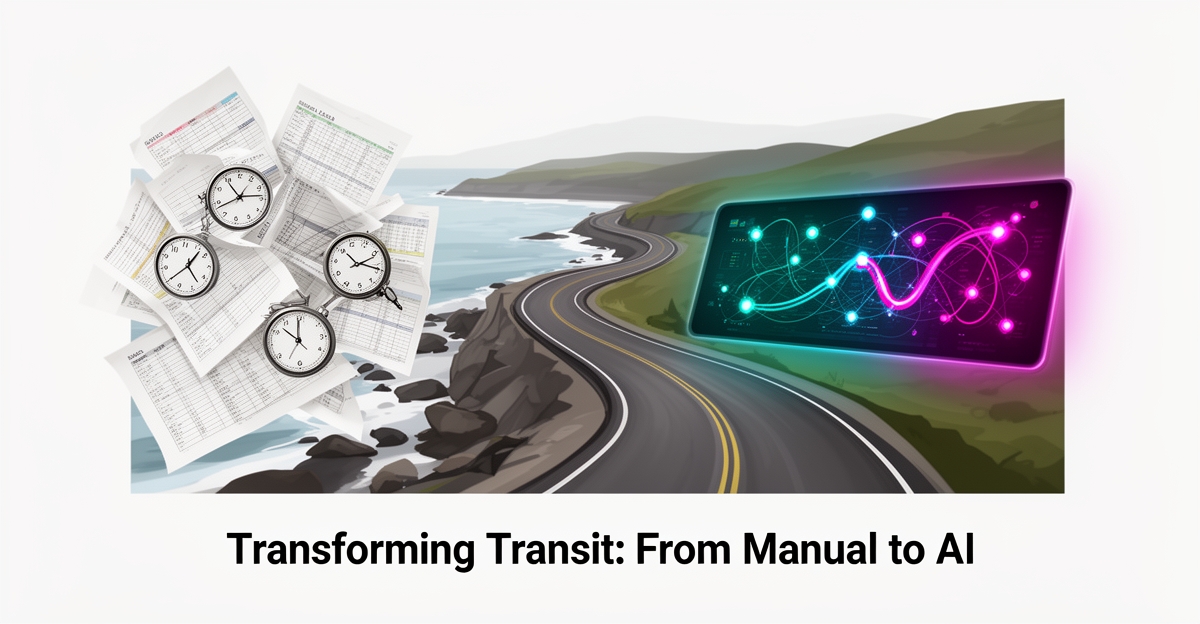
From Manual to AI: Transforming Shuttle Operations in Nova Scotia
Key Facts
- A large share of AI projects—often cited in the 70–80% range—fail to meet expectations due to poor integration and misalignment with business goals.
- Shuttle operators typically lose 6–8 hours a week compiling status updates manually from emails, calls and notes.
- AI-assisted development can meaningfully boost build speed, letting teams move from kickoff to a working prototype in 2–3 weeks.
- Automated reporting and dispatch workflows can turn hours of manual compilation into minutes of generated output.
- AIQ Labs has deployed 200+ multi-agent systems and runs 4 live SaaS products daily—proof of operational AI, not demos.
Hire a team member that works 24/7 — for less than a part-time wage.
AI receptionists, SDRs, dispatchers and 99+ roles. Trained on your business, fully managed.
Not sure where to start? Ask our AI planner
The Hidden Costs of Manual Shuttle Operations
Regional shuttle operators in Nova Scotia are bleeding time on work that never moves a vehicle. The pain is invisible until it shows up as missed pickups, driver overtime, and frustrated customers.
Manual scheduling and paper-based dispatch create a cycle of reactive firefighting. Staff commonly spend 6–8 hours weekly compiling status updates from emails, calls, and notes—a task modern AI workflows can automate. That administrative drag leaves little capacity for predictive planning.
The cost is not only hours. Without data integration, teams rely on gut feeling and optimistic human estimates. Industry analyses consistently warn that a large share of AI projects—often cited in the 70–80% range—fail to meet expectations due to a lack of integration, ownership, and alignment with business goals. For small to mid-sized operators, a misaligned pilot becomes stranded capital rather than relief.
Reactive operations also magnify risk. Problems are addressed after they occur instead of being anticipated from traffic patterns, maintenance logs, and driver availability. Resource allocation stays manual, leading to burnout and inefficient vehicle use. Knowledge lives in tribal memory, so lessons leave when staff do.
Common hidden costs include:
- Status reporting consuming 6–8 hours weekly with manual compilation
- Reactive problem-solving instead of predictive risk management
- Fragmented knowledge and repetitive administrative tasks
- Over-optimistic planning based on intuition rather than historical trip data
These bottlenecks are amplified in regional markets where margins are thin and teams wear multiple hats. AIQ Labs sees this pattern across small to mid-sized airport shuttles, where the move from paper scheduling to AI-powered operations requires treating workforce capability as core infrastructure, not an afterthought.
The shift begins with defining the business problem first. Speeding up scheduling, cutting operational costs, and improving customer satisfaction are measurable outcomes that should drive tool selection, not the other way around. When strategy is tied to specific operational pain, automation stops being a novelty and starts replacing the manual burden that hides in daily routines.
Why AI Transformations Fail—And How to Avoid the Trap
Many shuttle operators in Nova Scotia invest in AI technology only to find their initiatives stalled by a fundamental mismatch between capability and infrastructure. A large share of AI projects fail to deliver real value due to poor integration and misalignment with business goals, often because organizations treat AI as a technology deployment rather than an organizational redesign. AI infrastructure without workforce capability becomes stranded capital—investments that sit idle because teams lack the skills to use them effectively.
True transformation requires developing three interconnected workforce tiers: Builders who create the AI systems, Integrators who adapt them to operational workflows, and Consumers—frontline staff like drivers and dispatchers who use them daily. Most organizations overinvest in hiring data scientists and engineers while neglecting the upskilling needed for integrators and consumers, creating a capability gap that stalls ROI. Without balanced development across all tiers, even the most advanced AI scheduling tools remain underutilized, leaving shuttle operators stuck in manual processes despite their technology investments.
AIQ Labs addresses this by treating workforce upskilling as a technical dependency from the start, embedding training into every phase of implementation. Whether an operator starts with a single Workflow Build that rebuilds the one workflow costing the most, or a broader AI Operating System built in phases and owned outright, the approach ensures shuttle operators don't just deploy AI—they build the organizational capacity to sustain and scale it. This holistic design is what separates successful AI transformations from costly pilots that never scale.
From Reactive to Predictive: The AI-Powered Operations Model
Shuttle operators in Nova Scotia are moving beyond reactive crisis management by adopting AI systems that anticipate disruptions before they impact service. By analyzing historical trip data alongside real-time traffic, weather, and vehicle telemetry, AI enables predictive risk management that forecasts delays and maintenance needs with actionable lead time. This shift allows dispatchers to adjust routes and staffing proactively rather than scrambling to compensate after problems arise.
Intelligent resource allocation transforms how drivers and vehicles are assigned to shifts and routes. Instead of relying on static schedules or supervisor intuition, AI evaluates driver certifications, fatigue indicators, vehicle readiness, and historical demand patterns to optimize each deployment. This data-driven approach reduces idle time, prevents overburdening staff, and ensures the right resource is in the right place at the right time—directly supporting consistent on-time performance.
Administrative burdens like status reporting, shift logging, and compliance documentation are increasingly automated through AI workflows that synthesize data from dispatch logs, GPS feeds, and driver check-ins. What once consumed 6–8 hours weekly in manual compilation can now be generated in minutes, freeing supervisors to focus on service quality and team support. Automating these routine tasks not only saves time but also reduces errors and improves data consistency across operations. For shuttle companies working with AIQ Labs, this transformation follows a phased roadmap that builds workforce capability alongside technical implementation, ensuring AI enhances rather than disrupts daily operations. The result is an operations model where foresight replaces reaction, and efficiency becomes a continuous, data-driven advantage.
The Phased Roadmap: Your Path from Paper to AI-Powered
The journey from paper schedules to AI-powered shuttle operations begins with a clear problem statement, not a technology wishlist. For Nova Scotia shuttle operators, this means pinpointing where manual processes create the most friction—whether it's inefficient driver allocation, unpredictable route delays, or hours lost to status reporting. AI initiatives commonly stall when they lack alignment with specific business challenges, making this first step critical for success. Starting with the "why" ensures AI investments target real pain points like cutting operational costs or improving scheduling accuracy.
Once high-impact problems are identified, the next phase strengthens the data foundation essential for AI to function reliably. Shuttle operators must organize historical trip data, maintenance logs, and driver schedules into accessible, secure formats while establishing governance for quality and privacy. This prepares the ground for predictive capabilities—like using AI to analyze traffic patterns and vehicle performance to forecast bottlenecks before they disrupt service. With clean, integrated data, teams can shift from reactive fixes to proactive planning, turning wishful thinking into evidence-based decisions.
Executive sponsorship and cross-functional collaboration then transform technical potential into organizational reality. Leaders must champion the AI vision by connecting it to measurable outcomes such as reduced idle time or improved on-time performance, securing the resources and cultural buy-in needed for change. Simultaneously, teams should blend shuttle operators, dispatchers, and technical specialists to ensure solutions reflect frontline realities. This approach avoids siloed efforts and builds workforce capability across builders, integrators, and consumers—treating upskilling as core infrastructure rather than an afterthought.
With alignment and readiness in place, the focus shifts to rapid prototyping and iterative scaling. AIQ Labs' milestone-driven delivery model typically moves teams from concept to a working prototype in 2–3 weeks, significantly de-risking the transformation for SMB operators. Payment follows the same logic: Start Monthly, Build in Milestones, or Own It Outright—no fake prices, no surprises. Teams begin with a narrow, high-value use case—such as automating daily status reports or optimizing morning dispatch—validate results with stakeholders, then scale incrementally by adding predictive route adjustments or intelligent resource matching. Each iteration builds confidence, refines the system, and delivers tangible value without overhauling operations overnight.
This phased, learn-by-doing approach ensures AI becomes a practical tool for better shuttle service—not a disruptive experiment. By grounding each step in business impact, data readiness, and team capability, Nova Scotia operators can evolve from manual processes to predictive operations at a pace that matches their capacity. The result is a resilient, efficient system where AI supports drivers and dispatchers instead of replacing them, turning scheduling complexity into streamlined, reliable service. For those ready to begin, the first step is a focused conversation to map bottlenecks and validate opportunity—no obligation, just clarity on where AI can deliver the fastest win. Start the 2-minute Fit Check to map your fastest path from paper to AI-powered operations.
Governance, Integration, and Long-Term Success
The most expensive shuttle AI projects are the ones that look great in a demo and stall in production. Governance, integration and continuous optimization decide whether an AI rollout becomes a sustained operating advantage or an expensive experiment.
Data governance and privacy frameworks form the foundation. Shuttle operations handle passenger details, driver logs and route data that must be well-organized, secure and accessible. A robust data strategy covers governance, quality, privacy and availability planning, with monitoring for model drift and performance across the AI lifecycle. Without this foundation, integration with existing CRM and scheduling tools creates fragmentation rather than flow.
Integration prevents the silo trap. Enterprises treating AI as a siloed capability often stumble because scalable, reliable and secure AI requires more than just models. For regional shuttles, that means connecting AI dispatch and predictive routing to the CRM, accounting and scheduling systems already in use, with automated data synchronization and a single source of truth.
Performance monitoring turns pilots into ROI. A large share of AI projects fail to meet expectations due to a lack of integration, ownership and alignment. Continuous optimization counters that risk by establishing clear business outcomes, tracking adoption and retraining models as conditions change.
A practical governance and integration approach for shuttle operators includes:
- Data foundations and privacy controls aligned to regulations and operational risk
- Enterprise integration with CRM, scheduling and financial systems via APIs and workflow automation
- Monitoring for model performance, drift, cost and compliance with human-in-the-loop escalation
- Workforce capability building across builders, integrators and consumers to avoid stranded capital
Administrative burden also shrinks under proper governance. Traditional status reporting consumes 6–8 hours weekly, a task AI can automate by synthesizing updates from emails, messaging and meeting notes. When reporting is automated and data is trusted, leadership can focus on predictive risk management and intelligent resource allocation instead of chasing spreadsheets.
Long-term success requires treating AI as embedded capability, not a one-time project. Alignment of workforce capability with infrastructure investment from day one determines whether value compounds. AIQ Labs supports this through phased rollouts with training, governance and performance tracking—whether that's an AI dispatcher or receptionist handling day-to-day work, or a full operating layer built in phases and owned outright. With 200+ multi-agent systems deployed and 4 live SaaS products run daily, the track record is operational, not theoretical.
Continuous improvement is engineered, not assumed. Benchmark performance, iterate use cases and expand across departments as confidence grows. That disciplined loop is how AI investments deliver sustained ROI rather than becoming costly experiments.
Still paying for 10+ subscriptions that don’t talk to each other?
We build custom AI systems you own outright. No vendor lock-in. Full control.
Not sure where to start? Ask our AI planner
Frequently Asked Questions
Why does manual shuttle scheduling feel like it eats up all the week?
What makes AI projects fail for small shuttle operators?
How fast can we actually get a working AI prototype for dispatch?
Can AI really predict delays before they happen?
Do we need to hire data scientists for AI to work?
What's the hidden cost of relying on gut feeling for scheduling?
From Paper Schedules to Predictive Service
Moving from manual shuttle operations to AI-powered service is less about adopting technology and more about aligning capability, data, and process around measurable outcomes like cost reduction, on-time performance, and driver utilization. Nova Scotia operators who start with the business problem first—rather than a tool—avoid the trap where most AI projects fail to deliver value due to poor integration and misalignment with goals. Success comes from building workforce capability alongside infrastructure, shifting from reactive firefighting to predictive risk management and automated reporting that frees supervisors for service quality. A phased roadmap grounded in data foundations, executive sponsorship, and iterative prototyping lets small to mid-sized teams scale confidence without overhauling operations overnight. If you're ready to map where manual work hides in your daily routines and test a high-impact first win, start with a focused conversation. Take the 2-minute Fit Check at https://aiqlabs.ai/apply, then book a free 30-minute strategy call to identify your fastest path from paper to AI-powered operations.
Make AI your competitive advantage — not just another tool.
Strategy, implementation and ongoing optimization. One partner, end to end.
Not sure where to start? Ask our AI planner