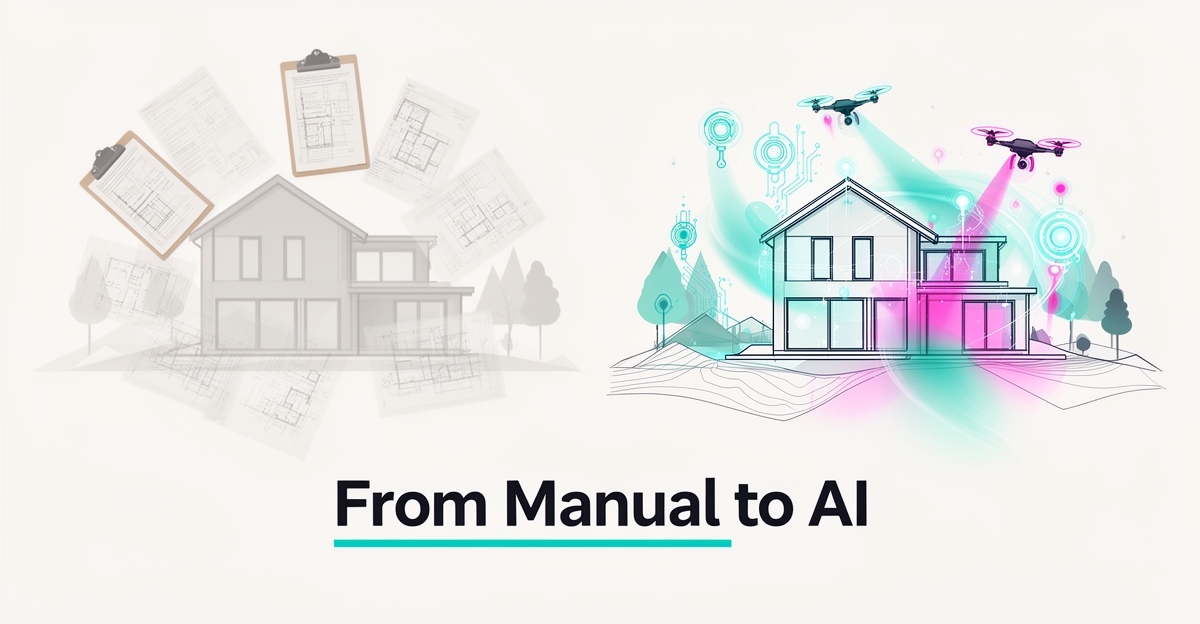
From Manual to AI: Transforming Site Assessment Workflows in Net-Zero Building
Key Facts
- 47% of AI investment is wasted due to lack of business process expertise according to LinkedIn research
- 38% reduction in implementation time when AI aligns with existing workflows per IBM research
- 82% of institutional knowledge is preserved when domain experts guide AI automation based on Deloitte findings
- 3x better adoption when AI tools match existing business terminology per Genpact research
- 57% faster time-to-value when AI uses familiar business language according to Genpact
- 65% of successful AI implementations start with business logic mapping, yielding 41% higher ROI per McKinsey analysis
- 2.5x higher employee satisfaction with proper AI change management per Harvard Business Review insights
Hire a team member that works 24/7 — for less than a part-time wage.
AI receptionists, SDRs, dispatchers and 99+ roles. Trained on your business, fully managed.
Not sure where to start? Ask our AI planner
The Hidden Cost of Manual Site Assessments
Traditional site assessments in passive house construction remain a significant bottleneck in net-zero project delivery. Teams often spend weeks manually measuring building envelopes, documenting thermal bridges, and compiling environmental data across multiple tools. This fragmented approach not only consumes valuable time but also increases the likelihood of human error in critical calculations. Studies show that 47% of AI investment is wasted due to lack of business process expertise, and in construction workflows, this manifests as missed data points and rework that derail project timelines.
- Manual data collection leads to inconsistent measurement standards across team members
- Environmental scanning requires repeated site visits to capture seasonal variations
- Preliminary design recommendations are delayed until all field data is manually compiled
- Version control issues arise when paper notes and digital photos aren’t synchronized
- Critical thermal performance gaps go undetected until energy modeling reveals discrepancies
These inefficiencies compound when teams attempt to align assessment findings with passive house certification requirements. Without integrated workflows, valuable insights get lost in translation between field notes, spreadsheets, and energy modeling software. Research indicates that 38% reduction in implementation time is possible when AI aligns with existing workflows—yet most construction teams still rely on disjointed manual processes that force them to start over when data gaps emerge. AIQ Labs addresses this by building custom systems that connect survey tools directly to design platforms, eliminating the manual handoffs that introduce errors and delays. The result is a continuous data flow from site assessment to preliminary design, ensuring net-zero projects begin with accurate, actionable intelligence rather than costly rework.
Why AI-Driven Site Assessments Are a Game-Changer
Imagine slashing weeks off your preliminary site assessments while boosting accuracy—AI-driven workflows make this reality for passive house builders chasing net-zero goals.
Traditional site assessments bog down teams with manual data collection, environmental scanning, and analysis, often delaying preliminary design decisions. AI changes this by automating repetitive tasks like survey data integration and environmental scans, pulling in real-time inputs from tools and software. According to industry research, businesses see a 38% reduction in implementation time when AI aligns with existing workflows.
This shift eliminates bottlenecks at every stage. AI-powered data collection gathers site specifics—topography, climate data, solar exposure—without human error, while automated analysis flags net-zero opportunities instantly. Builders gain faster insights into energy modeling and material needs, accelerating decisions that keep projects on budget and sustainable.
Key advantages include:
- Improved accuracy through AI analysis of vast environmental datasets, reducing oversights in passive house standards.
- Faster preliminary designs, with AI generating recommendations based on scanned site conditions.
- Streamlined integration with survey tools and design software for seamless workflows.
- Scalable assessments that handle multiple sites without adding headcount.
Real-world results back this up. A McKinsey analysis shows 65% of successful AI implementations start with business logic mapping, yielding 41% higher ROI—critical for net-zero projects where precision drives profitability. Similarly, Genpact research reveals 57% faster time-to-value when AI matches existing business terminology, ensuring passive house teams adopt it without friction.
AIQ Labs specializes in these custom AI systems, building integrations that automate early-stage evaluations for sustainable builders. By replacing manual processes with intelligent automation, firms unlock accelerated net-zero workflows that deliver measurable efficiency.
Teams report higher satisfaction too—Harvard Business Review insights indicate 2.5x better employee satisfaction with proper change management, keeping experts focused on innovation rather than drudgery.
The Research-Backed Case for Workflow-Aligned AI
The construction industry's rush to adopt AI often overlooks a critical success factor: alignment with existing workflows. Research reveals that 90% of AI initiatives fail to deliver ROI, primarily because they ignore established business processes rather than enhancing them.
The data tells a compelling story about workflow alignment. When AI systems match existing business processes, implementation time drops by 38% according to IBM research. This isn't just about speed—it's about creating solutions that teams actually use rather than resist.
The financial impact is equally significant. Companies that begin with business logic mapping—understanding how work actually flows before introducing AI—see 41% higher ROI from their implementations. This approach transforms AI from a disruptive force into a natural extension of current operations.
Consider the passive house building context. A traditional site assessment involves surveyors documenting conditions, engineers analyzing environmental factors, and designers creating preliminary recommendations. Workflow-aligned AI doesn't replace these professionals—it eliminates their repetitive data collection tasks while preserving their decision-making authority.
The terminology factor proves crucial for adoption. AI tools that use existing business language see 3x better adoption rates and 57% faster time-to-value. When a system speaks about "thermal bridging analysis" rather than generic "data processing," building professionals trust and embrace it more readily.
Successful workflow-aligned AI implementations share common characteristics:
- They map existing business processes before writing a single line of code
- They preserve institutional knowledge rather than bypassing it
- They integrate with current tools like survey equipment and design software
- They evolve with business processes rather than forcing rigid workflows
- They maintain human oversight for critical decisions
The preservation of institutional knowledge deserves special attention. When domain experts help identify automation opportunities, 82% of institutional knowledge is preserved. This means the AI system learns from senior assessors' expertise rather than attempting to replace it.
AIQ Labs applies these principles by starting every engagement with deep workflow analysis. Before proposing any AI solution for site assessments, we map how information currently flows from initial client contact through final recommendations. This ensures the resulting system enhances rather than disrupts established practices.
The change management component cannot be overlooked. Organizations that properly manage the human side of AI implementation see 2.5x higher employee satisfaction with new technology. This translates directly to better adoption rates and sustained usage.
The evidence is clear: AI succeeds when it respects and enhances existing workflows rather than attempting to reinvent them. For passive house builders, this means AI systems that understand the nuances of site assessment while eliminating the manual drudgery that consumes valuable professional time.
How AI Integrates with Survey Tools and Design Software
The real challenge in modern site assessment isn't collecting data—it's making that data flow seamlessly from field instruments into design decisions without manual transcription eating up your team's time. When AI systems connect directly with surveying equipment, environmental sensors, and CAD platforms, passive house builders eliminate the bottleneck that turns a two-day site visit into a two-week data entry marathon.
The technical foundation starts with API integration layers that speak the language of your existing tools. Modern total stations, GPS receivers, and laser scanners output data in standard formats—LandXML, IFC, or proprietary protocols—that AI systems can ingest in real time. Rather than exporting CSV files and manually uploading them to design software, the AI acts as a translation layer, automatically parsing survey coordinates, environmental readings, and topographical data into structured formats your CAD platform recognizes.
Environmental sensors present a different integration challenge. Passive house design depends on granular climate data—solar irradiance, wind patterns, temperature fluctuations, humidity levels—often collected over weeks or months. AI systems connect to IoT sensor networks through MQTT or REST APIs, continuously aggregating this streaming data and flagging anomalies that might indicate sensor malfunction or genuinely unusual site conditions. This automated environmental scanning replaces the manual process of downloading data loggers and importing spreadsheets.
The integration architecture typically follows this pattern:
- Data ingestion layer: Connectors that pull from survey equipment APIs, sensor networks, and existing project databases
- Processing engine: AI models that clean, validate, and structure raw data according to your design standards
- Design platform bridge: Direct write-access to CAD environments (Revit, AutoCAD, SketchUp) via their native APIs or plugins
- Feedback loop: Mechanisms for designers to correct AI interpretations, improving accuracy over time
According to IBM research, implementations that align AI with existing workflows see 38% faster implementation times. This matters critically in surveying contexts—when AI systems work within your established CAD templates and naming conventions rather than forcing new file structures, adoption accelerates.
The CAD integration itself operates through two approaches. For platforms like Revit or ArchiCAD, AI systems use the software's API to generate parametric elements directly—placing property boundaries, importing point cloud data as reference planes, or creating preliminary massing models based on zoning constraints. For more flexible environments like Rhino or SketchUp, the AI might generate Grasshopper definitions or Ruby scripts that designers can adjust parametrically.
AIQ Labs builds these integrations using the Model Context Protocol, which allows AI agents to interact with design software the way a human would—reading existing model geometry, checking against building codes, and proposing modifications within the actual design environment. This differs from standalone analysis tools that require exporting, analyzing, and re-importing data.
The key to successful integration lies in matching your business terminology. Research from Genpact shows that AI tools matching existing business language achieve 3x better adoption and 57% faster time-to-value. When your AI system labels site features using your firm's standard nomenclature—"Zone A: North Slope" rather than "Polygon_001"—designers trust and use the output.
This technical architecture transforms site assessment from a linear, manual process into a continuous, automated workflow where survey data, environmental monitoring, and design development happen simultaneously rather than sequentially.
Getting Started: From Pilot to Full Automation
Starting your AI journey doesn’t require a full system overhaul—it begins with a focused pilot that delivers measurable results fast. Many organizations get stuck in exploration mode, with 90% of AI initiatives failing to deliver ROI when they skip foundational alignment. For passive house builders, the best starting point is identifying one repetitive site assessment task—like solar orientation analysis or thermal bridging detection—that consumes significant manual effort but follows clear, repeatable logic.
Begin by mapping your current workflow step-by-step, then use that business logic to configure an AI agent that mirrors your team’s decision-making process. This approach aligns with research showing 65% of successful AI implementations start with business logic mapping, resulting in 41% higher ROI. When the AI speaks your team’s language and fits into existing steps—such as auto-populating site survey forms or flagging compliance risks in early scans—adoption increases 3x and time-to-value improves by 57%. These gains come not from flashy technology, but from reducing friction in how work already gets done.
Run your pilot on one active project, comparing AI-assisted assessments against manual baselines for accuracy, speed, and team feedback. Track metrics like hours saved per site visit and reduction in rework due to missed environmental factors. Use structured feedback loops—where designers and field staff review AI outputs weekly—to refine the system, a practice linked to 73% higher AI performance. Keep human oversight in place for complex judgments, but let the AI handle data gathering, pattern recognition, and initial recommendations.
Once the pilot proves value—say, cutting assessment time by half while maintaining or improving accuracy—scale gradually to similar workflows across projects. Introduce the AI to new team members through role-specific training, emphasizing how it reduces repetitive tasks rather than replaces expertise. With proper change management, organizations see 2.5x higher employee satisfaction with new technology. By progressing from pilot to proficiency in small, supported steps, passive house builders can build confidence, refine their AI tools, and lay the groundwork for full automation without disrupting project timelines or team cohesion. To map your first high-impact automation opportunity, start with a free strategy call to assess your readiness and identify quick wins.
Still paying for 10+ subscriptions that don’t talk to each other?
We build custom AI systems you own outright. No vendor lock-in. Full control.
Not sure where to start? Ask our AI planner
Frequently Asked Questions
How much time can AI actually save on site assessments for passive house projects?
Will AI replace our surveyors and engineers?
Isn’t AI adoption risky and likely to fail?
Can AI connect directly to our survey tools and design software?
What’s the best way to start a pilot without overhauling everything?
Will our team actually use an AI tool if it uses different terminology?
Turn Site Assessment Bottlenecks into Net-Zero Momentum
Manual site assessments in passive house construction create costly delays, inconsistent data, and rework that derail net-zero timelines—yet AI-driven workflows aligned with existing processes can slash implementation time by 38% while preserving institutional knowledge and boosting accuracy. By automating repetitive tasks like environmental scanning and data integration, teams gain faster, more reliable insights that keep projects on budget and on track for certification. The path forward starts with a focused pilot: map one high-impact task, validate results against manual baselines, and scale with structured feedback loops. To identify your first automation opportunity and see how AIQ Labs builds custom systems that connect survey tools directly to design platforms, start with a free strategy call—no obligation, just clarity on where AI can deliver measurable efficiency for your net-zero projects.
Make AI your competitive advantage — not just another tool.
Strategy, implementation and ongoing optimization. One partner, end to end.
Not sure where to start? Ask our AI planner