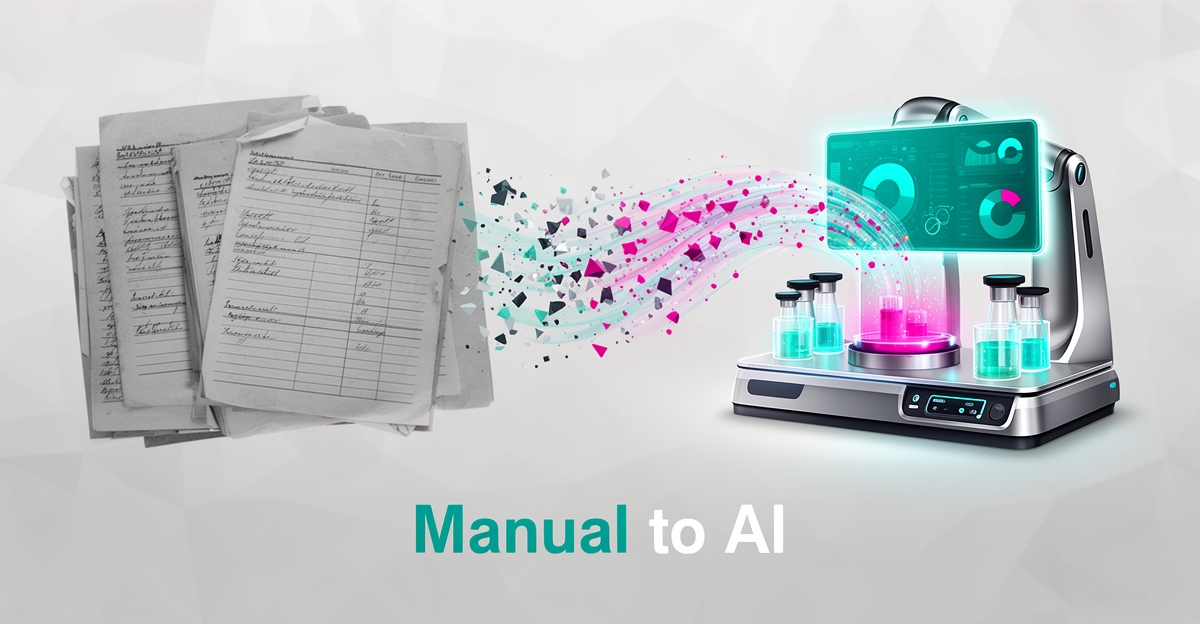
From Manual to AI: Transforming Test Data Entry in Material Labs
Key Facts
- Automated, continuous-monitoring experiments can generate an order of magnitude more usable data per reaction than manual steady-state methods, according to recent self-driving lab research
- AI-powered extraction tools have reported over 90% precision in pulling structured material property values from research papers in published studies
- Research on AI-assisted laboratory analysis suggests combining AI output with expert human review substantially improves accuracy over either working alone
- Continuous data capture—sampling every fraction of a second—produces dozens of data points per reaction versus a single point in steady-state methods
- AI-assisted workflows have been shown in certain laboratory applications to cut human interpretation time dramatically
- AI systems enable round-the-clock data interpretation and real-time monitoring for quality control
Hire a team member that works 24/7 — for less than a part-time wage.
AI receptionists, SDRs, dispatchers and 99+ roles. Trained on your business, fully managed.
Not sure where to start? Ask our AI planner
The Data Bottleneck in Material Labs: Why Manual Entry Slows Discovery
In material laboratories worldwide, the pace of discovery isn't limited by scientific insight—it's throttled by the manual entry of test data into spreadsheets and paper logs. This bottleneck doesn't just slow down individual experiments; it restricts the volume and quality of data available for analysis, creating a cascade of delays that can stretch material discovery timelines from days into years.
The contrast between manual and automated approaches is stark. Traditional steady-state flow experiments typically generate a single data point per reaction, often requiring scientists to wait significant time for results. In contrast, AI-driven dynamic flow experiments can capture data many times per second, producing an order of magnitude more data over the same period while continuously monitoring reactions in real-time, according to recent self-driving lab research.
This data deficit has real consequences. Manual entry introduces transcription errors at every step, while the time spent on data handling is time not spent on analysis or experimental design. Modern materials research increasingly depends on robust data protocols and automated experimental infrastructure—capabilities that paper-based systems simply cannot provide.
The limitations of manual data entry extend beyond volume to accuracy and accessibility:
- Transcription errors compound over time, corrupting datasets and leading to flawed conclusions
- Data trapped in spreadsheets or notebooks remains siloed, preventing cross-experiment analysis
- Manual entry creates delays between data collection and availability, slowing iterative experimentation
- Human error rates increase with fatigue, particularly during high-throughput testing periods
The cost of these inefficiencies is measured not just in time, but in missed discoveries. Laboratory research on AI-assisted workflows suggests automation can cut human interpretation time substantially in certain applications while improving overall accuracy—and that combining AI analysis with human expertise outperforms either working alone. Automation doesn't replace human insight; it amplifies it.
This transformation isn't theoretical. AIQ Labs builds production-ready AI systems that integrate directly with lab equipment and data logging tools, eliminating the manual entry bottleneck at its source. Through AI Workflow Builds, the focus is on rebuilding the one workflow that costs your lab the most—fixed price, delivered in phases. By automating the capture, validation, and organization of test data, laboratories can shift their focus from data management to material innovation—turning the bottleneck into a competitive advantage.
How Self-Driving Labs and AI Extraction Are Transforming Data Workflows
Self-driving labs are redefining how material data is collected by moving beyond static measurements to continuous, real-time observation. Instead of waiting for reactions to finish, these systems vary chemical mixtures while monitoring reactions continuously, generating many more data points per experiment than traditional methods. This shift enables machine learning algorithms to make faster, more informed decisions by working with significantly richer datasets—and recent research suggests it can accelerate discovery while reducing chemical waste.
AI-powered extraction tools are further streamlining the workflow by automating the interpretation of scientific literature. Methods built on conversational large language models have reported over 90% precision in published studies when pulling structured data from research texts—such as material properties and experimental values—using engineered prompts that guide accurate retrieval. This capability allows labs to rapidly build databases from existing papers without extensive manual curation or custom parsing rules. The result is a pipeline where real-time experimental data and literature-derived insights feed into intelligent decision-making systems.
AIQ Labs supports this transformation by designing custom AI workflows that integrate directly with lab equipment and data logging tools, enabling end-to-end automation from data capture to analysis. By connecting sensors, experimental controllers, and knowledge extraction models into unified systems, laboratories can eliminate manual entry bottlenecks and ensure data flows continuously into actionable insights. This integration not only improves throughput but also enhances reproducibility and traceability across materials discovery pipelines. As labs adopt these intelligent workflows, they shift from reactive data handling to proactive, AI-driven experimentation that scales with their research goals.
From Pilot to Production: Implementing AI Workflow Automation in Your Lab
Transitioning from manual to AI-driven test data entry requires a structured approach that aligns technology with lab workflows and team capabilities. The process begins with assessing current data handling practices, identifying bottlenecks in manual entry, and mapping how AI can integrate with existing equipment like spectrometers, chromatographs, or data loggers. This foundation ensures the automation targets real pain points rather than adding complexity.
Infrastructure readiness is critical—labs need reliable sensors for real-time monitoring, edge computing or cloud connectivity for data processing, and secure APIs to link instruments with AI systems. Continuous-capture experiments can generate high-frequency, high-volume data streams, which demands systems capable of handling them without latency or loss. AIQ Labs builds production-ready integrations that normalize this data flow into usable formats for downstream analysis.
Human-AI collaboration models define success: AI handles repetitive data capture, initial classification, and pattern recognition, while scientists focus on hypothesis design, anomaly interpretation, and experimental validation. Published research on AI-driven data extraction reports high precision when pulling material values from research papers, but combining AI outputs with expert review improves reliability further. This balance ensures automation enhances, rather than replaces, scientific judgment.
AIQ Labs guides labs through each phase—from pilot validation in a single workflow to full-scale deployment across teams, and ultimately to a connected AI Operating System if the lab wants one layer running it all. Deployments are structured in milestones so you validate results before scaling, with data protocols and feedback loops configured along the way. Because you own the built system outright, there's no vendor lock-in—your lab maintains control over customization, scaling, and long-term evolution of its AI capabilities. That ownership turns automation from a project into a sustainable competitive advantage.
Still paying for 10+ subscriptions that don’t talk to each other?
We build custom AI systems you own outright. No vendor lock-in. Full control.
Not sure where to start? Ask our AI planner
Frequently Asked Questions
How much more data can AI-driven labs actually collect compared to manual methods?
Will AI replace human scientists in the lab?
How accurate is AI at extracting data from research papers?
What's the biggest bottleneck AI solves in material testing labs?
How long does it take to implement AI workflow automation in an existing lab?
Does AI automation work for small labs or just large research facilities?
Turning Data Bottlenecks into Discovery Engines
Manual data entry in material labs isn't just tedious—it's a silent throttle on innovation, introducing errors, delaying insights, and locking valuable information in silos. AI-driven workflows flip that script: continuous capture multiplies the data available per experiment, while AI-powered extraction pulls structured data from research papers with high reported precision. The result isn't just faster data—it's richer, more reliable datasets that let scientists focus on hypothesis and interpretation instead of transcription. For labs ready to move beyond spreadsheets and into continuous discovery, the path starts with assessing where manual entry steals the most time. Take the 2-minute Fit Check and book a free 30-minute strategy call to map your biggest bottleneck and see where automation delivers real ROI—no obligation, just clarity on your AI opportunity.
Make AI your competitive advantage — not just another tool.
Strategy, implementation and ongoing optimization. One partner, end to end.
Not sure where to start? Ask our AI planner