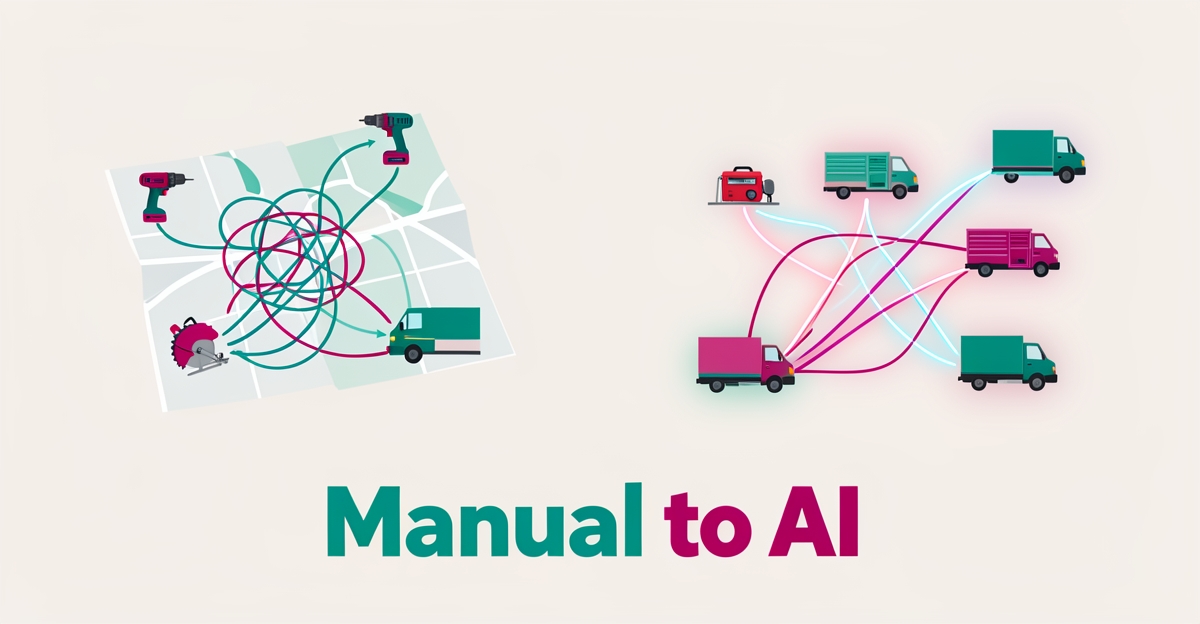
From Manual to AI: Transforming Tool Dispatch in Power Tool Rentals
Key Facts
- A 25-truck diesel fleet can save $88,000–$110,000 annually with AI implementation.
- AI dispatch automation delivers 30–50% productivity increases compared to manual processes.
- Daily job completions rise by 25–40% within three months of adopting AI dispatch.
- On-time arrival rates exceed 96% when using automated AI route planning.
- AI recalculation takes 2–5 seconds versus 15–30 minutes for manual adjustments.
- Dynamic AI re-routing reduces fuel consumption by 8–15% for fleets.
- Most organizations achieve full ROI payback within 8 to 14 months.
What if you could hire a team member that works 24/7 for $599/month?
AI Receptionists, SDRs, Dispatchers, and 99+ roles. Fully trained. Fully managed. Zero sick days.
The Hidden Cost of Manual Dispatch
In the razor-thin margins of power tool rentals, manual dispatching is a silent profit killer. Human dispatchers simply cannot process the complex variables of route optimization, tool availability, and technician skill sets fast enough. This bottleneck leads to suboptimal routing that eats into fuel budgets and human error that delays critical jobs.
Operational inefficiencies compound quickly when relying on spreadsheets or phone calls. A single misrouted technician can cost thousands in lost revenue and overtime. You need a system that eliminates guesswork and maximizes every mile driven.
- Manual rerouting takes 15–30 minutes; AI does it in seconds
- Human error leads to incorrect tool assignments and delayed jobs
- Spreadsheet dependency creates data silos and compliance risks
- Suboptimal routes increase fuel consumption and wear on equipment
Research from Answering Agent shows that manual dispatcher rerouting takes 8–12 minutes for a scenario affecting three trucks. In contrast, AI systems handle the same complex adjustments in under 2 minutes. This speed difference translates directly to more jobs completed per day and higher customer satisfaction.
Consider a mid-sized rental fleet struggling with last-minute cancellations. Without AI, dispatchers spend hours manually reassigning tools, often resulting in drivers driving empty miles. By automating these decisions, you eliminate the "locally corrected but globally suboptimal" routes that plague manual systems.
The true cost isn't just the time spent dispatching; it's the revenue lost from delayed service calls and inefficient fuel usage. Understanding these hidden costs is the first step toward transformation.
The financial drain of manual processes extends far beyond labor hours. Fuel waste and inefficient drive times represent the largest variable costs in field operations. When drivers take longer routes, you pay for the extra mileage and the increased wear on your rental inventory.
Manual systems also fail to account for real-time variables like traffic or sudden job changes. This rigidity forces businesses to absorb unnecessary costs that automated systems would avoid. The result is a significant gap between projected and actual operational expenses.
- Fuel costs can increase by 8–15% due to inefficient routing
- Drive time increases by 15–25% without AI optimization
- Unplanned changes consume 18–27% of total dispatch labor time
- Overtime costs rise when manual delays push jobs into extended hours
According to Usmart Technologies, a 25-truck diesel fleet spending $1.1 million annually on fuel could save $88,000–$110,000 per year with AI implementation. These savings come from dynamic re-routing that minimizes idle time and unnecessary mileage.
Furthermore, productivity gains are substantial. AI dispatch automation platforms can help fleets achieve 30–50% increases in productivity compared to manual processes. This efficiency allows you to handle more rentals with the same resources, directly boosting your bottom line.
When inefficiency is quantified, the cost of inaction becomes clear. Transitioning to AI is not just an upgrade; it’s a financial necessity for survival in a competitive market.
AI transforms dispatch from a reactive chore into a strategic advantage. By acting as a "super-intelligent co-pilot," AI handles data crunching while humans focus on complex customer needs. This hybrid model ensures accuracy without replacing human judgment entirely.
Integration with your existing inventory and booking tools is critical for success. AI systems must have real-time access to tool availability, technician locations, and skill sets to make optimal decisions. Without this integration, AI recommendations are based on stale or incomplete data.
- AI recalculation takes 2–5 seconds versus 15–30 minutes manually
- Daily job completions can increase by 25–40% within three months
- On-time arrival rates can exceed 96% with automated routing
- First-time fix rates improve by 35% with skill-based matching
As reported by LoadStop, AI provides a co-pilot that never sleeps and constantly learns from historical data. This continuous learning curve means your dispatch system gets smarter and more efficient over time, reducing errors with every job.
For power tool rentals, this means matching the right technician with the right voltage tester or drill, ensuring the job is done right the first time. This precision reduces callbacks and enhances customer trust.
The technology is ready. The next step is implementing a system that turns this potential into tangible operational excellence.
The AI Co-Pilot: Efficiency and Savings
Manual dispatch is no longer just a bottleneck; it is a financial leak that drains margins from power tool rental businesses. By transitioning to an AI-driven model, companies can transform chaotic scheduling into a streamlined, data-backed operation that saves time and reduces overhead.
AI acts as a "super-intelligent co-pilot" rather than a replacement for human staff. This collaborative model allows algorithms to handle complex data crunching while human dispatchers focus on strategic exceptions and customer relationships.
The speed at which dispatch decisions are made directly impacts operational efficiency and customer satisfaction. Manual processes are too slow to handle the dynamic nature of field services, leading to delays and frustrated clients.
- Instant Route Recalculation: AI systems can recalculate optimal routes in 2–5 seconds. In contrast, manual adjustments for the same scenario typically take 15–30 minutes.
- Rapid Scenario Handling: For disruptions affecting three trucks, a human dispatcher spends 8–12 minutes on rerouting. AI handles this identical workload in under 2 minutes.
- Real-Time vs. Batch: Unlike legacy systems that update schedules once or twice daily, true AI integrates live traffic and telematics to optimize dynamically.
This velocity is critical for maintaining service standards. On-time arrival rates can exceed 96% with AI dispatch, compared to the inconsistency of manual planning. Faster decision-making ensures that tools and technicians are deployed where they are needed most, reducing idle time and increasing daily job completions.
The financial impact of AI dispatch is measurable and immediate. By minimizing fuel waste and optimizing labor hours, rental businesses can see a direct improvement to their bottom line within the first year of implementation.
- Fuel Savings: Dynamic re-routing reduces fuel consumption by 8–15%. A 25-truck diesel fleet spending $1.1 million annually could save $88,000–$110,000 per year.
- Drive Time Reduction: AI implementation leads to a 15–25% reduction in total drive time, allowing crews to complete more jobs per shift.
- Labor Efficiency: Unplanned order changes consume 18–27% of total dispatch labor time. AI significantly reduces this burden by automating routine adjustments.
Most organizations see a full payback period of 8 to 14 months. Beyond direct costs, 30–50% increases in productivity mean businesses can scale operations without proportionally increasing headcount.
Successful AI adoption relies on a hybrid approach where technology augments human expertise. Research indicates that AI handles routine scheduling while humans manage complex customer interactions and exceptions.
- Skill-Based Matching: AI matches jobs to technicians based on specific tool requirements and skill sets, improving first-time fix rates by 35%.
- Staff Trust: Integrating human feedback, such as local parking knowledge, into the AI model builds trust and reduces driver resistance.
- Error Reduction: Automated assignments reduce human error, which is critical for ensuring the correct high-voltage tools are paired with qualified technicians.
This collaborative framework ensures that 75–86% of customers are retained by maintaining high service quality. As you prepare to implement this technology, understanding the technical integration requirements is essential for seamless operation.
Implementation: Integration and Skill Matching
Transitioning from manual spreadsheets to AI-driven dispatch requires more than just buying software; it demands a strategic technical roadmap. For power tool rental businesses, the goal is to seamlessly connect inventory data with field operations to eliminate the "locally corrected but globally suboptimal" routes that plague manual coordination.
AIQ Labs architect custom systems that integrate directly with your existing booking tools, ensuring your AI acts as a super-intelligent co-pilot rather than a disconnected silo. This approach allows you to automate the assignment of tools and technicians based on real-time location, demand, and specific skill sets.
By automating complex data crunching, your human staff can focus on high-value customer service and exception handling. This shift transforms dispatch from a reactive chore into a proactive competitive advantage, significantly reducing the operational waste that erodes margins in rental industries.
The foundation of any successful AI dispatch system is deep integration with your current infrastructure. Standalone solutions often create data silos, leading to errors such as assigning unavailable tools or technicians who are already booked.
To prevent this, AIQ Labs builds systems using deep two-way API integrations that synchronize data across your CRM, inventory management, and scheduling platforms. This ensures that every dispatch decision is based on accurate, live information rather than outdated static files.
According to industry integration experts, effective AI dispatch requires this seamless connectivity to ensure outputs are traceable and compliant. Without it, you risk implementing a system that is faster but less accurate than your manual processes.
Key benefits of robust API integration include:
- Eliminating Data Silos: Ensuring inventory levels and technician locations are always synchronized.
- Real-Time Visibility: Allowing the AI to ingest live traffic and job changes instantly.
- Scalability: Providing a framework that grows with your fleet without requiring complete system overhauls.
In power tool rentals, the right technician is only half the equation; they must also have the correct specialized equipment. Generic dispatch software often matches jobs solely by location, ignoring critical skill and tool requirements.
AIQ Labs implements custom skill-based matching algorithms that analyze technician certifications, historical performance, and specific tool availability. This ensures that a high-voltage job is assigned to a certified electrician with the appropriate voltage tester, reducing callbacks and increasing first-time fix rates.
Research indicates that AI systems focusing on skill-based matching can improve customer satisfaction by up to 20% and boost productivity by 10–15% according to Answering Agent. This precision is vital for maintaining trust with B2B clients who rely on specific equipment for their projects.
Implementing AI is as much a cultural challenge as a technical one. Field technicians may resist systems they perceive as replacing their local knowledge or expertise. To mitigate this, AIQ Labs recommends a phased rollout strategy rather than a sudden, full-scale switch.
Start with a pilot project for a single service line or department. Allow your team to use the AI as a decision-support tool alongside human oversight. This hybrid approach builds trust and allows you to refine the algorithm using real-world feedback before scaling.
A structured implementation timeline typically follows this path:
- Discovery & Architecture: Assessing your tech stack and defining ROI projections.
- Development & Integration: Building custom APIs and testing validation layers.
- Deployment & Training: Go-live with role-specific user training.
- Optimization & Scale: Continuous monitoring and feature expansion.
As reported by Usmart Technologies, integrating human feedback loops during this phase is critical to overcoming driver resistance. Once your team sees that the AI saves them time rather than complicating their day, adoption becomes natural.
This strategic approach ensures your AI dispatch system delivers immediate value while laying the groundwork for long-term operational excellence.
Driving Adoption and Measuring ROI
Implementing AI dispatch in power tool rentals is less about code and more about culture. When staff fear replacement, they resist change, but positioning AI as a "super-intelligent co-pilot" eliminates that friction. By handling complex data crunching and route optimization, AI allows human dispatchers to focus on exceptions and customer service. This shift reduces the burden of manual coordination, which is often prone to error and inefficiency.
Key statistics highlight the urgency of this transition:
- Businesses report a 25–40% increase in daily job completions within three months of adopting AI dispatch.
- Unplanned order changes account for 18–27% of total dispatch labor time, which AI can significantly reduce.
- AI systems can recalculate routes in 2–5 seconds, compared to 15–30 minutes for manual adjustments.
Drivers and technicians may find workarounds if they do not trust the system, making change management critical. Successful adoption requires integrating human feedback, such as local knowledge of parking or docks, into the model. This builds trust and ensures the AI acts as a supportive partner rather than an overseer. Research from Usmart Technologies notes that 75% of mobile workers report time savings, proving that AI reduces workload rather than replacing jobs.
To drive adoption, AIQ Labs recommends a phased, hybrid approach. Start with a pilot project for a single service line, allowing the AI to handle routine scheduling while humans manage exceptions. This "co-pilot" model allows your team to see immediate benefits without the shock of full automation. LoadStop’s industry analysis confirms that AI serves as a decision-support tool, allowing humans to focus on strategic planning and customer service.
Measuring ROI requires tracking specific KPIs that directly impact your bottom line. Fuel costs and drive time are the most immediate indicators of success. AI implementation leads to a 30–40% reduction in fuel costs and a 15–25% reduction in drive time. For a 25-truck diesel fleet spending $1.1 million annually, this translates to $88,000–$110,000 in annual savings.
Beyond cost savings, service quality metrics validate the investment. Companies with a first-time fix rate above 70% retain 86% of customers, compared to 76% for those with lower rates. AI matching job requirements with technician skills and history can lead to a 10–15% productivity boost and up to 20% increase in customer satisfaction. On-time arrival rates can exceed 96% with AI dispatch, directly influencing customer trust and repeat business.
Essential KPIs to Track:
- Fuel Cost Reduction: Monitor the 8–15% savings from dynamic AI re-routing.
- First-Time Fix Rate: Aim for above 70% to maximize customer retention.
- Daily Job Completions: Track the 25–40% increase in completed jobs.
- Dispatch Labor Time: Measure the reduction in time spent on manual rerouting.
Most organizations see a payback period of 8 to 14 months, making AI dispatch a financially sound investment. Answering Agent’s guide indicates that for field service contractors running around 10+ technicians, automated scheduling typically pays for itself within months. This rapid ROI justifies the initial investment in custom development and integration.
AIQ Labs ensures these results by building systems that integrate deeply with your existing inventory and booking tools. Standalone solutions risk creating data silos, but our custom AI dispatch systems connect directly to your CRM and inventory management. This ensures that AI recommendations are based on accurate, live data, preventing errors such as assigning unavailable tools.
By focusing on skill-based matching, you ensure the right tools and personnel are deployed correctly. Configuring the AI to match jobs by specific technician skills and equipment needs improves operational efficiency significantly. This precision is critical for tool rentals, where the right tool is as important as the right technician.
Ultimately, the goal is to eliminate manual bottlenecks and create a scalable, efficient operation. With AI handling the grunt work, your team can focus on growth and customer experience. The technology is proven, the ROI is clear, and the implementation is manageable. Usmart Technologies emphasizes that embracing AI is "key to survival and strategic growth" in margin-deficient industries.
Ready to transform your dispatch operations? AIQ Labs builds the custom AI systems you need to achieve these results. Contact us today to start your AI transformation journey.
Next Steps: Architecting Your Competitive Advantage
The transition from manual dispatch to intelligent automation is no longer a luxury—it is a critical survival mechanism for power tool rental businesses operating in margin-deficient environments. By automating tool and technician assignments based on real-time data, you transform operational chaos into a scalable competitive edge.
According to LoadStop, embracing AI in dispatch is key to strategic growth, not just a tech upgrade. AI systems act as "super-intelligent co-pilots," crunching complex data to allow your human staff to focus on exceptions and customer service rather than routine logistics.
To maximize this advantage, you must move beyond simple scheduling and implement a system that integrates deeply with your existing infrastructure. This approach ensures that every tool assignment is optimized for location, skill, and availability.
While many vendors offer point solutions, they often create data silos that limit long-term scalability. True efficiency requires a unified system where AI outputs are traceable and directly influence your operational workflow.
Research from Answering Agent indicates that businesses report a 25–40% increase in daily job completions within three months of adopting AI dispatch. These gains come from eliminating the "locally corrected but globally suboptimal" routes that human dispatchers often produce when handling last-minute changes.
To replicate this success, your system must prioritize:
- Deep API Integration: Connect seamlessly with your current inventory and booking tools to prevent data silos.
- Real-Time Adaptation: Dynamically recalculate routes in seconds, not minutes, to handle unplanned changes.
- Skill-Based Matching: Assign the right technician to the right tool based on specific expertise and availability.
Investing in custom AI architecture delivers tangible financial returns that justify the initial development costs. For field service contractors, automated scheduling and routing typically pay for themselves within months through fuel savings and increased daily job completions.
Specifically, dynamic AI re-routing saves 8–15% on fuel costs, while implementation leads to a 30–40% reduction in overall fuel expenses. Furthermore, companies with a first-time fix rate above 70% retain 86% of customers, compared to 76% for those with lower rates.
A typical 25-truck diesel fleet spending ~$1.1 million annually on fuel could save $88,000–$110,000/year with AI implementation. Most organizations see a payback period of 8 to 14 months, making this one of the highest-ROI investments in your operational technology stack.
Building a custom AI dispatch system requires more than just software; it demands engineering excellence and a partnership mindset. AIQ Labs specializes in creating production-ready AI systems that businesses own outright, eliminating vendor lock-in and subscription dependencies.
We architect solutions that integrate with your existing inventory and booking tools, ensuring faster, smarter operations. Our approach focuses on:
- True Ownership: Clients receive full ownership of custom-built systems and code.
- Engineering Excellence: We build scalable applications, not prototypes.
- Strategic Partnership: We guide you from strategy through execution to ongoing optimization.
Don't let manual processes limit your growth. Contact AIQ Labs today to discover how we can architect your competitive advantage.
Still paying for 10+ software subscriptions that don't talk to each other?
We build custom AI systems you own. No vendor lock-in. Full control. Starting at $2,000.
Frequently Asked Questions
Is AI dispatch going to replace my human dispatchers?
How quickly will we see a return on investment for an AI dispatch system?
Will my drivers resist using a new AI system?
How does AI improve tool matching for power tool rentals?
Can AI handle sudden schedule changes or cancellations in real-time?
Does the AI system integrate with our existing inventory software?
Stop Bleeding Margins: Automate Your Dispatch Today
Manual dispatching is no longer just an operational inconvenience; it is a silent profit killer that drains margins through fuel waste, human error, and lost revenue. As highlighted, the difference between manual rerouting and AI automation is not merely incremental—it is the difference between hours of guesswork and seconds of precision. By eliminating suboptimal routing and reducing empty miles, power tool rental businesses can reclaim critical resources and improve customer satisfaction. AIQ Labs helps you turn these insights into action. We develop custom AI dispatch systems that integrate seamlessly with your existing inventory and booking tools, automating complex decisions to ensure the right tool reaches the right technician at the right time. Don’t let spreadsheet dependency limit your growth. Take the first step toward smarter operations: contact AIQ Labs today for a free AI Audit & Strategy Session and discover how we can architect your competitive advantage.
Ready to make AI your competitive advantage—not just another tool?
Strategic consulting + implementation + ongoing optimization. One partner. Complete AI transformation.