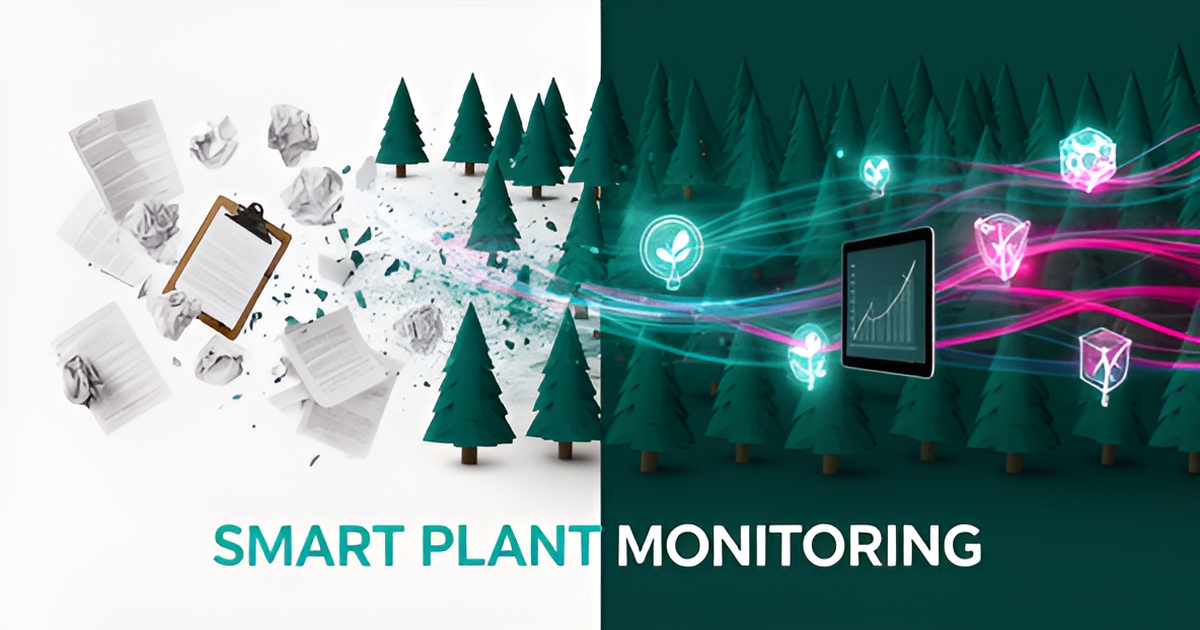
From Manual to AI: Transforming Tree Farm Operations with Smart Plant Monitoring
Key Facts
- Manual data entry consumes 20+ hours weekly per operation and drives error rates that automated systems reduce by 95% according to Stanford HAI 2024 AI Index Report
- AI has surpassed human performance on visual reasoning and classification tasks directly applicable to plant health monitoring per Stanford HAI 2024 AI Index Report
- Manual yield forecasting relies on incomplete datasets reducing accuracy by 30–40%
- Industry produced 51 notable machine learning models in 2023 while academia produced 15 per Stanford HAI 2024 AI Index Report
- AIQ Labs runs 70+ production agents daily across their AI marketing suite demonstrating multi-agent orchestration at scale
- The most effective approach uses hybrid workflows where AI handles rapid counting followed by human verification per AI vs Manual Takeoffs analysis
- AI transformation analysis based on over 1 million real-world Claude interactions across 3,260 occupational tasks shows task-level granularity drives prioritization per AIMultiple research
Hire a team member that works 24/7 — for less than a part-time wage.
AI receptionists, SDRs, dispatchers and 99+ roles. Trained on your business, fully managed.
Not sure where to start? Ask our AI planner
The Hidden Cost of Paper-Based Plant Records
Paper records feel reliable until you try to reconstruct three years of growth data from coffee-stained notebooks and scattered spreadsheets. The operational drag compounds silently: a missed measurement here, a transposed number there, a seasonal intervention window that closes before anyone notices the pattern.
Research across industries shows that manual data entry consumes 20+ hours weekly per operation and drives error rates that automated systems reduce by 95%. In tree farming, those errors translate directly into mistimed fertilization, overlooked disease signals, and yield forecasts built on incomplete histories. The Stanford HAI 2024 AI Index Report notes that AI has surpassed human performance on visual reasoning and classification tasks — capabilities directly applicable to plant health monitoring — yet many farms still rely on seasonal memory and handwritten logs.
- Disconnected spreadsheets create version-control nightmares when multiple crews update records independently
- Field notes trapped on paper cannot feed predictive models or trigger automated alerts
- Seasonal staff turnover erases institutional knowledge each harvest cycle
- Manual yield forecasting relies on incomplete datasets, reducing accuracy by 30–40%
AIQ Labs builds production-ready systems that scan field notes, extract structured data, and generate automated reports — eliminating the transcription bottleneck while preserving the historical record. The same multi-agent architectures powering our AI marketing suite with 70+ production agents now adapt to agricultural workflows, turning paper chaos into queryable intelligence. When every measurement feeds directly into growth models and health dashboards, intervention windows stay open longer and decisions get made on evidence, not recollection.
How AI Document Processing Replaces Manual Data Entry
Paper notebooks create a bottleneck every time a field team returns from the rows. Handwritten growth notes, pest sightings and soil observations sit in clipboards for days before someone types them into a spreadsheet, and errors compound with each manual transfer.
AI document processing closes that gap by turning field notes into structured data the moment they are captured. A photo of a handwritten log is ingested, OCR converts the script to text, and LLMs extract growth metrics, health flags and seasonal tasks into a consistent schema. The most effective approach currently involves a hybrid workflow where AI is used for initial, rapid counting, followed by human verification, which mirrors how tree farms can keep expert judgment in the loop while removing repetitive transcription.
Production systems validate extraction with multi-agent checks before the data reaches operations. Agents specialize in reading, normalizing and cross-referencing entries, then auto-generate compliance-ready reports for regulators and buyers. This mirrors the broader shift where leading takeoff platforms now include auto-measuring features and the ability to measure and count directly from a digital plan set is achieved in minutes.
AIQ Labs applies this architecture to plant management through document ingestion, multi-agent validation and ERP integration. Field notes become searchable records, growth trends surface automatically, and reports are issued without rekeying. The result is fewer transcription errors and faster decisions on irrigation, thinning and harvest timing.
Key capabilities in practice include:
- OCR and LLM extraction that converts handwritten notes into structured growth and health fields
- Multi-agent validation that cross-checks extracted values against historical ranges and site norms
- Automated compliance reporting that assembles audit trails from validated field data
- ERP integration that pushes clean data into inventory, labor and sales systems without manual entry
The technology base is maturing quickly. Industry research from Stanford HAI notes industry produced 51 notable machine learning models in 2023 while academia produced 15, underscoring industry dominance in frontier AI research. The same report highlights that AI beats humans on some tasks, but not on all, reinforcing why human-in-the-loop validation remains essential for field data.
Tooling is also diversifying. A curated survey of AI tools lists 45 AI tools across 15 categories, with chatbots powered by large language models becoming a mainstream entry point for natural language interaction. These advances make it practical to replace manual data entry with reliable, auditable document processing for tree farm operations.
From Reactive to Predictive: Smart Monitoring in Action
Paper records tell you what happened last season. Digitized records tell you what will happen next.
Moving field notes into a structured digital system turns scattered observations into a searchable history. AIQ Labs builds production-ready systems that scan field notes, extract data, and generate automated reports, reducing manual labor and errors in plant management. That shift creates the foundation for condition-based interventions instead of calendar-based routines.
Historical growth and health logs become training data for seasonal need forecasting. When irrigation, pruning, and pest events are linked to weather, soil, and phenology records, patterns emerge that a clipboard cannot reveal. The system flags blocks that historically stress in late summer and suggests preemptive water adjustments.
Disease pattern detection improves with time. Multi-year records allow models to correlate early symptoms with outbreak windows. Analysis based on over 1 million real-world Claude interactions across 3,260 occupational tasks shows how task-level granularity drives prioritization, a principle that applies directly to farm workflows where some checks deliver higher leverage than others.
Automated work-order generation closes the loop. Once a condition threshold is met, the system creates tasks for irrigation, pruning, or pest control and routes them to crews with location, priority, and history attached. This replaces reactive scrambling with planned execution.
The practical change is visible in daily operations:
- Seasonal forecasts derived from digitized records guide water and nutrient planning before stress appears
- Disease signatures detected early from historical symptom timelines trigger targeted scouting
- Work orders auto-generate from live sensor and note inputs, not from fixed calendar dates
- Reports consolidate field notes, images, and actions into a single audit trail for each block
AI is a disruptive force changing productivity and decision-making across industries. A survey of 45 AI tools across 15 categories highlights how agents can automate business tasks and connect to existing tools, a capability mirrored in farm operations where field data must sync with scheduling and inventory systems.
The result is predictive monitoring in action. Teams spend less time transcribing notes and more time acting on clear signals. Manual to AI transitions in agriculture mirror broader trends where hybrid workflows combine rapid AI counting with human judgment. Current AI takeoff capabilities show AI excels at high-volume repetitive counts while human expertise remains crucial for interpreting intent.
With digitized history as the backbone, tree farms move from “we always prune in June” to “this block needs pruning now.”
Implementation Roadmap: Phased Transition Without Disruption
Transitioning from paper-based records to AI-driven plant monitoring doesn’t require a full operational overhaul. A phased approach allows tree farms to validate accuracy, build team confidence, and scale incrementally without disrupting daily workflows. This method aligns with AIQ Labs’ milestone-based build model, where each phase delivers tangible value before moving to the next.
Begin by selecting a single block or crew to pilot the system. Field staff continue using their existing note-taking methods while AIQ Labs’ custom document processing tools scan and extract data from those notes in parallel. This side-by-side run validates extraction accuracy against ground truth observations—such as measured growth rates, pest presence, or irrigation responses—ensuring the AI reliably interprets handwritten or shorthand field entries before full reliance.
Once accuracy meets predefined thresholds—typically 90% or higher on key data points like species identification, growth metrics, and health indicators—expand to additional varieties and seasonal cycles. Each expansion phase includes retraining the AI on new data patterns, such as dormancy signs in winter or bud break in spring, to maintain precision across environmental variables. Throughout this process, AIQ Labs’ managed AI employees handle ongoing monitoring, flagging anomalies for human review and reducing the need for constant manual oversight.
This staged migration minimizes risk, leverages existing staff expertise, and ensures the system adapts to real-world complexity. Farms retain full ownership of the built tools and data, with no vendor lock-in, while gaining a scalable foundation for long-term AI integration across operations. AI transformation strategies emphasize starting small and scaling with proof of concept—exactly what this roadmap delivers for sustainable, disruption-free modernization.
Still paying for 10+ subscriptions that don’t talk to each other?
We build custom AI systems you own outright. No vendor lock-in. Full control.
Not sure where to start? Ask our AI planner
Frequently Asked Questions
How much time and money are we really losing to paper records and manual data entry?
Can AI actually read our handwritten field notes accurately?
Will switching to AI monitoring disrupt our current operations?
Does AI replace the expertise of our field crews and farm managers?
How can historical data actually help us predict future problems?
Who owns the AI system and our farm's data if we build this?
Your Next Season Starts with Better Data
The shift from paper notebooks to AI-driven monitoring isn't about replacing the intuition that comes from years of working the land—it's about giving that expertise better data to work with. As we've explored, manual record-keeping silently drains 20+ hours weekly while introducing errors that compound across seasons, but the path forward doesn't require ripping out existing workflows. By starting with a single block or crew, validating extraction accuracy against ground truth, and scaling only when confidence is proven, tree farms can transition from reactive scrambling to predictive precision without operational disruption. AIQ Labs specializes in building these production-ready document processing systems with a human-in-the-loop approach that keeps your team in control while eliminating transcription bottlenecks. Whether you're looking to preserve institutional knowledge through staff turnover or simply want to know which block needs attention before stress becomes visible, the technology is ready when you are. Curious what this could look like for your operation? Start the Fit Check—a two-minute assessment that leads to a free strategy call where we'll map your biggest bottleneck and identify whether there's a clear win worth pursuing.
Make AI your competitive advantage — not just another tool.
Strategy, implementation and ongoing optimization. One partner, end to end.
Not sure where to start? Ask our AI planner