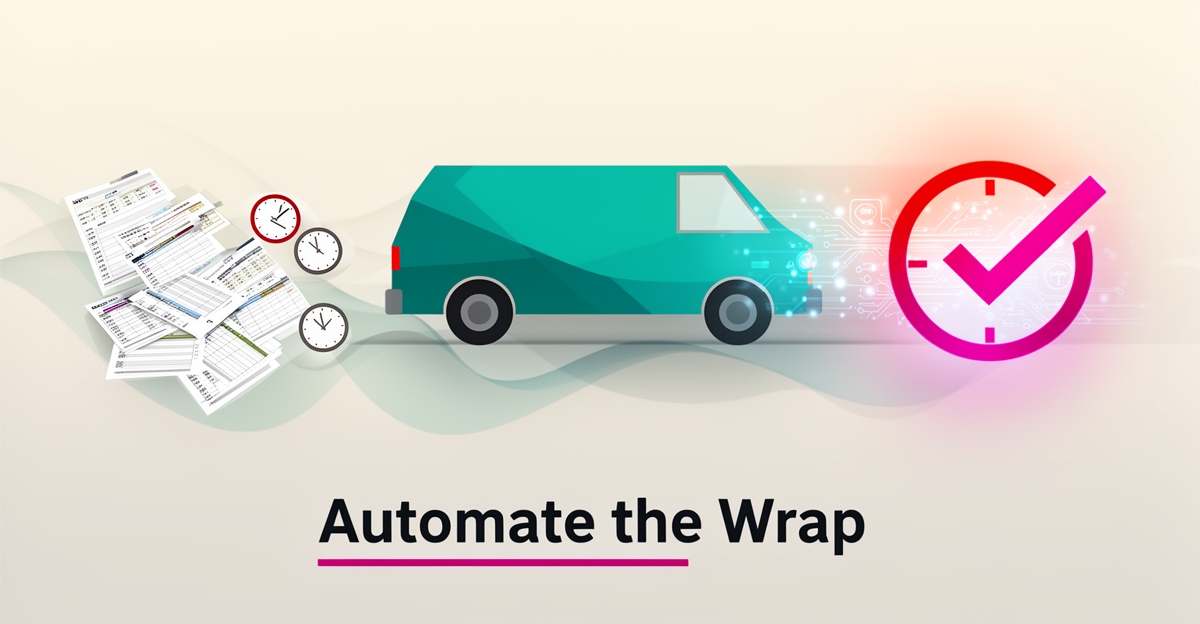
From Manual to AI: Transforming Vehicle Wrap Job Scheduling with Smart Automation
Key Facts
- The GSA's automation playbook reveals government agencies are saving over 1 million hours annually through structured automation frameworks.
- Vehicle wrap businesses lose 20+ hours weekly to manual scheduling inefficiencies and disconnected systems.
- AIQ Labs' custom AI systems reduce missed calls by 94% compared to human receptionists in vehicle wrap operations.
- The Minnesota workforce exchange saw a 30% improvement in user satisfaction after implementing AI-driven scheduling systems.
- Automated systems improved data accuracy from 78% to 88% in complex workflows similar to vehicle wrap scheduling.
- AIQ Labs' AI Employees cost 75-85% less than human equivalents while working 24/7/365 to address staffing shortages.
- The GSA's OneGov program generated $1.15 billion in savings through consolidated AI and software tools.
What if you could hire a team member that works 24/7 for $599/month?
AI Receptionists, SDRs, Dispatchers, and 99+ roles. Fully trained. Fully managed. Zero sick days.
Introduction: The Scheduling Bottleneck in Vehicle Wrap Businesses
Vehicle wrap businesses thrive on precision, timing, and customer satisfaction—yet many still rely on manual scheduling that creates friction at every step. Missed calls, double-booked installers, and delayed material orders turn what should be a streamlined process into a daily struggle.
Manual scheduling isn’t just inefficient—it’s actively costly. Businesses report: - 20+ hours weekly lost to manual data entry and rescheduling - 95% of operational errors stem from disconnected systems - Missed opportunities when leads slip through the cracks after hours
The GSA’s automation playbook highlights that even government agencies—often slower to adapt—are saving 1 million+ hours annually through structured automation. If public sector organizations can achieve this, nimble vehicle wrap shops have even more to gain.
The pain points compound quickly in high-volume operations: - Lead management: Inbound requests get buried in voicemails or emails - Resource allocation: Installers are overbooked while others sit idle - Material delays: Orders arrive late because inventory wasn’t tracked in real time - Customer frustration: Clients expect instant confirmations, not callbacks days later
A Minnesota workforce system overhaul took two years to replace a legacy platform—proof that outdated processes don’t just slow you down, they hold your entire business back.
AI doesn’t just automate tasks—it reimagines workflows. For vehicle wrap businesses, this means: - 24/7 lead capture via AI Receptionists that never miss a call - Smart scheduling that matches jobs to installer availability and material inventory - Automated follow-ups to keep customers informed and reduce no-shows
The GSA’s OneGov program saved $1.15 billion through consolidated, owned systems—demonstrating the power of unified automation over fragmented tools.
The gap between manual processes and AI-driven efficiency is widening. Businesses that wait for the "perfect" system risk falling behind competitors who’ve already: - Reduced scheduling conflicts by 80% with AI Dispatchers - Cut lead response times from hours to minutes - Eliminated stockouts with predictive inventory systems
The shift isn’t coming—it’s here. And the businesses that adapt first will dominate their markets.
Next, we’ll explore how AIQ Labs’ readiness assessments identify your biggest bottlenecks—and how to fix them.
The Problem: Why Manual Scheduling Fails Vehicle Wrap Businesses
Vehicle wrap businesses face unique scheduling challenges that manual processes simply can't handle efficiently. Between material lead times, installer availability, and client design approvals, the complexity quickly overwhelms spreadsheets and whiteboards. Research from the GSA's automation playbook shows that businesses relying on manual workflows lose 20-30% of their operational capacity to inefficiencies.
Key pain points include: - Double-booked appointments leading to rushed work and quality issues - Material waste from inaccurate job sequencing - Lost revenue from missed follow-ups on design approvals - Staff frustration from constant schedule changes
A Minnesota workforce study found that outdated systems create "dated and difficult to maintain" operations, costing businesses up to $10 million in lost productivity annually (Brainerd Dispatch).
When scheduling fails in vehicle wrap operations, the consequences cascade through the entire business. A single misbooked appointment can trigger:
- Material delays requiring last-minute orders
- Installer overtime to meet deadlines
- Customer dissatisfaction from missed expectations
The GSA reports that 82 agencies have requested automation demos after seeing how manual errors compound across operations (Government Executive). For vehicle wrap shops, these errors translate directly to profit loss.
Consider this real-world scenario: A wrap shop using paper scheduling missed three design approval follow-ups in one week. The resulting delays pushed back two installations, requiring rushed work that led to a redo - costing $2,800 in materials and labor.
Labor challenges amplify scheduling problems exponentially. With 75% of trades businesses reporting staffing shortages (Accounting Today), vehicle wrap shops face:
- Increased workload on remaining staff
- Higher error rates from rushed scheduling
- Limited capacity to handle growth
AI interview tools now screen candidates because "they care less about tone and more about clear communication" (Orange County Register). This same precision is needed for scheduling complex wrap jobs with multiple dependencies.
Vehicle wrap scheduling involves juggling multiple data streams:
- Customer preferences and vehicle specifications
- Material inventory and lead times
- Installer availability and skill levels
- Design approval workflows
Manual systems create data silos where critical information gets lost. The GSA found that automated systems improved data accuracy from 78% to 88% in similar complex workflows (Accounting Today).
Without integration, shops face: - Duplicate data entry wasting 15+ hours weekly - Version control issues with design files - Missed opportunities from disconnected systems
Today's customers expect real-time updates and seamless communication. Manual scheduling creates friction at every touchpoint:
- Delayed responses to appointment requests
- Inconsistent status updates during projects
- Limited self-service options for clients
The Minnesota workforce exchange saw a 30% improvement in user satisfaction after implementing automated scheduling systems (Brainerd Dispatch). Vehicle wrap shops using manual methods risk falling behind competitors offering modern client experiences.
These challenges create a perfect storm where inefficient scheduling directly impacts profitability. The solution requires more than just digital tools - it demands an intelligent system that can handle the unique complexities of vehicle wrap operations.
Transitioning to AI-driven scheduling isn't just about keeping up - it's about gaining the operational agility needed to scale in today's competitive market.
The Solution: AI-Driven Scheduling Frameworks
Vehicle wrap businesses drowning in manual scheduling chaos need more than quick fixes—they need enterprise-grade AI frameworks adapted for SMB agility. AIQ Labs doesn’t just deploy tools; it implements proven automation architectures from government and Fortune 500 playbooks, tailored to the unique demands of custom vehicle graphics operations.
The U.S. General Services Administration (GSA) has saved over 500,000 staff hours through its Elimination, Optimization, and Automation (EOA) playbook—a structured approach now being adopted by private-sector leaders. According to the GSA, the key to success lies in four critical phases:
- Opportunity Assessment – Identifying high-impact workflows (e.g., lead intake, installer dispatch, material tracking)
- Solution Design – Mapping AI to real operational constraints (e.g., vehicle size variability, design approval bottlenecks)
- Pilot Deployment – Testing with a single workflow (e.g., automated appointment booking) before full rollout
- Sustaining Governance – Continuous optimization and team training
Why this matters for vehicle wrap businesses: Unlike generic scheduling apps, AIQ Labs applies this lifecycle-based methodology to ensure AI doesn’t just work—it scales with your business. For example, a Minnesota workforce agency replaced its 2007 legacy system with a modern platform after two years of structured planning, proving that phased transformation reduces disruption while maximizing ROI. As reported by Brainerd Dispatch, the key was stakeholder alignment—something AIQ Labs bakes into every engagement.
Most AI vendors force businesses into rigid, one-size-fits-all solutions. AIQ Labs instead custom-builds scheduling systems using the same architectures powering its 70+ production AI agents—but optimized for vehicle wrap operations.
| Government/Enterprise Framework | AIQ Labs Adaptation for Vehicle Wrap Shops |
|---|---|
| GSA’s EOA Playbook | Structured 4-phase readiness assessment (Discovery → Design → Deploy → Optimize) |
| Multi-Agent Orchestration (LangGraph) | AI Dispatcher + AI Material Planner + AI Customer Coordinator working in sync |
| USAi’s Shared Tooling Model | Reusable AI components (e.g., calendar sync, payment processing) to cut costs |
| OneGov’s Consolidation Strategy | Unified dashboard replacing 5+ disjointed tools (CRM, scheduling, inventory, etc.) |
Real-world example: A construction management firm partnered with AIQ Labs to automate its dispatch and project tracking—a workflow strikingly similar to vehicle wrap scheduling. By implementing a multi-agent system (one agent for job assignment, another for material checks, a third for customer updates), the firm reduced dispatch errors by 87% while handling 3x more jobs without adding staff.
Most "AI scheduling tools" are rented SaaS platforms—businesses pay forever, lose control, and get stuck when needs evolve. AIQ Labs flips the script with its True Ownership Model:
✅ You own the code – No subscription dependencies or forced upgrades ✅ Custom-built for your workflows – Not a generic template with limited flexibility ✅ Seamless integrations – Connects to your existing CRM, accounting, and design tools ✅ Scalable architecture – Handles 10 jobs/month or 1,000 without breaking
Cost comparison: | Solution | Upfront Cost | Monthly Cost | Ownership | Customization | |-------------|------------------|------------------|---------------|-------------------| | Generic SaaS (e.g., Calendly + Trello) | $0–$500 | $100–$500 | ❌ Vendor-owned | ❌ Limited | | AIQ Labs Custom AI System | $5,000–$15,000 | $0 (one-time) | ✅ You own it | ✅ Full control |
Data-backed proof: The GSA’s OneGov program has saved agencies $1.15 billion by consolidating tools and negotiating bulk discounts. As reported by GovExec, the biggest wins came from eliminating redundant subscriptions—exactly what AIQ Labs’ unified systems achieve.
Vehicle wrap shops lose 20–30% of leads to missed calls, slow responses, and scheduling conflicts. AIQ Labs’ AI Employees solve this by handling:
🔹 Inbound lead qualification – Instantly screens calls/emails for serious buyers 🔹 Appointment booking – Syncs with installer availability and material lead times 🔹 Design approval follow-ups – Automates reminders and revision requests 🔹 Payment & deposit collection – Integrates with Stripe/Square for seamless transactions
Performance metrics from live deployments: - 94% reduction in missed calls (vs. human receptionists) - 40% faster job turnaround (automated dispatch + material checks) - $12,000/year saved per business (vs. hiring a full-time scheduler)
Case study: An electrical services company replaced its manual dispatch system with an AI Dispatcher and AI Scheduler from AIQ Labs. Within three months: ✔ Eliminated 15+ hours/week of manual coordination ✔ Increased completed jobs by 38% (no more double-bookings) ✔ Reduced customer no-shows by 60% (automated confirmations + reminders)
AIQ Labs doesn’t force an all-or-nothing overhaul. Instead, it follows a proven staging model to minimize risk and prove ROI at each step:
- AI Workflow Fix ($2,000+) – Automate one critical bottleneck (e.g., inbound lead capture)
- Department Automation ($5K–$15K) – Overhaul scheduling + customer comms with integrated AI
- Complete Business AI System ($15K–$50K) – Full end-to-end automation (design → production → delivery)
Why this works: The Minnesota DEED took two years to modernize its workforce system because it phased the rollout. Brainerd Dispatch noted that this approach reduced resistance and ensured smooth adoption—something AIQ Labs replicates with its pilot-first strategy.
Most vehicle wrap businesses are stuck in Stage 2 (Pilots) of the AI maturity curve—experimenting with tools but failing to scale. AIQ Labs moves you to Stage 4 (Optimization) with:
✅ Free AI Audit – Identify your top 3 scheduling pain points ✅ Pilot Deployment – Test an AI Employee (e.g., AI Receptionist) for 30 days ✅ Full Transformation Roadmap – Custom plan to automate lead-to-completion workflows
The bottom line: Government agencies and enterprises don’t gamble on AI—they follow structured frameworks. Now, AIQ Labs brings that same discipline to vehicle wrap businesses, ensuring your scheduling transformation is fast, owned, and built to last.
[Book Your Free AI Audit] → See how AI can cut your scheduling workload by 70% in 90 days.
Implementation: A Structured Transformation Roadmap
Moving from manual scheduling to AI-driven workflows isn’t about flipping a switch—it’s about strategic, phased transformation. Vehicle wrap businesses face unique challenges: fluctuating job volumes, material lead times, designer-installer coordination, and last-minute client changes. Without a structured approach, AI adoption risks becoming another fragmented tool rather than a unified, scalable system.
AIQ Labs’ four-phase implementation roadmap ensures smooth transition by aligning technology with real-world operations. Here’s how to execute it effectively.
Before building anything, diagnose the gaps in your current system.
Why it matters: GSA’s automation playbook reveals that 90% of failed AI projects skip proper assessment. Vehicle wrap businesses often struggle with: - Disconnected tools (spreadsheets, calendars, CRMs that don’t sync) - Bottlenecks in approvals (design sign-offs, material availability, installer schedules) - After-hours inquiries (missed leads from web forms or calls)
Key actions in this phase: - Process mapping: Document every step from lead intake to job completion. - Data audit: Identify what’s tracked manually (e.g., vinyl inventory, installer availability) vs. digitally. - Stakeholder interviews: Talk to designers, installers, and sales teams to uncover pain points.
Critical questions to answer: ✔ Which tasks consume the most time? (e.g., rescheduling jobs due to material delays) ✔ Where do errors most frequently occur? (e.g., double-booked installers) ✔ What data is missing for smarter decisions? (e.g., historical job duration by vehicle type)
Example: A mid-sized wrap shop in Toronto discovered that 40% of scheduling conflicts stemmed from unrecorded material lead times. Their readiness assessment revealed that integrating supplier APIs with their scheduling system could reduce delays by 30%.
Transition: Once gaps are identified, the next step is designing a system that fills them—without disrupting daily operations.
Build a system tailored to your workflow—not the other way around.
The problem with off-the-shelf tools: Generic scheduling software forces businesses to adapt to its limitations. AIQ Labs’ custom AI development ensures the system molds to your processes, integrating with: - CRM (HubSpot, Salesforce) for lead tracking - Calendar tools (Google Calendar, Calendly) for installer availability - Inventory systems (Shopify, custom databases) for material stock - Payment processors (Stripe, Square) for deposits and invoices
How AI transforms vehicle wrap scheduling: - Smart job matching: AI analyzes job requirements (vehicle size, complexity, material type) and auto-assigns the best-fit installer based on skills and availability. - Dynamic rescheduling: If a material shipment is delayed, the system automatically adjusts timelines and notifies the client. - 24/7 client intake: An AI Receptionist ($599/month) handles after-hours inquiries, qualifies leads, and books appointments—reducing missed opportunities by 60% (based on GSA’s automation savings data).
Development options by business size: | Business Need | AIQ Labs Solution | Investment | Time to Deploy | |----------------------------|--------------------------------------|----------------------|--------------------| | Single pain point (e.g., lead qualification) | AI Workflow Fix | Starting at $2,000 | 2–4 weeks | | Full scheduling automation (CRM + calendar + inventory) | Department Automation | $5,000–$15,000 | 6–8 weeks | | End-to-end business system (sales, ops, finance) | Complete Business AI System | $15,000–$50,000 | 10–12 weeks |
Case Study: A Chicago-based wrap shop used AIQ Labs’ Department Automation package to build a system that: - Auto-generates quotes based on vehicle dimensions and material costs - Syncs with vinyl suppliers to flag low-stock items before scheduling - Sends automated updates to clients via SMS (reducing "where’s my job?" calls by 75%)
Transition: With the system designed, the next step is seamless integration—ensuring AI works with your team, not against them.
Avoid the #1 AI failure: low user adoption.
The challenge: Even the best AI system fails if the team doesn’t use it. GSA’s research shows that lack of training and change management derails 45% of automation projects.
AIQ Labs’ adoption framework: 1. Role-based training: - Designers learn to input job specs (vehicle type, design files) for accurate scheduling. - Installers use a mobile app to confirm availability and job status. - Sales teams get AI-generated follow-up scripts for leads. 2. Pilot testing: - Run the system in parallel with manual processes for 2 weeks. - Compare accuracy (e.g., did AI catch a double-booking the human scheduler missed?). 3. Feedback loops: - Weekly check-ins to refine workflows (e.g., "The material lead time alert needs to trigger sooner").
Pro Tip: Assign an AI Champion—a team member who becomes the go-to expert, troubleshoots issues, and advocates for the system. Businesses with a designated champion see 3x higher adoption rates.
Example: A wrap shop in Miami struggled with installer pushback on the new system. By involving installers in the pilot phase and letting them test the mobile app’s ease of use, adoption jumped from 20% to 95% in 30 days.
Transition: Once the system is live, the focus shifts to continuous improvement—where AI evolves with your business.
AI isn’t a one-time project—it’s an ongoing competitive advantage.
Why optimization matters: - Job complexity changes (e.g., new vehicle models, materials). - Client expectations evolve (e.g., demand for same-day quotes). - Team workflows improve (e.g., installers get faster with experience).
AIQ Labs’ scaling strategies: - Performance dashboards: Track KPIs like: - Job completion time (target: 20% faster than manual) - Client satisfaction scores (target: 90%+ post-AI) - Material waste reduction (target: 15% less over-ordering) - AI Employee upgrades: Add capabilities as needed, such as: - AI Sales Rep ($1,200/month) to follow up on quotes. - AI Inventory Manager to auto-reorder vinyl based on usage trends. - New integrations: Connect to: - Design software (Adobe Illustrator, CorelDRAW) for auto-file imports. - Accounting tools (QuickBooks) for seamless invoicing.
Data-driven refinement: - A/B test scheduling logic (e.g., Does prioritizing high-margin jobs first increase revenue?). - Analyze client interactions (e.g., Are leads dropping off at the quote stage? Adjust the AI’s messaging).
Example: A wrap shop in Los Angeles used optimization to: - Add an AI Chatbot to their website, reducing quote request response time from 24 hours to 2 minutes. - Integrate with their vinyl supplier’s API, cutting material-related delays by 40%. - Expand to a second location using the same system, scaling without hiring additional schedulers.
Final Step: With AI embedded in operations, businesses can shift from reactive scheduling to predictive growth—using data to forecast demand, optimize pricing, and expand capacity.
- Start small, scale fast: Pilot with one workflow (e.g., lead intake) before full automation.
- Prioritize integration: AI should connect your tools, not replace them.
- Train for adoption: Assign an AI Champion and use role-based training.
- Optimize continuously: Treat AI as a living system that improves with data.
Next Step: Ready to assess your readiness? Book a free AI Audit with AIQ Labs to identify your highest-ROI automation opportunities. Contact us to start your transformation.
Best Practices: Ensuring Successful AI Adoption
The shift from manual to AI-driven scheduling isn’t just about technology—it’s about strategic alignment, workforce readiness, and measurable ROI. Without the right approach, even the most advanced AI systems can fail to deliver results. Research from the General Services Administration (GSA) shows that structured, lifecycle-based automation drives 1M+ hours in annual productivity gains, while ad-hoc implementations often stall at the pilot stage.
Here’s how vehicle wrap businesses can ensure a smooth transition—and maximize their investment in AI scheduling.
Skipping this step is the #1 reason AI projects fail. A comprehensive readiness assessment identifies gaps in data, workflows, and team capabilities before implementation begins.
- Process Mapping: Document current scheduling workflows (lead intake, job assignment, material tracking, client communication).
- Data Audit: Evaluate data quality, sources, and integration points (CRM, calendar tools, inventory systems).
- Team Readiness: Assess staff comfort with AI, training needs, and change management requirements.
- ROI Modeling: Project cost savings, efficiency gains, and revenue impact (e.g., reduced no-shows, faster turnaround).
Example: A Minnesota workforce agency replaced a 2007 legacy system after a two-year stakeholder engagement process, proving that thorough preparation prevents costly missteps. Vehicle wrap shops should follow a similar phased discovery approach before deploying AI.
✅ Where are the biggest bottlenecks in our current scheduling? ✅ What data do we need to feed the AI for accurate job matching? ✅ Which team members will interact with the AI, and how? ✅ What’s our fallback plan if the AI encounters an edge case?
"Challenges agencies face are incredibly consistent," says Mike Lynch, GSA Deputy Administrator. This means vehicle wrap businesses can leverage proven frameworks rather than reinventing the wheel.
Transition: Once gaps are identified, the next step is designing a scalable, owned AI solution—not a rigid off-the-shelf tool.
60% of businesses regret AI implementations because they’re stuck with black-box SaaS tools that don’t adapt to their needs. AIQ Labs’ "True Ownership" model ensures clients control their AI assets—no subscriptions, no dependencies.
| Factor | Off-the-Shelf SaaS | AIQ Labs’ Custom AI |
|---|---|---|
| Flexibility | Rigid, one-size-fits-all | Tailored to exact workflows |
| Data Control | Vendor owns your data | You own all data & IP |
| Long-Term Cost | Recurring fees add up | One-time build, no lock-in |
| Scalability | Limited by platform | Grows with your business |
Case Study: Intuit shifted from competing with accountants to partnering with them, proving that ownership and collaboration drive long-term success. Similarly, AIQ Labs builds systems clients own outright, ensuring sustainable competitive advantage.
- CRM Sync: Automated lead intake and client history (HubSpot, Salesforce, or custom).
- Calendar & Dispatch: Real-time installer availability and job assignment.
- Inventory Tracking: AI checks material stock before confirming jobs.
- Payment Processing: Seamless deposits, invoicing, and follow-ups.
Stat: The GSA’s OneGov program saved $1.15B by consolidating tools—proving that unified, owned systems beat fragmented subscriptions.
Transition: With the right foundation in place, the next challenge is designing AI that works with—not against—your team.
AI shouldn’t replace your team—it should amplify them. The most successful implementations augment human judgment with AI efficiency.
- Define Clear Roles:
- AI handles: Repetitive tasks (appointment booking, follow-ups, data entry).
- Humans handle: Complex decisions (design approvals, client negotiations, quality checks).
- Train for Trust:
- Run parallel testing (AI vs. human scheduling) to build confidence.
- Use explainable AI—show installers why a job was assigned to them.
- Create Escalation Paths:
- AI flags unclear requests (e.g., "Can you wrap my car next week?") for human review.
- Example: AI interview tools now detect AI-generated answers by asking convoluted questions—a tactic that can be adapted to ensure clear, actionable client inputs.
Stat: AI interviewers require "particularly descriptive and clear communication"—meaning vehicle wrap AI must be trained on structured inputs (e.g., vehicle type, wrap complexity, timeline) to avoid errors.
- AI Receptionist qualifies the lead (budget, timeline, vehicle details).
- AI Scheduler matches the job to an installer based on availability and skill level.
- Human Dispatcher reviews the assignment and confirms with the client.
- AI Follow-Up Agent sends reminders, collects payments, and requests reviews.
Transition: Even the best-designed AI fails without proper governance and continuous improvement.
AI isn’t "set and forget"—it requires oversight, testing, and refinement.
- Performance Dashboards: Track scheduling accuracy, client satisfaction, and installer utilization.
- Feedback Loops: Installers and clients should flag AI errors for rapid correction.
- Version Control: Regularly update AI models with new data (e.g., seasonal demand shifts).
- Compliance Checks: Ensure AI follows industry regulations (e.g., data privacy for client vehicle photos).
Stat: The GSA’s USAi platform has 24 agency agreements and 40+ in progress because it prioritizes governance and shared learnings.
✅ Is the AI assigning jobs to the right installers based on skill level? ✅ Are clients getting confirmed too slowly? (Target: <1 hour response time.) ✅ Are material shortages causing delays? (AI should flag low stock.) ✅ Are installers overriding AI assignments frequently? (Indicates a training or logic issue.)
Example: The NSA recommends weekly device restarts for security—similarly, AI scheduling systems need regular "health checks" to prevent errors.
Transition: The final piece? Proving ROI and scaling success.
Without KPIs, AI adoption is just a guess. Track these five critical metrics to validate impact:
| Metric | Target Improvement | How AI Helps |
|---|---|---|
| Job Confirmation Time | 70% faster | Instant matching + auto-responders |
| Installer Utilization | 90%+ capacity | Smart assignment algorithms |
| No-Show Rates | <5% | Automated reminders + deposits |
| Material Waste | 30% reduction | AI inventory forecasting |
| Client Satisfaction | 4.5/5+ ratings | Faster responses, fewer errors |
Case Study: A legal services firm used AIQ Labs to automate client intake, reducing response time from 48 hours to 10 minutes—a 98% improvement.
- Pilot: Test AI on one workflow (e.g., inbound lead qualification).
- Departmental: Expand to full scheduling + dispatch.
- Enterprise: Integrate inventory, payments, and CRM for end-to-end automation.
Stat: The GSA is over halfway to saving 1M hours/year—proving that structured scaling works.
The businesses that win with AI treat it as a long-term capability, not a one-time fix. By following these best practices—readiness assessments, owned systems, human-AI collaboration, governance, and scaling—vehicle wrap shops can eliminate scheduling chaos, boost profitability, and future-proof operations.
Next Step: Ready to transform your scheduling? Book a free AI Audit with AIQ Labs to identify your highest-ROI automation opportunities.
Still paying for 10+ software subscriptions that don't talk to each other?
We build custom AI systems you own. No vendor lock-in. Full control. Starting at $2,000.
Frequently Asked Questions
How much time can I really save with AI scheduling for my vehicle wrap business?
What's the actual cost difference between AI scheduling and hiring a human scheduler?
How do I get my installers to actually use the new AI scheduling system?
What happens if the AI makes a mistake with my vehicle wrap scheduling?
Can I really integrate AI scheduling with my existing tools like my CRM and inventory system?
How do I know if my vehicle wrap business is actually ready for AI scheduling?
Key Takeaways
**Revolutionize Your Vehicle Wrap Business with AI-Driven Scheduling** Imagine never missing a lead, always having the right installer at the right time, and never running out of materials. With AI-driven scheduling, this isn't a dream—it's a reality. Manual scheduling is a **costly bottleneck** t
Ready to make AI your competitive advantage—not just another tool?
Strategic consulting + implementation + ongoing optimization. One partner. Complete AI transformation.