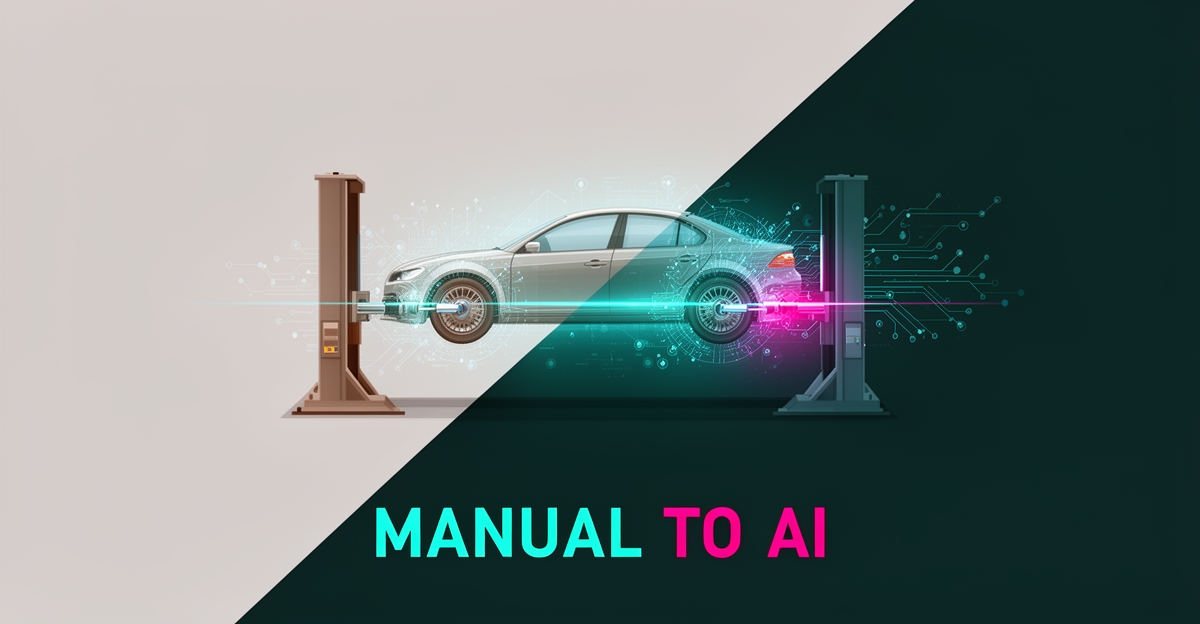
From Manual to AI: Transforming Wheel Alignment Shop Operations in Halifax
Key Facts
- Manual throughput is capped by human capacity, while automated systems run continuously at higher volume — a core contrast between manual and AI-driven operations.
- Businesses adopting modern AI automation typically report payback within roughly a year to eighteen months, though timelines vary by workflow.
- AI workers can often resolve routine (Tier 0) inquiries autonomously from day one, freeing staff for complex work.
- AI applications in automotive business operations include customer segmentation, inventory management, and operational optimization.
- AIQ Labs has deployed 200+ multi-agent systems and runs 4 live SaaS products daily — proof the approach works in production, not just on paper.
Hire a team member that works 24/7 — for less than a part-time wage.
AI receptionists, SDRs, dispatchers and 99+ roles. Trained on your business, fully managed.
Not sure where to start? Ask our AI planner
The Hidden Cost of Running an Alignment Shop on Manual Processes
It's 8:15 a.m. on a rainy Tuesday in Halifax, and the phone is ringing. The technician who should answer it is under a lifted vehicle checking camber readings by hand, and by the time he wipes his hands and picks up, the caller has hung up. That caller may have already dialed the shop across town.
This is the quiet arithmetic of running an alignment shop on manual processes. Nothing dramatic fails. Revenue simply leaks out through the seams — one missed call, one inconsistent measurement, one double-booked bay at a time.
Consider what a typical day actually looks like. Bookings depend on whoever is free to answer the phone, so appointment slots fill unevenly and capacity goes unused. Quality checks rely on paper forms and a technician's eye, which means accuracy fluctuates with experience and fatigue. And because scheduling is reactive rather than data-driven, throughput stays capped by shift schedules — a limitation that consistently shows up in comparisons of manual versus automated operations, where manual throughput is limited by human capacity while automated systems run continuously at higher volume.
The measurement problem deserves particular attention. Manual alignment verification is subject to human error and variability, whereas machine-assisted systems perform the same checks with consistent, data-driven precision. For an alignment shop, that gap translates directly into rework, warranty disputes, and customers who don't come back.
Then there's the data you never collect. Paper-based processes leave almost nothing behind — no service history to power reminders, no patterns to inform scheduling, no basis for customer segmentation. Research on the automotive value chain notes that AI applications in business operations like customer relationship management and inventory management become data-driven processes, but only when the underlying data exists to begin with.
So where does manual work quietly bleed revenue?
- Missed calls become missed bookings — every unanswered ring is a customer who likely calls a competitor.
- Inconsistent quality checks create rework, comebacks, and reputation damage that no discount can fix.
- Reactive scheduling leaves bays idle during slow stretches and overwhelmed during peaks.
- No data means no insight — the shop can't see its own bottlenecks, let alone fix them.
None of this means replacing technicians with robots. The evidence consistently favors a hybrid model: automation handles high-volume, standardized tasks while people keep the complex problem-solving and customer relationships. That's the philosophy behind how AIQ Labs approaches transformation — phased, practical steps that fix the highest-cost leaks first. Businesses adopting modern automation typically report returns within a year to eighteen months, and survey data across industries shows AI-driven productivity and efficiency gains are now viewed as essential rather than optional.
The question isn't whether a Halifax alignment shop can afford to modernize. It's how long it can afford not to.
What AI Actually Does for a Service Shop (Backed by Real-World Results)
The idea that AI belongs only to autonomous vehicles misses where the value shows up first. For a Halifax wheel alignment shop, the gains come from high-volume, repeatable work handled with machine precision while technicians focus on judgment.
Industrial AI already proves the pattern. Machine vision and automated quality-control systems in heavy industry routinely outperform manual inspection on both consistency and speed, and facilities adopting them typically report payback within a year to eighteen months through higher throughput and lower labor costs.
That same hybrid logic maps directly to alignment operations. Machine vision can measure toe, camber and caster faster and more consistently than manual gauges, automated scheduling can fill bays based on historical demand, and computer vision checkpoints can verify specs before a car leaves. Humans stay on complex diagnostics, custom suspensions and customer conversations.
The automotive value chain research confirms AI is moving beyond the car itself into service workflows, inventory management and customer relationship management — with applications in customer segmentation, inventory management and operational optimization that translate directly to service businesses.
AI workers demonstrate how standardized tasks can be automated without full replacement. Deployed case studies show routine (Tier 0) inquiries resolved autonomously from day one, with booking, reminders, pre-service intake and follow-up running 24/7 while staff handle the work that actually needs a human. AIQ Labs offers this directly through AI Employees — managed AI staff like receptionists, SDRs and dispatchers across 99+ roles, at roughly 80% less cost than a human hire.
A proven implementation model keeps both layers working together:
- AI for high-volume standardized tasks: automated measurements, appointment optimization, quality control checks
- Humans for complex judgment: unusual vehicle setups, warranty disputes, relationship-driven service
- Data feedback loop: every job improves scheduling accuracy and defect detection
This is not full automation. It is hybrid augmentation — adding AI alongside existing lines rather than ripping them out. AI and automation are practical tools available today to improve throughput, tighten quality, and reduce costs.
For Halifax shops, that means phased adoption with measurable returns. AIQ Labs works with SMBs to design phased roadmaps that start with diagnostics and scheduling automation and expand to predictive maintenance and customer analytics, keeping ownership and control with the business.
The Four-Phase Roadmap: From Operational Audit to AI-Driven Operations
Most wheel alignment shops struggle not from lack of customers, but from operational inefficiencies that drain profitability and limit growth potential. The path from manual processes to AI-driven operations requires a structured approach that transforms your Halifax shop systematically.
The transformation begins with Phase 1: Operational Assessment, where you conduct a comprehensive audit of current workflows, map every customer touchpoint from initial inquiry to post-service follow-up, and establish robust data infrastructure. This foundation phase identifies bottlenecks in your scheduling, diagnostic processes, and customer communication that AI can address immediately.
Phase 2 introduces targeted technology integration through AI-powered diagnostic equipment that uses machine vision for precise wheel alignment measurements, automated booking systems that optimize appointment scheduling based on historical patterns, and customer communication AI that handles routine inquiries and service reminders. Automotive industry research shows AI applications in business operations specifically include customer segmentation, inventory management, and operational optimization that directly benefit service-oriented businesses.
The integration approach mirrors successful implementations in other industries, where AI quality-control systems work alongside human expertise rather than replacing it entirely.
Phase 3 advances to predictive optimization:
- Predictive maintenance systems that forecast equipment service needs based on usage patterns
- Inventory forecasting that predicts parts demand and optimizes ordering cycles
- Customer analytics that segment clients and personalize service recommendations
- Performance monitoring dashboards that track throughput, accuracy, and customer satisfaction metrics
AI implementation specialists report that businesses can achieve fully autonomous resolution for routine operational tasks, with some implementations completed in as little as six weeks when the workflow is well-defined.
Phase 4: Continuous Improvement establishes ongoing ROI tracking across key metrics including throughput increases, labor efficiency gains, and revenue impact. Facilities adopting modern AI solutions typically report payback within a year to eighteen months, with meaningful quarter-on-quarter productivity gains in well-executed rollouts.
AIQ Labs structures this transformation through its Workflow Builds — rebuilding the one workflow that costs you the most, at a fixed price, in phases — and, for shops ready to go further, AI Operating Systems that connect everything into one operating layer you own outright. Each phase builds on previous successes while maintaining operational continuity. The hybrid approach preserves human expertise for complex diagnostics and customer relationships while automating high-volume, standardized processes that currently consume valuable technician time.
This phased roadmap transforms your Halifax alignment shop from reactive, manual operations to proactive, data-driven service delivery that scales efficiently and delivers measurable competitive advantages.
Avoiding the Pitfalls: Integration, Change Management, and Why Ownership Matters
Transitioning from manual to AI-driven operations in a Halifax wheel alignment shop requires more than just new technology — it demands careful navigation of integration challenges and human factors. Many shops underestimate the complexity of connecting AI systems with existing diagnostic equipment and scheduling tools, which can disrupt workflows if not managed properly. Data quality is another critical hurdle; AI tools depend on clean, consistent inputs from service histories and sensor readings to deliver accurate results. Staff resistance often stems from fear of job displacement rather than the technology itself, making change management essential to preserve trust and engagement.
A phased, milestone-based approach significantly reduces these risks by allowing shops to validate each step before moving forward. Instead of overhauling everything at once, starting with a single workflow — like automated booking or AI-assisted quality control — lets teams adapt gradually while maintaining operational stability. This method aligns with AIQ Labs' Build in Milestones payment model, where each phase delivers tangible value that can be reviewed and approved before proceeding. Shops that prefer to start light can Start Monthly with an AI Employee, and those committing long-term can Own It Outright. Crucially, ownership rather than subscription dependence avoids vendor lock-in and ensures long-term control over customizations, data, and future upgrades. Ownership empowers shops to evolve their AI capabilities independently, scaling only when proven ROI justifies the investment. See pricing for how each model works — no fake prices, no surprises.
Maintaining a hybrid balance is where true transformation succeeds. AI excels at high-volume, standardized tasks like precision alignment measurements or automated appointment reminders, freeing technicians to focus on complex diagnostics, customer education, and personalized service recommendations. This preserves the human expertise that builds loyalty and handles edge cases machines can't anticipate. By anchoring the transition in practical milestones, clean data practices, and team involvement, Halifax alignment shops can harness AI's efficiency without sacrificing the craftsmanship and trust that define their service. The result isn't just faster operations — it's a resilient, adaptable business where technology amplifies human skill rather than replacing it.
Your First Step: Mapping the Highest-ROI Starting Point
Most Halifax alignment shops don't need a full rebuild on day one. They need one bottleneck removed, measured, and proven before anything else scales.
The pattern across AI transformation in automotive operations is clear: successful adoption is phased and hybrid. AI handles high-volume, standardized tasks while human expertise stays on complex problem-solving and customer service. Facilities adopting modern automation typically report payback within a year to eighteen months through enhanced productivity and reduced labor costs.
That timeline is relevant for alignment shops because the first win rarely comes from diagnostics. It comes from the workflow that touches every customer and creates the most manual rework.
Mapping the highest-ROI starting point means auditing where time leaks and errors compound. For most small shops, three workflows consistently surface:
- Booking and scheduling where calls are missed and slots sit empty
- Follow-up and retention where completed alignments don't convert to repeat business
- Quality verification where manual checks create variability and rework
Booking is often the cheapest path to a measurable win. AI worker deployments show routine (Tier 0) inquiries resolved autonomously from day one, with booking, reminders and intake running 24/7 — no missed calls while your techs are under a lift.
Quality verification is the second high-impact lever. Machine vision applied to alignment measurements and defect detection brings industrial-grade consistency. Consistency replaces fatigue-driven error.
Follow-up closes the loop. Automated, personalized reminders and service prompts turn one-time visits into repeat revenue without adding staff hours.
AIQ Labs works with SMBs to identify that single workflow first, not a big-bang transformation. The approach is practical: map the current process, quantify the cost of delay and error, then design a contained automation that integrates with existing tools.
A concrete action plan starts with the free 2-minute Fit Check, then a free 30-minute strategy call with an AI engineer. The session maps the shop's biggest bottleneck and the cheapest path to a measurable win, with honest guidance if there isn't a clear win right now. No obligation, just clarity on where automation will actually move throughput, accuracy, and customer satisfaction.
Still paying for 10+ subscriptions that don’t talk to each other?
We build custom AI systems you own outright. No vendor lock-in. Full control.
Not sure where to start? Ask our AI planner
Frequently Asked Questions
Will AI replace my technicians at a Halifax wheel alignment shop?
How long does it typically take to see ROI from AI in a small service shop?
Is AI actually more accurate than manual alignment measurements?
Can AI handle booking and calls when my techs are under a lift?
Do I have to rip out my existing diagnostic equipment to add AI?
What's the best first workflow to automate in my shop?
Your First Step Toward Smarter Alignment Operations
Running a wheel alignment shop on manual processes quietly erodes profitability — missed calls, inconsistent measurements, idle bays, and untapped data all add up to lost revenue. The good news? You don't need to overhaul everything at once. By starting with a targeted automation — like AI-powered booking or quality verification — you can achieve measurable wins in weeks, not months, while preserving the human expertise that builds customer trust. AIQ Labs helps Halifax shops map their highest-ROI starting point through a free 2-minute Fit Check and a no-obligation 30-minute strategy call with an AI engineer. This session identifies your biggest bottleneck and the most practical path to improved throughput, accuracy, and customer satisfaction — without pressure or guesswork. If there isn't a clear win, we'll tell you that too. Take the first step toward a more efficient, data-driven shop today.
Make AI your competitive advantage — not just another tool.
Strategy, implementation and ongoing optimization. One partner, end to end.
Not sure where to start? Ask our AI planner