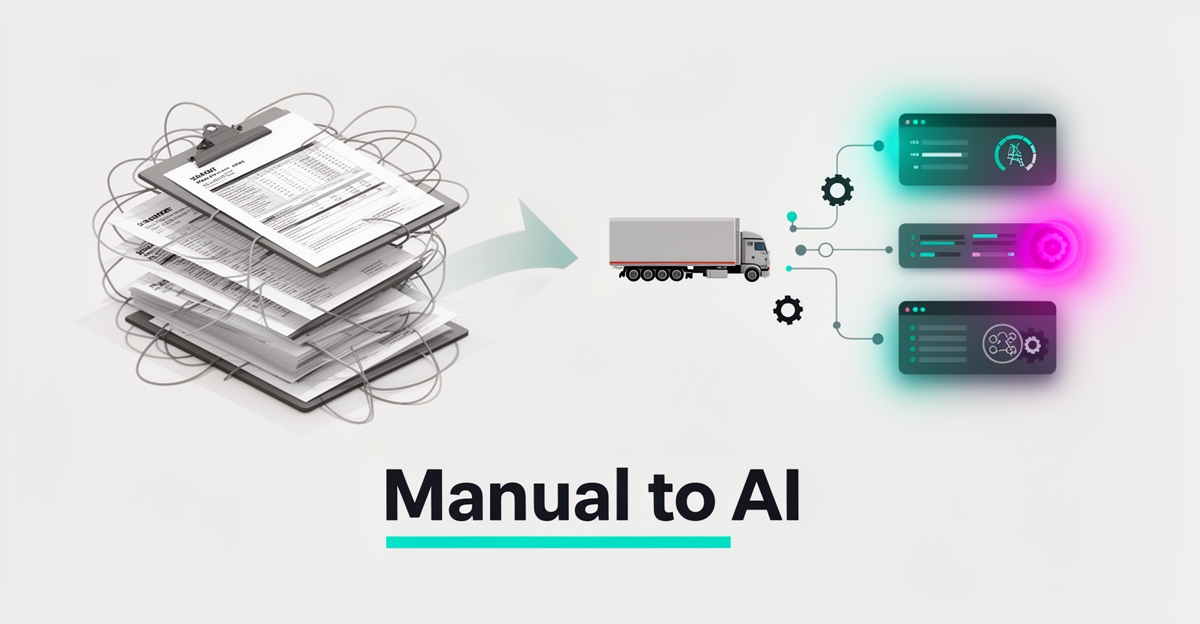
From Manual to AI: Transforming Workflows in a Mid-Size Trailer Repair Shop
Key Facts
- Paper-based trailer repair shops can generate job packets of 100 pages or more per repair, creating heavy manual data entry and transcription errors.
- Legacy ERP systems often expose only a small fraction of the underlying database to users, severely limiting reporting accuracy and operational insight.
- Industry deployments of AI workflows have reported 60–70% drops in average return-handling time and 40–70% reductions in Average Handling Time across service operations.
- In one documented manufacturing case, a trailer builder reduced barcode scans from 80+ per work order to just one, reportedly saving several hours daily in scheduling alone.
- Full ERP implementations commonly run 8–12 months; one trailer manufacturer's 8-month plan stretched to 12 months during the pandemic.
- Shop floor supervisors—not IT staff—are best positioned to lead training so adoption aligns with actual workflow realities.
- Manufacturers pursuing automation have reported roughly 40% reductions in administrative tasks and around 30% less downtime through predictive maintenance.
Hire a team member that works 24/7 — for less than a part-time wage.
AI receptionists, SDRs, dispatchers and 99+ roles. Trained on your business, fully managed.
Not sure where to start? Ask our AI planner
The Hidden Costs of Paper-Based Operations in Mid-Size Shops
Paper-based operations in mid-size trailer repair shops create hidden costs that extend far beyond the price of paper and ink. The most visible symptom is the job packet—often 100 pages or more per repair—that slows technicians and clogs workflows with physical handling. These manual packets force repeated data entry, increase the likelihood of transcription errors, and consume valuable shop floor time that could be spent on actual repairs. Beyond the immediate inefficiency, legacy systems often trap critical information in data silos, with legacy ERP modules exposing only a small slice of the full database to everyday users. This fragmentation means supervisors cannot generate real-time reports on parts usage, labor allocation, or job status without manual consolidation—a process that is both time-consuming and prone to oversight.
Administrative burdens compound these issues, driving up labor costs and error rates in ways that are difficult to quantify but impossible to ignore. Technicians and supervisors spend hours each week chasing down missing paperwork, re-entering data into multiple systems, and correcting mistakes that originated in handwritten notes or illegible forms. These repetitive tasks not only inflate payroll expenses but also divert skilled labor from higher-value activities like diagnostics and customer consultation. Over time, the cumulative effect is a workforce stretched thin by inefficiency, where the cost of maintaining paper-based processes quietly erodes profitability and hinders scalability. AIQ Labs helps shops uncover these hidden costs through detailed workflow assessments that map every manual touchpoint and quantify its impact on throughput and accuracy—typically as the first step of an AI Workflow Build.
Why AI Workflows Outperform Traditional Automation
Rigid rule-based automation hits a wall the moment a trailer repair shop encounters a messy real-world request. Traditional systems follow "If X → then Y" logic and break on typos, missing fields, or multi-step problems. AI workflows replace that brittleness with goal-driven orchestration that understands intent and executes end-to-end.
Traditional automation is fast on paper but fragile in practice. It routes invoices or emails when inputs match exactly, yet fails on unstructured data and complex service cases. AI workflows combine semantic intelligence from large language models with structured business processes, so the system can branch, verify conditions, and recover from errors without human rework. In practice, these are predefined multi-step chains where AI executes tasks autonomously across CRM, ERP, and ticketing systems.
The performance gap shows up in handling time and autonomy. Industry deployments have reported a 60–70% drop in average return-handling time and 40–70% reduction in Average Handling Time across service operations, with 60–80% automation rates on standard email requests in some systems.
For a mid-size trailer repair shop, that means a single request can trigger a complete process chain. The system identifies a part replacement, verifies vehicle history, checks inventory, generates a work order, and updates the customer without manual handoffs. Traditional automation would stop at routing; an AI workflow follows the goal and figures out the path itself.
The difference is especially visible in manufacturing and repair environments where data is messy and steps interlock. Manual workflows remain flexible through human judgment but are slow, error-prone, and limited by working hours. Manual processes carry high long-term costs from wages, error correction, and training, while AI automations deliver 24/7 availability and consistent quality at scale.
AIQ Labs designs these transformations as phased builds, moving shops from paper trails to integrated ERP, mobile hardware, and AI agents that own the workflow end-to-end.
AI workflows outperform traditional automation because they:
- Follow goals not fixed rules, branching with conditional logic such as authentication checks
- Handle unstructured inputs like emails with typos or multi-part requests without breaking
- Execute complex multi-step tasks autonomously across connected systems
- Maintain auditability through defined process chains while allowing agent flexibility inside guardrails
This goal-driven approach is why shops can reduce repetitive data entry and error correction while scaling service without adding headcount.
The Infrastructure Foundation: Hardware, Networks, and Data Access
Before AI can transform workflows, the physical and technical foundation must be in place. For a mid-size trailer repair shop, this begins with upgrading the wireless network to a secure mesh system capable of supporting mobile operations across the shop floor. In one documented trailer manufacturing case, legacy Wi-Fi failed to sustain real-time data capture during peak activity—without that upgrade, mobile hardware investments cannot deliver the seamless ERP integration needed to eliminate manual data entry and paper trails.
Equally vital is deploying mobile barcode scanning hardware preloaded with shortcuts to the new ERP system. In the case referenced above, this reduced an average of 80+ scans per work order to just one—reportedly saving several hours daily in scheduling alone. This hardware integration enables real-time inventory updates and work order tracking directly from the shop floor, turning previously siloed tasks into synchronized digital workflows. Without it, even the most advanced AI system remains starved for timely, accurate input.
Finally, full ERP database access must be established to overcome the data silos that cripple reporting accuracy. Legacy systems often expose only a small fraction of the underlying tables to users, leading to incomplete queries and flawed decision-making. Ensuring complete database access allows AI workflows to pull real-time data across inventory, labor, and parts modules—turning fragmented records into a single source of truth. AIQ Labs assesses and upgrades this foundation as part of its AI Operating System engagements, ensuring infrastructure readiness before intelligent automation begins.
Leading the Change: Why Shop Floor Supervisors Must Drive Training
The success of any AI transformation hinges not on the technology itself, but on the people who use it daily. A recurring lesson from manufacturing implementations is that training should not be left to the IT team, as they are often far removed from the nuances of shop floor workflows. Instead, supervisors or managers who deeply understand the operational realities must lead the training process, ensuring that every step of the new system aligns with how work actually gets done.
When shop floor supervisors drive adoption, they bridge the gap between technical implementation and practical execution. They can anticipate workflow interruptions, explain the rationale behind new steps—such as reducing barcode scans from 80+ to one per work order—and address worker concerns in real time. This hands-on leadership prevents the common pitfall of assuming intuitive adoption, which often leads to underutilization or errors during transition. Supervisors also play a key role in reinforcing data governance practices, ensuring the new system provides full database access—unlike legacy ERPs that exposed only a fraction of the underlying tables—thereby enabling accurate reporting and informed decision-making.
AIQ Labs supports this human-centered approach by embedding change management into every transformation engagement, recognizing that sustainable AI adoption requires more than software—it demands trusted leaders who can guide their teams through change with credibility and clarity. By empowering supervisors as trainers, trailer repair shops turn a potentially disruptive shift into a cohesive, team-driven evolution toward AI-optimized operations.
Your Step-by-Step Transformation Roadmap
Transforming a trailer repair shop from paper trails to AI-optimized workflows doesn't happen overnight, but it follows a predictable path. The shops that succeed treat the journey as a phased project with clear milestones, realistic timelines, and honest expectations about the work involved.
Phase 1: Assessment and Infrastructure. Start by documenting your pain points—excessive paperwork, data silos, repetitive manual steps. Legacy ERPs that expose only a fraction of the database produce inaccurate reports; know exactly what your system can and cannot see. Before any software goes live, upgrade your wireless network to a secure mesh system and procure mobile hardware like barcode scanners and printers. Working with certified integration partners helps—devices can come preloaded with shortcuts to your new software, saving significant setup time.
Phase 2: Implementation and Data Migration. Plan for an 8–12 month timeline for a full ERP implementation—one trailer manufacturer's initial 8-month projection stretched to 12 during the pandemic. Build that buffer into your expectations. During migration, ensure your new system provides full database access so queries and reporting reflect reality rather than a fragmented slice of your data.
Phase 3: Training and Workflow Optimization. This is where many transformations stall. Don't put the training burden on the IT team—the trainer should be a supervisor or manager deeply familiar with shop floor workflows. Then redesign the workflows themselves to eliminate redundant steps. The payoff can be dramatic: one manufacturer reduced 80+ barcode scans per work order to just one, reportedly saving several hours daily in scheduling alone.
A practical roadmap includes:
- Map current workflows and quantify inefficiencies like paper-heavy job packets and manual data entry
- Upgrade network infrastructure and mobile hardware before deploying software
- Migrate data with full database access to eliminate silos and inaccurate reporting
- Have shop floor supervisors—not IT staff—lead user training
- Monitor, measure, and refine continuously after go-live
The financial case justifies the effort. Manufacturers pursuing automation have reported roughly 40% reductions in administrative tasks and around 30% drops in downtime through predictive maintenance. And unlike rigid rule-based automation, modern AI workflows follow goals rather than fixed rules, branching intelligently across systems like ERP, inventory, and customer communication.
This is the approach AIQ Labs takes: assess readiness, design a phased roadmap, and build custom systems the shop owns outright—so the workflow optimization sticks long after go-live. You can start monthly, build in milestones, or own the system outright, depending on how fast you want to move.
Still paying for 10+ subscriptions that don’t talk to each other?
We build custom AI systems you own outright. No vendor lock-in. Full control.
Not sure where to start? Ask our AI planner
Frequently Asked Questions
How much time can AI workflows save in a trailer repair shop compared to manual processes?
Why shouldn't IT staff lead the training when implementing AI workflows in a repair shop?
What infrastructure upgrades are needed before implementing AI workflows in a mid-size trailer repair shop?
How long does it typically take to fully implement AI workflows in a trailer repair shop?
What are the hidden costs of paper-based operations in trailer repair shops beyond just paper and ink?
Can AI workflows handle messy, real-world inputs like emails with typos or missing information?
From Paper Piles to Profit: Your Shop's Next Move
Moving from 100-page job packets and siloed ERP data to AI-optimized workflows isn't a software swap — it's a phased rebuild of how work flows on the floor. The shops that win start with the foundation: a secure mesh network, mobile barcode hardware, and full database access, then design goal-driven AI workflows that handle messy, real-world requests end-to-end instead of breaking on a typo. Training led by shop floor supervisors, not IT, and a realistic phased roadmap turn that foundation into measurable gains like cutting barcode scans from 80+ to one per work order and freeing technicians for higher-value diagnostics. This is where business value compounds: less rework, faster throughput, and reporting you can actually trust. If you're mapping your own transformation, start with a clear assessment of manual touchpoints and infrastructure readiness, then pressure-test the plan with someone who builds these systems daily. Take the 2-minute Fit Check at https://aiqlabs.ai/apply, then book a free 30-minute strategy call to map your biggest bottleneck and highest-ROI automation opportunities — and if there isn't a clear win, AIQ Labs will tell you so.
Make AI your competitive advantage — not just another tool.
Strategy, implementation and ongoing optimization. One partner, end to end.
Not sure where to start? Ask our AI planner