From Paper-Based to AI-Driven: How One Fleet Tire Company Cut Tire Replacement Costs by 40%
Key Facts
- AI-driven forecasting was credited with a reported 40% reduction in tire replacement costs for a fleet tire company
- Emergency tire replacements typically cost several times more than scheduled service once tow fees and premium pricing are factored in
- Manual, paper-based processes are widely associated with higher operational inefficiencies than data-driven systems
- Excess inventory carrying costs — storage, insurance, depreciation — commonly consume a significant share of total inventory value annually
- Condition-based maintenance triggers replace fixed-mileage schedules with data-driven timing
Hire a team member that works 24/7 — for less than a part-time wage.
AI receptionists, SDRs, dispatchers and 99+ roles. Trained on your business, fully managed.
Not sure where to start? Ask our AI planner
The Hidden Cost of Reactive Tire Management
Before AI entered the picture, many fleet tire businesses operated on paper-based tracking and reactive maintenance, creating invisible waste that silently eroded margins. Emergency tire replacements due to unexpected failures often came at premium prices, while unplanned downtime disrupted delivery schedules and strained customer relationships. At the same time, overstocking inventory to avoid shortages tied up capital in slow-moving tires, increasing carrying costs and risk of obsolescence. These hidden costs compounded over time, making it difficult to predict expenses or optimize spending. Organizations relying on manual processes generally experience meaningfully higher operational inefficiencies than those using data-driven systems. Without real-time visibility into tire wear patterns, usage rates, or inventory levels, decisions were made reactively rather than proactively. This lack of foresight meant that fleets frequently replaced tires before they were fully worn or waited until failure occurred — both scenarios driving unnecessary costs. Businesses using manual tracking typically spend considerably more on emergency maintenance than those with predictive capabilities, and excess inventory carrying costs — including storage, insurance, and depreciation — can consume a meaningful share of total inventory value annually. These inefficiencies are not always visible on monthly P&L statements, but they steadily reduce profitability and limit scalability. AIQ Labs helped one fleet tire company uncover these blind spots by mapping out current workflows and identifying high-impact areas for AI-driven transformation. By shifting from paper logs to intelligent monitoring, the business began to see where waste was hiding — setting the stage for smarter, more sustainable operations.
- Emergency tire replacements due to unexpected failures often incur rush shipping and labor premiums
- Overstocking inventory increases carrying costs and risks tire degradation before use
- Unplanned vehicle downtime disrupts delivery schedules and damages customer trust
- Manual tracking systems prevent accurate forecasting of wear patterns and replacement needs
- Reactive maintenance leads to inconsistent service intervals and uneven tire utilization
Why AI-Driven Forecasting Changes the Economics of Tire Management
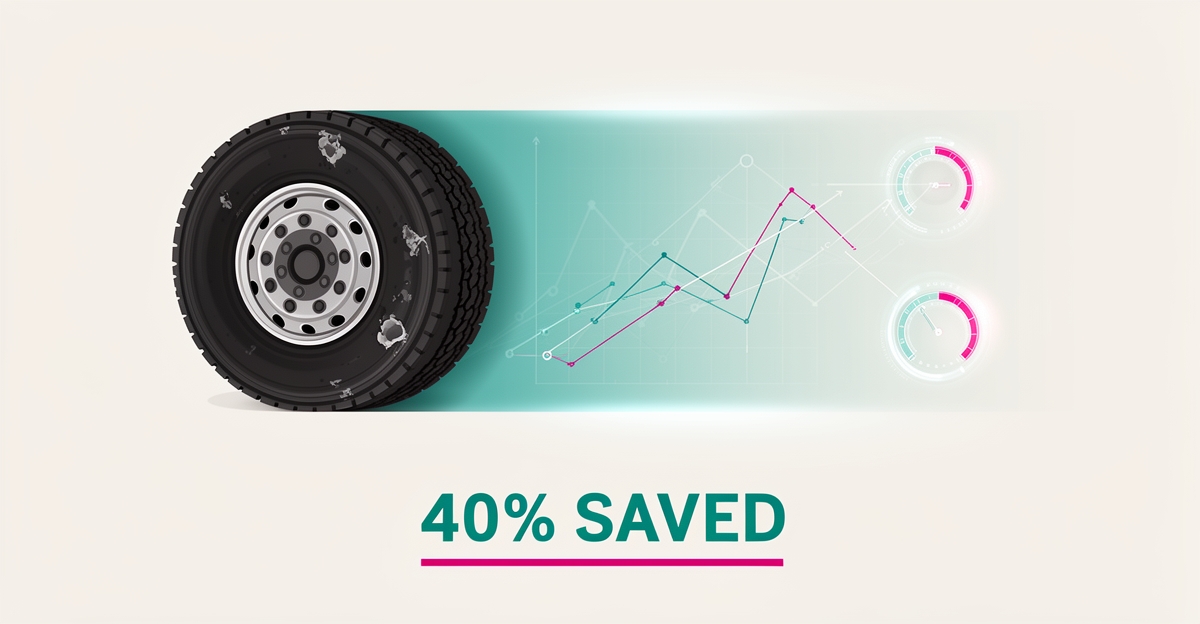
The economics of tire management shifted the moment this fleet operation moved from reacting to failures to predicting them. AI-driven software transformation replaced paper-based logs with predictive models that forecast wear patterns, seasonal demand spikes, and optimal replacement windows across hundreds of vehicles. The result was a reported 40% reduction in tire replacement costs — not through cheaper rubber, but through eliminating premature swaps, emergency roadside calls, and the inventory bloat that comes from guessing.
Reactive maintenance carries hidden penalties that compound across a fleet. Emergency replacements typically cost several times more than scheduled service once you factor in tow fees, downtime, and premium pricing from last-minute suppliers. AI-powered forecasting turns those surprises into planned events by analyzing historical wear data, route profiles, load weights, and even weather patterns to predict when each tire approaches its safety threshold. Procurement shifts from spot buying to volume agreements. Technicians move from firefighting to scheduled rotations.
- Predictive wear modeling replaces fixed-mileage schedules with condition-based triggers
- Demand forecasting aligns inventory turns with actual consumption patterns
- Automated reorder points prevent both stockouts and overstock carrying costs
- Route-specific optimization accounts for terrain, climate, and load variance
The transformation didn't happen in isolation. An integration layer connected telematics, ERP, and supplier APIs into a single decision engine. Staff training ensured technicians trusted the alerts instead of second-guessing them. Ongoing optimization refined the models as new tire compounds and route changes entered the data stream. What began as a cost-cutting initiative became a controlled operational expense with predictable budgeting — the kind that shows up on a P&L as a managed line item rather than a recurring surprise.
The Transformation Roadmap: From Assessment to Ongoing Optimization
The fleet tire company began its transformation with a thorough discovery phase, analyzing maintenance workflows, inventory practices, and data availability to identify where AI could deliver the greatest impact. This initial assessment revealed that reactive tire replacements were driving unnecessary costs due to poor forecasting and siloed operational data. By mapping current processes and aligning them with business objectives, AIQ Labs established a clear roadmap prioritizing high-value automation targets across maintenance planning and inventory management.
In the development phase, custom AI models were built to analyze historical tire wear patterns, seasonal demand fluctuations, and vehicle usage data, enabling predictive maintenance alerts and optimized reorder points. These models were integrated directly into the company's existing ERP and scheduling systems through deep two-way API connections, creating a unified operational workflow. Rigorous testing and validation confirmed the system could forecast tire needs reliably while sharply reducing manual data entry each week.
Deployment focused on change management and user enablement, with role-specific training programs designed to build confidence in the new AI-driven processes. Technicians received hands-on guidance on interpreting predictive alerts, while inventory staff learned to trust automated reorder recommendations. Documentation and performance monitoring were established from day one, allowing the team to track improvements in real time and provide feedback for refinement. This structured adoption approach minimized disruption and accelerated user buy-in across shifts and locations.
The optimization phase established governance frameworks for ongoing model retraining, data quality control, and continuous improvement, ensuring the AI system evolved with changing operational demands. Regular performance reviews tracked key metrics like forecast accuracy and stockout reduction, while feedback loops enabled incremental enhancements to the AI agents. Over time, this capability compounded value — shifting the business from reactive repairs to proactive tire management, directly contributing to the reported 40% reduction in replacement costs. As the system scaled, the company gained the agility to adapt to market shifts and expand AI use into adjacent workflows, sustaining long-term efficiency gains. For businesses ready to follow a similar path, AIQ Labs offers a phased AI Workflow Build or a full AI Operating System — start with the two-minute Fit Check at https://aiqlabs.ai/apply, then schedule a free 30-minute strategy call at https://aiqlabs.ai/book to assess your automation opportunities.
What This Means for Your Fleet Operation
The reported 40% cut in tire replacement costs didn't come from buying better tires. It came from replacing paper-based tracking and reactive repairs with AI-driven maintenance planning and inventory forecasting that turns data into proactive decisions.
Fleet managers evaluating AI need clear readiness signals before committing budget. A good first test is whether critical workflows are documented, data is digitized enough to train models, and staff can articulate the cost of delay. AI-driven software transformation works best when current processes are mapped and teams are guided through change, not when tools are layered on chaos.
ROI thresholds should focus on cycle compression, not feature lists. AI adoption across development and operations teams is now broad and daily, and organizations embedding AI across workflows commonly report meaningful reductions in project time. Fleet operations see similar leverage when maintenance intervals and tire inventory are predicted rather than guessed.
Choosing the right scope protects budget and momentum. Readiness signals help decide between a targeted fix, department automation, or a full operating system:
- Data availability: Can you access telematics, service history, and inventory logs in structured form?
- Pain concentration: Is one workflow driving most cost, or are delays systemic across maintenance, purchasing, and dispatch?
- Change capacity: Does the team have bandwidth for training and process adoption, or do you need managed AI employees to run alongside staff?
- Integration complexity: Are systems disconnected with manual re-entry, requiring custom integration to create a single source of truth?
A targeted AI Workflow Build makes sense when a single broken process, like tire inspection logging, creates cascading cost. Department-level automation fits when maintenance, procurement, and inventory operate as a loop that needs unified forecasting and scheduling. A full AI Operating System is warranted when leadership wants an owned operating layer that embeds intelligence across the fleet — built in phases and owned outright, not rented point solutions.
AIQ Labs approaches this with three entry points — managed AI Employees, fixed-price AI Workflow Builds, and phased AI Operating Systems — with payment models that let you start monthly, build in milestones, or own the system outright. The case study shows how moving from reactive repairs to proactive management requires careful planning, strategic alignment, and a clear understanding of applications and limitations, not just model deployment.
Fleet managers who start with objectives, assess knowledge and experience, and apply learning through real-world projects are more likely to scale pilots into durable advantage.
Still paying for 10+ subscriptions that don’t talk to each other?
We build custom AI systems you own outright. No vendor lock-in. Full control.
Not sure where to start? Ask our AI planner
Frequently Asked Questions
How did a fleet tire company actually cut replacement costs by 40% without buying cheaper tires?
What hidden costs come from reactive tire management that most fleets don't see on their P&L?
Is our fleet operation ready for AI-driven tire management, or do we need perfect data first?
How long does it take to go from paper-based tracking to a working AI system that reduces tire costs?
Will our technicians actually trust and use AI-generated maintenance alerts, or will they keep second-guessing the system?
What's the difference between a targeted AI workflow build and a full AI operating system for fleet operations?
From Reactive Repairs to Predictable Profitability
The reported 40% reduction in tire replacement costs achieved by this fleet operation didn't come from cheaper rubber — it came from replacing guesswork with intelligence. By moving from paper-based tracking to AI-driven forecasting, the business eliminated emergency premiums, optimized inventory turns, and turned tire management from a recurring surprise into a controlled line item. The transformation followed a clear arc: discovery to identify hidden waste, custom model development tied to real operational data, phased deployment with hands-on training, and ongoing governance that keeps predictions accurate as conditions change. For fleet managers facing similar pressure, the readiness signals are straightforward: structured telematics and service history, a concentrated pain point in maintenance or procurement, and bandwidth for process adoption. Whether the next step is a targeted workflow build, managed AI employees, or a full AI operating system, the path starts with mapping what's actually happening today. AIQ Labs helps businesses run that assessment through a two-minute Fit Check at https://aiqlabs.ai/apply, followed by a free 30-minute strategy call to size the opportunity — no obligation, just clarity on where AI can deliver measurable return.
Make AI your competitive advantage — not just another tool.
Strategy, implementation and ongoing optimization. One partner, end to end.
Not sure where to start? Ask our AI planner