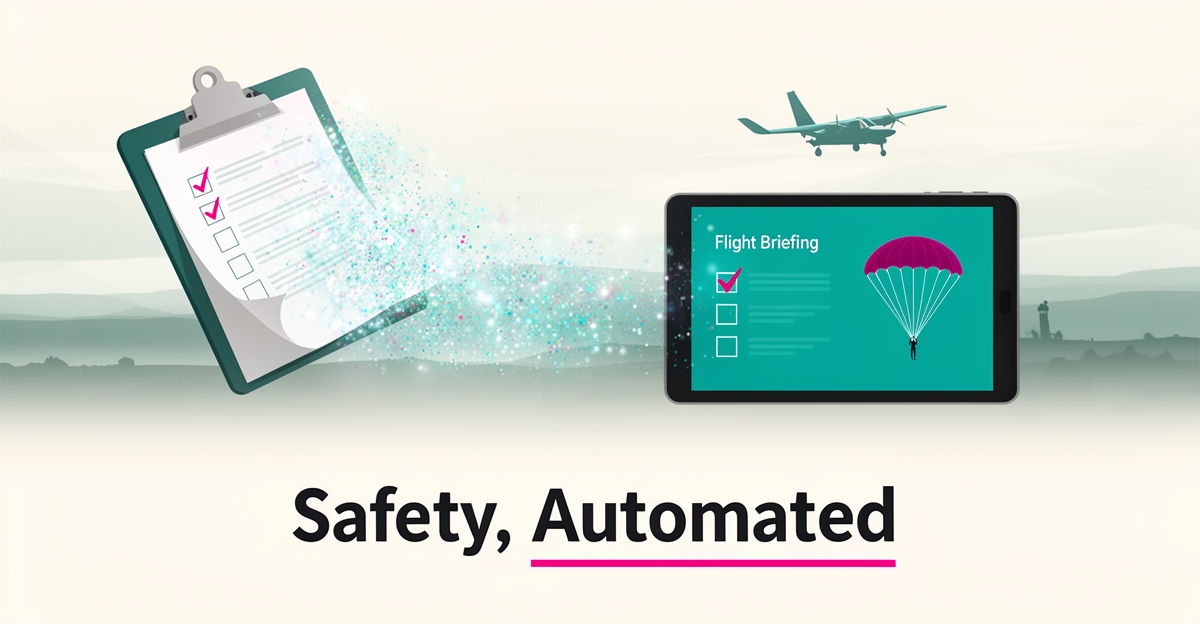
From Paper Checklists to AI: Modernizing Safety & Pre-Flight Briefings
Key Facts
- Digital pre-flight inspection workflows are widely reported to improve accuracy and reduce errors compared with paper processes
- AI-guided checklists are typically rated more satisfying to use than manual paper forms in safety-critical settings
- AI-powered automation can validate user profiles in real time and flag inconsistencies before jumpers board the aircraft
- AI systems create timestamped, tamper-resistant audit trails for every briefing and validation step
- Predictive maintenance approaches are commonly associated with less unplanned downtime and lower maintenance costs in aviation-adjacent operations
Hire a team member that works 24/7 — for less than a part-time wage.
AI receptionists, SDRs, dispatchers and 99+ roles. Trained on your business, fully managed.
Not sure where to start? Ask our AI planner
Why Paper Checklists Are Failing Skydiving Operations
Paper checklists create a bottleneck that skydiving operations feel every jump day. The manual handoff between staff, students, and gear checks adds friction, fatigue, and risk at the exact moment precision matters most.
Manual paperwork forces repetitive pre-flight briefings that consume staff time and attention. Teams read the same safety points, hand-write names and signatures, and re-check the same items, which increases the chance of missed steps. Industry comparisons of industrial safety consistently show paper-based processes struggle to match digital alternatives on accuracy and error reduction.
The cost shows up as downtime and compliance gaps. Manual logs are hard to audit in real time, corrections are illegible, and version control is weak. Aviation safety work on digital pre-flight inspection workflows highlights how paper creates administrative burden and limits real-time validation and alerts.
Staff workload compounds the problem. Instructors repeat briefings for every load, while manifest staff transcribe information across multiple sheets. This repetition drives fatigue and reduces capacity for genuine risk assessment. Analyses of safety culture and AI tools note that manual forms increase administrative burden while digital checklists increase efficiency.
The operational drag from manual methods is well documented in safety-critical industries: predictive maintenance approaches are commonly associated with less unplanned downtime, lower maintenance costs, and fewer labor hours spent on routine checks.
These patterns illustrate how manual processes tie up labor and create avoidable interruptions. Paper also limits compliance visibility. Without real-time capture, centers cannot flag inconsistencies between user profiles, gear assignments, and jump experience levels during briefing.
Error-prone transcription is a core failure mode. Handwritten entries lead to misread signatures, skipped boxes, and lost forms. That erodes audit trails when regulators ask for proof of briefing completion and equipment checks.
Adoption friction is another hidden cost. Staff accustomed to clipboards resist change, and centers hesitate to integrate new tools with existing operations. Guides to smart safety checklists note recurring challenges around user acceptance and integrating with existing systems and processes.
Many skydiving centers still rely on manual checklists and paperwork for daily operations. AI document processing and workflow automation offer a path to automate safety briefings, validate user profiles, and flag inconsistencies while reducing staff workload. AIQ Labs' Workflow Builds rebuild the one workflow that costs you the most—fixed price, delivered in phases—making it a natural fit for these manual pain points.
The result is a system where briefings are consistent, records are complete, and staff focus shifts from paperwork to people.
How AI Automates Briefings, Validation, and Compliance
AI-powered automation is changing how skydiving centers handle safety briefings and compliance, moving beyond static paper checklists to dynamic, intelligent systems. By integrating AI into pre-flight processes, operators can validate user profiles in real time, flag inconsistencies before they become risks, and ensure every step meets regulatory standards without manual oversight. This shift enhances accuracy and reduces the administrative burden on staff, allowing them to focus on higher-value tasks like customer engagement and emergency preparedness.
Digital checklists powered by AI are typically rated more satisfying to use than manual paper forms in safety-critical applications. These systems provide real-time validation and alerts, instantly identifying missing or incorrect information—such as expired certifications or mismatched equipment logs—before a jumper boards the aircraft. AI-driven inspection tools also strengthen compliance by generating immutable audit trails, automatically logging every validation action for regulatory review and internal quality assurance.
- Automated profile validation reduces manual data entry errors by cross-referencing user inputs with licensing databases and equipment records
- Real-time inconsistency flagging alerts staff to discrepancies like weight limits mismatched with gear ratings or outdated medical waivers
- Audit trails created by AI systems provide timestamped, tamper-resistant records of every briefing and validation step
- Staff workload decreases as AI handles routine checks, freeing personnel to focus on interpersonal briefings and emergency drills
AIQ Labs applies this same intelligent automation to skydiving operations, building custom systems that integrate with existing waiver platforms, gear tracking software, and scheduling tools. Rather than replacing human judgment, AI augments it—handling repetitive validation tasks while surfacing critical insights for instructors and safety officers. For centers that want a full connected layer across manifest, waivers, gear, and scheduling, AI Operating Systems build one operating layer in phases that you own outright. The result is a safer, more efficient briefing process that scales with demand, maintains rigorous compliance, and improves the experience for both staff and jumpers.
Building a Modern Safety System That Integrates With Your Operations
Skydiving centers can transform safety operations by moving beyond paper checklists to integrated digital systems. This shift starts with adopting digital checklists that improve accuracy and reduce errors while cutting administrative burden. In safety-critical applications, these tools are consistently rated easier to use than manual paper forms, directly improving the experience of pre-flight briefings.
Digital pre-flight inspection workflows enable real-time validation and alerts, ensuring compliance while reducing staff workload. By automating routine checks, centers free up instructors to focus on participant engagement and risk assessment rather than paperwork.
Implementing AI-powered inspection tools adds another layer of safety through real-time defect detection and predictive maintenance capabilities. These systems improve accuracy and reduce errors while strengthening compliance and audit trails. Combined with predictive maintenance approaches, centers typically see fewer unplanned interruptions and lower maintenance costs, keeping aircraft operational and safe.
Successful integration requires addressing user adoption and acceptance through targeted training and clear communication of benefits. Centers should also prioritize data quality and accuracy while integrating new tools with existing scheduling, customer management, and operational systems. AIQ Labs supports this transition by building systems that skydiving centers own outright—no vendor lock-in, no monthly ransom for your own safety records. The result is a modern safety system that delivers measurable efficiency gains while maintaining the highest standards of participant safety.
Implementation Playbook for Skydiving Centers
Skydiving centers can transition from paper checklists to AI-powered briefings without disrupting daily operations by following a structured, phased approach. Start by assessing current workflows to identify repetitive tasks like profile validation and equipment checks that consume staff time and risk human error. AIQ Labs begins with a two-minute Fit Check followed by a free 30-minute strategy call to map existing systems, data flows, and team capabilities, ensuring the solution aligns with operational realities. This foundation allows centers to pilot digital briefings in a low-risk environment—such as tandem jump orientations—before scaling to solo or advanced training programs.
Piloting digital briefings delivers visible improvements early in the process. AI-guided checklists are typically rated easier and more satisfying to use than manual paper forms, while real-time validation and alerts reduce administrative burden. During the pilot phase, AIQ Labs' Build in Milestones model lets centers implement one workflow at a time—like automated waiver verification or gear inspection prompts—approving and paying for each phase as it ships. This approach minimizes disruption, keeps staff engaged, and builds confidence in the system's reliability before expanding to broader use cases.
Successful integration requires connecting AI tools with existing scheduling, payment, and customer management platforms without overhauling current operations. AIQ Labs uses deep two-way API integrations to synchronize data across tools like waiver platforms, scheduling apps, or custom databases, creating a single source of truth for participant profiles and safety compliance. Addressing data security and privacy is critical; well-built systems implement validation layers, guardrails, and audit trails to protect sensitive information while meeting aviation-adjacent regulatory expectations. Finally, driving adoption involves customized training and feedback loops that position AI as a workload reducer—not a replacement—ensuring staff embrace the technology as a force multiplier for safety and efficiency. For routine briefing and validation work, AI Employees can also handle repetitive administrative roles at a fraction of the cost of a human hire.
Still paying for 10+ subscriptions that don’t talk to each other?
We build custom AI systems you own outright. No vendor lock-in. Full control.
Not sure where to start? Ask our AI planner
Frequently Asked Questions
Do paper checklists really cause more mistakes in skydiving operations?
How much time and money can AI actually save for a drop zone?
Will jumpers and staff actually like digital briefings better than paper?
Can AI briefings integrate with the waiver and gear tracking tools we already use?
What if my team resists moving away from clipboards?
Does AI replace instructors or just handle the paperwork?
Where Safety Meets Simplicity
Skydiving centers stuck with paper checklists are paying a hidden price: staff fatigue, compliance risks, and missed opportunities to focus on what truly matters—people. AI doesn't replace the human touch in briefings; it removes the repetitive validation work that steals time from real safety conversations. By automating profile checks, flagging inconsistencies in real time, and building tamper-proof audit trails, centers gain measurable efficiency while strengthening compliance and jumper satisfaction. The path forward isn't about overhauling everything at once—it's about starting small, proving value, and scaling with confidence. Ready to see where your biggest bottleneck lives? Start with the two-minute Fit Check, then book a free 30-minute strategy call to map your automation opportunities with zero obligation.
Make AI your competitive advantage — not just another tool.
Strategy, implementation and ongoing optimization. One partner, end to end.
Not sure where to start? Ask our AI planner