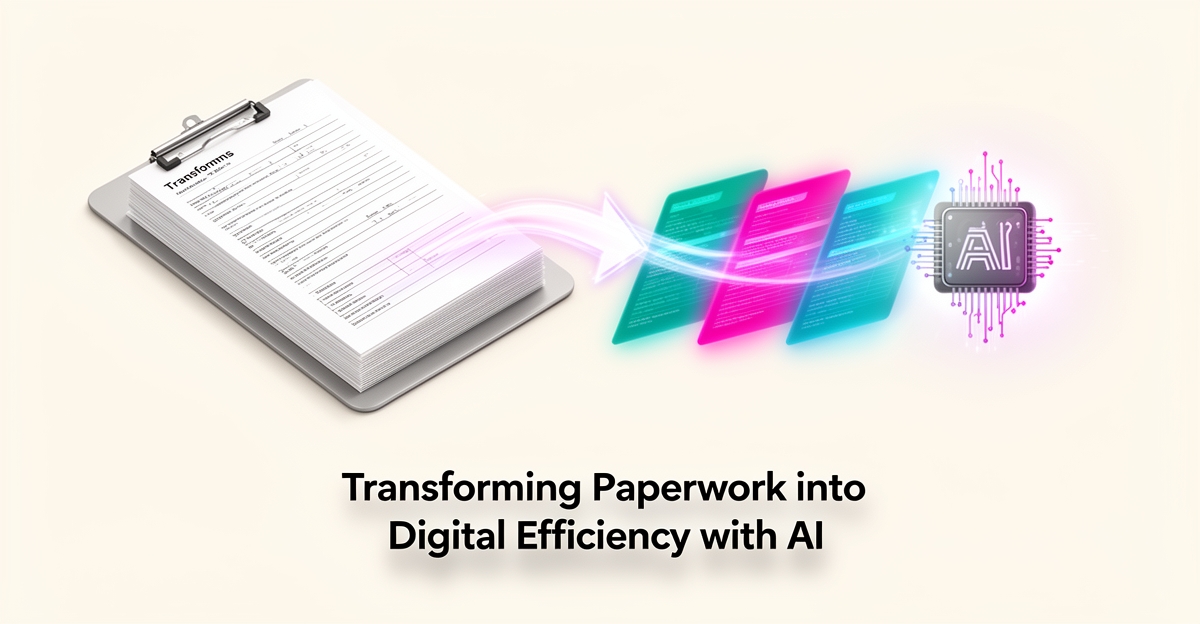
From Paper Forms to AI: Modernizing Client Job Intake for Coating Services
Key Facts
- Administrative staff commonly spend 15+ minutes per intake form on manual data entry according to form digitization research
- Paper forms show a far higher error-of-omission rate than digital forms in manual re-typing per digital forms research
- Knowledge workers can spend up to 40% of their time on manual data entry tasks per form digitization analysis
- AI-driven document processing can boost processing speed by 80-90% according to document processing analysis
- AI solutions typically deliver very high accuracy (often cited above 99%) for structured documents per evolving document processing research
- Organizations adopting AI document processing commonly report strong ROI within the first 18 months per enterprise adoption data
Hire a team member that works 24/7 — for less than a part-time wage.
AI receptionists, SDRs, dispatchers and 99+ roles. Trained on your business, fully managed.
Not sure where to start? Ask our AI planner
The Hidden Cost of Paper Forms in Ceramic Coating Intake
Despite the push toward digital workflows, paper forms remain deeply embedded in ceramic coating intake processes due to real-world accessibility needs. Many clients—particularly in field service contexts—lack reliable internet access, smartphone proficiency, or simply prefer tangible documentation they can review and sign physically. This persistence creates operational friction: administrative staff commonly spend 15+ minutes per intake form manually entering data, a task that can consume up to 40% of knowledge workers' time on manual entry alone. The result is not just delayed scheduling but a systemic drain on productivity that scales with every job request received.
The hidden cost intensifies when considering error rates. Paper forms show a far higher omission rate during manual re-typing than digital alternatives, meaning critical job details—like vehicle specifications or coating package selections—are frequently lost or misrecorded. These inaccuracies trigger costly rework, client follow-ups, and scheduling delays that erode trust and increase administrative overhead. For coating installers managing high-volume intake, these small inefficiencies compound into significant bottlenecks that prevent teams from focusing on core service delivery.
AI-powered document processing resolves this tension by preserving paper accessibility while eliminating its inefficiencies. By instantly converting scanned or photographed forms into structured data—typically with very high accuracy on structured documents—these systems remove the re-typing step that makes paper costly. Clients retain their preferred submission method, whether via email attachment, photo upload, or physical drop-off, while businesses gain immediate access to clean, actionable data for scheduling, estimation, and workflow automation. This hybrid approach ensures no client is excluded due to technological barriers, yet eliminates the manual labor that slows operations and inflates costs. The outcome is faster response times, fewer errors, and a smoother path from job request to service delivery—without forcing either party into an unsuitable workflow. For ceramic coating businesses seeking to modernize intake without sacrificing accessibility, this balance isn't just ideal—it's essential.
AI Document Processing: Bridging Paper and Digital Workflows
Paper forms still arrive on the counter, but the re-typing bottleneck does not have to follow them inside the shop. AI-powered document processing extracts structured data from handwritten or printed job requests in seconds, letting ceramic coating installers keep paper-friendly client interactions while running a digital back office.
Modern systems combine advanced optical character recognition with intelligent form recognition that goes far beyond simple text extraction. According to form digitization research, the technology analyzes visual layout to identify form elements, labels, and data entry areas and understands contextual relationships between fields. That means a paper intake sheet becomes immediately usable data without manual transcription.
The performance shift is measurable. Document processing analysis shows processing speed increases of 80-90% with AI-driven solutions, with documents processed in seconds compared to many minutes manually. Accuracy improves dramatically as well, with AI-driven document processing typically exceeding 99% accuracy on structured documents and performing strongly on unstructured content, versus manual data entry accuracy rates that commonly fall in the high-80s to low-90s.
For service businesses, the impact compounds beyond speed. Enterprise adoption data shows organizations deploying AI document processing commonly report strong ROI within the first 18 months. Knowledge workers can spend up to 40% of their time on manual data entry tasks, so eliminating re-typing frees staff for scheduling, estimates, and client follow-up.
A hybrid intake model preserves accessibility while removing friction:
- Accept paper job requests, estimates, and contracts from clients via photo, email, or drop-off
- Extract vehicle details, service type, contact info, and preferred dates in seconds per page
- Route structured data directly to scheduling and estimation systems with validation rules applied
- Flag illegible fields or exceptions for human review instead of full re-entry
This approach is why AI document processing sits at the core of modern service workflows. AIQ Labs builds these systems for coating services through AI Workflow Builds—rebuilding the one workflow that costs you the most, at a fixed price and in phases—digitizing job requests and intake forms to improve accuracy, reduce delays, and enable faster scheduling within existing paper-based client habits. The goal is not to kill paper, it is to kill the re-typing step that makes paper data expensive.
Implementing AI Job Intake: A Practical Roadmap for Coating Installers
The gap between deciding to modernize intake and actually running an AI-driven system comes down to execution. Ceramic coating installers who follow a structured roadmap can move from paper forms and re-typed job data to automated processing in a matter of weeks — and the payoff is measurable from day one.
Start by auditing your current workflow. Map every step a job request takes today: how the form arrives, who re-enters the data, where it lands in your scheduling system, and where delays or transcription errors occur. This matters because the bottleneck is often bigger than owners realize — knowledge workers can spend up to 40% of their time on manual data entry tasks, with form processing being one of the biggest culprits. Note which clients genuinely need paper, since your solution must accommodate them rather than eliminate them.
Select technology that handles your real-world forms. Your intake documents include handwritten vehicle condition notes, printed estimates, and photos of check-in sheets. The right AI processing solution reads both printed and handwritten text, understands layout — checkboxes, tables, signature fields — and outputs structured data your scheduling and estimation tools can consume. Modern systems go well beyond basic OCR, applying field-type validation and handling multi-page forms with conditional logic.
Configure validation rules around your business logic. This is where generic tools fail coating installers. Your system should:
- Enforce required fields for estimates — vehicle year, make, model, paint condition, and selected coating package
- Validate contact details like phone formats and email addresses before data reaches your scheduler
- Apply conditional logic, so a ceramic coating job request prompts different questions than a paint protection film inquiry
- Flag illegible handwriting or incomplete forms for human review instead of pushing bad data downstream
Measure the right metrics after launch. Track processing time per form, accuracy versus manual entry, and how quickly clients receive scheduling confirmation. The benchmarks are compelling: organizations implementing AI-driven document processing commonly see 80-90% improvements in processing speed, with documents that took many minutes handled in seconds. Accuracy also jumps dramatically — AI extraction typically exceeds 99% on structured documents, compared to manual data entry accuracy rates that often sit in the high-80s to low-90s. That difference directly reduces scheduling errors and callback friction with clients.
For shops that want a single broken workflow fixed — say, estimate intake alone — a targeted Workflow Build can deliver results in weeks at a fixed price. Businesses ready to automate the full intake-to-scheduling pipeline may be better served by a broader AI Operating System, built in phases and owned outright. Either way, the implementation typically follows a phased path: discovery and architecture, development and integration with your existing tools, deployment with staff training, then ongoing optimization.
One final consideration: keep humans in the loop. Even at very high accuracy, edge cases — a smudged signature, an unusual form layout — deserve a quick review. Configure escalation rules so exceptions reach a person, and your intake system will run fast without sacrificing trust.
Ready to see what this looks like for your shop? Take the two-minute Fit Check at aiqlabs.ai/apply, then book a free 30-minute strategy call at aiqlabs.ai/book to map your intake bottleneck and identify the highest-ROI automation opportunity. If there isn't a clear win, we'll tell you that too.
Still paying for 10+ subscriptions that don’t talk to each other?
We build custom AI systems you own outright. No vendor lock-in. Full control.
Not sure where to start? Ask our AI planner
Frequently Asked Questions
How much time do administrative staff typically spend on manual data entry for job intake forms?
What is the error rate when manually re-typing data from paper forms compared to digital alternatives?
How does AI document processing improve the speed and accuracy of handling paper job intake forms?
Can ceramic coating businesses still accept paper forms from clients while using AI to process them?
What kind of ROI do organizations typically see from implementing AI document processing?
What should ceramic coating installers look for when selecting an AI document processing solution for their intake forms?
Turning Paper into Progress: Your Path to Smarter Intake
The hidden cost of paper forms isn't just in the time spent re-typing—it's in the delayed jobs, frustrated clients, and missed opportunities that add up every day. By embracing AI-powered document processing, ceramic coating installers can keep the accessibility clients rely on while eliminating the manual bottlenecks that slow them down. The result? Faster scheduling, fewer errors, and teams free to focus on what they do best: delivering flawless finishes. If you're ready to see how this works in your shop, start with a two-minute Fit Check at aiqlabs.ai/apply to map your intake bottleneck, then book a free 30-minute strategy call at aiqlabs.ai/book to explore the highest-ROI automation opportunity—no obligation, just clarity on your path forward.
Make AI your competitive advantage — not just another tool.
Strategy, implementation and ongoing optimization. One partner, end to end.
Not sure where to start? Ask our AI planner