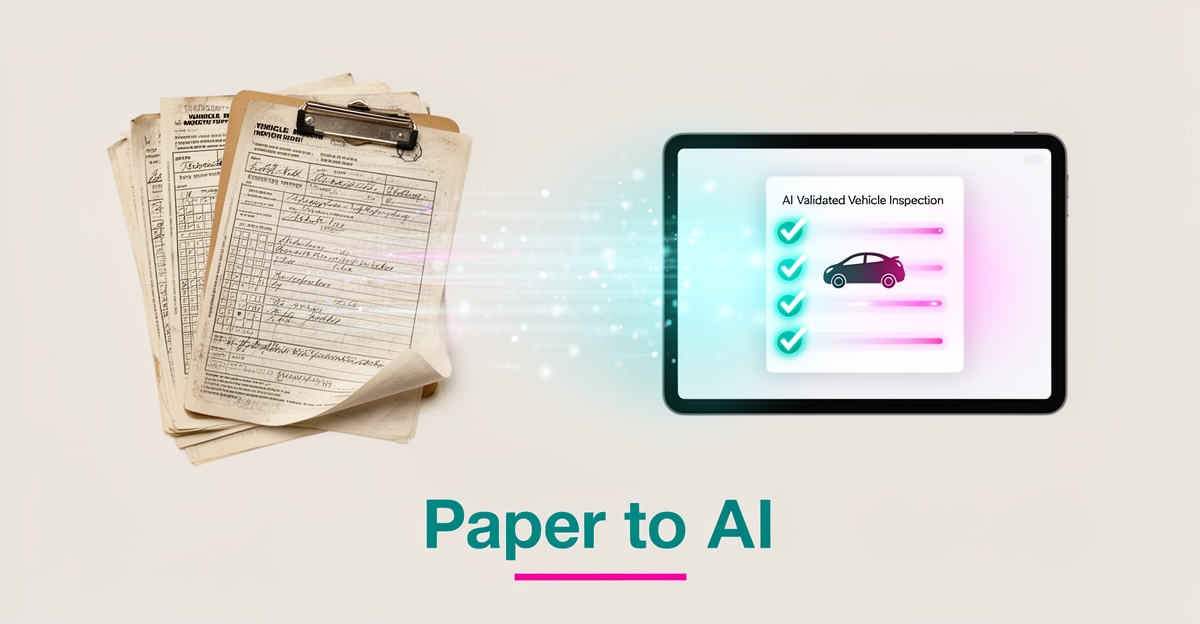
From Paper Forms to AI: Modernizing Vehicle Inspection Documentation
Key Facts
- Many document-heavy teams still operate with only partial automation, leaving inspection data trapped in manual workflows.
- AI agents have moved from experimental tools to standard infrastructure for business automation as of 2026.
- AI-powered inspection systems reduce manual data entry errors by auto-filling fields from photos and handwritten forms.
- Automated validation catches missing safety checks and out-of-range values before inspection reports are finalized.
- Image recognition AI automatically tags vehicle damage and defects to the correct inspection sections.
- Digital inspection records enable real-time access across departments instead of paper files trapped in trucks.
Hire a team member that works 24/7 — for less than a part-time wage.
AI receptionists, SDRs, dispatchers and 99+ roles. Trained on your business, fully managed.
Not sure where to start? Ask our AI planner
The Hidden Cost of Paper Inspection Forms
Paper inspection forms feel familiar, but familiarity masks a growing operational drag. Every handwritten checklist, lost folder, and retyped report adds friction that compounds across fleets, shops, and compliance audits.
Manual data entry errors remain a core risk. Inspectors transcribe measurements, photos, and notes by hand, then staff re-enter them into systems. The delay creates compliance gaps and makes real-time access impossible. Document-heavy teams across industries commonly still run on partial automation, and inspection-driven businesses are no exception.
Lost or delayed forms translate directly into missed service windows and audit exposure. A paper record sitting in a truck cannot be searched, validated, or shared instantly with service, compliance, or finance teams. That fragmentation forces duplicate work and slows decision-making when vehicle history matters most.
The cost is not only administrative. Without structured capture, inspection data cannot feed predictive maintenance or fleet performance analytics. Teams operate on memory and spreadsheets instead of data-driven insights, limiting scalability as volume grows.
AI agents have become table stakes for business automation and scaling as of 2026. Consumer and business adoption of AI-powered document scanning and management tools has grown into the tens of millions of users, a signal that digitized paperwork is now the norm rather than the exception.
For inspection documentation, digitization means more than scanning PDFs. It requires auto-fill, validation, and secure storage that preserves context and compliance. AI extraction can transform forms into structured data at capture, reducing manual touchpoints while keeping records auditable.
The hidden costs of paper show up repeatedly:
- Manual transcription errors that require rework and create liability
- Lost or misfiled forms that delay compliance reporting
- Delayed access to records across departments and locations
- Inconsistent formatting that blocks analytics and reporting
Modernizing inspection forms with AI addresses these points by auto-filling fields from images and notes, validating entries against rules, and storing data securely for real-time access. AIQ Labs builds custom AI systems—through AI Workflow Builds and broader AI Operating Systems—that ensure compliance, reduce data loss, and provide real-time access to inspection records across departments.
When capture is automated and validated at source, inspectors focus on high-value assessments instead of paperwork. That improved accuracy and consistency reduces rework and strengthens audit readiness. The result is faster reporting, fewer errors, and inspection data that can actually be used.
What AI Actually Does to an Inspection Workflow
Paper forms create bottlenecks that inspectors feel every day. AI changes the workflow by moving repetitive documentation out of the inspector’s hands and into automated systems that capture, validate, and store data in real time.
Automated data entry removes the manual transcription step that drives errors. AI reads handwritten notes, checklists, and VINs from photos or forms and maps them to structured fields without retyping. This shifts inspectors from paperwork to high-value inspection work while improving accuracy and consistency across teams.
Image recognition brings visual evidence into the record automatically. AI models identify damage, defects, wear patterns, and missing components from inspection photos and tag them to the correct vehicle section—the same class of AI-powered image recognition now common in digital asset and fleet management platforms.
Auto-validation enforces completeness and compliance before a report is finalized. The system checks required fields, flags out-of-range values, and cross-references prior inspections to prevent missing data. Given how many teams still run on partial automation, manual validation remains one of the biggest gaps in inspection-adjacent processes.
Instant report generation closes the loop for customers and departments. Once data is captured and validated, AI assembles a formatted inspection report with photos, findings, and recommendations in seconds. This is the step-by-step digitization of inspection forms—auto-fill, validate, and store data securely—that AIQ Labs builds as a fixed-price AI Workflow Build.
The capabilities that change the workflow include:
- Automated data entry from forms, photos, and voice notes with AI extraction
- Image recognition for damage and defect capture with automatic tagging
- Auto-validation of form fields for completeness, range checks, and compliance
- Instant report generation with real-time access across departments
Adoption is accelerating because AI agents are now table stakes for business automation and scaling. The market signal is reinforced by consumer adoption, with tens of millions of users relying on AI-powered document scanning and management apps.
The net effect is fewer manual errors, faster turnaround, and consistent records that can be accessed securely in real time. Inspectors focus on judgment and condition assessment while AI handles capture, validation, and storage.
From Scanned Paper to a Single Source of Truth
The shift from paper-based vehicle inspections to digital workflows starts with capturing physical forms and transforming them into reliable, actionable data. Many teams across industries still operate with partial automation, and for vehicle inspection documentation this often means scanned paper forms sitting in folders or email threads—silos that slow down decision-making and increase the risk of errors. Digitizing these records is the first step toward establishing a single source of truth—where every inspection record is consistently captured, enriched, and accessible across teams.
Once paper forms are scanned, AI-powered extraction tools convert handwritten or typed entries into structured data, automatically populating fields like VIN, mileage, defect codes, and inspector notes. This reduces manual data entry—a task known to consume significant time and introduce inaccuracies—while enabling real-time validation against business rules or regulatory standards. Systems can flag inconsistencies, such as mismatched odometer readings or missing safety checks, triggering alerts for review before data is finalized. These validation layers ensure data quality from the outset, addressing one of the top challenges in modernizing inspection workflows: maintaining accuracy at scale.
To support seamless operations, the digitized data integrates directly with existing platforms such as maintenance schedulers, repair estimators, or compliance trackers through secure APIs, eliminating the need for duplicate entry or manual handoffs. Audit trails are automatically generated, recording every change, approval, and access event—critical for meeting regulatory requirements in transportation and fleet management. All records are stored in encrypted, access-controlled environments with role-based permissions, ensuring cybersecurity and data protection without sacrificing availability. Authorized personnel in safety, operations, finance, or compliance can retrieve inspection histories instantly, enabling faster responses to incidents, better trend analysis, and informed maintenance planning. This end-to-end pipeline turns paper forms into a trusted, real-time asset that supports both daily operations and long-term strategic decisions.
A Step-by-Step Path to AI-Powered Inspection Records
Transitioning from paper forms to AI-powered inspection records requires a structured approach that minimizes disruption while maximizing long-term value. The first step is auditing current forms and workflows to identify manual bottlenecks, data duplication, and compliance gaps—common inefficiencies in document-heavy processes. This assessment clarifies which data fields can be auto-extracted, where validation rules are needed, and how AI can reduce manual errors without overhauling existing operations.
Next, deploy AI extraction and validation tools tailored to vehicle inspection specifics—such as VIN recognition, damage assessment tagging, and mileage verification—using models trained on real inspection documentation. Unlike generic tools, custom-built systems owned outright ensure these algorithms adapt to your unique forms, retain full data sovereignty, and avoid vendor lock-in. Integration with existing business systems follows, connecting AI outputs to CRM, maintenance logs, or inventory platforms via secure APIs so inspection data flows automatically into service histories, warranty claims, or resale workflows—eliminating re-entry and reducing delays.
Training inspectors comes next, focusing not on tool operation but on interpreting AI-generated insights and handling exceptions—building trust through transparency in how data is captured and validated. Finally, establish continuous monitoring to track accuracy rates, processing time, and user feedback, refining models over time as inspection patterns evolve. By owning the AI system end-to-end, businesses de-risk the transition: they control updates, ensure regulatory alignment, and scale capabilities without recurring subscription costs or dependency on third-party roadmaps—turning inspection documentation from a cost center into a source of real-time operational intelligence. AIQ Labs builds in milestones with fixed pricing and hands the system over to own outright, so there is no lock-in. For businesses ready to begin, start with the two-minute Fit Check leading to a free 30-minute strategy call.
Why Waiting Costs More Than Acting Now
Waiting to modernize your vehicle inspection documentation means missing the window where competitive advantage is being built today. AI agents have already shifted from experimental tools to essential infrastructure for business automation and scaling—by 2026, they are table stakes, not a future bet. Meanwhile, many teams still operate with partial automation, a readiness gap that early adopters are already closing.
Delaying action increases exposure to avoidable costs: manual data entry errors, compliance risks from inconsistent records, and lost productivity from siloed paper workflows. AI-powered inspection systems eliminate these bottlenecks by auto-filling fields, validating data in real time, and securely storing records for instant cross-departmental access—turning documentation from a liability into a strategic asset. The efficiency gains are not incremental; AI-driven document tools have already been adopted at massive scale, proving both scalability and user trust.
For vehicle inspection providers, this shift means faster turnaround times, fewer disputes over record accuracy, and stronger audit readiness—all while reducing reliance on error-prone manual processes. AIQ Labs helps SMBs in automotive services and related fields implement custom AI systems that digitize inspection forms end-to-end, ensuring compliance, minimizing data loss, and enabling real-time insights across teams—with 200+ multi-agent systems deployed to date. The window to act isn’t next quarter—it’s now, before the cost of waiting outweighs the investment in transformation.
Map your highest-ROI automation opportunity in a free strategy call. Start with the two-minute Fit Check at https://aiqlabs.ai/apply, then schedule your no-obligation session to identify where AI delivers immediate impact—whether it’s inspection documentation, workflow automation, or another high-leverage area. If there isn’t a clear win, we’ll tell you that too. This is a working session with an AI engineer, not a sales pitch. Take the first step today: https://aiqlabs.ai/book.
Turning Inspection Data into Your Competitive Edge
Modernizing vehicle inspection documentation with AI isn’t just about replacing paper—it’s about transforming a cost center into a source of real-time operational intelligence. By automating data entry, validating records instantly, and enabling secure, cross-departmental access, businesses eliminate errors, accelerate reporting, and unlock insights that drive smarter maintenance and compliance decisions. The shift from fragmented paper trails to a single source of truth means inspectors spend less time on paperwork and more on high-value assessments, while teams gain the consistency and speed needed to scale confidently. For automotive service providers and fleet operators ready to move beyond manual bottlenecks, the next step is clear: map your highest-ROI automation opportunity in a free strategy call. Start with the two-minute Fit Check at https://aiqlabs.ai/apply, then schedule your no-obligation session to see where AI delivers immediate impact—whether it’s inspection documentation, workflow automation, or another high-leverage area. If there isn’t a clear win, we’ll tell you that too.
Make AI your competitive advantage — not just another tool.
Strategy, implementation and ongoing optimization. One partner, end to end.
Not sure where to start? Ask our AI planner