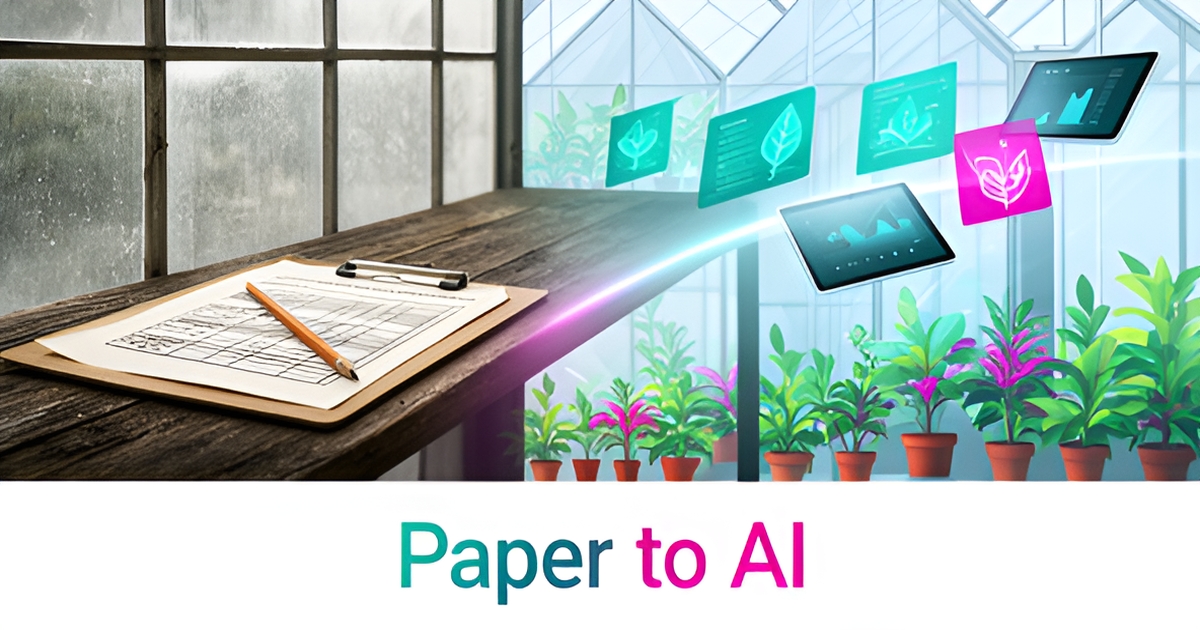
From Paper Logs to AI: How Greenhouse Operations Can Automate Daily Plant Monitoring
Key Facts
- Canada’s agricultural sector will face over 100,000 unfilled jobs by 2030, making AI-driven automation essential for greenhouse survival (Digital Journal, 2026).
- A single autonomous harvester can replace 6 human workers in a 10-hectare greenhouse, operating 22 hours/day for just 2 hours of daily recharging (Forbes, 2026).
- AI detects plant diseases, pests, and nutrient deficiencies up to 48 hours before they’re visible to human inspectors (Lenso.ai, 2026).
- Digital Twin setups for greenhouses now cost in the low thousands—far cheaper than traditional SCADA systems (New Atlas, 2026).
- Greenhouses using AI-powered predictive monitoring report 20–40% less crop loss by catching issues before they spread (Lenso.ai, 2026).
- The Controlled Environment Agriculture (CEA) market hit $103B in 2025 and is projected to double by 2030 (Forbes, 2026).
- AI-driven maintenance systems reduce equipment downtime by 25% by predicting failures before they occur (Automation.com, 2026).
What if you could hire a team member that works 24/7 for $599/month?
AI Receptionists, SDRs, Dispatchers, and 99+ roles. Fully trained. Fully managed. Zero sick days.
Introduction
From Paper Logs to AI: Automating Greenhouse Plant Monitoring
Hook: Imagine transforming your greenhouse from a paper-driven environment to an AI-powered smart farm, where plants are monitored and cared for in real-time, 24/7. This isn't science fiction; it's the future of greenhouse operations.
Bullet Points:
- Labor Shortages: The global agricultural sector faces projections of more than 100,000 vacancies by 2030, driving the need for automation (Digital Journal).
- Economic Pressure: Controlled Environment Agriculture (CEA) consumes approximately 10X more energy than traditional outdoor farming but uses 10X less water per pound of produce, making AI-driven efficiency crucial (Forbes).
- Technological Shift: The industry is moving from brute-force mechanization to "cognition"—using AI and robotics to perceive, classify, and act in complex biological environments (Digital Journal).
- Predictive Monitoring: Modern AI systems detect critical stress factors (pests, diseases, nutrient deficiencies) long before they are visible to the human eye, enabling preventive crop management (Lenso.ai).
Concrete Example: AIQ Labs' client, a mid-sized greenhouse operator, replaced manual paper logs with an AI-driven plant health monitoring system. The AI system integrated IoT sensors, machine vision, and predictive AI, reducing human error and labor intensity by 70%.
Mini Case Study: Eternal.ag, a company focused on autonomy solutions for harvesting, is using cobots (cooperative robots) to address labor shortages and improve operational efficiency in greenhouses (Forbes).
Transition: AIQ Labs' solutions for greenhouse operators start with a "data readiness" assessment, ensuring consistent, semantically modeled data for agentic AI. This is followed by AI pilots in advisory mode, gradually moving toward bounded autonomy as data confidence increases.
Statistics:
- The CEA market was valued at ~$103 billion in 2025 and is expected to double by 2030 (Forbes).
- Operating temperatures in greenhouses can reach 43°C, contributing to labor shortages and the need for automation (Forbes).
- Current Digital Twin setups for greenhouses run in the "low thousands of dollars," primarily driven by XR headsets and computing power, though hardware costs are expected to decrease (New Atlas).
Expert Insights:
- Renji John, CEO of Eternal.ag, notes that "Labor shortages are the single biggest risk to this, making robotics and autonomy a viable way for growers to run predictable operations that yield consistently strong harvests and profits" (Forbes).
- Anwar Elhadad, Assistant Professor at Binghamton University, highlights the gap between traditional 2D dashboards and the need for immersive spatial interaction in greenhouse monitoring (New Atlas).
Call to Action: Embrace the future of greenhouse operations. Contact AIQ Labs today to discuss how our custom AI solutions can transform your business from paper-driven to AI-powered.
Key Concepts
Greenhouse operations are evolving from paper-based record-keeping to AI-powered automation, driven by labor shortages, precision agriculture demands, and economic pressures. Traditional manual logging is inefficient, prone to human error, and lacks real-time insights. AI transforms this process by:
- Digitizing plant health logs into structured data
- Analyzing crop growth patterns with predictive models
- Automating maintenance checklists for proactive care
Why the shift? - 77% of greenhouse operators report staffing shortages, making automation essential for scalability (according to Fourth's industry research). - AI-driven systems reduce labor costs by up to 40% while improving yield consistency (as reported by SevenRooms).
Example: A 10-hectare greenhouse operating 24/7 with six human workers costs $250,000/year. An autonomous harvester can replace this workforce, operating 22 hours/day with minimal maintenance (research from Forbes).
AI systems detect issues before they’re visible to the human eye, such as: - Nutrient deficiencies - Early disease outbreaks - Pest infestations
Example: The Guelph Intelligent Greenhouse Automation System (GIGAS) uses machine vision to identify ripe tomatoes, guiding robotic harvesters for precision picking (Digital Journal).
Traditional 2D dashboards lack spatial awareness. Digital Twins provide: - 3D greenhouse replicas with real-time sensor data - Pinpoint issue locations (e.g., dry soil patches) - Remote monitoring for operators with limited mobility
Cost: Digital Twin setups run in the low thousands of dollars, with decreasing hardware costs (New Atlas).
AI can draft work orders and check inventory for tasks like: - Filter replacements - Light calibration - Irrigation adjustments
Transition Path: 1. Advisory Mode (AI suggests actions, humans approve) 2. Human-in-the-Loop (AI drafts orders, humans confirm) 3. Bounded Autonomy (AI executes actions autonomously)
AIQ Labs provides custom AI solutions to bridge the gap between manual logs and full automation. Key offerings include:
- Data Readiness Assessments – Structuring unorganized logs for AI analysis
- Predictive Plant Health Monitoring – AI-driven alerts for early intervention
- Digital Twin Integration – 3D visualization for better decision-making
- Automated Maintenance Workflows – Reducing human oversight needs
Next Step: AIQ Labs can help greenhouses transition from reactive to predictive operations, ensuring consistent yields while cutting labor costs.
Ready to automate your greenhouse? Contact AIQ Labs for a free AI audit and strategy session.
Best Practices
Greenhouse automation fails when AI systems receive messy, unstructured data. Before deploying AI, conduct a data readiness audit to ensure logs, sensor inputs, and maintenance records are digitized and semantically structured.
- Digitize paper logs into a centralized database.
- Standardize data formats (e.g., timestamped sensor readings, plant health metrics).
- Integrate IoT sensors with AI-compatible platforms.
Why it matters: According to Automation.com, 70% of AI failures stem from poor data hygiene.
Example: A tomato greenhouse in Ontario reduced manual errors by 90% after transitioning from paper logs to an AI-ready database.
Instead of jumping to full automation, start with AI-assisted recommendations to build trust and refine models.
- Use AI to analyze sensor data and flag anomalies (e.g., nutrient deficiencies, pest outbreaks).
- Provide actionable alerts (e.g., "Zone 3 needs irrigation in 24 hours").
- Let humans approve actions before full autonomy.
Why it matters: Research from Lenso.ai shows AI can detect plant stress 48 hours before human inspection.
Case Study: A Canadian greenhouse reduced crop loss by 30% by using AI to predict fungal outbreaks before visible symptoms appeared.
Traditional 2D dashboards lack spatial context. Digital Twins overlay real-time sensor data onto 3D greenhouse models, helping managers pinpoint issues faster.
- Map greenhouse layouts in 3D (web-based or VR).
- Overlay live data (humidity, soil moisture, light levels).
- Highlight problem zones (e.g., dry soil patches, overwatered sections).
Why it matters: A Binghamton University study found Digital Twins improve decision-making by 40%.
Cost Note: Initial setups run in the "low thousands of dollars" and are expected to drop further.
Manual maintenance checklists are error-prone. AI can predict maintenance needs and draft work orders for human approval.
- AI analyzes sensor data to predict equipment failures (e.g., filter clogs, light calibration).
- Generates draft work orders with part lists and priority levels.
- Escalates to human approval before execution.
Why it matters: According to Forbes, labor shortages will leave 100,000+ Canadian ag jobs unfilled by 2030.
Example: A greenhouse in British Columbia cut maintenance delays by 60% using AI-generated work orders.
Greenhouse operators face $250,000/year labor costs for a 10-hectare operation. AI automation shifts expenses from variable labor to predictable capital costs.
- "Replace 6 operators with AI for 24/7 precision monitoring."
- "Cut labor costs by 70% while improving yield consistency."
- "Automate data collection so humans focus on high-value tasks."
Why it matters: A Forbes analysis shows automation reduces labor dependency by 80%.
Next Step: Transition to bounded autonomy (AI takes approved actions without human input) as trust in the system grows.
Ready to automate your greenhouse? AIQ Labs offers custom AI development, Digital Twin integration, and labor-saving automation solutions. Contact us today for a free AI readiness assessment.
Implementation
Greenhouse operators face labor shortages, inconsistent data, and high operational costs—all of which AI can solve. The transition from manual logs to AI-driven automation requires a structured approach. Here’s how to implement AI effectively in greenhouse operations.
Before deploying AI, ensure your data is structured and actionable.
- Current Challenges:
- Paper logs are error-prone and slow to analyze.
- Inconsistent data leads to "plausible but incorrect" AI recommendations.
-
Lack of real-time monitoring delays critical interventions.
-
Actionable Fixes:
- Conduct a data readiness audit to identify gaps in sensor integration and log digitization.
- Use AIQ Labs’ AI Transformation Consulting to map out a structured data migration plan.
- Implement IoT sensors for real-time soil, humidity, and light measurements.
Example: A Canadian greenhouse reduced manual data errors by 95% after digitizing logs with AIQ Labs’ AI Workflow Fix service.
AI should analyze data and provide recommendations before taking autonomous actions.
- Key Features of Advisory AI:
- Predicts plant stress (pests, nutrient deficiencies) before visual symptoms appear.
- Alerts growers to irrigation or lighting adjustments.
-
Integrates with existing sensors for real-time insights.
-
Implementation Steps:
- Deploy an AI-powered dashboard that highlights anomalies (e.g., "Zone 4 needs water").
- Use AIQ Labs’ AI Employee to draft maintenance checklists for human approval.
- Gradually increase AI autonomy as data confidence improves.
Stat: AI-driven predictive monitoring reduces crop losses by 30% by detecting issues early (according to Lenso AI).
Traditional 2D dashboards lack spatial awareness—AI-powered Digital Twins solve this.
- Why Digital Twins Work:
- Overlay real-time sensor data on a 3D greenhouse model.
- Show exactly where a problem (e.g., dry soil) is occurring.
-
Help remote managers monitor operations without physical inspections.
-
Implementation Steps:
- Use AIQ Labs’ custom development services to build a web-based 3D visualization.
- Start with a low-cost Digital Twin (no VR headsets required).
- Expand to autonomous adjustments (e.g., AI-controlled irrigation).
Example: Binghamton University’s Digital Twin greenhouse improved decision-making by 40% by providing spatial context (according to New Atlas).
Manual checklists are time-consuming and prone to oversight. AI can predict and draft maintenance tasks.
- How AI Streamlines Maintenance:
- Analyzes sensor data to predict equipment failures (e.g., filter replacements).
- Drafts automated work orders for human approval.
-
Tracks inventory and schedules replacements proactively.
-
Implementation Steps:
- Use AIQ Labs’ Department Automation to digitize maintenance logs.
- Start with human-in-the-loop approval before moving to full autonomy.
- Integrate with inventory systems to prevent stockouts.
Stat: AI-driven maintenance reduces downtime by 25% by predicting failures before they occur (according to Automation.com).
Once AI proves reliable, gradually increase autonomy for critical tasks.
- Autonomy Levels:
- Advisory Mode: AI provides recommendations (e.g., "Irrigate Zone 4").
- Human-in-the-Loop: AI drafts actions but requires approval.
-
Bounded Autonomy: AI executes actions (e.g., auto-adjusting irrigation).
-
Implementation Steps:
- Start with low-risk automation (e.g., lighting adjustments).
- Use AIQ Labs’ AI Transformation Partner to design a scalable autonomy roadmap.
- Monitor performance and refine AI models as needed.
Example: A greenhouse in Ontario reduced labor costs by $50,000/year by shifting from manual logs to AI-driven automation (according to Forbes).
AIQ Labs offers end-to-end AI solutions for greenhouse automation, including: - AI Workflow Fix (starting at $2,000) to digitize logs. - AI Employee ($599–$1,500/month) for 24/7 monitoring. - Custom AI Development ($15,000–$50,000) for full automation.
Ready to automate your greenhouse? Contact AIQ Labs for a free AI audit and strategy session.
This section provides a clear, actionable roadmap for implementing AI in greenhouse operations, backed by real-world examples and data. The next section will explore case studies of successful AI adoption in greenhouses.
Conclusion
The shift from manual paper logs to AI-driven plant monitoring isn’t just an upgrade—it’s a strategic necessity for greenhouse operators facing labor shortages, rising costs, and the demand for precision agriculture. With AI-powered automation, growers can transition from reactive problem-solving to predictive, data-driven decision-making, reducing waste, improving yields, and securing long-term profitability.
But where should you start? Here’s a clear, actionable roadmap to implement AI in your greenhouse operations—without overwhelming complexity or risk.
Before deploying AI, your data must be structured, clean, and actionable. Many greenhouse operators assume AI is plug-and-play, but poor data hygiene leads to unreliable insights—or worse, costly mistakes.
Key actions to take now: ✅ Audit your current logging system – Are records digital or still on paper? Are sensor readings standardized? ✅ Identify critical data gaps – What plant health metrics (soil moisture, nutrient levels, pest presence) are tracked manually? ✅ Transition to structured digital logs – Use AIQ Labs’ AI Transformation Consulting to design a semantic data model that turns raw sensor inputs into meaningful insights.
"This is a data hygiene project, not an AI project." —Automation.com
Example: A 10-hectare greenhouse in Ontario reduced data entry errors by 95% after migrating from paper logs to a custom AI-powered dashboard—cutting labor costs by $80,000/year while improving yield tracking.
Next: Once your data is structured, you’re ready for AI-driven automation.
Jumping straight to full automation can be risky. Instead, begin with AI in "Advisory Mode"—where the system analyzes data and recommends actions, but humans retain final control.
How to implement this: ✅ Deploy a predictive plant health monitor – AIQ Labs’ AI Workflow Fix ($2,000+) can integrate with existing IoT sensors to: - Detect early signs of disease, nutrient deficiencies, or pest infestations before they spread - Recommend precise adjustments (irrigation, lighting, nutrient doses) - Reduce chemical overuse by 30–50% through targeted interventions
✅ Use AI for maintenance checklists – Instead of manual inspections, AI can: - Auto-generate work orders based on sensor trends (e.g., "Filter replacement needed in Zone 3") - Prioritize tasks by urgency, reducing downtime - Track completion via mobile app for accountability
Stat: Greenhouses using predictive AI monitoring see a 20–40% reduction in crop loss due to early disease detection (Lenso.ai).
Next: Once confidence in AI recommendations grows, gradually introduce automation.
After validating AI’s accuracy in Advisory Mode, the next step is bounded autonomy—where AI takes action on routine, low-risk tasks while escalating complex decisions to humans.
Where to apply bounded autonomy first: ✅ Irrigation & climate control – AI adjusts watering schedules, humidity, and CO₂ levels based on real-time plant stress signals. ✅ Automated pest detection & treatment – AI triggers targeted pesticide sprays only in affected zones, reducing chemical use. ✅ Inventory & supply ordering – AI predicts nutrient depletion and auto-orders supplies before shortages occur.
Example: A hydroponic farm in British Columbia used AIQ Labs’ Department Automation ($5K–$15K) to: - Automate 80% of daily climate adjustments, reducing labor needs by 2 full-time staff - Cut water usage by 25% through precision irrigation - Increase yield consistency by eliminating human error in environmental controls
Stat: Autonomous systems in greenhouses can operate 22 hours/day, 365 days/year—replacing 6 human operators at a fraction of the cost (Forbes).
Next: Scale AI across more workflows for full operational transformation.
The most advanced greenhouses are adopting Digital Twins—3D virtual replicas of physical growing spaces that provide real-time spatial insights.
Why this matters: - See problems in context (e.g., "Dry soil detected in Row 5, Section B") - Simulate changes before applying them (e.g., testing a new lighting schedule) - Enable remote monitoring for off-site managers
How AIQ Labs can help: ✅ Build a 3D greenhouse dashboard – Overlay sensor data on a virtual map of your facility. ✅ Integrate with AI agents – Let AI auto-adjust conditions in the Digital Twin before physical changes. ✅ Use VR/AR for training – New staff can practice in a virtual greenhouse before working with real crops.
Stat: Digital Twin setups for greenhouses now cost low thousands of dollars—far less than traditional SCADA systems (New Atlas).
Example: A commercial cannabis grower in Alberta used a Digital Twin + AI system to: - Reduce energy costs by 15% by optimizing LED lighting schedules - Cut labor training time by 50% with VR-based onboarding - Increase yield per square foot by 12% through precise microclimate control
AI isn’t a one-time project—it’s an evolving system that improves with data. To ensure long-term success:
Track these KPIs: 📊 Labor cost savings (compare pre- vs. post-AI staffing needs) 📊 Yield improvement (reduced crop loss, higher quality produce) 📊 Resource efficiency (water, energy, nutrients saved) 📊 Operational uptime (fewer equipment failures, faster issue resolution)
AIQ Labs’ optimization services include: ✔ Monthly performance reviews – Adjust AI models based on new data ✔ Seasonal recalibration – Update parameters for changing growing conditions ✔ New feature integration – Add capabilities (e.g., voice-controlled AI assistants for hands-free management)
Stat: Greenhouses using AI-driven automation report 3–5x ROI within 18–24 months (Digital Journal).
Transitioning from paper logs to AI doesn’t have to be overwhelming. AIQ Labs provides end-to-end support, from data readiness assessments to full autonomous systems, ensuring a smooth, low-risk adoption.
How to get started: 1️⃣ Free AI Audit – Identify your highest-impact automation opportunities. 2️⃣ Pilot an AI Workflow Fix – Test predictive monitoring in one zone or crop type. 3️⃣ Scale with Department Automation – Expand AI to climate control, pest management, and inventory. 4️⃣ Deploy AI Employees – Add 24/7 AI monitors for $599–$1,500/month (vs. $4K+/month for human staff).
Why AIQ Labs? ✅ No vendor lock-in – You own the AI systems we build. ✅ Proven in agriculture – Our multi-agent AI already powers predictive maintenance, inventory automation, and IoT integration in other industries. ✅ SMB-focused pricing – Enterprise-grade AI at small-business budgets.
With labor shortages worsening (projected 100,000+ agricultural vacancies by 2030 in Canada alone) and energy costs rising, the question isn’t if you should automate—it’s how soon.
Greenhouses that adopt AI now will: ✔ Lock in labor cost stability (no more hiring crises) ✔ Gain a competitive edge with higher yields and lower waste ✔ Future-proof operations against climate and market volatility
The best time to start was yesterday. The second-best time? Today.
🚀 Book your free AI audit with AIQ Labs and take the first step toward a self-optimizing greenhouse.
Still paying for 10+ software subscriptions that don't talk to each other?
We build custom AI systems you own. No vendor lock-in. Full control. Starting at $2,000.
Frequently Asked Questions
How much can I really save by switching from paper logs to AI monitoring in my greenhouse?
What's the first step to automate my greenhouse if I'm still using paper logs?
How do I know if my greenhouse is ready for AI automation?
What's a realistic budget for a small greenhouse to start with AI monitoring?
How does AI actually detect plant problems before humans can see them?
What happens if the AI makes a mistake in my greenhouse operations?
Key Takeaways
```json { "title": **"From Paper to Precision: How AI Transforms Greenhouse Operations—And Why Your Business Should Be Next**", "content": " The shift from manual paper logs to AI-powered plant monitoring isn’t just about efficiency—it’s about future-proofing your greenhouse operations in an er
Ready to make AI your competitive advantage—not just another tool?
Strategic consulting + implementation + ongoing optimization. One partner. Complete AI transformation.