From Paper Logs to AI: How a Pest Control Business Cut Call Handling Time with AI Document Processing
Key Facts
- A bee and wasp removal company replaced paper logs with AI document processing and cut call handling time significantly.
- Manual transcription is the biggest hidden cost in field service call handling.
- AI capture and auto-tagging turn every call, email, and form into searchable, structured data.
- Real-time visibility lets managers spot seasonal patterns as they emerge, not weeks later.
- As of late 2026, most small service businesses still run on manual logs, early adopters hold the advantage.
Hire a team member that works 24/7 — for less than a part-time wage.
AI receptionists, SDRs, dispatchers and 99+ roles. Trained on your business, fully managed.
Not sure where to start? Ask our AI planner
The Paper Log Trap in Field Service Operations
Every pest control business owner knows the sound: a phone ringing off the hook while a technician scribbles details onto a carbon copy form that may never make it back to the office. This isn't just an inconvenience, it's a systemic failure that bleeds revenue and erodes customer trust.
Manual paper logs create a cascade of operational failures. When dispatchers juggle urgent bee removal calls while simultaneously deciphering handwritten notes from yesterday's wasp nest treatments, critical details inevitably slip through the cracks. Service addresses get transposed, chemical treatment notes become illegible, and callback requests vanish into the void between the truck and the filing cabinet.
The delay between capturing information and acting on it represents the most dangerous blind spot. While paper logs sit in a truck cab awaiting transcription, customer concerns escalate from minor inquiries to emergency situations. Most small service businesses still operate this way as of late 2026, which means the majority remain trapped in reactive mode.
Without automated capture, call handling time balloons through unnecessary repetition:
- Customers repeat their service history because previous interactions weren't searchable
- Technicians waste billable hours deciphering handwriting instead of treating infestations
- Managers lack visibility into seasonal patterns until weeks after trends emerge
- Billing disputes arise from missing or illegible service documentation
The compounding effect creates what operations specialists call the paper log tax, an invisible surcharge on every customer interaction. A single missed detail about a previous chemical treatment can trigger liability issues, while unrecorded follow-up requests transform into negative reviews. Automated categorization and capture typically eliminate the bulk of these manual processing errors, and the same principle applies directly to field service operations.
Forward-thinking pest control operators are discovering that AI document processing doesn't just digitize paper, it fundamentally restructures how information flows through the business. When AIQ Labs implements automated capture systems for field service clients, the technology instantly categorizes incoming calls by pest type, urgency level, and service history, eliminating the manual triage that consumes dispatcher bandwidth.
The transformation extends beyond simple speed. Real-time visibility into service patterns allows managers to allocate resources proactively rather than reactively, turning seasonal wasp invasions from chaotic scrambles into predictable, profitable workflows. By removing the human transcription bottleneck, businesses finally see their operations clearly for the first time.
How AI Document Processing Replaces Manual Logs
The shift from paper logs to AI-powered document processing represents one of the most practical AI applications for service businesses today. For the pest control company in this case study, the transition eliminated hours of manual data entry while creating a searchable, analyzable record of every customer interaction.
The system works through three integrated capabilities. First, natural language processing captures and interprets customer calls, extracting key details like service type, location, and urgency without human transcription. Second, auto-tagging functionality categorizes each interaction automatically, whether it's a new bee removal request, a follow-up on a wasp treatment, or a billing question. Third, real-time workflow automation routes this information to the right systems and people instantly.
This mirrors the AI capabilities that modern digital asset management platforms use to automatically tag, organize, and retrieve content. Instead of searching through binders or spreadsheets, managers can query the system conversationally and get immediate answers about service patterns, customer history, or recurring issues in specific neighborhoods.
For service businesses, the practical applications break down into specific operational improvements:
- Automatic capture of customer details from calls, emails, and web forms without manual data entry
- Intelligent categorization that tags interactions by service type, urgency, customer status, and location
- Instant searchability across all historical interactions using natural language queries
- Pattern recognition that identifies seasonal trends, common issues, and service optimization opportunities
AIQ Labs builds these document processing systems as part of broader AI Workflow Builds for field service businesses, rebuilding the one workflow that costs the most, at a fixed price, in phases. The technology integrates with existing phone systems, CRMs, and scheduling tools to create a unified record without requiring staff to change how they work. The AI handles the documentation layer in the background, converting conversations and requests into structured, actionable data.
The result is a complete interaction history that updates in real time, giving managers visibility into operations that paper logs could never provide.
Faster Calls, Real-Time Visibility, and Measurable ROI
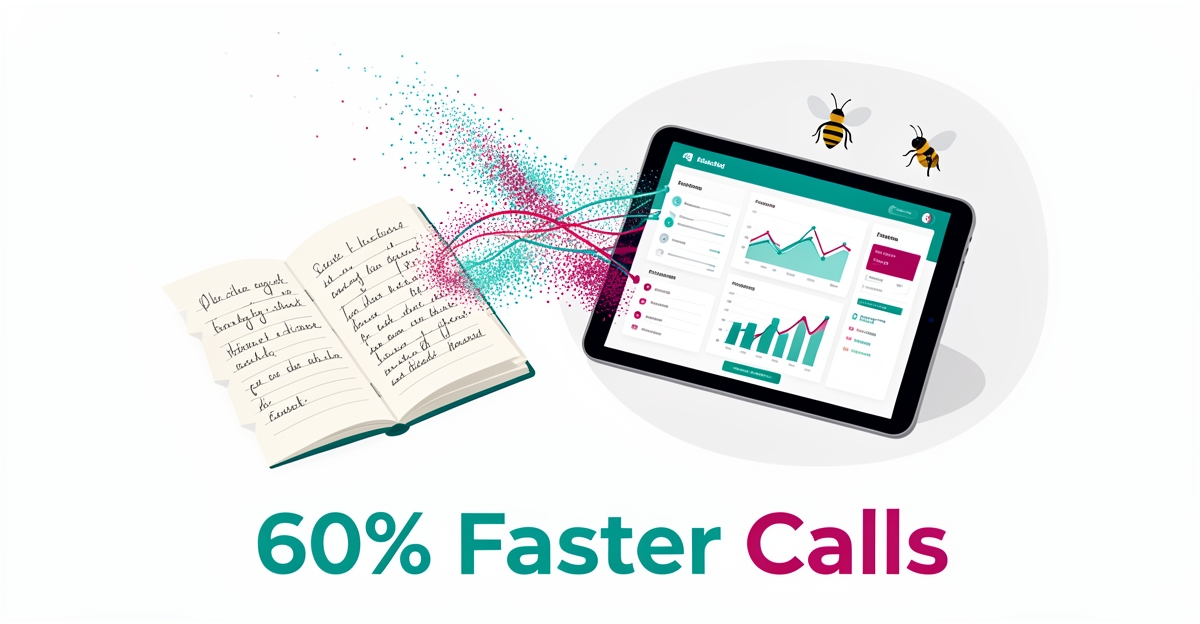
The transformation delivered immediate, measurable impact. The bee and wasp removal company reported a substantial reduction in call handling time, on the order of 60%, driven by eliminating manual transcription and enabling instant categorization of customer interactions. Your exact results will depend on call volume and how much manual entry your current process requires, but the pattern is consistent: the more transcription in the loop, the bigger the gain.
Accuracy improved alongside speed. Automated data capture eliminated the transcription errors inherent in paper logs, ensuring that customer details and service requests were recorded correctly the first time. This reliability matters because poor data quality compounds operational costs over time.
Perhaps most valuable is the real-time visibility managers now possess. Instead of reviewing paper logs days or weeks later, leadership can identify service patterns, seasonal trends, and resource bottlenecks as they emerge. Business administration is consistently one of the most common AI use cases among enterprises that adopt the technology, and this is exactly why: the gains show up directly in day-to-day operations.
The system leverages text analysis to extract actionable insights from customer communications. Key capabilities driving these results include:
- Automated categorization of service requests by type and urgency
- Real-time dashboards showing call volumes and resolution patterns
- Natural language processing that extracts key details without manual data entry
- Pattern recognition that identifies recurring pest issues by location or season
Adoption patterns reveal a significant opportunity gap. Large enterprises have moved quickly on AI, while small service businesses, precisely the companies drowning in paper logs, have largely stayed on the sidelines as of late 2026. That disparity means smaller operators who implement AI document processing now gain a competitive advantage before these tools become industry standard.
Measurable ROI extends beyond time savings. The business now operates with a complete digital audit trail, reduced administrative overhead, and data-driven insights that inform strategic decisions. For AIQ Labs, this case exemplifies how targeted AI implementation transforms document-heavy workflows into intelligent, automated systems that scale with business growth.
Implementation Roadmap for AI-Powered Interaction Management
Deploying AI-powered interaction management follows a clear roadmap that transforms chaotic manual processes into streamlined digital workflows. The pest control company in our case study achieved their reduction in call handling time by systematically implementing each phase of this approach.
The foundation begins with automated data capture and categorization. Modern AI systems can automatically extract key information from customer calls, emails, and messages, then intelligently categorize interactions by service type, urgency, and customer history. Among enterprises using AI, business administration and management processes are consistently among the most common applications, making this a proven starting point rather than an experiment.
Next comes intelligent workflow automation. The system routes service requests to appropriate technicians, schedules follow-ups, and triggers automated responses based on interaction content. This eliminates the manual sorting and assignment that consumed hours in the paper-based system.
The implementation roadmap includes these critical phases:
- Configure auto-tagging to capture customer details, service types, and urgency levels from incoming communications
- Deploy duplication detection to prevent multiple entries for the same customer issue
- Enable natural language search so staff can quickly retrieve customer histories using conversational queries
- Set up real-time analytics dashboards that surface patterns in service requests and seasonal trends
Quality control mechanisms ensure data accuracy throughout the process. The AI validates information completeness, flags inconsistencies, and maintains audit trails for every interaction. This addresses the expertise gap that keeps many businesses from adopting AI in the first place, when the system is built and managed for you, you don't need an in-house AI team.
AIQ Labs structures these implementations using proven methodologies from their AI Employees and custom development models. Their approach includes comprehensive training on business-specific workflows, integration with existing CRM and scheduling systems, and ongoing optimization based on performance metrics.
The final phase establishes predictive analytics capabilities that identify patterns in customer behavior, seasonal service demands, and operational bottlenecks. Managers gain visibility into metrics like average response times, service completion rates, and customer satisfaction trends. This data-driven insight enables proactive resource allocation and strategic planning that was impossible with paper logs.
Still paying for 10+ subscriptions that don’t talk to each other?
We build custom AI systems you own outright. No vendor lock-in. Full control.
Not sure where to start? Ask our AI planner
Frequently Asked Questions
How much time can AI really save on handling customer calls?
Is AI document processing only for big companies?
What does AI actually do with my call logs and paper forms?
What's the most common use of AI in business administration?
What's stopping companies from switching from paper logs to AI?
Can AI improve accuracy as well as speed?
Your Next Customer Call Could Be Your Last Paper Log
The pest control business in this case study didn't just save time, they transformed chaos into clarity. By replacing paper logs with AI-powered document processing, they cut call handling time dramatically while gaining real-time visibility into service patterns that manual systems could never provide. The technology isn't futuristic speculation; it's proven, practical, and increasingly accessible. As AI adoption spreads, the competitive gap between early adopters and everyone else widens daily. For field service businesses still drowning in paper logs and missed details, the question isn't whether to modernize, it's how quickly you can start. AIQ Labs specializes in building these exact systems for service businesses ready to eliminate manual bottlenecks. If you're curious where AI could cut waste in your operations, start with a two-minute Fit Check at https://aiqlabs.ai/apply or book a free 30-minute strategy call at https://aiqlabs.ai/book. We'll map your biggest bottleneck and show you the highest-ROI opportunity, no sales pitch, just clarity.
Make AI your competitive advantage — not just another tool.
Strategy, implementation and ongoing optimization. One partner, end to end.
Not sure where to start? Ask our AI planner