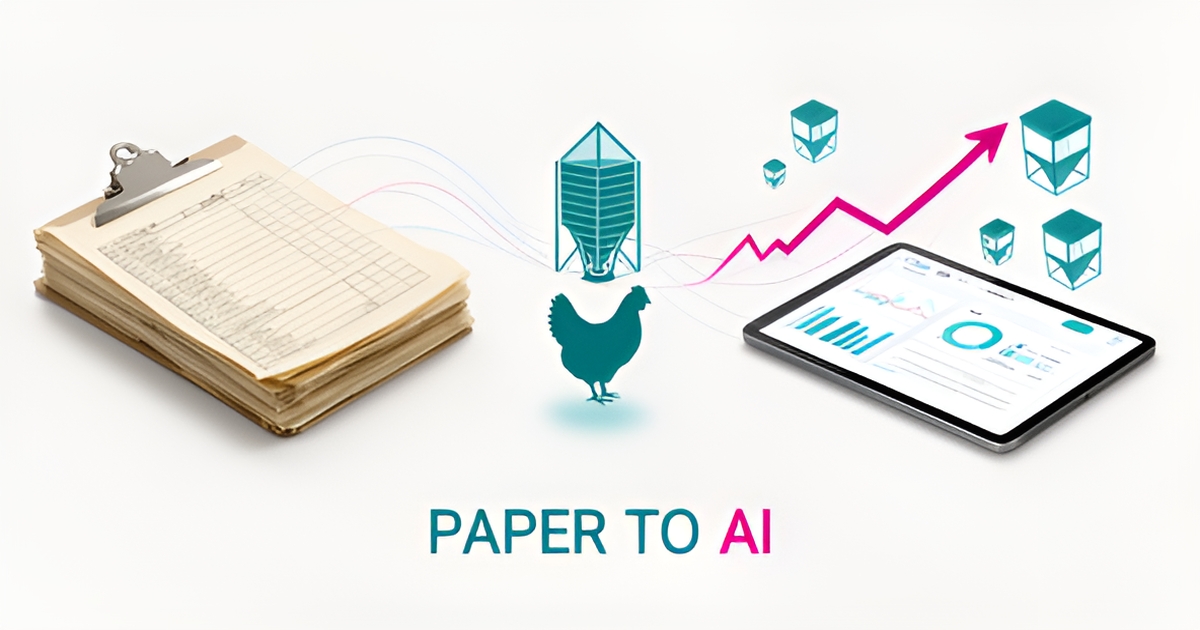
From Paper Logs to AI: Modernizing Poultry Feed Records and Inventory Tracking
Key Facts
- A grower with eight houses and six flocks per year produces thousands of data points annually — most of which are never analyzed on paper.
- Feed typically represents 60-70% of poultry production costs, making precision tracking essential for profitability.
- Digital logging with defaults and templates can typically reduce logging time to under a minute per house.
- AI-powered inventory management can automate daily record-keeping, feed tracking, and inventory updates, reducing errors and freeing up labor.
- Best practice recommends running paper and digital systems in parallel for 2-4 weeks to verify accuracy before a full switch.
Hire a team member that works 24/7 — for less than a part-time wage.
AI receptionists, SDRs, dispatchers and 99+ roles. Trained on your business, fully managed.
Not sure where to start? Ask our AI planner
Introduction
Paper logs feel simple on day one and become a liability by flock three. Handwritten feed sheets, lost pages and endless manual counts create errors that compound across houses, while the data that could drive better decisions sits unread in binders.
A grower with eight houses and six flocks per year produces thousands of data points annually, yet paper records are easy to start but hard to maintain and nearly impossible to analyze across time. That gap means missed patterns in feed use, delayed health signals and compliance preparation that eats labor. Digital record keeping transforms raw data into actionable information through searchable records, automatic trend charts and one-click compliance reports.
AI moves the step further from digital to autonomous. AI-powered inventory management can automate daily record-keeping, feed tracking, and inventory updates, reducing errors and freeing up labor. For poultry operations this shows up as real-time stock visibility, automated consumption logging and demand forecasting that adjusts to flock performance and supply conditions. Large food producers have reported meaningful reductions in forecast error after adopting AI demand forecasting — the same principle applies at farm scale.
Modern platforms prove the approach is practical at farm scale. Research platforms in poultry intelligence have demonstrated modular, low-cost systems that integrate sensing, edge analytics and AI-powered forecasting to predict feed consumption and production days in advance. These capabilities bridge isolated pilot tools and farm-wide intelligence.
The shift is less about technology than habit and workflow fit. Successful adoption typically starts small and expands:
- Start with one or two data types such as daily mortality and water consumption, then expand
- Use defaults, autofill and templates to reduce logging time to under a minute per house
- Run paper and digital in parallel for 2-4 weeks to verify accuracy and build confidence
- Involve employees early so the system supports existing walkthrough routines
AIQ Labs works in this space through [AI Workflow Builds](/workflow-builds), rebuilding the one workflow that costs you the most — like daily feed logging and inventory updates — at a fixed price, in phases, integrating with the farm management tools you already run. The result is less manual entry, fewer errors and more time for proactive flock management.
Key Concepts
Imagine knowing roughly how much feed your flock will need next week, before you even place the order. That level of foresight is no longer a luxury for industrial operations; it is becoming the baseline for modern poultry management.
Traditional paper logs served their purpose, but they trap valuable insights in notebooks and filing cabinets. Consider the scale: a grower managing eight houses across six flocks annually generates thousands of data points that rarely see analysis. The shift from paper to digital represents one of the highest-leverage investments a grower can make, with financial benefits typically realized within the first year.
Feed represents 60-70% of poultry production costs, making precision tracking essential for profitability. Modern AI systems can forecast consumption patterns with useful accuracy, turning inventory from reactive guesswork into proactive management. Emerging poultry research platforms have demonstrated forecasting models that predict feed consumption and egg yield up to 10 days in advance, alongside highly accurate automated counting on low-cost edge devices.
Digital transformation delivers immediate operational advantages beyond forecasting. When you digitize feed records and inventory tracking, you unlock several critical capabilities:
- Real-time visibility into stock levels across multiple houses or locations
- Automated alerts when feed supplies hit reorder thresholds
- Trend analysis that identifies underperforming flocks or feed conversion issues
- One-click compliance reporting for audits and certifications
The accuracy improvements alone justify the transition. Manual data entry introduces errors through illegible handwriting, transposed numbers, and missed entries. Businesses implementing AI-supported inventory systems typically reduce manual errors significantly while cutting hours of repetitive administrative work.
AIQ Labs builds custom workflows that integrate directly with existing farm management tools, ensuring that data flows automatically from sensors or manual inputs into centralized dashboards. This approach eliminates the double-entry problem that plagues many operations attempting to bridge analog and digital systems.
The transition requires minimal disruption when approached strategically. Best practices for digital migration recommend starting with a single data type—such as daily feed consumption or mortality tracking—before expanding to comprehensive inventory management. This phased approach builds staff confidence while proving value quickly.
Modern systems also enhance accountability. Digital logs create audit trails showing exactly who recorded what and when, addressing the transparency gaps that often complicate paper-based compliance. When every bag of feed is tracked from delivery to consumption, variance analysis becomes straightforward rather than speculative.
Best Practices
Paper logs are easy to start but hard to maintain and almost impossible to analyze across time, and that friction costs poultry operations in accuracy and labor every day. Moving to digital feed records and inventory tracking starts with habit change, not just new software.
Start small and build confidence before scaling. Successful adoption requires starting with one or two data types such as daily mortality and water consumption and gradually expanding. A grower with eight houses and six flocks per year produces thousands of data points annually that are never reviewed on paper. Digital record keeping transforms raw data into actionable information through searchable records, automatic trend charts, cross-house comparisons, and one-click compliance reports.
Design the transition for people first. A successful transition depends on people, not just technology. Involve employees early, train on defaults and templates, and run paper and digital in parallel for 2-4 weeks to verify data accuracy and build confidence. This parallel run is recommended to verify data accuracy and build confidence before a full switch.
Make capture fast and mobile. The most immediate benefit of digital records is accessibility, data entered during morning walkthroughs is immediately available for review and analysis from a phone. Digital records can typically reduce logging time to under a minute per house using defaults, autofill, and templates. Within one or two flock cycles, most growers find digital record keeping is faster than paper.
Use AI to automate the repetitive work that creates errors. AI-powered inventory management can automate daily record-keeping, feed tracking, and inventory updates, reducing errors and freeing up labor. AI tools can cut manual errors, save hours of repetitive work, and spot stock and supply chain patterns your team can act on before they turn into problems. AI-powered demand forecasting can produce more accurate and reliable forecasts, enabling better insights and smarter decision-making.
Best practices for a smooth transition include:
- Start simple with one or two data types and expand gradually
- Use QR codes and mobile apps for fast, accurate feed and inventory capture
- Schedule regular audits and back up data to the cloud
- Involve employees early and provide hands-on training before go-live
Keep systems modular and integrable. Research platforms like Poultry Farm Intelligence use low-cost sensing, edge analytics, and prescriptive AI to continuously monitor flocks, predict production, and optimize performance — with field trials demonstrating highly accurate automated egg counting and feed consumption forecasts up to 10 days in advance. The lesson for growers: choose tools designed to plug into what you already run, not replace it.
AIQ Labs builds custom workflows that integrate with existing farm management tools, ensuring accuracy and real-time visibility across poultry farms. The financial case for digital records is typically positive within the first year for most commercial growers, with ROI coming from earlier detection of health problems, feed conversion improvements from identifying underperforming houses, and reduced labor time for record keeping and compliance preparation.
Implementation
Transitioning from paper logs to AI-driven systems transforms how poultry farms manage feed and inventory. Start by assessing current manual processes to identify bottlenecks in data collection and reporting. Many growers find that paper records generate thousands of data points annually that are never reviewed due to analysis limitations.
Next, select a modular AI platform that integrates with existing farm tools, such as feed sensors and environmental controls. Research systems demonstrate how low-cost sensing and edge analytics can forecast feed consumption days in advance while automating counts that used to be done by hand. This approach ensures scalability without disrupting established workflows.
Finally, implement the system in phases using parallel runs to build confidence and verify accuracy. Begin with tracking daily feed intake and mortality rates—two high-impact data types—before expanding to environmental adjustments and predictive forecasting. Digital records typically reduce logging time to under a minute per house through defaults and autofill, making the shift faster than paper within one or two flock cycles. AIQ Labs supports this transition by designing custom workflows that eliminate manual entry errors and provide real-time visibility into inventory levels, enabling proactive adjustments that reduce waste and improve flock productivity.
- Assess current paper-based workflows to pinpoint inefficiencies in feed tracking and inventory logging
- Deploy modular AI tools that integrate with existing sensors and farm management software
- Run paper and digital systems in parallel for 2-4 weeks to validate accuracy and train staff
- Expand to predictive analytics and automated reporting once core tracking is stabilized
This structured approach minimizes disruption while delivering measurable improvements in data accuracy and operational efficiency. Farms adopting digital record keeping typically see earlier detection of health issues and significant labor savings from automated compliance reporting. By grounding each step in proven practices, poultry producers can confidently modernize their operations without overhauling entire systems at once. Ready to map your feed tracking workflow? [Start the Fit Check](/apply) — it takes two minutes — and follow up with a free 30-minute strategy call to identify your highest-ROI automation opportunity.
Conclusion
The shift from paper logs to AI-powered intelligence isn't a futuristic concept—it's a practical progression already delivering results on farms today. Growers managing eight houses across six flocks generate thousands of data points annually that paper systems simply cannot analyze. By contrast, modern poultry intelligence platforms demonstrate accurate automated counting on edge devices while forecasting yield and feed consumption up to 10 days in advance.
AI-driven inventory management cuts manual errors, saves hours of repetitive work, and spots supply chain patterns before they become problems. The financial case is typically compelling: ROI arrives within the first year through earlier health detection, improved feed conversion ratios, and reduced compliance labor. Large food producers' results with AI demand forecasting illustrate what's possible when AI meets operational data.
- Start with one or two data types—mortality and water consumption—to build the digital habit
- Run paper and digital systems in parallel for 2-4 weeks to verify accuracy
- Choose specialized inventory software over spreadsheets for scalable growth
- Integrate weather and environmental data for prescriptive operational adjustments
The technology exists, the ROI is well documented, and the competitive gap widens daily. AIQ Labs helps poultry operations automate daily record-keeping, feed tracking, and inventory updates through custom AI workflows that integrate with existing farm management tools. [Start the Fit Check](/apply) for a free 30-minute strategy call to map your biggest bottleneck and identify high-ROI automation opportunities—no obligation, just clarity on your AI opportunity.
Still paying for 10+ subscriptions that don’t talk to each other?
We build custom AI systems you own outright. No vendor lock-in. Full control.
Not sure where to start? Ask our AI planner
Frequently Asked Questions
How much time can I save by switching from paper feed logs to digital records?
Is it really worth the cost to move from paper to AI-powered feed tracking?
How accurate are AI predictions for feed consumption and egg yield?
What’s the best way to start using digital feed records without overwhelming my team?
Can AI really reduce errors in feed inventory tracking?
Do I need to replace my current farm management tools to use AI for feed tracking?
The Data is Already There—Now Make It Work for You
The transition from paper logs to AI-driven intelligence isn't about chasing technology—it's about capturing the value already flowing through your operation. Those thousands of annual data points currently trapped in binders represent your clearest path to catching health issues days earlier, trimming feed costs, and reclaiming hours lost to manual entry. Start small: pick one or two metrics like daily mortality or water consumption, run digital alongside paper for a few weeks, and let the patterns prove themselves. When you're ready to automate the repetitive logging and gain real-time inventory visibility, AIQ Labs rebuilds your costliest workflow at a fixed price, in phases, integrating with your existing farm tools to eliminate double-entry and surface insights before problems escalate. The ROI typically lands within the first year through reduced mortality and labor savings. Ready to map your biggest bottleneck? [Start the Fit Check](/apply) — two minutes now, then a free 30-minute strategy call. No obligation, just clarity on your highest-impact automation opportunity.
Make AI your competitive advantage — not just another tool.
Strategy, implementation and ongoing optimization. One partner, end to end.
Not sure where to start? Ask our AI planner