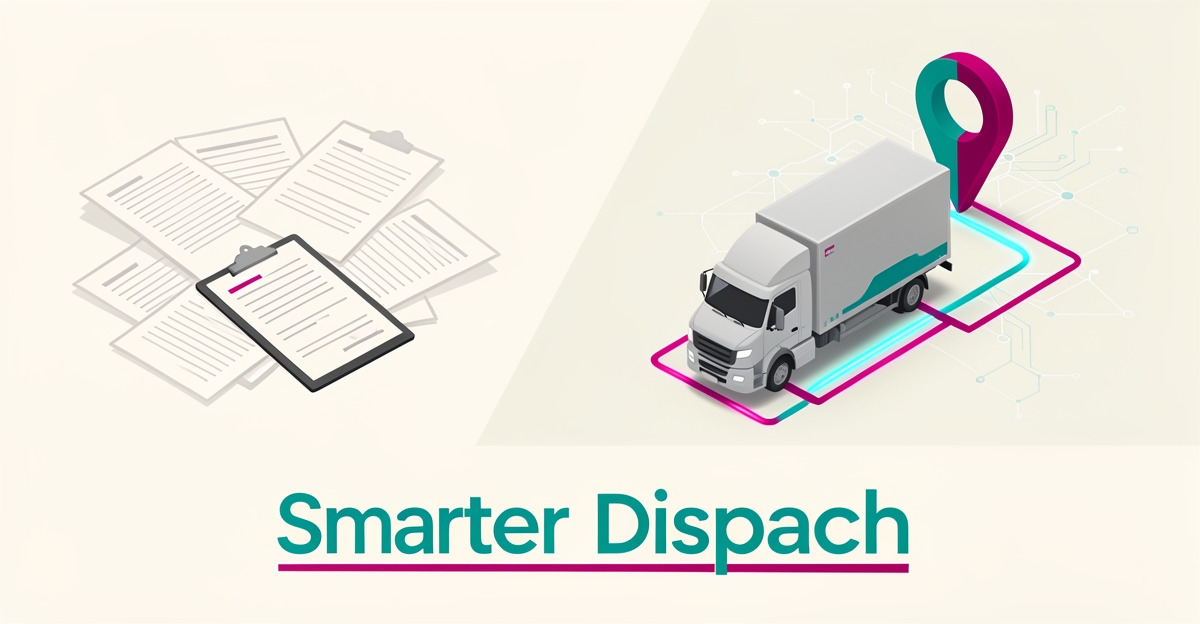
From Paper Orders to AI-Driven Dispatch: How Distributors Can Modernize Their Operations
Key Facts
- AI dispatch software optimizes routes using real-time data on traffic, distance, and delivery windows, reducing fuel waste and operational costs according to industry research
- Automated task assignment matches drivers to loads based on vehicle capacity, location, and urgency—reducing the misassignments common with manual dispatch per operational findings
- Real-time tracking and proactive notifications improve the delivery experience by giving customers accurate ETAs instead of guesswork per customer experience research
- AI dispatch enables 24/7 coordination without added labor overhead by automating task assignment per operational efficiency findings
- Unlike manual dispatch—where costs scale linearly with order volume—AI systems absorb growth without proportional staffing increases per scalability analysis
Hire a team member that works 24/7 — for less than a part-time wage.
AI receptionists, SDRs, dispatchers and 99+ roles. Trained on your business, fully managed.
Not sure where to start? Ask our AI planner
The Hidden Cost of Manual Dispatch in Distribution
Distributors relying on paper-based and manual dispatch systems face mounting operational inefficiencies that directly impact their bottom line. Every delayed decision, misrouted delivery, or manual data entry point adds up to significant waste in time, fuel, and labor. These legacy methods struggle to keep pace with rising customer expectations for speed and accuracy, creating a growing gap between what's possible and what's being delivered.
Fuel waste alone represents a substantial drain on distribution profitability. Manual route planning often fails to account for real-time traffic, delivery windows, or vehicle capacity, leading to unnecessary mileage and idling. Industry research shows that AI-powered dispatch software reduces fuel consumption and operational costs by optimizing routes against live conditions—directly addressing one of the most visible inefficiencies in traditional systems. Without dynamic routing, distributors routinely burn through more fuel than necessary, inflating expenses with every mile driven.
Labor overhead compounds these inefficiencies, as dispatchers spend hours each day coordinating schedules, fielding calls, and correcting errors that could be prevented with automation. Manual task assignment based on dispatcher judgment lacks the precision of algorithm-driven systems that analyze driver location, load capacity, and urgency in real time. This reliance on human intuition increases the likelihood of misassignments, delays, and missed delivery windows—each requiring costly rework or customer concessions. The scalability of manual systems is inherently limited; as order volumes grow, so does the need for additional dispatch staff, creating a linear cost increase that undermines profitability.
Error rates in paper-based processes further erode efficiency, with misplaced tickets, illegible handwriting, and delayed updates causing ripple effects across the fulfillment cycle. These mistakes often go unnoticed until a delivery fails or a customer complains, triggering emergency interventions that disrupt workflows and damage trust. AI-driven dispatch eliminates these touchpoints by digitizing the entire workflow—from order intake to delivery confirmation—ensuring data accuracy and enabling proactive exceptions management. For distributors aiming to scale without proportional cost growth, the limitations of manual dispatch are no longer just inconvenient—they're unsustainable. AIQ Labs helps distributors replace these fragile systems with custom AI-driven dispatch platforms that own, optimize, and scale with their business.
How AI Dispatch Solves Core Distribution Challenges
Distributors today face mounting pressure to deliver faster, cheaper, and more reliably—yet many still rely on manual dispatch methods that struggle to keep pace. AI-powered dispatch transforms this critical function by turning reactive scheduling into proactive optimization, directly addressing core operational pain points.
AI dispatch software reduces fuel consumption and operational costs by optimizing routes using real-time data on traffic, distance, and delivery windows. Industry research confirms this capability leads to measurable savings by eliminating unnecessary mileage and idle time. Beyond cost, automated task assignment eliminates guesswork, ensuring the right driver gets the right load at the right time based on vehicle capacity, location, and urgency—something manual dispatching often fails to achieve consistently.
Real-time tracking and dynamic rescheduling further enhance delivery efficiency, allowing systems to instantly reroute drivers around congestion or delays. This responsiveness not only improves on-time performance but also boosts customer satisfaction through timely notifications and transparent ETAs. Studies show that proactive communication from AI-powered systems significantly enhances the customer experience, turning delivery visibility into a trust-building advantage.
- Reduces fuel waste through intelligent, real-time route optimization
- Improves on-time delivery with dynamic rescheduling around traffic and delays
- Lowers operational costs via reduced idle time and better asset utilization
- Enables 24/7 dispatch coordination without added labor overhead
- Scales with order volume, avoiding bottlenecks during peak periods
By replacing reactive decision-making with data-driven precision, AI dispatch shifts from a cost center to a strategic lever—enabling distributors to do more with less while building resilience into their logistics network. AIQ Labs helps businesses implement these capabilities through custom AI workflow automation that integrates routing, scheduling, and carrier coordination into a unified, owned system.
Preparing Your Data and Systems for AI Dispatch Integration
Distributors face a pivotal moment where legacy dispatch methods collide with the demands of AI-driven commerce. Before implementing AI dispatch, organizations must first ensure their data and systems are ready to support intelligent automation—because even the most advanced AI will falter on fragmented or unreliable inputs.
A foundational step is assessing data quality across core operational systems. Research shows that AI-driven dispatch software can reduce fuel consumption and operational costs by optimizing routes, but only when fed accurate, real-time data on vehicle location, delivery windows, and inventory levels. Poor data quality directly undermines the algorithm's ability to make optimal decisions, negating potential savings and efficiency gains. Distributors should audit data sources for completeness, consistency, and timeliness, prioritizing integration between ERP, WMS, and CRM platforms to create a unified operational view.
System integration readiness is equally critical. AI dispatch doesn't operate in isolation—it must seamlessly exchange data with existing tools like scheduling software, carrier portals, and accounting systems. Without robust APIs or middleware, data silos persist, forcing manual workarounds that defeat the purpose of automation. Evaluating current infrastructure for compatibility and identifying integration gaps early prevents costly rework later. This phase also includes verifying network security and access controls to protect data flows between systems.
Finally, identity verification must be strengthened in anticipation of AI-driven fraud risks. As AI agents become more prevalent in commerce, they also enable sophisticated synthetic identity schemes and spoofed-device fraud that traditional detection struggles to catch, because AI can mimic legitimate behavior. Distributors need layered verification—combining device intelligence, behavioral biometrics, and real-time document validation—to distinguish between genuine and AI-generated transactions before they enter the dispatch workflow.
By addressing data integrity, system connectivity, and fraud resilience upfront, distributors create the secure, reliable foundation AI dispatch requires to deliver scalable, intelligent order fulfillment. This preparation isn't just technical—it's strategic, ensuring that automation enhances rather than exposes operational vulnerabilities. To begin assessing your readiness, start the Fit Check, which leads to a free 30-minute strategy call.
A Practical Roadmap to Implement AI-Driven Dispatch
Most AI initiatives stall before they scale — in fact, most organizations get stuck running limited pilots that never expand into production. A structured, phased approach is what separates distributors who modernize successfully from those who abandon the effort halfway. Here is a practical roadmap for moving from paper-based dispatch to an AI-driven operation.
Phase 1: Discovery and Architecture (1–2 weeks). Begin by auditing your current dispatch workflow end to end: how orders arrive, how routes get assigned, and where delays or errors occur. Assess your data infrastructure at the same time, because the effectiveness of any AI system depends directly on the quality and accessibility of your data. This phase produces a solution architecture, an ROI projection, and a realistic timeline.
Phase 2: Development and Integration (4–12 weeks). The build phase connects your dispatch logic to the systems you already use — order management, inventory, carrier tools, and customer communications. Deep two-way integrations matter here: AI dispatch works best when it can analyze variables like driver location, vehicle capacity, and delivery urgency in real time, which is how optimized routing reduces fuel consumption and operational costs.
Phase 3: Deployment and Training (1–2 weeks). Go live with role-specific training for dispatchers, drivers, and customer service staff. Change management is one of the most common failure points in technology adoption, so treat training as a core deliverable, not an afterthought.
Phase 4: Optimization and Scale (ongoing). AI systems improve with use. Continuous monitoring lets the system dynamically adjust to traffic, delays, and shifting order volumes — and the real-time tracking and notifications it enables are a proven driver of higher customer satisfaction.
Before you commit, choose the engagement model that matches your risk tolerance:
- Start Monthly — one AI dispatcher role for a flat monthly plan that costs less than a part-time hire, with build, training, integrations, and monitoring included.
- Build in Milestones — phase the dispatch build, approve and pay per phase, and keep everything built if you stop.
- Own It Outright — a full dispatch operating system with complete ownership of the code, agents, and data.
You can compare all three options on the AIQ Labs pricing page. AIQ Labs structures every engagement around exactly this kind of phased, ownership-first roadmap — starting with a free strategy call to map your highest-ROI automation opportunity.
Still paying for 10+ subscriptions that don’t talk to each other?
We build custom AI systems you own outright. No vendor lock-in. Full control.
Not sure where to start? Ask our AI planner
Frequently Asked Questions
How much can AI dispatch actually save on fuel and labor costs?
Will AI dispatch work with our existing ERP and warehouse systems?
How long does it take to implement an AI dispatch system?
What happens if our data isn't clean or organized enough for AI?
Do we need to worry about fraud or security risks with AI handling our dispatch?
Can AI dispatch scale as our order volume grows without adding staff?
Ready to Transform Your Distribution Operations?
The transition from paper-based dispatch to AI-driven operations is no longer a luxury—it's a competitive necessity. By optimizing routes, automating task assignments, and enabling real-time tracking, distributors can reduce fuel waste, improve on-time delivery, and scale operations without proportional increases in overhead. AIQ Labs specializes in building custom AI dispatch systems that integrate seamlessly with your existing workflows, ensuring a smooth transition and immediate ROI. Whether you choose to start with a single AI dispatcher on a monthly plan or build a full-scale AI operating system you own outright, the path to smarter, more efficient distribution begins with a single step. Start the Fit Check today and discover how AI can transform your operations—no obligation, just clarity.
Make AI your competitive advantage — not just another tool.
Strategy, implementation and ongoing optimization. One partner, end to end.
Not sure where to start? Ask our AI planner