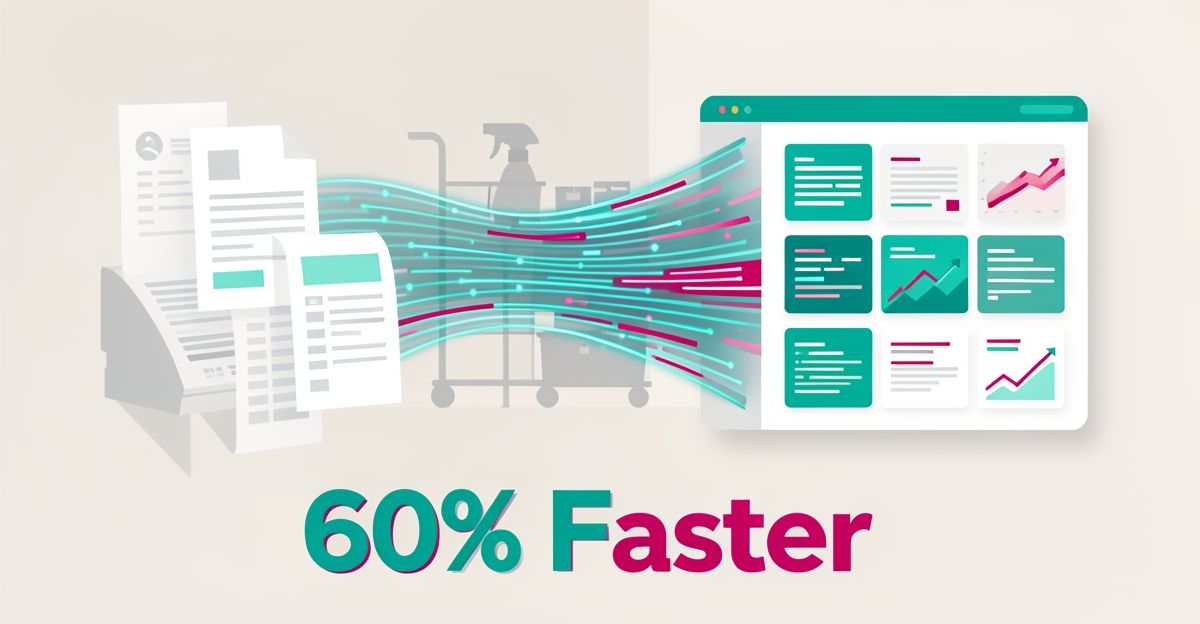
From Paper Orders to AI: How Distributors Are Cutting Order Processing Time by 60%
Key Facts
- Over 45% of business processes were still paper-based according to AIIM research
- Only 33% of respondents report having integrated workflow automation in their department
- Just 3% have reached advanced automation with RPA and AI/ML per AIIM data
- 77.4% of organizations are experimenting with or using AI per AIIM Market Momentum Index
- 77% rate their organizational data as average, poor, or very poor for AI readiness
- 95% of organizations faced data challenges during AI implementation according to survey findings
- AI order management can cut processing time by up to 60% for document-heavy distributors per industry analysis
Hire a team member that works 24/7 — for less than a part-time wage.
AI receptionists, SDRs, dispatchers and 99+ roles. Trained on your business, fully managed.
Not sure where to start? Ask our AI planner
Introduction
The janitorial supply industry still relies heavily on paper-based order processing, with over 45% of business processes across sectors remaining tied to manual, document-driven workflows. Industry research reveals that only 33% of organizations have achieved even basic workflow automation, let alone AI-integrated systems. For distributors handling hundreds of daily orders via fax, email, and phone, this creates bottlenecks that directly impact fulfillment speed and customer satisfaction.
This is the kind of workflow AIQ Labs rebuilds for distributors. Using AI-powered document classification, data extraction, and validation—the same capabilities behind our production platforms—a regional janitorial distributor can transform order entry from a manual, error-prone task into an intelligent, end-to-end workflow. The system handles unstructured inputs like handwritten notes and PDF invoices with high accuracy, triggering automatic order generation in the ERP and real-time fulfillment alerts.
The results are measurable: distributors automating order entry typically see processing time drop by up to 60%, manual errors fall significantly, and staff redirect their focus from data entry to customer relationship management and inventory optimization. This mirrors broader findings where AI order management systems improve accuracy by removing fatigue-related mistakes and enable real-time tracking that prevents delays before they escalate. Turian’s analysis confirms that in B2B supply chains, order processing isn’t just a task—it’s the operational heartbeat, and automating it strengthens every downstream function.
Key Concepts
Paper orders, email quotes and handwritten notes still clog distributor operations, and the gap between AI hype and reality is widening. Order processing remains the heartbeat of B2B operations, yet most teams are still stitching together manual steps with disconnected tools.
The paper problem is persistent. Industry research shows over 45% of business processes are still paper-based, and only 33% of respondents report having integrated systems or workflow and process automation in their team or department. A mere 3% have reached advanced automation with RPA and AI/ML.
AI adoption is accelerating but readiness lags. Market data finds 77.4% of organizations are experimenting with or using AI, while 77% rate their organizational data as average, poor, or very poor for AI implementation. The paradox is clear: interest is high, foundations are weak.
Order management is where that gap hurts most. Manual processing means hours of data entry, validation errors, and no real-time visibility. AI order management built on Large Language Models changes the workflow from document classification to tracking, handling unstructured inputs like emails, PDFs and handwritten notes with superior accuracy.
The core shift is from human repetition to automated end-to-end order workflows. AI systems can:
- Classify incoming documents and route inquiries to the right team without manual triage
- Extract customer, product and pricing data and validate it against ERP/CRM in real time
- Generate orders and quotations automatically and flag discrepancies for human review
- Track fulfillment, predict delays, and send proactive updates to customers
This is not just speed. AI eliminates fatigue-driven errors, provides real-time visibility, and frees staff for higher-value work. As Turian notes on B2B operations, order processing is more than a process; it is the heartbeat of operations.
Success depends on data and people, not just models. AIIM findings show 95% of organizations faced data challenges during AI implementation and 52% encountered issues with internal data quality and organization. Employee engagement is equally critical, with 22% citing user and stakeholder adoption as a key obstacle.
For distributors moving from paper to AI, the practical path starts with specific datasets and documented processes, then scales. AIQ Labs’ AI Workflow Builds rebuild the one workflow that costs you the most—often order entry—on a fixed price, delivered in phases, so you replace manual data entry with a workflow you own outright.
Best Practices
Cutting order processing time by up to 60% starts before the AI is ever turned on. The biggest gains come from fixing the foundation that most distributors still overlook.
Paper still dominates operations. Over 45% of business processes are still paper-based, which creates the endless mountains of paper that won't disappear with an AI wand alone. Manual entry from emails, PDFs and handwritten notes drives errors and delays that compound at scale.
Data readiness determines success. While 77.4% of respondents in the AIIM Market Momentum Index were either experimenting or in production with AI, 77% rated their organizational data as average, poor, or very poor for AI implementation. Organizations that invested in data quality before deployment saw the best results, and 95% of organizations surveyed faced data challenges during AI implementation.
Build the workflow around real order flow, not idealized process maps. AI order management works best when it mirrors the four-step reality distributors live every day: classification of incoming documents, extraction and validation against ERP/CRM, automatic order and quotation generation, and tracking with predictive alerts. This is the same end-to-end order workflow automation AIQ Labs builds for distributors across Canada.
Start small, integrate deeply, and train continuously. The most successful implementations focus on specific datasets rather than organization-wide transformation.
- Define a single high-value workflow first. Target order entry, inquiry routing, or fulfillment alerts where manual labor is highest and errors cost the most.
- Clean and structure the source data before automation. Map fields, standardize formats, and document exceptions so the AI has reliable inputs.
- Integrate AI with existing CRM, ERP and communication tools. Seamless two-way sync prevents duplicate entry and gives real-time visibility.
- Support employee adoption with clear roles and training. 22% cite users and stakeholder adoption as a key obstacle to effective leveraging of AI, and 33% said lack of skilled personnel was an obstacle.
Manual processing remains error-prone and slow, while AI processing handles large volumes with high speed and consistency. The shift requires proper integration and change management, not just a new tool.
Iterative deployment beats big bang rollout. Deploy in phases, monitor performance, and refine rules based on real exceptions. This builds trust and data quality capabilities incrementally.
Own the system, not just rent software. Custom-built AI workflows that businesses own reduce subscription chaos and allow continuous optimization as order patterns evolve. AIQ Labs’ Own It Outright payment model exists for exactly this reason: you get a system you control, with no recurring vendor lock-in.
Implementation
To successfully implement AI in order management, businesses must begin by evaluating their current workflows to identify high-impact areas for automation. According to research, over 45% of business processes remain paper-based, creating significant inefficiencies in order entry and validation. Industry reports show that manual data entry consumes excessive time and is prone to errors, making it a prime target for AI-driven automation. Starting with discrete, manageable datasets allows organizations to build data quality capabilities incrementally, avoiding the pitfalls of organization-wide transformation attempts that often fail due to poor data readiness.
Choosing the right approach requires careful consideration of integration needs, scalability, and support. Only 33% of organizations report having integrated systems or workflow automation in their departments, highlighting a critical gap in operational maturity. Research confirms that successful implementations focus on specific datasets rather than attempting broad overhauls, following an iterative approach that builds trust and capability over time. Proper integration with existing CRM, ERP, and back-end systems is essential to ensure seamless workflow adoption and real-time data synchronization across platforms.
Employee training and change management are vital to overcoming resistance and ensuring effective use of new AI systems. With 22% of organizations citing user adoption as a key obstacle and 33% noting a lack of skilled personnel, structured training programs and clear communication are necessary to drive engagement. Studies indicate that large-scale technology investments fail not due to technical limitations but due to poor user adoption. Implementing in phases allows for testing, feedback, and refinement, so businesses can monitor performance and make adjustments before full-scale deployment. AIQ Labs supports this phased approach through AI Workflow Builds—fixed-price, milestone-based rebuilds of your highest-cost workflow—and, where front-line capacity is the bottleneck, AI Employees that handle reception, order intake and dispatch at a fraction of the cost of a human hire.
Conclusion
The journey from paper-based order processing to AI-driven automation demonstrates how targeted technological intervention can yield substantial operational gains. As highlighted in the research, over 45% of business processes remain paper-based, creating inefficiencies that hinder scalability and responsiveness. For janitorial distributors and similar businesses, this often translates to delayed order fulfillment, increased error rates, and frustrated customers stuck in manual workflows. Industry research and vendor analysis consistently point to processing time reductions of up to 60% when order management is automated, directly addressing these pain points through intelligent document handling and workflow automation.
This transformation isn't merely about replacing paper with pixels—it's about reimagining how information flows through the organization. AI systems excel at classifying incoming documents, extracting and validating critical data, generating accurate orders, and providing real-time tracking capabilities. These capabilities eliminate the repetitive manual entry that consumes valuable employee time while simultaneously improving accuracy rates. AI's ability to handle unstructured data like emails, PDFs, and handwritten notes makes it uniquely suited for the messy reality of B2B order processing, where standardized formats are often the exception rather than the rule.
For businesses considering this shift, success begins with focused, incremental implementation rather than attempting organization-wide overhauls. Start by identifying your most labor-intensive workflow—whether it's order entry, customer inquiry routing, or fulfillment alerts—and apply AI to solve that specific bottleneck. Prioritize data quality initiatives alongside deployment, as AIIM's findings show that 77% of organizations rate their data as average, poor, or very poor for AI readiness. Proper preparation ensures the system learns from accurate foundations, maximizing its potential to reduce errors and accelerate processing.
AIQ Labs specializes in guiding distributors through this exact transformation, building custom AI systems that own and control their order workflows from end to end. By automating routine tasks while preserving human oversight for exceptions, companies achieve not just faster processing but also greater capacity to focus on customer relationships and strategic growth. The technology pays for itself through reduced operational costs, fewer costly errors, and improved customer satisfaction—creating a foundation for sustainable competitive advantage in an increasingly automated marketplace. Workflow automation tools continue to evolve, but the core principle remains: targeted AI implementation delivers measurable ROI when aligned with clear business objectives and supported by proper change management.
Still paying for 10+ subscriptions that don’t talk to each other?
We build custom AI systems you own outright. No vendor lock-in. Full control.
Not sure where to start? Ask our AI planner
Frequently Asked Questions
How much time can AI really save on order processing?
Is our data too messy for AI order automation to work?
Why are so many distributors still using paper orders?
Will my team actually adopt an AI order system?
Can AI handle handwritten notes, emails and PDFs from customers?
Do we need to automate everything at once?
Where Paper Ends and Performance Begins
The shift from paper-based order processing to AI-driven automation isn't just about technology—it's about reclaiming time, reducing errors, and letting your team focus on what truly drives growth: customer relationships and strategic decisions. As distributors who have automated order entry have shown, targeted AI implementation delivers measurable results when built on clean data, seamless integration, and thoughtful change management. For businesses still buried in manual workflows, the path forward starts small: identify your highest-friction process, prepare your data, and partner with a team that builds owned, end-to-end systems—not rented tools. If you're ready to turn order processing from a bottleneck into a competitive advantage, start with the 2-minute Fit Check, then book your free 30-minute strategy call to see how AIQ Labs can help you automate what matters most.
Make AI your competitive advantage — not just another tool.
Strategy, implementation and ongoing optimization. One partner, end to end.
Not sure where to start? Ask our AI planner