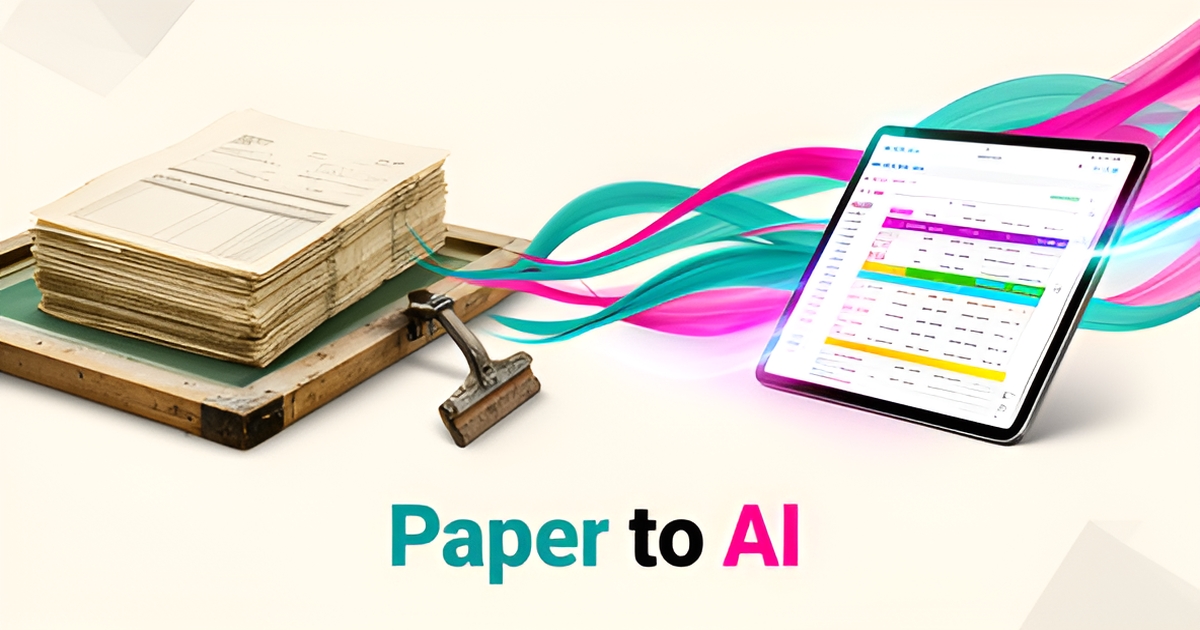
From Paper Orders to AI: How Screen Printing Businesses Can Digitize Their Order Flow
Key Facts
- Data accuracy consistently ranks as a top document automation priority in industry research, according to Rossum's industry research.
- A large share of organizations still rely on legacy OCR that can't handle handwritten orders or varying layouts, document automation trends show.
- High-confidence orders can be auto-approved while lower-confidence orders route for human review, as demonstrated in this open-source order system.
- Tesseract OCR is free and can run offline, offering a zero-licensing-cost path to order processing, according to the Order AI Backend project.
- Custom printing jobs involve a wide range of dimensions and turnarounds as tight as one business day, according to printing specifications.
- AI document processing combines OCR, machine learning, NLP, and RPA to extract and validate orders automatically, according to document processing experts.
- Google Document AI offers pre-built parsers for receipts and procurement documents with simple API integration, according to Google's implementation guide.
Hire a team member that works 24/7 — for less than a part-time wage.
AI receptionists, SDRs, dispatchers and 99+ roles. Trained on your business, fully managed.
Not sure where to start? Ask our AI planner
The Hidden Costs of Paper-Based Order Systems in Screen Printing
A single misread digit on a paper order form can derail an entire screen printing run—wrong garment count, wrong ink color, wrong delivery date. For print shops still relying on handwritten orders and manual entry, these small errors compound into costly reprints, missed deadlines, and strained client relationships.
The core problem is that paper-based workflows depend on human accuracy at every step. Staff members must decipher handwriting, manually key details into spreadsheets or job tickets, and physically route orders between departments. Each handoff introduces another opportunity for error, and the pressure intensifies during peak seasons when order volume spikes.
This isn't just anecdotal frustration. According to industry research from Rossum, improving data accuracy is a top priority in document automation—a clear signal that manual processes are failing to deliver the reliability modern operations demand.
The challenge runs deeper than occasional typos. Many print shops attempt to bridge the gap with legacy OCR tools, but the same research shows a significant share of organizations still rely on outdated OCR solutions that lack true intelligence. As document processing experts at turian explain, these older systems are "not efficient in handling unstructured data, like handwritten text, emails, or documents with varying layouts, formats, or languages"—precisely the kind of orders that arrive daily at a typical screen printing business.
The operational costs of sticking with paper extend across the entire workflow:
- Transcription errors that lead to incorrect garment counts, misprinted designs, or wrong shipping addresses
- Slow turnaround times as staff spend hours manually entering and verifying order details
- Limited scalability—doubling order volume typically means doubling administrative headcount
- Lost or damaged paperwork that creates gaps in order history and complicates reprints
- Inconsistent data across departments when sales, production, and shipping each maintain separate records
These bottlenecks become especially painful when customers expect rapid quotes and fast turnarounds. A custom printing job might involve dozens of specifications—multiple garment types, ink colors, print locations, finish options, and turnaround windows as tight as one business day. Capturing all of that accurately on paper, then re-entering it into production systems, creates friction at every stage.
Forward-thinking print shops are recognizing that order intake is a workflow problem, not just a paperwork problem. Custom AI systems built for order processing—like the ones AIQ Labs delivers through [AI Workflow Builds](/workflow-builds)—can capture, validate, and route orders automatically, eliminating the manual bottlenecks that keep print shops stuck in slow, error-prone cycles.
How AI Transforms Order Processing: From OCR to Intelligent Automation
Paper orders still slip through the cracks because manual entry is slow and error-prone. AI changes that by turning messy forms and handwritten notes into structured, validated data that moves through your shop automatically.
Traditional OCR extracts text from fixed layouts but stumbles on unstructured data. Industry analysis notes OCR-based tools are effective for standard documents with fixed formats but are not efficient in handling unstructured data like handwritten text, emails, or documents with varying layouts. That limitation drives the shift to intelligent systems.
Intelligent Document Processing adds machine learning, computer vision and RPA to OCR. The result is extraction plus classification. AI-backed solutions go further by using LLMs and NLP to understand context, meaning, and relationships between data points. Research on AI document processing highlights how this removes traditional limits.
Modern AI-powered order processing combines several capabilities:
- Document capture and preprocessing with deskewing, denoising and binarization
- Intelligent extraction and classification of customer names, products, quantities and prices
- Validation and confidence scoring with auto-approval for high-confidence orders
- Seamless integration with ERP, CRM and workflow automation via APIs
Confidence scoring drives routing decisions. In one open-source implementation, orders scoring above a high-confidence threshold are auto-approved while lower-confidence orders route for admin review. The system reads printed orders in any format, extracts products automatically, calculates totals and confidence, and sends low-confidence orders for review. The Order AI Backend project demonstrates this pattern.
Business priorities reflect the gap. Document automation research finds data accuracy tops the list of concerns for most businesses, while a large share are still working with legacy OCR solutions that lack true intelligence capabilities. The conversation shifts from what AI might do to what it delivers: faster processing, lower exception rates and reduced cost per document. Rossum's trends report captures this measurable impact focus.
Implementation approaches vary by control and cost. Cloud platforms like Google Document AI offer managed services with pre-built parsers for receipts and procurement documents and simple API integration. Google's procurement workflow guide shows how to enable the API, create a processor and map JSON output to business schemas.
Open-source stacks provide full ownership. Tesseract OCR is free and can run offline, paired with frameworks like NestJS and MongoDB for custom pipelines. The Order AI Backend repository illustrates a zero-licensing-cost model for shops that want control.
For screen printing businesses moving from paper to digital, AIQ Labs helps print shops transition smoothly with custom-built AI systems that maintain data integrity and reduce human error—workflows that auto-capture, validate and route orders end-to-end, built as owned assets rather than rented subscriptions.
Building Your AI Order Processing System: Key Components and Architecture
Paper orders create bottlenecks that slow screen printing shops down. An AI order processing system replaces manual entry with automated capture, validation, and routing that maintains data integrity and reduces human error.
The architecture starts with document capture and preprocessing. Orders arrive as PDFs, images, or emails and are normalized through deskewing, denoising, binarization, and cropping before processing. This step is critical because poor scan quality and inconsistent formatting can significantly impact extraction accuracy.
Intelligent data extraction follows. Modern systems combine OCR with Machine Learning and Natural Language Processing to identify document types and pull fields like customer names, product descriptions, quantities, and prices. According to industry research, data accuracy remains the top concern in document automation for most businesses, while many are still working with legacy OCR solutions that lack true intelligence capabilities.
Automated validation with confidence scoring adds a decision layer. Extracted data is checked against business rules and assigned a confidence score. As demonstrated in the Order AI Backend project, high-confidence orders can be automatically approved, while lower-confidence orders are routed for manual review. This approach ensures high-integrity auto-approval without risking errors.
Seamless integration completes the loop. Validated data flows via APIs into ERP, CRM, or workflow platforms like n8n, enabling end-to-end automation from capture to production.
Implementation approaches vary by control and speed needs:
- Cloud-based platforms such as Google's Document AI offer managed services with pre-built parsers and simple API integration for fast deployment
- Open-source implementations like the Order AI Backend use Tesseract OCR, NestJS, and MongoDB for full control and zero licensing costs
- Specialized AI platforms provide context understanding, intent recognition, and automated decision-making beyond simple extraction
AIQ Labs helps print shops transition smoothly with custom-built AI systems that maintain data integrity and reduce human error, architecting solutions that fit existing business systems rather than forcing wholesale replacement. The result is faster processing times, improved scalability, and better resource allocation as human reviewers focus on exceptions rather than routine processing.
Implementation Roadmap: Moving from Paper to AI-Powered Order Flow
The shift from paper-based orders to AI-driven workflows doesn't happen in a single leap—it unfolds through deliberate phases, each building on the last. Most screen printing shops start with a mix of email attachments, handwritten job tickets, and scattered spreadsheets, creating a fragile chain where data accuracy is the top automation concern. A structured roadmap turns that chaos into a repeatable, scalable process.
- Phase 1: Document capture and preprocessing — Centralize intake by routing every order (PDFs, photos, emails) into a single ingestion point. Apply deskewing, denoising, and binarization to normalize scan quality before extraction begins.
- Phase 2: Intelligent extraction and classification — Deploy an AI parser trained on your specific order formats to pull customer details, garment specs, ink colors, quantities, and deadlines. Confidence scoring separates clean orders from exceptions automatically.
- Phase 3: Validation and routing rules — Encode your business logic—minimum order quantities, stock availability, artwork approval status—so the system approves, flags, or escalates without human touch for routine jobs.
- Phase 4: System integration and automation — Push validated data into your MIS, ERP, or scheduling board via API or tools like n8n. Trigger production tickets, inventory commits, and customer confirmations in one flow.
- Phase 5: Continuous improvement loop — Track exception rates, retrain models on edge cases, and refine rules quarterly. The goal isn't perfection on day one—it's a system that gets sharper every month.
Common pitfalls include underestimating the variety of incoming order formats, skipping the preprocessing layer, and treating validation as an afterthought. Shops that try to force-fit generic OCR tools often hit the same wall: legacy OCR can't handle unstructured layouts or handwritten notes. The alternative isn't necessarily a massive build—cloud platforms like Google Document AI offer pre-trained parsers for rapid deployment, while open-source stacks such as the Order AI Backend provide full control with zero licensing costs. The right choice depends on your volume, technical capacity, and how unique your order structures are.
For teams that need a tailored pipeline—custom validation logic, deep MIS integration, or multi-location routing—partnering with a development team that owns the architecture end-to-end avoids the hidden costs of duct-taped SaaS tools. AIQ Labs builds these custom order-flow systems as owned assets, not rented workflows, so the logic, data, and IP stay with the shop. And once order intake is automated, the same foundation can support [AI Employees](/ai-employees) that handle quotes, order status calls, and customer follow-up—or grow into a full [AI Operating System](/ai-operating-systems) that connects intake, production, and billing in one layer. The first step is mapping your current order journey end-to-end; the second is deciding which phase delivers the fastest ROI. Start the Fit Check at aiqlabs.ai/apply to identify your highest-impact starting point, or book a free 30-minute strategy call at aiqlabs.ai/book to walk through the roadmap with an AI engineer.
Still paying for 10+ subscriptions that don’t talk to each other?
We build custom AI systems you own outright. No vendor lock-in. Full control.
Not sure where to start? Ask our AI planner
Frequently Asked Questions
How much do paper order mistakes actually cost a screen printing shop?
Will AI really read my handwritten job tickets and messy emails?
Isn't OCR good enough for order intake?
How does auto-approval work without risking mistakes?
Do I need expensive software to start digitizing orders?
What's the first step to move from paper to AI order flow?
Your Order Flow, Smarter: From Paper Chaos to AI Clarity
Screen printing businesses stuck with paper orders face a familiar frustration: misread digits, delayed jobs, and wasted resources that add up fast. As we've seen, the real issue isn't just the paperwork—it's the manual handoffs, transcription errors, and scalability limits that keep shops from operating at their best. The good news? AI-powered order processing changes that by turning chaotic inputs into structured, validated data that flows automatically through your shop. With capabilities like intelligent extraction, confidence scoring, and seamless system integration, you're not just digitizing forms—you're building a foundation for faster turnarounds, fewer errors, and smarter use of your team's time. The path forward starts with understanding where your order flow breaks down and which phase of automation delivers the quickest win. Take the first step by mapping your current process and exploring what's possible. Start the Fit Check at aiqlabs.ai/apply to see where AI can make the biggest impact in your shop.
Make AI your competitive advantage — not just another tool.
Strategy, implementation and ongoing optimization. One partner, end to end.
Not sure where to start? Ask our AI planner