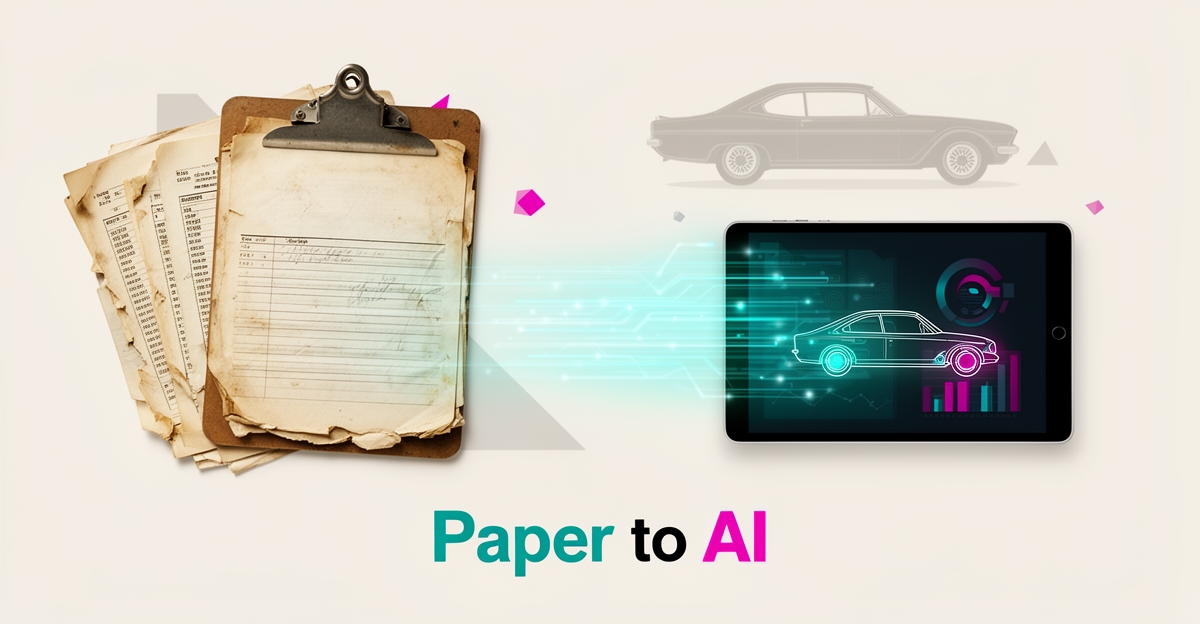
From Paper Records to AI: How Classic Car Dealers Can Digitize Their Maintenance Logs
Key Facts
- AI review can get through first passes up to 80% faster than manual review according to Source 5
- 79% of AI contract review users pointed to time savings as the payoff per Source 5
- 38% of in-house legal teams already use AI tools, with another 50% exploring implementation Source 5
- AI adoption for contract review surged 75% in a single year per LegalOn's 2025 State of Contracting survey
- The Netherlands digitized Holland America Line's passenger lists from 1900 to 1969, allowing individuals to explore immigration stories Source 1
- The In Codice Ratio project successfully transcribed complex handwritten Latin manuscripts from the Vatican Archives using CNNs Source 1
- MobiDev has a 9.1 NPS as of the 2025 Client Survey, with 400+ total clients and 5+ years average client retention Source 4
Hire a team member that works 24/7 — for less than a part-time wage.
AI receptionists, SDRs, dispatchers and 99+ roles. Trained on your business, fully managed.
Not sure where to start? Ask our AI planner
The Hidden Cost of Paper-Based Maintenance Logs in Classic Car Dealerships
Walk into most classic car dealerships and you'll find the same scene: filing cabinets stuffed with handwritten service logs, faded receipts in shoeboxes, and decades of vehicle histories locked inside paper that only one longtime employee can decipher. That paper isn't just inconvenient—it's quietly costing the business money, credibility, and insight every single day.
The first hidden cost is operational. Records analysts observe that most organizations still treat documents "like boxes in a warehouse"—kept for reference and revisited only when an audit looms, rather than treated as usable data (Daida). When a serious buyer asks for proof of an engine rebuild or a transmission overhaul, staff can spend hours—or days—digging through files. In adjacent document-heavy fields, AI review completes first passes up to 80% faster than manual review, a gap that illustrates just how much time manual retrieval leaves on the table.
The second cost is buyer trust. Classic car transactions hinge on transparency, and a vehicle's paper trail is often the difference between a confident sale and a stalled negotiation. Digitization efforts in government archives show why this matters: when records become searchable, a researcher who once needed weeks to find a document can locate it in seconds instead of weeks. Dealers who can instantly produce a complete, verified service history give buyers the confidence paper folders never could.
The third cost is analytical. Handwritten logs can't reveal patterns—but structured data can. Once maintenance records are digitized into searchable, normalized datasets, dealers can spot trends across their inventory: which models need frequent brake work, which engines fail at predictable mileage intervals, and which repairs tend to generate follow-up visits. This is the same principle used to train AI models that predict risk-prone areas from historical flood and fire records—applied instead to vehicle wear and tear.
The core problems with paper-based logs cluster into three areas:
- Retrieval delays: critical service facts are buried in unindexed paper, slowing sales and service decisions.
- Trust gaps: buyers can't verify a car's history quickly, undermining transparency at the moment it matters most.
- Missed intelligence: decades of wear-and-tear data sit inert instead of informing pricing and inventory choices.
Modern AI document processing—OCR, natural language processing, and computer vision—can now read cursive handwriting, interpret faded or damaged text, and tag records with searchable metadata, turning static files into structured data assets (MobiDev). At AIQ Labs, we've seen this same transformation pattern apply across industries: converting manual, unstructured workflows into owned, automated systems. For classic car dealers, the paper archive isn't just a storage problem—it's an untapped data asset waiting to work.
How AI Converts Scanned and Handwritten Logs into Structured, Searchable Data
Classic car dealers often face the challenge of turning decades of handwritten maintenance logs into usable, searchable data. AI-powered document processing transforms these analog records into structured digital assets by combining optical character recognition, computer vision, and natural language processing. This enables accurate extraction of critical details like service dates, part replacements, and mechanic notes from even the most complex or faded documents.
Modern OCR systems leverage convolutional neural networks (CNNs) to interpret intricate handwriting, including faded or damaged text, while recurrent neural networks (LSTMs) analyze sequential context to improve accuracy in cursive writing according to Source 1. Computer vision enhances this by analyzing document layouts to distinguish text, tables, and stamps—essential for maintenance logs with mixed formats as noted in Source 1. Once text is recognized, NLP models classify and extract entities such as vehicle VINs, service types, and part numbers, enabling structured data storage per Source 4.
A key capability in this pipeline is data normalization, which resolves inconsistencies like varied address formats or misspelled part names by transforming data into a common, searchable format as explained in Source 4. For example, AI can standardize entries like “123 Main St,” “123 Main Street,” or “123 Main St.” into a single verified format, improving searchability and reducing duplication per Source 4. This process mirrors real-world successes such as the Vatican’s In Codice Ratio project, which used CNNs to transcribe complex Latin manuscripts as cited in Source 1.
- Deskewing corrects scan angles for consistent image alignment
- Denoising removes grain, light spots, and scanner artifacts
- Binarization converts images to black and white for clearer text recognition
- Cropping frames the document to focus on relevant content
These preprocessing steps ensure that even low-quality scans of vintage logs are optimized before AI models process them per Source 4. The result is not just a digital copy of a paper log, but a structured dataset where each service entry can be searched, filtered, and analyzed—turning archival records into actionable intelligence for pricing, inventory, and buyer transparency. For dealers using AIQ Labs’ AI Documentation Generation services, this means transforming tribal knowledge into a repeatable, auditable system that supports both operational efficiency and customer trust.
A Phased Implementation Plan for Classic Car Dealers to Digitize Maintenance Records with AI
For classic car dealers, digitizing maintenance records isn’t just about going paperless—it’s about turning decades of handwritten logs into a strategic asset. With AI-powered document processing, dealers can convert smudged cursive notes, service stamps, and faded receipts into structured, searchable data that reveals patterns in vehicle wear and tear while building buyer trust through instant access to full service histories. AI-powered records management turns that habit on its head, converting static files into trusted data that fuels decisions and compliance.
A phased implementation plan ensures sustainable adoption without overwhelming limited dealer resources. Begin with an assessment to identify pain points—such as time lost searching for specific service records or inconsistencies in handwritten logs across decades of vehicle inventory. 79% of AI contract review users pointed to time savings as the payoff, making this initial step critical for proving value early. Establish a governance framework that includes security, compliance, and business owners to define metadata standards for fields like service dates, part replacements, and mechanic observations, ensuring consistency across digitized records.
Select tools that prioritize accuracy with historical documents and offer clear ownership of extracted data—key considerations since 38% of in-house legal teams already use AI tools, with another 50% exploring implementation. Preprocess scanned logs through deskewing, denoising, binarization, and cropping to improve OCR accuracy on faded or damaged pages. Launch a pilot with one high-volume workflow, such as digitizing all service records for a single vehicle model, to surface gaps early and build team trust before scaling. Implement AI-driven classification and extraction to tag entities like VINs, service types, and mileage, then connect enriched fields to enterprise systems so analytics can generate dashboards tracking wear-and-tear patterns. Finally, evaluate performance metrics like search speed and error rates, adapting the system as new record types or compliance needs emerge.
- Start with assessment to quantify manual effort lost to paper logs
- Establish governance for consistent metadata tagging across decades of records
- Select tools with proven accuracy on historical documents and clear data ownership
- Preprocess scans to improve OCR on smudged or cursive handwriting
- Pilot with one vehicle model’s records before full inventory rollout
Still paying for 10+ subscriptions that don’t talk to each other?
We build custom AI systems you own outright. No vendor lock-in. Full control.
Not sure where to start? Ask our AI planner
Frequently Asked Questions
How can AI actually read my mechanics' faded, handwritten service logs from the 1970s?
Will digitizing our paper logs really save us time when buyers ask for service history?
Isn't AI just for big companies? We're a small classic car shop—can we afford this?
What if the AI makes mistakes reading our old logs—could that hurt buyer trust?
How do we start digitizing without disrupting our daily operations?
Can digitized logs help us spot patterns in which cars need frequent repairs?
Turn Your Filing Cabinets Into a Competitive Edge
Paper maintenance logs were never meant to be a sales tool — they slow down deals, erode buyer trust, and keep decades of wear-and-tear intelligence locked away. AI-powered document processing changes that by turning handwritten service notes, faded receipts and stamps into structured, searchable data you can retrieve in seconds, verify with confidence, and analyze for pricing and inventory decisions. The shift from static files to trusted data assets is a phased journey — assess the costliest retrieval pain points, establish consistent metadata governance, preprocess scans for accuracy, and pilot with one model before scaling across inventory. Classic car dealers who make this move stop relying on tribal memory and start offering instant provenance that buyers pay for. AIQ Labs supports this transformation through AI Documentation Generation services that convert analog records into repeatable, auditable systems. See if it fits your operation by Start the Fit Check for a free 30-minute strategy call to map your biggest bottleneck and high-ROI automation opportunity.
Make AI your competitive advantage — not just another tool.
Strategy, implementation and ongoing optimization. One partner, end to end.
Not sure where to start? Ask our AI planner