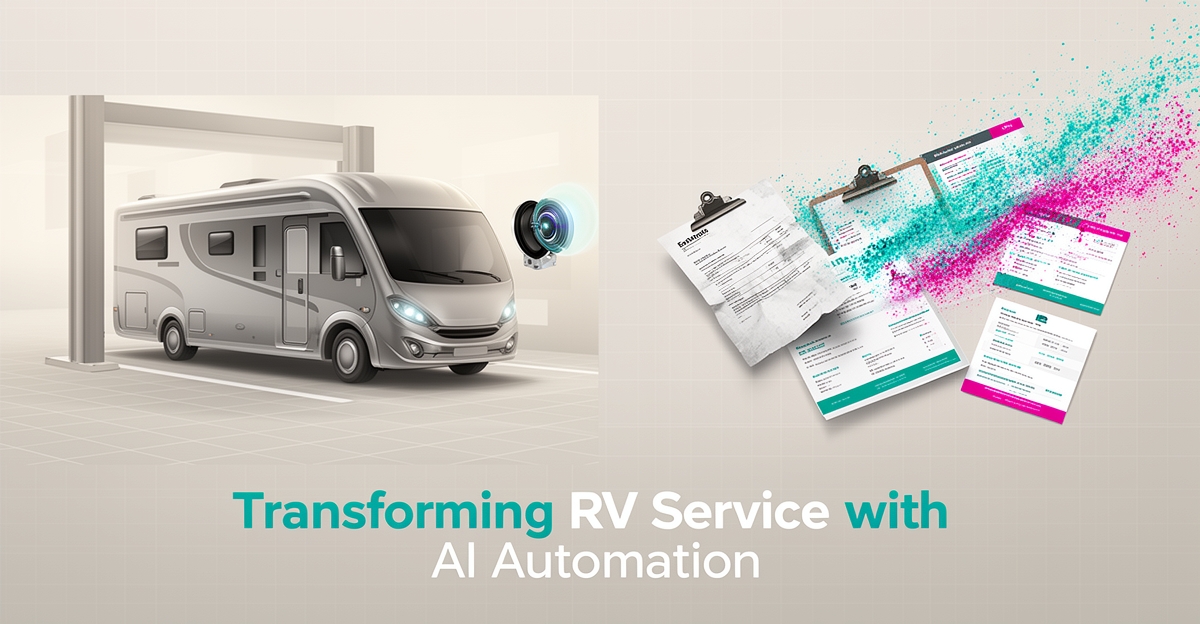
From Paper to AI: Automating Service Estimates in RV Body Shops
Key Facts
- Manual inspection and data entry accuracy tends to drift over a long shift, meaning late-day estimates carry more error risk.
- Fully loaded labor for manual inspection and retyping typically runs in the tens of dollars per hour—and multiplies across every estimate.
- AI vision and document systems are typically built to target detection accuracy in the high 90s and operate around the clock without fatigue.
- Document AI can group description and price as one line item entity using specialized parsing.
- Estimates move from hours to seconds with structured JSON output that integrates directly into estimating engines.
Hire a team member that works 24/7 — for less than a part-time wage.
AI receptionists, SDRs, dispatchers and 99+ roles. Trained on your business, fully managed.
Not sure where to start? Ask our AI planner
The Hidden Cost of Paper Estimates: Accuracy Drift and Lost Hours
The daily grind in an RV body shop often starts with a technician scribbling damage notes on a clipboard, then retyping those line items into a spreadsheet or estimating software hours later. This manual dance isn't just tedious—it's costly. Fully loaded labor for manual inspection and data entry typically runs in the tens of dollars per hour, a figure that adds up fast when estimates take hours to complete due to repetitive typing and verification steps. Worse, accuracy tends to drift as a shift wears on, meaning estimates created late in the day are more likely to contain errors that trigger costly warranty claims or customer returns.
These hidden costs compound in ways that aren't always visible on the balance sheet. Fatigue-induced mistakes can lead to underquoted jobs that eat into profits or overquoted ones that drive customers away. Each incorrect estimate risks not only immediate financial loss but also long-term damage to reputation when clients discover discrepancies after repairs are complete. The reliance on handwritten reports and manual data entry creates a fragile process where human variability directly impacts financial outcomes and customer trust.
AIQ Labs addresses this bottleneck by building custom AI systems that transform paper-based estimates into instant, accurate quotes. Using document processing technology, these systems extract structured data from photos of damage or handwritten reports in seconds, eliminating the need for retyping and reducing human error. By integrating customer history and vehicle data, the AI generates personalized estimates that are both reliable and transparent—turning a daily pain point into a streamlined, trustworthy workflow. For shops that want a faster starting point, managed AI Employees can handle intake, follow-ups, and scheduling around the estimate workflow.
How Document AI Turns Damage Reports Into Structured Quotes in Seconds
Picture the front desk of a busy RV body shop: a stack of handwritten damage forms, phone photos of dented fiberglass, and crumpled parts receipts waiting to be typed into an estimate. Document AI collapses that entire workflow into seconds by converting unstructured paperwork into clean, structured data.
The core technology works like a specialized document parser. Machine learning models automatically classify, extract, and enrich data from images and PDFs, identifying key entities such as line items, supplier information, currency, and amounts. Google's Document AI platform demonstrates how a parser can group related data naturally—recognizing that a description and a price belong together as a single line item entity—something standard OCR struggles to do, according to Google Cloud's technical breakdown.
The output is structured JSON rather than raw text. That distinction matters enormously for body shops, because structured data plugs directly into estimation software, databases, and quoting engines without a human retyping a single field. As Google puts it, with this structure you can build a schema for downstream systems so you never manually create an expense report again—the same principle applies to estimate creation.
Volume is where the technology truly earns its keep. Document AI supports asynchronous batch calls that process large sets of documents in the background without blocking the main application, which is essential when a shop is juggling dozens of insurance claims and walk-in estimates simultaneously.
Once extraction is complete, the real magic happens: personalization. The structured vehicle data—make, model, damage location, parts costs—combines with customer history to feed real-time estimate generation. This is the approach AIQ Labs takes when building custom systems that process vehicle details and generate accurate, personalized quotes in seconds rather than hours.
The consistency gains are well documented in adjacent industries. Manual data entry and inspection tend to suffer from accuracy drift over long shifts, while AI-driven systems are typically built to target detection accuracy in the high 90s and operate around the clock without fatigue. For a shop owner, that means an estimate generated at 4:45 PM is just as reliable as one produced at 9:00 AM.
Reliability, however, cannot come at the cost of trust. Because these systems handle customer history and financial data, they must be built with privacy protections, transparent logic, and human oversight—principles Microsoft outlines as foundational requirements for responsible AI. A service advisor should always be able to review and explain a generated quote.
Key capabilities that make this workflow work include:
- Automatic entity extraction from photos, handwritten forms, and receipts
- Structured JSON output that integrates directly with estimation engines
- Asynchronous batch processing for high-volume claim periods
- Customer history and vehicle data feeding personalized, real-time quotes
The result is a shop where estimates move from hours to seconds, staff escape the drudgery of data entry, and advisors spend their time where it matters—explaining the repair and building customer trust.
Building Trust: The Responsible AI Guardrails Every Estimate System Needs
Handing pricing authority to an algorithm feels risky because estimates carry real financial weight for both the shop and the customer. Microsoft's responsible AI framework addresses this directly by anchoring every system in six principles: fairness, reliability and safety, privacy and security, inclusiveness, transparency, and accountability. These aren't abstract ideals—they are the operational guardrails that prevent an automated quote from becoming an unchecked liability. When an AI generates a repair estimate, it must treat every customer equitably, perform consistently across varying input quality, and protect the sensitive vehicle and history data it ingests.
- Fairness checks ensure pricing logic doesn't drift based on demographics or location
- Reliability standards demand consistent accuracy whether the input is a high-res scan or a low-light photo
- Privacy-by-design architecture secures customer history against breaches
- Transparency tooling surfaces the "why" behind every line item
- Accountability structures keep a human in the loop for final sign-off
The "human-in-the-loop" model isn't a bottleneck—it's the trust mechanism. Manual inspection accuracy tends to drift over hours of continuous work, while AI systems maintain consistent performance around the clock. By letting the machine handle the exhaustive data extraction and calculation, then requiring a technician to review and approve the output, shops get the best of both: machine consistency and human judgment. This approach also solves the explainability problem. When a customer asks why a fender replacement costs $2,400, the estimator can show the exact parts pricing, labor hours, and historical benchmarks the AI surfaced, turning a black-box quote into a collaborative conversation.
AIQ Labs builds these guardrails into every custom estimation system we deploy, ensuring the automation enhances your reputation rather than risking it. The goal isn't to remove the estimator from the process; it's to remove the drudgery so their expertise lands where it matters most—on the complex judgment calls that build lifelong customer loyalty.
Your Implementation Roadmap: From First Scan to Full Estimate Automation
A practical four-step path modeled on the Document AI workflow: create the parser, set up processing code, batch large document sets, and integrate structured output into your estimating and CRM systems. Start by enabling the Document AI API and setting up service account authentication, then navigate to the console to create a processor tailored for damage reports or receipts—copying the unique Processor ID for reference per Google Cloud's Document AI workflow. Next, initialize a client in your preferred language (Python, Java, or Node.js), reference the processor using its full resource name, read the document file, and execute the API call to extract text entities with high precision as demonstrated in production implementations. For high-volume operations, leverage asynchronous batch calls to process multiple documents simultaneously in the background without blocking your main application, integrating with cloud storage solutions like Google Cloud Storage to handle large sets efficiently. Finally, inspect the structured JSON output to verify key entities like line items, amounts, and supplier information are correctly grouped, then create a schema to feed this data directly into your estimation engine or CRM for automated quote generation eliminating manual data entry entirely.
This layered architecture ensures resilience: fast local processing handles real-time quote generation so network hiccups never stop quoting, while centralized cloud dashboards aggregate data for analytics and long-term storage. The economic case is compelling—automation of this kind typically pays for itself well within the first couple of years, transforming what was once an hours-long manual task into a seconds-driven process. Yet caution is warranted: shops that attempt to build these systems entirely in-house often spend a year or more and still end up with something that doesn't hold up in production, underscoring the value of partnering with experienced providers who deliver production-ready systems. If you'd rather rebuild just the one workflow that costs you the most, AIQ Labs' fixed-price Workflow Builds are designed for exactly that. By following this roadmap, RV body shops can replace paper-based drudgery with AI-powered accuracy, freeing staff to focus on the human elements of service that build trust and loyalty. To explore how AIQ Labs can architect your custom estimate automation system with full ownership and no vendor lock-in, start with a free strategy call to map your specific workflow and ROI potential.
Keeping the Human Touch While the AI Does the Paperwork
The estimate is printed, but the customer remembers how you looked them in the eye.
AI removes the drudgery of data entry so staff can focus on explaining damage, building trust, and personalized service — the emotional "vibe" customers actually remember. When document processing turns photos and handwritten forms into structured data in seconds, teams stop retyping line items and start having conversations.
Manual inspection and data entry tend to drift in accuracy over long shifts, and the labor costs add up with every estimate. Production data on manual QA shows that fatigue increases error rates and warranty risk, while AI vision systems are typically built to target high-90s detection accuracy and run around the clock without fatigue.
That shift matters in the shop. Customers don't bond with a faster PDF; they bond with a clear explanation of what's damaged, why it costs what it costs, and how you'll care for their RV. Automation handles the paperwork, humans handle the trust.
Responsible automation keeps the human in control. Microsoft's principles for responsible AI call for transparency, reliability, and accountability, with humans remaining responsible for AI output. Principles for trustworthy systems emphasize fairness, privacy and security, and the ability for a person to intervene when an estimate looks off.
Custom-built, owned systems protect your shop's identity while automating the routine. AIQ Labs builds custom AI systems that process vehicle details and generate accurate, personalized estimates in seconds, with payment models that fit SMB realities: Start Monthly, Build in Milestones, or Own It Outright. Whichever you choose, you automate without losing control of your process or data—and for shops ready to connect estimating, scheduling, and customer communication into one layer, an AI Operating System ties it all together.
What stays human when estimates go real-time:
- Explaining damage in plain language and showing photos with context
- Validating the AI-generated quote against real-world parts availability and shop capacity
- Building rapport, managing expectations, and turning a stressful repair into a trusted relationship
- Signing off on the final number with accountability, as required by responsible AI practice
The result is speed without sterility. Fast local processing delivers near-instant detection-to-decision latency for immediate quote generation, while cloud integration supports analytics and history. Layered architectures for production AI ensure uptime even during network outages, so the conversation never stalls.
Keep the human touch where it earns loyalty. Let AI do the paperwork, and let your team do the people work.
Start the two-minute Fit Check at https://aiqlabs.ai/apply, then book a free 30-minute strategy call at https://aiqlabs.ai/book to map your biggest bottleneck and identify high-ROI automation opportunities.
Still paying for 10+ subscriptions that don’t talk to each other?
We build custom AI systems you own outright. No vendor lock-in. Full control.
Not sure where to start? Ask our AI planner
Frequently Asked Questions
How long does it take to generate an estimate with AI compared to manual methods?
What is the accuracy of AI-driven estimate systems compared to manual entry?
How much does manual estimate creation cost per hour in labor?
What happens if I build an AI estimate system in-house instead of partnering with a provider?
How does AI ensure estimates are fair and transparent for customers?
What is the typical return on investment timeline for automating RV body shop estimates with AI?
The Clipboard Era Is Over: Your Next Estimate Could Take 30 Seconds
The math is hard to argue with. Manual estimates consume hours of skilled labor, accuracy drifts as the day wears on, and every misquoted job risks warranty claims or lost customers. AI-driven document processing flips that equation: damage photos and handwritten forms become structured data in seconds, feeding personalized quotes with consistent, high-accuracy extraction and a payback period typically measured well under two years. Just as importantly, responsible guardrails—transparency, privacy, and a human signing off on every final number—mean automation strengthens customer trust instead of eroding it. Your team stops retyping line items and starts doing the work that actually builds loyalty: explaining the repair, validating the quote, and looking the customer in the eye. You don't have to figure out the architecture alone. Start the two-minute Fit Check at https://aiqlabs.ai/apply, then book a free 30-minute strategy call at https://aiqlabs.ai/book to map your biggest bottleneck and see your real ROI potential—and if there isn't a clear win, we'll tell you that too.
Make AI your competitive advantage — not just another tool.
Strategy, implementation and ongoing optimization. One partner, end to end.
Not sure where to start? Ask our AI planner