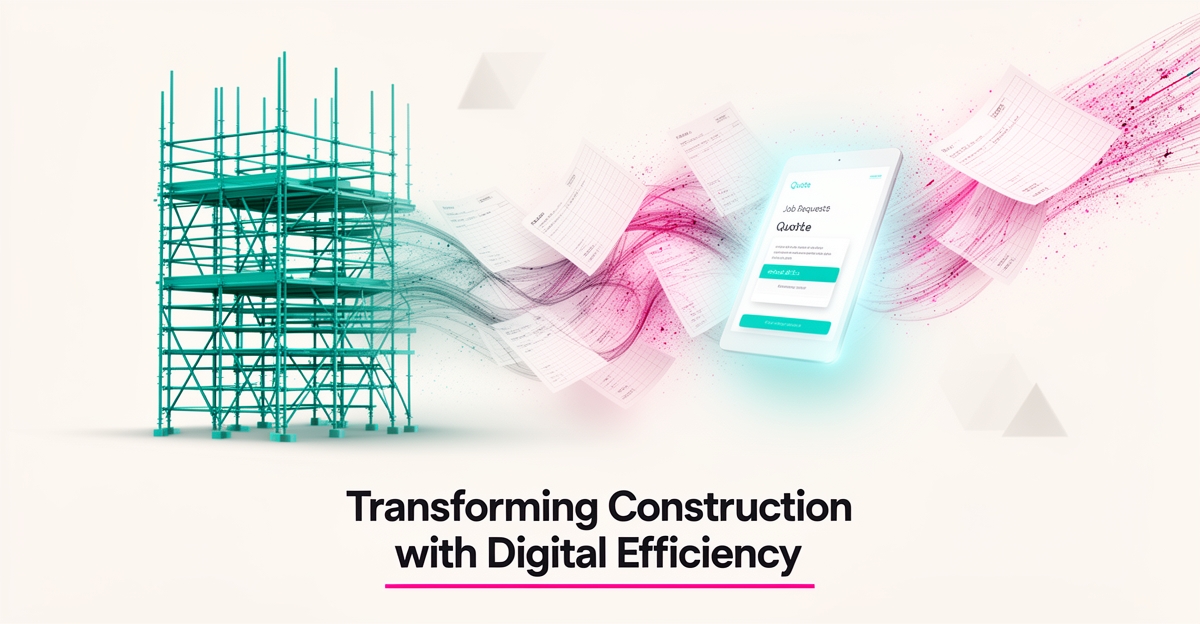
From Paper to AI: How Scaffolding Rentals Can Digitize Job Requests & Quotes
Key Facts
- AI automates instant quote generation from job site photos or descriptions for scaffolding rentals
- AI-powered intake converts calls, forms and emails into structured job requests instantly
- Automated workflows reduce manual data entry, transcription errors, and quote turnaround time
- Phased builds let you prove ROI on one workflow before scaling across operations
- Owned systems mean long-term control—no per-seat subscription stack
Hire a team member that works 24/7 — for less than a part-time wage.
AI receptionists, SDRs, dispatchers and 99+ roles. Trained on your business, fully managed.
Not sure where to start? Ask our AI planner
Introduction
The construction industry is in the middle of a digital shift, and scaffolding rentals are uniquely positioned to benefit from AI-driven automation. Moving from paper-based job requests to intelligent workflows isn't just about modernization—it's about unlocking speed, accuracy, and responsiveness in a competitive market.
AI-powered systems can now automate quote generation and crew dispatch in real time, reducing the delays and errors inherent in manual processes. Every hour a quote sits on a clipboard is an hour a competitor can undercut you. Every transcribed measurement is a chance to quote the wrong scaffold package. Automation removes both problems at the source.
- Instant quote generation from job site photos or descriptions
- Automated crew scheduling based on availability and location
- Reduced manual data entry and paperwork
- Fewer quoting errors through automated validation
- 24/7 customer request processing
For scaffolding rental companies, this shift means turning every inquiry into a tracked, actionable workflow—from initial request to final invoice. AI tools like conversational interfaces can interpret job details, pull pricing rules, and generate professional quotes without human intervention. AI doesn't replace expertise—it amplifies it, letting teams focus on complex decisions while automation handles the routine.
AIQ Labs helps scaffolding rental businesses build custom AI workflows that integrate with existing dispatch and accounting systems, ensuring a smooth transition from paper to automation. By starting with a targeted workflow fix—such as automating job requests and quotes—companies can validate ROI quickly before scaling across operations. The result is a leaner, more responsive business that meets customer expectations for speed and precision.
Key Concepts
Paper job requests create bottlenecks that slow scaffolding rentals from first call to crew dispatch. Moving to AI-powered workflows replaces manual forms and phone tag with instant intake, automated quoting, and real-time scheduling.
AI automates and streamlines job requests and quotes, reducing manual labor and increasing productivity. The shift delivers improved accuracy in quotes and job requests while enhancing customer experience through instant quotes and faster crew dispatch.
Efficiency gains show up quickly once workflows are digitized. Time that used to go to transcribing job cards, chasing pricing approvals, and re-keying orders gets recaptured—and that time directly supports more jobs processed without adding headcount.
Speed compounds across the delivery cycle. When quote validation and approval steps run automatically, the entire path from inquiry to dispatched crew shortens. What used to take a day of phone tag can happen in minutes.
Parallel work becomes practical. Instead of handling one quote at a time, scaffolding operations can process multiple site assessments, quote revisions, and dispatches simultaneously rather than sequentially.
Core concepts that enable this transition include:
- Automated intake that converts calls, forms, and emails into structured job requests
- Quote generation that applies pricing rules, site requirements, and inventory availability instantly
- Dispatch integration that pushes approved jobs to crews and updates customers automatically
- Data quality foundations that ensure automated decisions are reliable across existing systems
Integration with existing systems remains a primary challenge. AI tools may require integration with existing systems, which can be time-consuming and costly if approached carelessly. Data quality also matters because automated systems require high-quality data to function effectively, which can be a challenge in the construction industry.
Change management shapes adoption success. Implementing AI may require significant changes to business processes and workflows, which can be challenging for employees. Best practices recommend starting small with a pilot project, defining clear goals, and providing training and support for employees.
AIQ Labs builds custom systems that integrate with existing operations to ensure smooth adoption. Through [AI Workflow Builds](/workflow-builds), we rebuild the one workflow that costs you the most—like job intake and quoting—at a fixed price, in phases. The approach prioritizes owned systems rather than subscription stacks, with workflows designed for long-term control.
The transition is not about replacing crews or estimators. It is about removing repetitive manual steps so teams can focus on site safety, customer service, and growth.
Best Practices
Paper-based job requests are costing scaffolding rentals time, accuracy, and crews on standby. Moving to AI-powered workflows requires disciplined execution, not just new software.
Start with a contained pilot instead of a full rollout. A small pilot project lets you test AI tools and workflows on one crew or one quote type before scaling. This approach limits risk while proving value, and it surfaces integration points with existing systems early. Teams that begin narrow can define success metrics and adjust faster than those attempting a company-wide change at once.
Define clear goals before any tool is selected. Clearly define the goals and objectives of the AI project so automation targets real bottlenecks like quote turnaround and dispatch latency. Goals should tie to measurable outcomes such as quote speed, error reduction, and crew utilization. Without that clarity, AI becomes a feature search rather than a workflow fix.
Data quality and change management determine adoption. Automated systems require high-quality data to function effectively, which can be a challenge in the construction industry where job cards and site notes are inconsistent. Clean, structured inputs for scaffold type, height, access, and duration are essential for reliable instant quotes. Provide training and support for employees to ensure a smooth transition and reduce resistance.
- Start small with a pilot project to test AI tools and workflows on a limited scope
- Define clear goals and objectives tied to quote speed, accuracy, and dispatch time
- Provide training and support for employees to build confidence with new processes
- Integrate AI tools with existing systems to avoid data silos and manual re-entry
For scaffolding rentals, that discipline translates to instant quotes and faster crew dispatch. Automation of job requests and quotes reduces manual labor and improves productivity while improving accuracy in quotes and job requests. Enhanced customer experience follows when instant quotes and dispatch become the norm.
AIQ Labs supports this transition through AI Workflow Builds that integrate with existing operations to ensure smooth adoption. Custom systems can connect CRM, scheduling, and dispatch so a customer request triggers quote generation, approval, and crew assignment without paper handoffs.
Implementation
Moving from paper job requests to instant AI quotes is less about buying software and more about rebuilding the workflow around real data. Scaffolding rentals live on speed, accuracy, and crew availability, and manual forms create bottlenecks at every step.
Start by defining clear goals and objectives for the AI project before any tool is selected. Freeing staff from repetitive data entry lets them focus on site work and customer conversations. That time gain is the foundation for faster quoting and dispatch.
Map the current paper process end-to-end and identify the highest-friction points. Job intake, site measurement capture, pricing rules, and crew assignment are typical candidates for automation. Integration with existing systems is a common challenge, so audit your CRM, accounting, and dispatch tools early to avoid costly rework later.
A practical rollout follows a controlled, phased approach:
- Pilot a single workflow, such as inbound job requests to instant quote generation, with a small set of customers.
- Integrate AI tools with existing systems to create a single source of truth for inventory, pricing, and crew schedules.
- Provide training and support for employees to ensure a smooth transition and adoption of new workflows.
- Monitor and evaluate effectiveness with clear KPIs for quote speed, error rate, and dispatch time.
Data quality determines success. Automated systems require high-quality data to function effectively, which can be a challenge in the construction industry where site details are often handwritten. Clean historical quotes, standardize measurement fields, and digitize asset records before building automated quoting.
Change management matters as much as technology. Implementing AI may require significant changes to business processes and workflows, which can be challenging for employees accustomed to paper. Start small with a pilot project to test AI tools and workflows, build trust, and demonstrate wins.
When teams adopt AI for workflow automation, they often see parallel gains in throughput. Instead of processing one quote at a time, your business can handle multiple site assessments and dispatch jobs concurrently rather than sequentially. Improved accuracy follows as automation reduces errors in quotes and job requests from manual transcription.
AIQ Labs builds custom systems that integrate with existing operations to ensure smooth adoption, focusing on workflow and task automation that fits scaffolding operations rather than forcing a generic platform. For companies ready to go further, an [AI Operating System](/ai-operating-systems) connects intake, quoting, dispatch, and billing into one owned operating layer, built in phases. The goal is instant quotes and crew dispatch without replacing the people who know the sites.
Continuous monitoring closes the loop. Track quote-to-dispatch time, customer satisfaction, and manual rework. With clear goals, clean data, and employee support, paper-based job requests become automated, AI-powered workflows that scale with demand.
Conclusion
The journey from paper-based job requests to AI-powered automation isn't just a technological upgrade—it's a fundamental shift in how scaffolding rental businesses operate, compete, and serve their customers. By digitizing workflows, companies unlock measurable gains in speed, accuracy, and customer satisfaction while positioning themselves for scalable growth in an increasingly digital marketplace.
Every week you stay on paper, the costs compound: quotes that take hours instead of minutes, transcription errors that trigger rework, and inquiries that go unanswered after hours. Competitors who automate first will win the jobs you're still writing up by hand.
For scaffolding rental businesses ready to begin this transition, success hinges on a structured, phased approach:
- Start with a clearly defined pilot—such as automating job request intake for a single service line or geographic region—to validate ROI and refine workflows before scaling.
- Prioritize data quality by auditing existing job templates, pricing rules, and crew availability logs to ensure AI systems have accurate inputs for reliable quote generation.
- Invest in targeted training that focuses not just on tool operation but on how AI augments human expertise—helping dispatchers and estimators shift from data entry to higher-value tasks like client consultation and complex job planning.
- Choose integration-friendly AI solutions that connect seamlessly with existing scheduling, invoicing, and fleet management tools to avoid creating new silos.
- Establish clear metrics from day one—tracking quote turnaround time, error rates, and crew dispatch efficiency—to measure impact and justify further investment.
AIQ Labs specializes in guiding scaffolding rental companies through this exact transformation, building custom AI workflows that own job requests end-to-end—from initial customer inquiry to automated quote generation and crew dispatch—while integrating with the tools teams already use daily. With 200+ multi-agent systems deployed and four live SaaS products we run ourselves, we build systems we'd rely on. The result isn't just digitized paperwork; it's a responsive, intelligent operational core that adapts to demand, reduces manual burden, and delivers faster, more accurate service at scale.
To explore how this applies to your specific operations, start with a free strategy call to assess your current processes and identify high-impact automation opportunities. Visit [the Fit Check](/apply) to begin—it takes two minutes—or book a free 30-minute strategy call directly. The path from paper to AI is clearer than ever—and the first step is simply deciding to begin.
Still paying for 10+ subscriptions that don’t talk to each other?
We build custom AI systems you own outright. No vendor lock-in. Full control.
Not sure where to start? Ask our AI planner
Frequently Asked Questions
How can AI actually help my scaffolding rental business with quotes and job requests?
Will AI replace my estimators and office staff?
How much time can we realistically save by switching from paper to AI workflows?
What's the biggest challenge when moving from paper to AI-powered workflows?
How do we get started without disrupting our current operations?
Can AI handle multiple job requests and quotes at the same time?
From Paper to Precision: Your Scaffolding Rental's AI Advantage
Transitioning from paper-based job requests to AI-powered workflows isn't just about adopting new technology—it's about reclaiming time, reducing errors, and delivering faster, more accurate service to your customers. As outlined in this article, automating quote generation, crew dispatch, and data entry cuts admin hours and boosts productivity without adding headcount. For scaffolding rental businesses, this means turning every inquiry into a tracked, actionable workflow—from initial request to final invoice—while freeing your team to focus on site safety, client relationships, and growth. The path forward starts small: pilot a single workflow like instant quote generation, prioritize clean data, and integrate with your existing systems to avoid silos. AIQ Labs specializes in building custom AI workflows that integrate seamlessly with your current tools, ensuring you own the system and maintain long-term control. To see how this applies to your operations, start with a free strategy call to assess your processes and identify high-impact automation opportunities. Visit [the Fit Check](/apply) to begin, or book a free 30-minute strategy call for immediate guidance. The shift from paper to AI is clearer than ever—and the first step is simply deciding to begin.
Make AI your competitive advantage — not just another tool.
Strategy, implementation and ongoing optimization. One partner, end to end.
Not sure where to start? Ask our AI planner