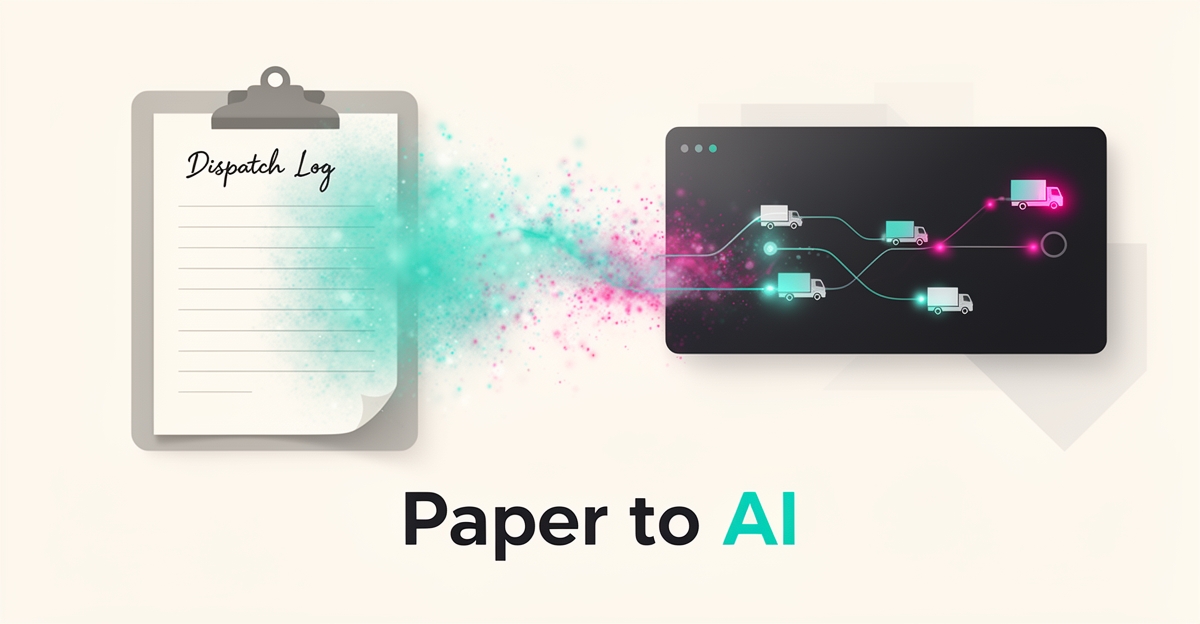
From Paper to AI: Modernizing Freight Brokerage Dispatch Logs
Key Facts
- AI dispatch can cut planning time from hours to minutes for a 15-driver fleet as demonstrated in real-world deployments
- AI document extraction typically reaches high first-pass accuracy on freight documents, eliminating several minutes of manual entry per file according to industry research
- Manual processing of freight documents typically takes 5-15 minutes per file with a meaningful error rate according to industry research
- A mid-sized forwarder processing hundreds of shipments monthly can spend 40+ hours on manual data extraction according to industry research
- AI can support strong final-mile ETA prediction by analyzing lane performance patterns according to industry research
- Companies adopting AI-driven logistics tools commonly report double-digit cost reductions while improving service levels from research reports
- The freight dispatcher role is considered highly augmentable by AI rather than fully automatable from workforce analysis
Hire a team member that works 24/7 — for less than a part-time wage.
AI receptionists, SDRs, dispatchers and 99+ roles. Trained on your business, fully managed.
Not sure where to start? Ask our AI planner
The Hidden Cost of Paper Dispatch Logs
Manual dispatch is reactive by design, forcing teams to spend hours on check-calls, document entry, and error correction rather than strategic work. A dispatcher managing 30 active loads can easily spend 2-4 hours daily just confirming truck locations by phone—a task that adds no strategic value to the organization.
This administrative burden extends to document processing, where manual handling of freight documents like bills of lading and invoices typically takes 5-15 minutes per file and carries an error rate high enough to trigger customs holds, payment disputes, and damaged carrier relationships. For a mid-sized forwarder processing hundreds of shipments monthly, these inefficiencies accumulate into dozens of hours each month spent solely on manual data extraction.
The financial stakes keep rising: rising driver costs and fuel volatility squeeze margins for operations still running on paper, while brokerages that delay automation risk falling behind peers already using predictive analytics to protect margin.
- 2-4 hours daily on check-calls for 30 active loads
- 5-15 minutes per document processed manually, with recurring errors
- Dozens of hours monthly lost to manual data extraction for mid-sized forwarders
When dispatchers are freed from reactive tasks like check-calls and manual data entry, they can shift focus to high-value activities such as building carrier relationships and managing complex exceptions—exactly the strategic oversight AIQ Labs enables through its AI Workflow Builds and AI Employees.
Start the Fit Check—a free 2-minute assessment—then book your free 30-minute strategy call at aiqlabs.ai/book to assess your current dispatch workflow and identify high-ROI automation opportunities.
What AI Actually Does With Your Dispatch Data
Modern dispatch logs are no longer just records of what happened—they're becoming engines for what will happen next. AI transforms raw, unstructured data into forward-looking intelligence, shifting brokerage operations from reactive firefighting to proactive optimization.
AI begins by digitizing the chaos of paper, PDFs, and handwritten CMRs with high first-pass extraction accuracy, eliminating the 5-15 minutes of manual entry once required per document and cutting admin time substantially according to industry research. This isn't just faster data entry—it's the foundation for real-time anomaly detection, where AI flags detention risks, geofence breaches, and HOS conflicts before they trigger costly invoice line items.
Beyond monitoring, AI turns historical logs into predictive assets. Models can predict final-mile ETAs by analyzing lane performance patterns, while demand forecasting and dynamic pricing insights help brokers anticipate load volumes and protect margins. The operational impact is stark: planning time that once took hours for a 15-driver fleet can drop to minutes with AI dispatch, and scalability jumps from managing 10-15 drivers manually to overseeing hundreds with AI-assisted routing as demonstrated in real-world deployments. For freight brokerages, this means dispatchers spend less time on data entry and more on strategic decisions—exactly the shift AIQ Labs enables through AI Operating Systems that turn dispatch data into actionable foresight.
Augmented, Not Replaced: The New Dispatcher Role
The fear of AI replacing human dispatchers is understandable but misaligned with the data. Workforce analysis classifies the freight dispatcher role as highly augmentable rather than fully automatable—a critical distinction for workforce planning. This means AI takes on repetitive, data-intensive tasks while humans focus on areas requiring judgment, empathy, and strategic thinking.
In practice, the hybrid model is already proving effective. AI handles data entry from PDFs and emails, checks documents for accuracy, matches loads against carrier constraints, and monitors shipments for routine exceptions. This automation typically reclaims several hours weekly for experienced dispatchers, time previously lost to manual administrative work. As a result, dispatchers can redirect their efforts toward building carrier relationships, resolving complex customer issues, and managing escalations that demand negotiation skills and contextual understanding.
Importantly, vendors sometimes overpromise on AI's capabilities. Relationship decisions—such as whether to continue working with a carrier after repeated claims—remain inherently human calls. AI lacks the contextual awareness to assess trust, communication history, or long-term partnership potential, making these judgments irreplaceable by automation. The most successful operations recognize this boundary, using AI to inform decisions but not to make them.
Adoption barriers persist, particularly around workforce readiness. Digital literacy is frequently cited as the primary obstacle to AI deployment in logistics operations. To overcome this, role-segmented training is essential—office staff need dashboard and analytics fluency, while driver-facing teams require simplified, safety-compliant interfaces. Without tailored upskilling, even the most advanced AI tools will underperform due to human-system friction.
AIQ Labs supports this transition with AI Employees—managed AI staff that integrate with human dispatchers and handle routine workflows so teams can focus on higher-value activities, at roughly 80% less cost than a human hire. The goal isn't to remove the dispatcher but to elevate their role—turning data clerks into strategic operations managers who use AI as a force multiplier, not a replacement. This approach ensures technology serves people, not the other way around.
How to Modernize Your Dispatch Operation: A Practical Roadmap
Modernizing your dispatch operation begins with a clear-eyed assessment of your current workflows and data quality. Start by mapping how freight documents move from receipt to invoicing, pinpointing where manual entry creates delays or errors—such as the 5-15 minutes typically spent processing each file by hand. Clean, documented carrier rates in your TMS are foundational; operations with structured data see the highest returns from AI, as accurate inputs enable reliable automation and anomaly detection. Without this baseline, even advanced tools struggle to deliver consistent value.
Next, pilot AI on specific, high-friction document types or lanes where manual effort is greatest. Focus first on areas like invoice verification or load tender processing, where AI can extract structured data from PDFs or emails with high first-pass accuracy, slashing administrative time. Use this controlled test to measure time savings, error reduction, and team feedback before broader rollout. Success here builds confidence and reveals integration needs early, avoiding costly rework later.
Integrate the AI solution with your existing TMS via API to enable seamless data flow—this step is critical but demanding. Integration work can consume a significant share of total project costs and timelines due to legacy system constraints, so allocate resources accordingly. Once connected, configure business rules and anomaly thresholds—for example, setting detention risk alerts based on historical lane performance—to transform raw data into actionable insights. With these controls in place, scale toward dynamic pricing and demand forecasting, leveraging AI's ability to predict load demand and optimize routes. Companies following this phased path commonly report double-digit cost reductions and reach their first production use case within a few months. AIQ Labs builds dispatch automation in phases with fixed pricing per milestone, and clients own what gets built outright—no subscriptions you can never exit. Start the Fit Check to assess your dispatch operation's readiness for AI-driven modernization.
Still paying for 10+ subscriptions that don’t talk to each other?
We build custom AI systems you own outright. No vendor lock-in. Full control.
Not sure where to start? Ask our AI planner
Frequently Asked Questions
Will AI replace freight dispatchers or just change their role?
How much time can AI save on manual document processing in freight brokerage?
What ROI can freight brokerages expect from implementing AI in dispatch operations?
How does AI improve scalability for dispatchers managing truck fleets?
What are the main barriers to AI adoption in freight dispatch operations?
Can AI make relationship decisions like whether to keep working with a problematic carrier?
Your Dispatch Logs Are Ready to Work Smarter
Modernizing freight brokerage dispatch logs isn't about replacing people—it's about freeing dispatchers from hours of manual check-calls and document processing so they can focus on strategic work like building carrier relationships and managing complex exceptions. AI transforms paper logs into predictive intelligence, cutting document processing time substantially, reclaiming hours weekly per dispatcher, and enabling operations to scale far beyond what manual dispatch allows. The result is clearer foresight, fewer costly errors, and a shift from reactive firefighting to proactive optimization. To see how this applies to your operation, start with a free, no-obligation assessment: begin the Fit Check at aiqlabs.ai/apply to evaluate your current workflow and identify high-ROI automation opportunities, then book your free 30-minute strategy call to map out a practical path forward.
Make AI your competitive advantage — not just another tool.
Strategy, implementation and ongoing optimization. One partner, end to end.
Not sure where to start? Ask our AI planner