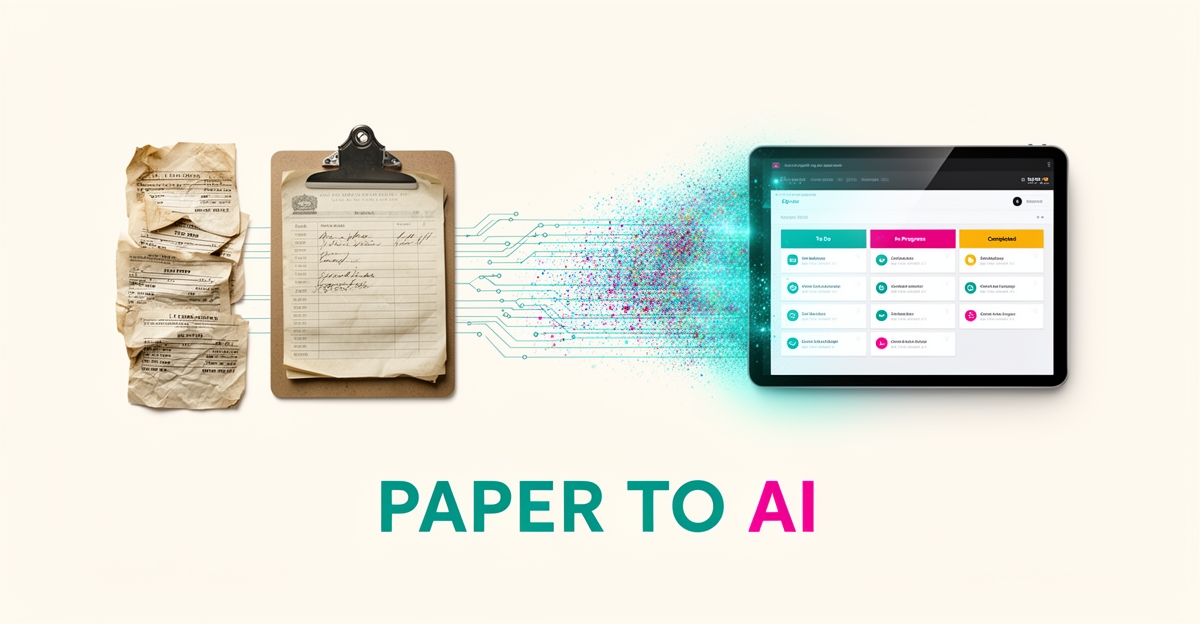
From Paper to AI: Modernizing Job Tracking and Repair Logs in Your Shop
Key Facts
- Voice-to-text input is typically several times faster than typing for hands-busy repair log entry
- Research on AI-assisted work suggests the largest performance gains often go to less-experienced workers, helping standardize documentation quality across a team
- Paper-based record-keeping ties institutional knowledge to individual memory and handwriting legibility rather than a searchable system
- Administrative workload on paper systems scales roughly in proportion to job volume—automation breaks that link
- AIQ Labs has deployed 200+ multi-agent systems and runs 4 live SaaS products daily
Hire a team member that works 24/7 — for less than a part-time wage.
AI receptionists, SDRs, dispatchers and 99+ roles. Trained on your business, fully managed.
Not sure where to start? Ask our AI planner
The Hidden Cost of Paper Job Tickets and Repair Logs
It's 7:45 a.m., and a customer is on the phone asking what parts were replaced on their equipment during a repair eighteen months ago. Somewhere in the back office is a paper ticket with the answer—or at least it was, before it got misplaced, water-damaged, or buried under three inches of newer tickets. Meanwhile, a technician is elbow-deep in a filing cabinet, squinting at handwriting that may or may not belong to the senior tech who handled the job.
This scene plays out daily in shops still running on paper job tickets and handwritten repair logs. The costs are real, and they compound. Paper-based record-keeping depends heavily on an individual's memory and handwriting legibility—meaning your shop's institutional knowledge lives in the heads of a few senior staff members rather than in any system anyone can actually search.
The inefficiencies stack up in three predictable ways:
- Manual entry delays: handwritten tickets and re-keyed information slow down every job, while voice-to-text capture is typically several times faster than typing for hands-busy technicians.
- Skill dependency: accurate records rely on whoever wrote them, not on the shop itself.
- Linear admin scaling: administrative time grows in direct proportion to job volume—double the jobs, double the paperwork.
That last point deserves emphasis. When admin work scales linearly with volume, growth becomes a liability instead of an asset. Every new customer adds filing, retrieval, and follow-up burden. AI-driven tracking breaks that link: it handles repetitive tasks like data entry and database updates, allowing teams to scale without proportional admin growth.
There's a certain retro charm to paper logs—much like the appeal of instant film photography, which enthusiasts love for its lo-fi aesthetic. But the "retro glow" is a matter of taste, not utility. In a repair shop, that glow can't compete with the functional demands of modern quality control: instantly searching a part number across thousands of past jobs, retrieving a customer's full repair history in seconds, or verifying that a recurring fault was actually documented the last three times it appeared.
Paper logs also fail the knowledge retention test. Information is static, easily lost or damaged, and impossible to summarize or analyze. Digital systems flip this: raw repair data becomes actionable intelligence that preserves critical details even when key employees move on.
This is precisely the gap AIQ Labs addresses with secure, searchable internal databases that auto-populate from daily shop operations—no re-keying, no filing cabinets, no dependency on memory. The problem isn't that paper doesn't work. It's that paper works exactly as well as it ever did, while your shop's demands have outgrown it.
What AI-Driven Tracking Actually Fixes: Searchable, Self-Populating Repair Databases
Tired of digging through stacks of paper to find last month's brake job details or the part number used on a similar repair six months ago? AI-driven tracking transforms this pain point into a strategic advantage by creating an internal knowledge base that builds itself from daily shop operations—no manual entry required.
Research on AI-assisted work suggests the largest performance gains often go to less-experienced workers. In practice, that means junior technicians can produce repair documentation and diagnostic logs that match senior staff quality when supported by AI—standardizing knowledge capture across your team and reducing reliance on a few expert individuals for accurate record-keeping.
The core of this system lies in automation: voice-to-text input lets technicians dictate repair details immediately after a job, capturing information several times faster than typing. This eliminates delays and errors associated with manual data entry while ensuring critical details—parts used, labor time, customer notes—are recorded accurately and consistently. Over time, these entries auto-populate a searchable internal database that grows smarter with every repair logged.
When a similar issue arises, AI instantly retrieves past cases, including the exact parts used, solutions applied, and even customer communication history—turning tribal knowledge into actionable intelligence. This capability supports faster diagnostics, improves first-time fix rates, and enables proactive quality control by identifying recurring issues before they escalate.
AIQ Labs builds these systems through AI Workflow Builds—a fixed-price rebuild of the one workflow that costs you the most, delivered in phases. The system integrates directly with your shop's workflow, auto-populating from work orders, technician voice notes, and parts logs to create a living repair history. Unlike generic tools, it's designed around your specific processes, so every data point captured serves a purpose: faster access to past repairs, improved accuracy in estimates, and stronger customer communication backed by verifiable history.
By replacing reactive paper trails with a proactive, self-updating database, shops shift from relying on memory to making decisions grounded in data—scaling operations without proportional increases in administrative overhead while preserving institutional knowledge that would otherwise walk out the door with experienced staff.
Start the Fit Check — a free two-minute assessment at aiqlabs.ai/apply leading to a free 30-minute strategy call at aiqlabs.ai/book to map your biggest bottleneck and identify high-ROI automation opportunities in your repair tracking workflow. No obligation—just clarity on your AI opportunity.
Getting Your Team On Board Without the Backlash
Paper logs feel safe until a comeback repair takes an hour to trace. The resistance you meet when modernizing job tracking is rarely about the technology itself, and more about how the change is introduced to the team.
Adoption is a leadership signal first. AI adoption is as much a leadership challenge as a technology one, and accelerating it is a stated priority for most business leaders as of late 2026. When owners and shop managers use AI tools daily and talk openly about the time they save, the team reads it as permission, not pressure.
Peer learning lowers the intimidation factor. Workforce studies consistently show that most workers turn to their peers when they want to learn a new skill. Identifying AI superusers who already dictate notes, search past repairs, or summarize tickets creates a low-friction path for others. These superusers become the translators who show how searchable internal databases auto-populate from shop operations and make critical repair details instantly retrievable.
Visible advocacy beats tool selection. Teams watch what leaders do more than what leaders buy. Leaders who personally adopt AI tools inspire teams to do the same. That visibility turns upskilling from a chore into an opportunity.
Make learning social and practical. Large companies run AI learning days that draw employees from well outside tech roles, turning experimentation into a shared event. A shop can replicate the format on a smaller scale:
- Host an AI learning day with live demos of voice-to-text log entry and instant repair history search
- Run short challenges to draft customer updates or summarize a complex repair using the new system
- Pair superusers with technicians and front-desk staff for peer-to-peer coaching
- Celebrate early wins publicly, such as faster retrieval of past parts used or cleaner quality control notes
Articulate the why in shop terms. Employees resist training that feels disconnected from daily work. When the purpose is clear—AI increases efficiency, automates repetitive data entry, and frees time for diagnostic and customer work—resistance softens. Training feels like opportunity, not a mandate when technicians see they can dictate a repair immediately after a job instead of catching up on paperwork later.
AIQ Labs builds secure, searchable internal databases that auto-populate from shop operations and store critical repair details, so the system supports the team rather than adding steps. With the right framing, peer support, and visible leadership, modernizing job tracking becomes a shared upgrade to quality control and customer communication, not a backlash waiting to happen.
Your 7-Step Rollout: From First Voice Note to Full AI Job Tracking
Moving from paper logs to AI-powered job tracking begins with a clear, step-by-step rollout that builds confidence and capability across your team. Start by securing visible leadership advocacy—when owners and managers actively use AI tools for tasks like summarizing repair histories or generating customer follow-ups, it signals that upskilling is a strategic priority, not an optional add-on.
Next, identify and empower peer mentors—those "AI superusers" already experimenting with voice-to-text tools or automated log entry—to guide colleagues through hands-on practice. Because most workers learn new skills from peers, this approach reduces intimidation and boosts retention far more than top-down mandates. Pair this with a dedicated AI learning day where technicians and front desk staff can test tools like voice notes that convert speech to text several times faster than typing, immediately seeing how capturing repair details verbally saves time without disrupting workflow.
To sustain momentum, gamify milestones with friendly competitions—such as recognizing techs who use AI to auto-populate service logs from customer emails, or front desk staff who generate instant summaries of past repairs for quicker customer communication. Simultaneously, build role-specific learning paths: technicians focus on voice-to-text capture and diagnostic log automation, while front desk teams learn AI-assisted appointment scheduling and knowledge base retrieval for faster responses. Finally, shift to a structured AI-first workflow where incoming work orders trigger automatic data population into searchable databases, transforming raw notes into instantly accessible intelligence for quality control and customer trust—proving that modern job tracking isn't just about replacing paper, but about unlocking actionable insights from every repair.
Ready to build your AI-powered job tracking system? Start with a free strategy call to map your shop's biggest bottleneck and see how AIQ Labs can design a custom solution that you own outright, integrates with your tools, and scales with your growth—no vendor lock-in, just measurable results. Book your free 30-minute strategy call after completing the two-minute Fit Check at aiqlabs.ai/apply.
Why Owning Your System Beats Renting One
Most shops are still renting their memory. Paper logs, spreadsheets and patchwork SaaS subscriptions create fragmented records that slow down repairs, repeat mistakes, and trap knowledge in whoever wrote the last note.
Owning a searchable internal database changes that equation. When job tracking auto-populates from daily operations, technicians get instant access to past repairs, parts used, and solutions applied. Quality control improves because documentation is consistent, not dependent on handwriting or recall. Customer communication improves because history is retrievable in seconds, not shelves.
Renting tools means renting limitations. Subscription stacks multiply costs, create vendor lock-in, and leave your repair data on someone else's platform. As of late 2026, paid AI adoption among small shops is still in its early innings—which means the gap between awareness and ownership is wide open for shops willing to own the infrastructure instead of cobbling together free tiers.
Ownership also aligns with how AI actually performs in the field. AI-assisted tools tend to lift work performance across skill levels, with the biggest gains often going to less-experienced workers. That standardizes documentation quality across junior and senior technicians and reduces reliance on a few experts.
AIQ Labs builds secure, searchable internal databases that auto-populate from shop operations and store critical repair details, with full ownership transferred to you. That means you control customization, data, and future development. For shops ready to go further, an AI Operating System connects job tracking with scheduling, quoting, and customer communication in one operating layer—built in phases and owned outright.
The payment model offers flexibility without subscription creep:
- Start Monthly — setup plus a flat monthly plan, build included, pause or adjust anytime
- Build in Milestones — pay per phase, keep everything built so far
- Own It Outright — one project price for a full system you own completely
This is true ownership, not vendor lock-in. Your job tracking becomes a durable asset that compounds value as more repairs are logged, rather than a recurring cost you rent month to month. See the full breakdown on the pricing page.
If most competitors are still renting, owning is the strategic edge. Start the Fit Check at aiqlabs.ai/apply, then book a free 30-minute strategy call at aiqlabs.ai/book to map your biggest bottleneck and see if a build you own is the right next step.
Still paying for 10+ subscriptions that don’t talk to each other?
We build custom AI systems you own outright. No vendor lock-in. Full control.
Not sure where to start? Ask our AI planner
Frequently Asked Questions
How does AI-driven job tracking actually save time for my technicians?
Will switching to an AI-powered system make my team dependent on a few tech-savvy employees?
Is it worth the effort to get my team to adopt AI for job tracking if they're used to paper logs?
Can AI really help me scale my shop without doubling my admin workload?
What if I don't want to be locked into a subscription or lose control of my repair data?
How do I know if AI job tracking is right for my shop's specific workflow?
Your Shop's Knowledge Is Waiting to Be Unlocked
Modernizing job tracking isn't about chasing trends—it's about fixing the daily friction that slows your team, risks quality, and hides your shop's true potential. Paper logs may feel familiar, but they scale poorly, depend on fragile memory, and turn every repair into a scavenger hunt for information that should be instantly accessible. AI-driven tracking changes that by turning routine voice notes and work orders into a living, searchable database that grows smarter with every job—no re-keying, no filing cabinets, no lost institutional knowledge. The result? Faster diagnostics, consistent documentation, and customer conversations backed by verifiable history, all while reducing admin burden as volume grows. If you're ready to see where your biggest bottleneck lives and what a self-populating repair history could do for your shop, start with a free two-minute Fit Check at aiqlabs.ai/apply, then book a no-obligation 30-minute strategy call at aiqlabs.ai/book to explore how AIQ Labs can build a system you own—designed around your workflow, not the other way around.
Make AI your competitive advantage — not just another tool.
Strategy, implementation and ongoing optimization. One partner, end to end.
Not sure where to start? Ask our AI planner