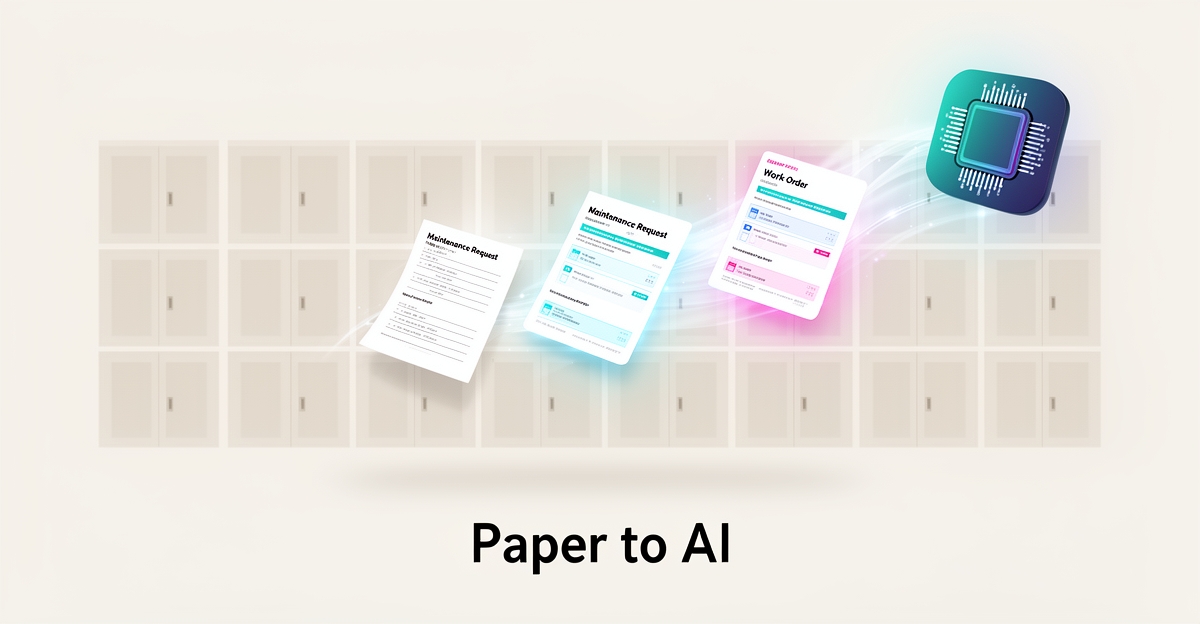
From Paper to AI: Modernizing Self-Storage Facility Maintenance Requests
Key Facts
- Industry surveys, including Storable's research, have found that a large majority of self-storage operators plan to implement AI
- AI and automation can deliver meaningful operational cost reductions — some industry analyses cite figures approaching 19%
- Paper requests typically add days to response times compared to digital submissions
- Manual systems are prone to lost or duplicate maintenance tickets that digital intake largely eliminates
- Slow maintenance response is a common reason tenants consider switching facilities
Hire a team member that works 24/7 — for less than a part-time wage.
AI receptionists, SDRs, dispatchers and 99+ roles. Trained on your business, fully managed.
Not sure where to start? Ask our AI planner
The Paper Request Bottleneck Costing You Time and Tenants
Paper maintenance requests create a silent bottleneck that erodes both operational efficiency and tenant trust in self-storage facilities. When tenants submit handwritten forms or drop slips into a physical box, those requests often get buried under daily tasks, lost in transit, or delayed until staff have a moment to process them—turning simple fixes into prolonged inconveniences. This delay isn't just frustrating; it directly impacts satisfaction in an industry where a large share of operators are planning to adopt AI to address exactly this kind of friction, according to industry research.
The consequences extend beyond inconvenience. Lost tickets left unresolved for days can escalate minor issues—like a leaking unit or faulty lock—into safety hazards or property damage, while tenants grow wary of a facility that seems unresponsive. Staffing shortages exacerbate the problem, as teams already stretched thin struggle to manually track, prioritize, and follow up on paper-based requests without a centralized system. What should be a quick resolution becomes a game of phone tag and missed messages, draining time that could be spent on proactive service.
Meanwhile, tenant expectations have shifted dramatically toward instant, digital convenience. Modern renters expect to report issues the same way they manage other aspects of their lives—through a tap on their phone, not a walk to the office during limited hours. Facilities relying on paper requests fail to meet this standard, especially during off-hours or holidays when no staff is present to collect forms. This gap between expectation and reality fuels frustration, increases turnover risk, and damages online reputation—all avoidable with a streamlined digital workflow.
- Paper requests typically add days to response times compared to digital submissions
- Manual systems are prone to lost or duplicate tickets that digital intake largely eliminates
- Slow maintenance response is a common reason tenants consider switching facilities
AIQ Labs helps self-storage operators replace this fragile paper trail with an AI-driven system that captures requests instantly, routes them to the right technician, and provides real-time status updates—turning a chronic pain point into a streamlined, accountable process. Learn more on our workflow builds page.
How AI Document Processing Turns Requests Into Real-Time Work Orders
Imagine a tenant snaps a photo of a broken gate lock, emails it to your facility, and within minutes, the right technician receives a detailed work order on their phone, complete with the image, location, and priority level. This is the reality of AI document processing, a technology that transforms unstructured maintenance requests into structured, actionable tasks without human intervention.
The process begins the moment a request arrives, whether as a paper form, an email with a photo, or even a voicemail. AI-powered document processing systems use optical character recognition (OCR) and natural language processing to extract key details: the nature of the issue, the unit number, the urgency, and any visual evidence. This data is then converted into a digital work order, eliminating the need for manual data entry and the errors that come with it.
Once the work order is created, the system automatically assigns it to the appropriate staff member based on their skills, location, and current workload. This ensures that a plumbing issue goes to the plumber, not the electrician, and that urgent requests are prioritized. Staff receive instant notifications via their preferred channel, whether it's a mobile app, SMS, or email, so they can respond immediately.
The benefits extend far beyond speed. According to industry research, AI and automation can deliver operational cost reductions—some analyses cite figures approaching 19%. This is partly because AI-powered systems reduce the need for additional administrative staff, allowing your existing team to focus on higher-value tasks.
Here's what a typical AI-driven workflow looks like in practice:
- Intake: A tenant submits a request via email, phone, or a web form.
- Processing: AI extracts key details and creates a structured work order.
- Assignment: The system assigns the task to the best-suited technician.
- Tracking: Managers monitor progress in real-time and receive alerts if a task is delayed.
- Completion: The technician closes the ticket, and the system logs the resolution for future reference.
This level of automation is becoming the industry standard. Recent industry surveys have found that a large majority of self-storage operators plan to implement AI in their businesses, signaling a major shift away from manual processes. For facilities with limited staff, this technology is a practical upgrade, enabling them to manage maintenance requests efficiently without being physically present.
The impact on customer service is equally significant. AI chatbots and voice agents, which often serve as the first point of contact for maintenance requests, can handle a high volume of inquiries simultaneously. Industry reporting suggests chatbots could save companies billions of dollars and billions of hours annually on a global scale. This frees up your team to handle more complex issues that require a human touch.
At AIQ Labs, we build AI intake and dispatch systems that integrate with your existing property management software. Our AI employees can capture requests around the clock, and our solutions are designed to scale with your business, ensuring that as you grow, your maintenance operations remain efficient and responsive. The result is a smarter, more accountable workflow that improves tenant satisfaction and protects your bottom line.
Implementation Roadmap for Self-Storage Operators
Moving from paper work orders to AI-driven maintenance is a practical upgrade for self-storage operators facing staffing pressure and rising customer expectations. With industry surveys showing most operators planning to adopt AI, the roadmap is becoming standard practice rather than an experiment.
Start by mapping the highest-friction maintenance workflows. Identify where paper requests stall: tenant submissions at the front desk, handwritten notes left in lockers, or phone calls logged after hours. Prioritize the process that creates the most delays and repeat contacts. This focus ensures early wins and measurable impact.
Pilot AI intake and dispatch on one site or property cluster. An AI employee can capture requests via phone, SMS, chat or a simple web form, classify the issue, and create a real-time work order. The system automatically assigns tasks to the right technician and alerts staff, reducing response times and improving accountability. This approach mirrors how AI-powered customer service tools help operators extend support without requiring additional staff.
Integration is the next critical step. Maintenance data must flow with existing property management systems, access control and billing tools. Seamless integration prevents duplicate entry and gives managers a single source of truth for completion rates and response times. AIQ Labs builds these production-ready systems with deep two-way API integrations so operators own what they build and avoid vendor lock-in.
Monitor and optimize with clear operational KPIs. Track request-to-dispatch time, first-time fix rate, and completion within SLA. AI and automation can deliver meaningful operational cost reductions, and continuous monitoring helps capture that value.
A practical rollout sequence typically includes:
- Audit current paper workflows and measure baseline response and completion metrics
- Launch AI intake pilot for one high-volume maintenance type with automated dispatch
- Integrate AI work orders with property management and maintenance software
- Train site staff on exception handling and human-in-the-loop escalation
- Scale to additional sites after validating time savings and tenant satisfaction
Once proven, expand the system across departments. The same AI document processing foundation that digitizes maintenance requests can handle invoices, access logs and tenant communications. True ownership of the custom system—built in milestones, owned outright—means operators can adapt workflows as the business grows without subscription creep.
This phased approach turns a fragmented paper process into a real-time, accountable maintenance operation that supports both staffed and unmanned facilities.
Still paying for 10+ subscriptions that don’t talk to each other?
We build custom AI systems you own outright. No vendor lock-in. Full control.
Not sure where to start? Ask our AI planner
Frequently Asked Questions
How much slower are paper maintenance requests compared to digital ones?
Are many self-storage operators planning to implement AI?
Can AI actually reduce our operational costs, or is that just hype?
We're a small facility with limited staff — can AI maintenance work without a big IT team?
How does AI know which technician to assign a maintenance request to?
What happens to our data if we switch providers or bring maintenance in-house later?
The Last Paper Slip You'll Ever Need
Paper maintenance requests quietly cost self-storage operators time, tenants, and reputation—slips get lost, response times stretch by days, and slow maintenance is a common reason tenants leave. As this article showed, AI document processing flips that dynamic: requests captured by phone, email, or photo become structured work orders in minutes, automatically routed to the right technician and tracked to completion. With industry surveys showing most operators planning to adopt AI, the question is no longer whether to modernize, but how quickly you can start. The roadmap is straightforward: audit your current paper workflows, pilot AI intake on one high-friction process, integrate with your property management software, and scale once the numbers prove out. At AIQ Labs, we build production-ready systems like these that you own outright—no vendor lock-in, no subscription creep. If you're ready to see where AI can save your facility the most time, take the two-minute Fit Check at aiqlabs.ai/apply and book a free strategy call. It's a real working session with an AI engineer—and if there's no clear win, we'll tell you that too.
Make AI your competitive advantage — not just another tool.
Strategy, implementation and ongoing optimization. One partner, end to end.
Not sure where to start? Ask our AI planner