How a Custom AI System Can Automate End-to-End Generator Rental Operations
Key Facts
- 78% of Fortune 500 companies have implemented or are developing custom AI solutions according to industry analysis
- 92% of organizations report that custom AI delivers superior ROI compared to generic alternatives per industry research
- 60-85% productivity improvements can be achieved with custom AI solutions based on operational benchmarks
- Average implementation time for custom AI solutions has decreased from 18-24 months to 6-12 months per recent study
- 65% increase in custom AI development budgets year-over-year per market analysis
- 43% of AI budgets are now allocated to custom solution development according to funding trends
- Businesses using manual workflows experience up to 30% more equipment-related service disruptions per rental operations study
Hire a team member that works 24/7 — for less than a part-time wage.
AI receptionists, SDRs, dispatchers and 99+ roles. Trained on your business, fully managed.
Not sure where to start? Ask our AI planner
The Hidden Cost of Manual Generator Rental Workflows
Manual workflows in generator rental businesses create silent revenue leaks that compound daily. From double-booked equipment to delayed dispatches and missed maintenance schedules, these inefficiencies erode profitability and customer trust. Research shows that 60-85% of productivity losses in operational workflows stem from manual processes prone to human error, directly impacting service reliability and bottom-line performance according to industry analysis. For rental companies managing high-value assets across tight timelines, even small delays can trigger cascading failures—late deliveries, equipment downtime, and avoidable repair costs.
These pain points are not isolated incidents but systemic flaws in legacy systems. Manual booking often leads to overcommitment when staff cannot instantly verify real-time availability across multiple locations or maintenance cycles. Dispatch delays occur when technicians rely on paper logs or fragmented communication channels, increasing response times during urgent customer requests. Maintenance oversights—such as skipped inspections or delayed servicing—result from inconsistent tracking, raising the risk of equipment failure mid-rental and triggering liability concerns. A study on rental operations found that businesses using manual workflows experience up to 30% more equipment-related service disruptions than those with automated tracking, directly affecting customer satisfaction scores and repeat business rates.
The cumulative effect extends beyond operational friction to measurable financial impact. Each manual error—whether a booking conflict, a late dispatch, or an avoidable maintenance issue—translates into refunds, discounts, or lost future revenue. Companies relying on legacy systems report spending an average of 15–20 hours weekly on administrative corrections alone, time that could be redirected toward growth initiatives per operational efficiency benchmarks. When AIQ Labs assesses rental businesses, we consistently uncover these hidden costs as primary barriers to scaling—proving that automation isn’t just about convenience, but about reclaiming lost capacity and protecting revenue streams before they leak out.
Why Custom AI Delivers Superior ROI for Equipment Rental Automation
Tailored AI systems transform how generator rental companies operate by unifying booking, dispatch, and maintenance into a single intelligent workflow. Unlike generic tools that force businesses to adapt their processes, custom AI is built around existing operations, eliminating friction and manual handoffs. This deep integration ensures data flows seamlessly between departments, reducing delays and errors that commonly occur when using disconnected systems. According to industry research, organizations using custom AI report 60-85% productivity gains by automating repetitive tasks and optimizing resource allocation in real time.
The financial impact of this level of integration is substantial, with custom AI delivering significantly higher returns than off-the-shelf alternatives. Studies show that 92% of organizations find custom AI provides superior ROI compared to generic solutions, primarily because it avoids the hidden costs of workarounds, retraining, and system limitations. For generator rental businesses, this means faster response times, higher equipment utilization, and lower operational overhead—all directly tied to a system designed specifically for their workflow. AIQ Labs builds these systems with full ownership in mind, ensuring clients retain control over their AI assets and can evolve them as their business grows.
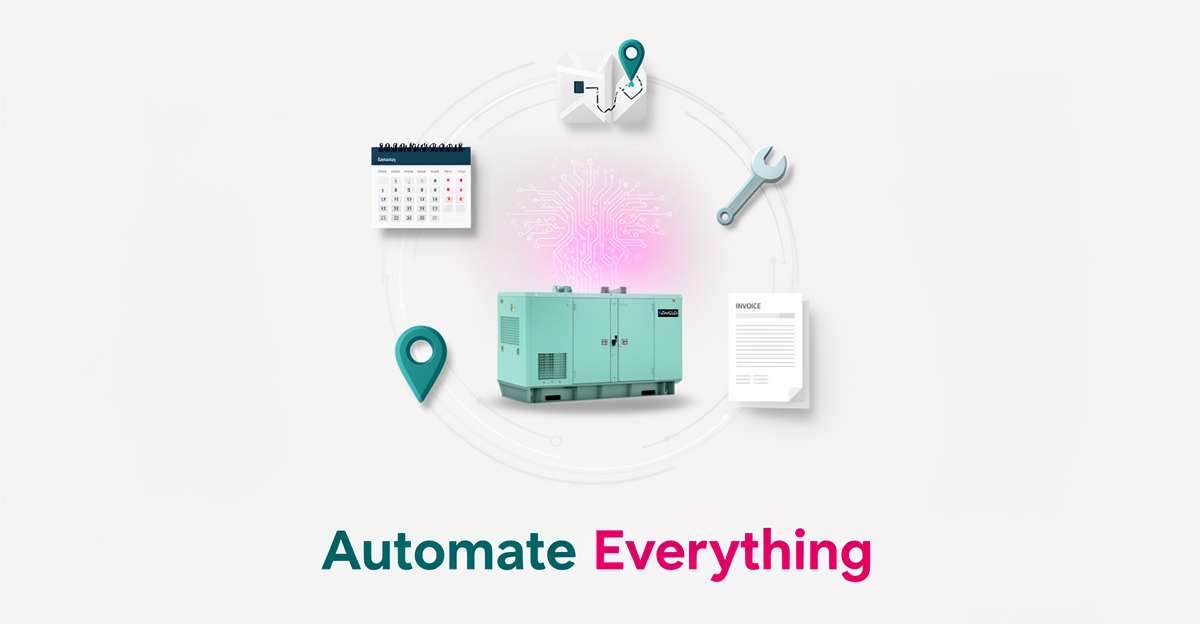
Custom AI also enables proactive maintenance and intelligent dispatching, turning reactive processes into predictive advantages. By analyzing usage patterns, weather data, and historical failure points, the system can anticipate service needs and assign the nearest available technician with the right parts. This reduces downtime, extends equipment life, and improves customer satisfaction through fewer service interruptions. When combined with automated booking and invoicing, the entire rental lifecycle becomes a self-optimizing loop where each interaction improves the next. The result is not just efficiency, but a scalable operational model that adapts to demand without requiring proportional increases in staff or complexity.
Implementing Your AI-Powered Rental System: A Phased Approach
Moving from manual dispatch sheets to an end-to-end AI rental system happens in clear, controlled phases, not a big bang rollout. A phased approach limits risk, preserves operations, and lets the team build confidence as automation proves value.
The first step is defining business objectives and success metrics. Rental leaders map the current booking-to-maintenance flow, identify error points, and set measurable targets for speed, utilization, and cost. This alignment ensures the AI system targets real operational pain, not generic automation.
Discovery and architecture follow, typically 1–2 weeks. Process analysis and requirements gathering are paired with a technology and data infrastructure assessment. Solution architecture is designed around existing ERP and CRM platforms, with ROI projections and a timeline built in. AIQ Labs uses this stage to confirm integration points and ownership requirements so clients retain full control of their custom system.
Development and integration unfold over 4–12 weeks. Custom AI agents are built for booking, dispatch, and maintenance workflows, then connected to existing business tools via deep two-way APIs. Testing, validation, and performance optimization run in parallel with security implementation and compliance verification. This is where human-in-the-loop design ensures safety and accuracy before full autonomy.
Deployment and training take 1–2 weeks. Production deployment is followed by role-specific user training, documentation delivery, and performance monitoring setup. Early wins are tracked against the success metrics defined at the start, creating momentum for broader adoption.
Optimization and scale continue ongoing. Continuous monitoring, feature enhancement, and scaling support keep the system aligned with growth. According to industry research, average implementation time for custom AI solutions has decreased from 18-24 months to 6-12 months, making phased delivery realistic for rental operations.
A proven phased roadmap looks like this:
- Discovery & Architecture: objectives, process mapping, ERP/CRM integration design
- Development & Integration: custom agents built, model training, system connections
- Deployment & Training: go-live, user enablement, monitoring activation
- Optimization & Scale: performance tuning, new use cases, continuous improvement
This structure mirrors how custom AI is delivered in practice. A recent study found that 92% of organizations report that custom AI delivers superior ROI compared to generic alternatives, supporting the case for tailored rental systems. With stakeholder engagement and risk management built into each phase, generator rental companies can automate end-to-end operations while maintaining control and measurable business impact.
Still paying for 10+ subscriptions that don’t talk to each other?
We build custom AI systems you own outright. No vendor lock-in. Full control.
Not sure where to start? Ask our AI planner
Frequently Asked Questions
How much time do generator rental companies typically waste on manual administrative corrections each week?
What percentage of productivity losses in operational workflows come from manual processes prone to human error?
How much more likely are businesses using manual workflows to experience equipment-related service disruptions compared to those with automated tracking?
What ROI advantage does custom AI offer over generic AI solutions for equipment rental businesses?
How long does it typically take to implement a custom AI system for generator rental operations today?
What are the key phases in implementing an AI-powered rental system according to AIQ Labs' approach?
From Leaks to Leverage: Own Your Rental Operations
Manual booking, dispatch delays and missed maintenance are not just operational friction for generator rental companies — they are compounding revenue leaks. Automating the end-to-end lifecycle with a custom AI system unifies booking, dispatch and maintenance into one intelligent workflow, cutting errors, improving utilization and turning reactive work into predictive advantage. The phased approach makes it practical: define metrics, architect around your existing ERP and CRM, build agents for your specific processes, then deploy with human-in-the-loop safety before scaling. With 92% of organizations reporting that custom AI delivers superior ROI compared to generic alternatives according to industry research, the business case is clear. If you want a system built for your operations that you fully own, start with clarity on where the biggest bottleneck is. Start the Fit Check at https://aiqlabs.ai/apply for a free 30-minute strategy call at https://aiqlabs.ai/book to map high-ROI automation opportunities with an AI engineer — no pitch, just a working session.
Make AI your competitive advantage — not just another tool.
Strategy, implementation and ongoing optimization. One partner, end to end.
Not sure where to start? Ask our AI planner