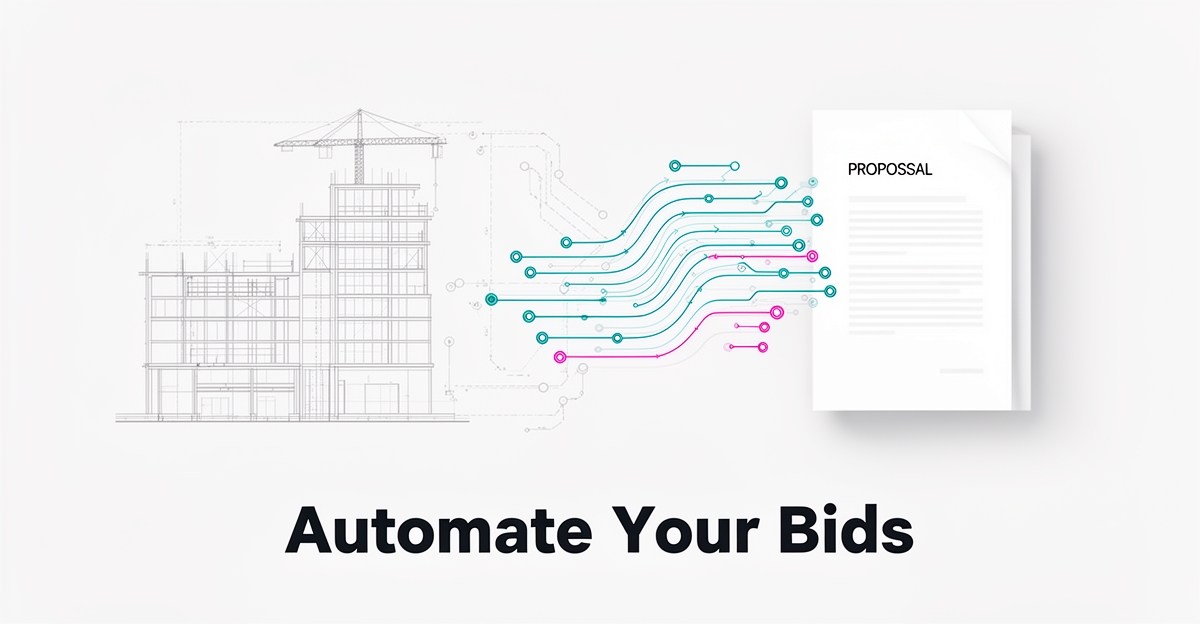
How AI Can Automate Client Estimating and Proposal Generation for Construction Firms
Key Facts
- AI-powered estimating software can reduce bid preparation time by 40-60%, according to industry analysis
- Leading AI takeoff platforms claim accuracy in the 95-98% range on standard commercial plan sets, based on vendor-reported testing
- A large majority of AEC firms already using AI plan to expand their investment in the coming year, per the Bluebeam AEC Technology Outlook report
- The construction estimating software market is valued at roughly $1 billion as of late 2026, with projections of continued growth through 2035 from market research
- The global AI in construction market reached an estimated $6 billion in 2026, growing at roughly 25% CAGR according to market tracking
- Togal.AI identifies and quantifies components across plan sets with vendor-reported accuracy around 98% as demonstrated in testing
- STACK combines AI Assist auto-detection with a deep integration ecosystem and 1,300-plus verified user reviews at 4.5/5 per user feedback
Hire a team member that works 24/7 — for less than a part-time wage.
AI receptionists, SDRs, dispatchers and 99+ roles. Trained on your business, fully managed.
Not sure where to start? Ask our AI planner
The Cost of Manual Estimating in Construction
Manual estimating is quietly eroding construction margins while competitors move faster. In a market where speed and precision decide who wins work, relying on spreadsheets and rework creates a compounding disadvantage.
Traditional takeoffs are time-intensive and error-prone. Teams spend hours measuring drawings, transferring quantities, and reconciling line items by hand. That manual repetition invites missed items, transposition errors, and inconsistent assumptions across bids. The result is longer turnaround and bids that don’t reflect true scope.
Response time is a direct win-rate lever. Industry analysis suggests AI-powered estimating software can reduce bid preparation time by 40-60%, letting firms return proposals while opportunities are still hot. Faster cycles also mean estimators can pursue more opportunities without adding headcount.
Accuracy suffers when estimates are built from fragmented data. Construction technology research notes leading AI takeoff platforms claim accuracy in the 95-98% range on standard commercial plan sets. That level of consistency reduces costly underbids and protects profitability on awarded work.
Inconsistent bid quality also damages client trust. When proposals vary in format, scope coverage, and pricing logic, general contractors appear disorganized and risk-prone. In a competitive environment, a large majority of AEC firms already using AI plan to expand their investment in the coming year, signaling that manual processes are becoming a liability.
The pain points show up daily in estimating teams:
- Manual errors from rekeying quantities and unit prices across tools
- Slow response times as estimators chase drawings, clarifications, and pricing updates
- Inconsistent bid accuracy due to reliance on tribal knowledge and past spreadsheets
- Revenue leakage from missed scope items and late submissions
These inefficiencies directly impact profitability. Every hour spent rechecking numbers is an hour not spent refining strategy or pursuing new work. Errors discovered post-award erode margins, while slow proposals lose out to faster competitors.
AIQ Labs sees this pattern across construction firms and addresses it through AI Workflow Builds that rebuild the estimating and proposal workflow end-to-end. By automating takeoff, pricing, and document assembly, firms reduce manual errors, accelerate response times, and improve bid accuracy without replacing estimators.
The cost of staying manual is rising as the market adopts AI. Firms that continue with disconnected estimating workflows risk higher error rates, missed bids, and margin compression in a sector where precision is the competitive edge.
How AI Eliminates Estimating Bottlenecks
Estimating has long been the choke point where profitable projects stall—endless takeoffs, manual line-item entry, and the constant risk of a missed scope item derailing a bid. AI-powered platforms are rewriting that dynamic by turning what once took days into hours without sacrificing precision.
According to industry research, AI-powered estimating software can reduce bid preparation time by 40-60%, while leading takeoff platforms claim 95-98% accuracy on standard commercial plan sets. Those gains come from two complementary approaches: pure computer vision tools that automatically detect, measure, and classify building elements from architectural drawings, and hybrid AI-plus-human models that layer expert review on top of automated processing for finished estimates ready to price.
- Computer vision engines like Togal.AI identify and quantify components across plan sets with vendor-reported accuracy around 98%
- Cloud-based platforms such as STACK combine AI Assist auto-detection with a deep integration ecosystem and 1,300-plus verified user reviews at 4.5/5
- Enterprise solutions like Procore Estimating embed AI floor plan detection directly into the GC workflow for teams already in that ecosystem
The broader market signals confirm this isn't experimental—the construction estimating software market sits at roughly $1 billion as of late 2026 with projected growth through 2035, and a large majority of AEC firms already using AI plan to expand their investment in the coming year. For firms ready to move beyond point solutions, AIQ Labs builds custom estimating workflows that connect takeoff outputs directly into proposal generation, CRM handoffs, and project setup—eliminating the re-entry that erodes the time savings AI creates.
From Software to System: AIQ Labs’ Ownership-First Approach
Most construction firms buy an estimating tool. A few build an estimating system.
Off-the-shelf AI estimating software can automate line-item generation and flag missing items, but it remains a point solution. These tools typically live in isolation, sync manually with CRM and accounting, and lock the firm into a vendor’s pricing and roadmap. The result is faster takeoffs without true end-to-end automation from takeoff to signed proposal.
With AI-powered estimating, bid preparation time can fall by 40-60% according to industry analysis. Leading takeoff platforms claim accuracy in the 95-98% range on standard commercial plan sets based on vendor testing. Adoption is accelerating because a large majority of AEC firms already using AI plan to expand investment in the coming year per the Bluebeam AEC Technology Outlook report.
AIQ Labs takes a different approach for construction firms. Instead of subscribing to a tool, firms work with AIQ Labs to build custom AI systems they own outright, with deep two-way API integrations to CRM, accounting, project management and proposal workflows. That ownership model eliminates vendor lock-in and lets estimating logic evolve with the firm’s unique processes.
A custom-built system connects the entire client journey:
- AI takeoff and quantity extraction from drawings, linked to historical cost data and supplier pricing
- Automated scope validation against past projects and industry standards to improve bid accuracy
- Proposal generation that pulls from CRM notes, prior change orders, and accounting rates
- Seamless handoff to project workflows once the proposal is signed
This is true IP ownership, not a license. Clients receive full ownership of custom-built systems with no platform dependencies, complete control over customization and future development. The global AI in construction market reached an estimated $6 billion in 2026, growing at roughly 25% CAGR according to market tracking, reflecting demand for more than point tools.
Construction firms need end-to-end automation from takeoff to signed proposal, tailored to how estimators actually work. A system built around their data, integrations and approval steps delivers reduced manual errors, accelerated response times and improved bid accuracy without subscription creep.
With AIQ Labs’ ownership-first approach, estimating becomes a connected business process, not another software tab.
Still paying for 10+ subscriptions that don’t talk to each other?
We build custom AI systems you own outright. No vendor lock-in. Full control.
Not sure where to start? Ask our AI planner
Frequently Asked Questions
How much time can AI estimating software actually save for construction firms?
Is AI estimating accurate enough to replace manual takeoffs without risking errors?
Will using AI estimating software lock our firm into a vendor’s ecosystem or pricing?
How does AI improve proposal quality beyond just speeding up takeoffs?
Is AI in construction estimating just a trend, or is there real market adoption behind it?
Can small or mid-sized construction firms afford AI estimating systems, or is it only for large enterprises?
Build Estimating That Wins Work, Not Just Spreadsheets
Manual estimating is costing construction firms margin, speed, and trust. Hours spent rekeying quantities, reconciling line items, and chasing clarifications create errors, late submissions, and inconsistent proposals that lose bids to faster competitors. AI changes the dynamic by automating takeoff, pricing, and document assembly, typically cutting bid preparation time by 40-60% with strong accuracy on standard commercial plans. The market is moving fast, with a large majority of AEC firms already using AI planning to expand investment in the coming year per industry analysis. Point tools help, but lasting advantage comes from an end-to-end system that connects takeoff to proposal generation, CRM handoffs, and project setup, built around your data and owned by you. AIQ Labs helps firms build custom estimating workflows with true IP ownership and deep integrations, so estimators focus on strategy instead of rework. Start the 2-minute Fit Check at https://aiqlabs.ai/apply, then book a free 30-minute strategy call to map your biggest bottleneck and identify a high-ROI automation path. If there isn’t a clear win, we’ll tell you. You can also reach the team at [email protected].
Make AI your competitive advantage — not just another tool.
Strategy, implementation and ongoing optimization. One partner, end to end.
Not sure where to start? Ask our AI planner