How AI Can Automate Damage Claims and Improve Client Trust in Flatbed Trucking
Key Facts
- Manual document handling typically consumes the majority of total claim processing time in traditional workflows, according to industry analysis.
- AI-driven workflows can reduce claim resolution from a week or more to as little as 36 hours in well-implemented systems.
- Carriers automating damage assessments typically report meaningful reductions in per-claim costs, often in the 30 to 40 percent range.
- Insurers using intelligent claims assistance have reported substantial gains in customer satisfaction scores.
- Modern AI can generate structured damage reports in minutes using photos submitted by drivers.
- AI systems can flag substandard damage photos within seconds, prompting immediate driver resubmission.
- Computer vision models trained on millions of real-world damage images power accurate automated assessments.
Hire a team member that works 24/7 — for less than a part-time wage.
AI receptionists, SDRs, dispatchers and 99+ roles. Trained on your business, fully managed.
Not sure where to start? Ask our AI planner
Why Manual Damage Claims Are Eroding Client Trust in Flatbed Trucking
Manual damage claims in flatbed trucking are a critical friction point that erodes client trust through slow processing, high costs, and lack of transparency. Traditional workflows force skilled staff into repetitive tasks like data entry and document handling, which typically consumes the majority of total claim processing time. This inefficiency stretches resolution timelines to a week or longer, leaving clients in the dark and frustrated with delayed updates.
The cost of manual processing further strains relationships, with carriers often spending $40 to $60 per claim on labor-intensive steps that could be automated. When claims remain unresolved for over a week, clients perceive the process as opaque and unresponsive, directly impacting retention. Claims represent the “moment of truth” in the carrier-client relationship—delays or confusion at this stage damage trust more than nearly any other interaction.
- Manual document handling accounts for the bulk of claim processing time
- Traditional claims often take a week or more to resolve
- Cost per claim commonly ranges from $40 to $60 in manual workflows
These pain points create a cycle where clients lose confidence in the carrier’s reliability and responsiveness. AIQ Labs addresses this by building integrated systems that automate damage capture, validation, and escalation—connecting directly with customer portals and insurance platforms to replace guesswork with real-time transparency. Depending on how much of your operation needs rebuilding, this can start with a single [AI Workflow Build](/workflow-builds) targeting the claims process, or scale into a full [AI Operating System](/ai-operating-systems) that connects claims with dispatch, billing, and client communication. By removing the manual bottlenecks that slow resolution and obscure status, AI transforms claims from a trust-eroding obligation into a demonstrable commitment to service excellence.
How AI Transforms Claims Workflow to Cut Time and Cost While Increasing Transparency
The claims process is the single most important moment of truth in the carrier-client relationship. When a shipper discovers damaged freight, their trust in your operation is put to the ultimate test. A slow, opaque, and frustrating claims experience can undo years of reliable service, while a fast, transparent, and fair process can solidify a partnership for the long term.
Traditionally, this process is anything but fast. Manual claims handling, with its reliance on paperwork, phone calls, and field adjusters, can drag on for a week or more. This delay is not just an inconvenience; it's a significant source of friction. Industry analysis consistently finds that manual document handling alone accounts for the majority of the total time spent processing a claim, tying up skilled staff in repetitive, low-value work.
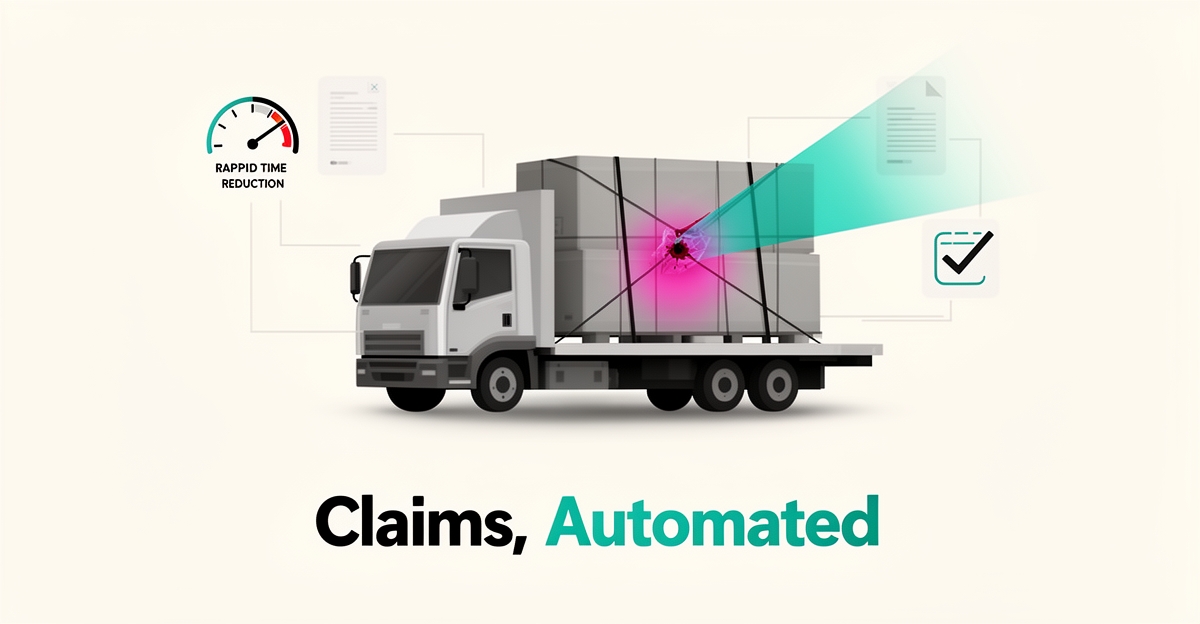
AI-driven automation fundamentally redesigns this broken workflow, shifting it from a source of friction to a driver of efficiency. By embedding intelligence directly into the claims process, carriers can eliminate the waiting and uncertainty that erode client trust. The transformation happens across three key stages:
- Instant Intake and Validation: Instead of waiting days for an acknowledgement, AI systems validate claim submissions in real time. If a driver submits photos of damaged goods, the AI checks for completeness and clarity within seconds, rejecting substandard images and prompting for a retake. This immediate feedback loop eliminates the typical 24-48 hour delay.
- Automated Damage Assessment: Once validated, AI analyzes the submitted photos and videos to generate a comprehensive damage report. This process, which once required scheduling a field adjuster, typically takes minutes rather than days. The system identifies the type, location, and severity of the damage, producing a structured condition report almost immediately.
- Intelligent Triage: With a complete damage report in hand, the system automatically routes the claim. Simple, low-value claims are sent for Straight-Through Processing (STP) and settled without human intervention. More complex cases are routed to a Fast-Track workflow, where an AI-assisted human adjuster reviews the AI's findings and makes a final decision.
The impact of this transformation is substantial. Carriers that automate these core tasks typically reduce claim processing time from a week or more to as little as 36 hours, and commonly see per-claim costs fall by 30 to 40 percent. More importantly, this efficiency and transparency build client trust. Insurers who have adopted intelligent claims assistance report significant increases in customer satisfaction, evidence that a better claims process is a powerful retention tool.
This is where a custom-built system becomes a competitive advantage. An AI solution designed by a partner like AIQ Labs can integrate directly with your existing customer portals and insurance platforms. This creates a single, transparent ecosystem where clients can submit claims, track their status in real time, and receive resolutions faster than ever before. It’s not about replacing your team; it’s about empowering them with a workflow that builds trust at every step.
Implementing AI-Driven Claims: From Guided Capture to Human-AI Collaboration
The implementation of an AI-driven claims system begins with fixing the workflow itself. Manual document handling accounts for the majority of total claim processing time, pulling skilled staff into repetitive tasks that erode efficiency and client trust. AIQ Labs helps flatbed trucking companies redesign this process by embedding AI into each step—from initial photo capture to final settlement—so that technology accelerates clarity rather than confusion.
The first practical step is implementing guided photo or video capture via a customer-facing portal or SMS link. This ensures drivers submit damage evidence from all required angles without needing a field adjuster visit for surface-level issues. Before any assessment occurs, the system runs an automated quality check, rejecting substandard images within seconds and prompting immediate resubmission. This prevents delays caused by unusable evidence and sets a tone of responsiveness from the outset.
Once valid media is received, AI analyzes the images using computer vision models trained on millions of real-world damage photos to generate a structured condition report and repair estimate in minutes. Based on predefined triage rules, claims are then routed: low-risk, straightforward damage qualifies for Straight-Through Processing (STP), settling in minutes to a few hours with no human involvement, while more complex cases enter a Fast-Track queue where AI prepares the file for human review. This approach enables carriers to cut processing time from a week or more to a day or two and reduce costs per claim by 30 to 40%, directly improving the client experience.
Finally, AIQ Labs supports reskilling claims handlers to transition from data entry to AI oversight—verifying recommendations, managing exceptions, and focusing on nuanced cases where human judgment adds value. For carriers that want managed AI staff handling intake, follow-ups, and status updates around the clock, [AI Employees](/ai-employees) can run these repetitive touchpoints at a fraction of the cost of additional hires. By integrating these capabilities with customer portals and insurance platforms, the system creates a transparent, fast, and trustworthy claims journey that turns a traditional pain point into a retention advantage.
Still paying for 10+ subscriptions that don’t talk to each other?
We build custom AI systems you own outright. No vendor lock-in. Full control.
Not sure where to start? Ask our AI planner
Frequently Asked Questions
How much time can AI actually save in processing a damage claim for flatbed trucking?
Will using AI for damage claims reduce costs, and if so, by how much?
Does AI replace human claims adjusters, or do they still play a role?
How fast can AI assess damage from photos or videos submitted by a driver?
What happens if a driver submits a blurry or incomplete photo of the damage?
Can clients track their claim status in real time with an AI-powered system?
Turning Claims into Client Confidence
AI transforms flatbed trucking claims from a slow, costly pain point into a trust-building advantage by automating intake, assessment, and triage—cutting processing time from a week or more to as little as 36 hours and reducing costs by up to 40%. This speed and transparency turn the 'moment of truth' into a demonstration of reliability, directly boosting client retention. AIQ Labs has deployed 200+ multi-agent systems and runs four live SaaS products daily, so we build and stand behind what we ship. To see how this applies to your operations, [start with a 2-minute Fit Check](/apply) and then book a free 30-minute strategy call to map your biggest bottleneck and identify high-ROI automation opportunities. Questions first? Reach us at [email protected].
Make AI your competitive advantage — not just another tool.
Strategy, implementation and ongoing optimization. One partner, end to end.
Not sure where to start? Ask our AI planner