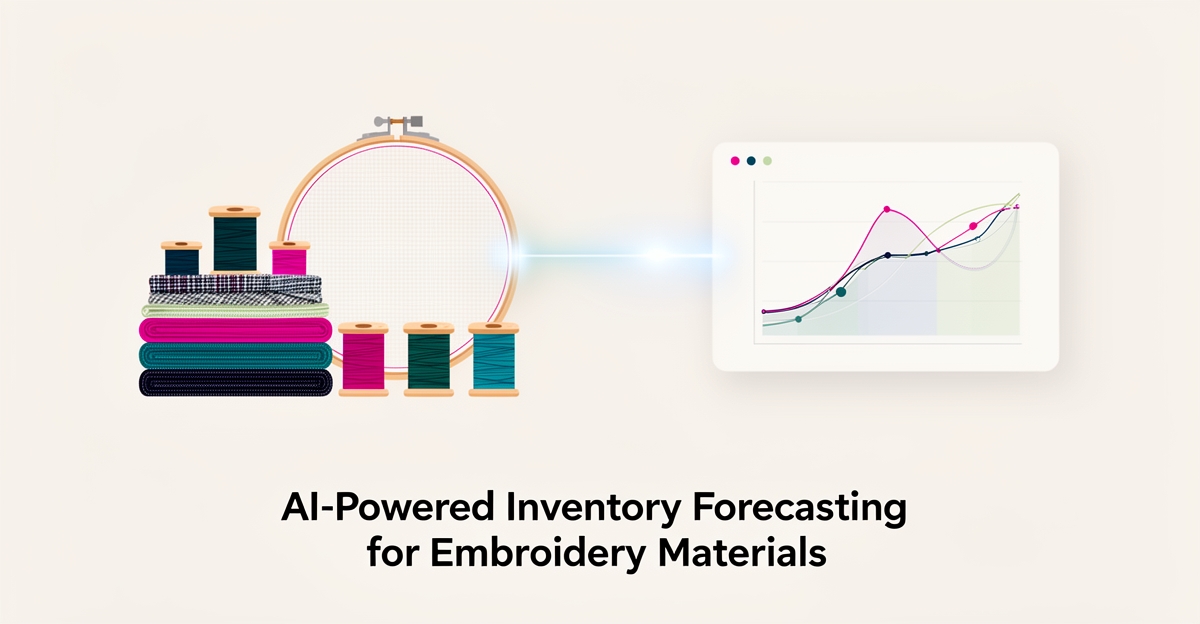
How AI Can Automate Inventory Forecasting for Embroidery Materials
Key Facts
- Inventory distortion is widely estimated to cost U.S. businesses over $1 trillion annually, with a large share of working capital tied up in misallocated stock
- AI demand forecasting typically achieves 85–92% accuracy at the SKU level, significantly outperforming traditional methods at roughly 60–70%
- Businesses using AI-driven demand planning commonly report 20–30% lower inventory holding costs by minimizing excess stock
- AI-powered reorder automation can cut stockout events dramatically, ensuring critical materials are available during demand spikes
- Manual inventory planning typically achieves only 40–60% accuracy, while predictive analytics commonly reaches 80–90%
- Teams using manual methods often spend 20–40 hours per month on repetitive data entry — time AI automation can redirect to design and production
- AI forecasting can analyze 50+ variables simultaneously including seasonality, holidays, and social trends to adjust for market shifts
Hire a team member that works 24/7 — for less than a part-time wage.
AI receptionists, SDRs, dispatchers and 99+ roles. Trained on your business, fully managed.
Not sure where to start? Ask our AI planner
The Cost of Guesswork in Embroidery Material Inventory
Every embroidery business knows the sinking feeling of a backordered thread color halting a rush order, or the quiet drain of capital sitting in bolts of fabric that won't move until next season. These aren't just operational hiccups — they are symptoms of a forecasting approach built on spreadsheets and intuition that cannot keep pace with modern SKU complexity. Industry estimates put the cost of inventory distortion at over $1 trillion annually for U.S. businesses, with the average company tying up a significant share of working capital in stock that is either missing or misallocated.
Traditional methods process only one or two variables — usually last year's sales — while ignoring the external signals that actually drive embroidery demand: fashion cycles, holiday calendars, viral social trends, and regional event schedules. Manual planning typically achieves only 40–60% accuracy and carries a meaningful error rate, a margin that evaporates margins on specialty materials like metallic threads or water-soluble stabilizers. When a stockout hits, most customers don't wait — they turn to a competitor, taking lifetime value with them.
The operational burden compounds the financial hit. Teams relying on spreadsheets often spend 20–40 hours per month on repetitive data entry and reconciliation — time that could be spent on design, customer relationships, or production optimization. Cognitive biases like recency bias and anchoring further distort orders, inflating forecasts and pushing excess inventory into corners where it becomes dead stock.
- Stockouts driving customers to competitors and eroding repeat business
- Excess inventory inflating holding costs by 20–30% annually
- Working capital locked in slow-moving specialty materials
- Procurement hours consumed by manual PO generation and supplier follow-up
- Inability to scale forecasting across hundreds of thread SKUs and fabric variants
AIQ Labs helps embroidery operations replace this guesswork with AI-powered inventory forecasting that analyzes 50+ demand signals simultaneously — from historical sales patterns to seasonal data and social trend velocity — delivering SKU-level accuracy that static formulas simply cannot achieve. For shops that want one workflow fixed first, our AI Workflow Builds rebuild the process that costs you the most, at a fixed price.
How AI Forecasting Transforms Demand Prediction for Threads and Fabrics
AI-powered demand forecasting transforms how embroidery businesses predict material needs by analyzing 50+ variables simultaneously, including historical sales, seasonal patterns, and external signals like fashion trends and social media activity. Unlike traditional methods that rely on static averages, these systems continuously learn from real-time data to generate dynamic, SKU-level predictions that adapt to market shifts and supply chain disruptions. This approach moves inventory planning from reactive guesswork to a proactive, data-driven science. As of late 2026, well-built AI forecasting systems typically achieve 85–92% accuracy at the SKU level, significantly outperforming traditional statistical methods, which usually reach only 60–70%.
For embroidery suppliers managing diverse inventories of threads, fabrics, and specialty materials, this level of precision directly reduces costly inefficiencies. Businesses using AI-driven demand planning commonly report 20–30% lower inventory holding costs by minimizing excess stock, alongside sharply fewer stockout events through smarter reorder automation. These improvements free up working capital and ensure critical materials are available when seasonal demand spikes or viral craft trends emerge—without over-investing in slow-moving inventory.
- Analyzes 50+ variables including seasonality, holidays, and social trends
- Adjusts forecasts dynamically for anomalies and lead time variability
- Integrates supplier performance data for precise reorder timing
- Scales across thousands of SKUs, unlike manual methods limited to a few dozen
- Reduces manual planning time by automating the majority of inventory tasks
AIQ Labs applies these forecasting principles through custom builds that produce production-ready systems tailored to embroidery material workflows. By integrating historical sales data with external signals such as search trends and competitor activity, these models continuously improve accuracy over their first months of deployment. The result is a resilient inventory strategy that reduces waste, prevents missed revenue opportunities, and ensures the right materials are available at the right time to meet customer expectations. For operations ready to go further, an AI Operating System connects forecasting, purchasing, and production into one connected layer you own outright. This shift from manual to predictive planning transforms inventory from a cost center into a strategic advantage for SMBs navigating volatile demand patterns.
Implementing AI Forecasting: From Data to Automated Reorders
The journey to automated inventory forecasting begins with building a robust data foundation. Embroidery businesses typically need 12–24 months of SKU-level historical data on fabrics, threads, and specialty materials to train effective AI models, including sales patterns, seasonal trends, and external variables like fashion cycles and craft industry events. This data foundation enables AI systems to analyze 50+ variables simultaneously, moving far beyond simple historical averages to capture the complex demand signals that affect material consumption.
Model training and validation typically takes a few weeks for initial calibration, followed by a period of continuous learning — often around 90 days — to reach peak SKU-level accuracy. During this period, AI systems integrate real-time signals from weather data, search trends, and competitor monitoring to dynamically adjust forecasts for anomalies and seasonal fluctuations. AIQ Labs' implementation process follows a phased timeline, ensuring models are production-ready before transitioning to autonomous operations.
Key implementation steps include establishing data pipelines from sales and inventory systems, integrating supplier lead times and minimum order quantities into reorder logic, and configuring dynamic safety stock levels that adjust based on demand volatility rather than static minimums. Once deployed, AI reorder agents automate PO generation, shipment tracking, and invoice matching, freeing procurement teams from the bulk of time typically spent on transactional communications. This end-to-end automation transforms inventory management from a reactive task into a strategic advantage, ensuring materials are always available while meaningfully reducing excess stock.
Still paying for 10+ subscriptions that don’t talk to each other?
We build custom AI systems you own outright. No vendor lock-in. Full control.
Not sure where to start? Ask our AI planner
Frequently Asked Questions
How accurate is AI forecasting compared to our current spreadsheet method?
What data do we need to start using AI for inventory forecasting?
How long does it take to implement AI inventory forecasting?
Can AI really predict demand for seasonal embroidery trends and viral patterns?
What's the ROI of switching from manual to AI-powered inventory planning?
Is AI forecasting affordable for small embroidery businesses, or is it just for enterprises?
From Guesswork to Growth: Making Inventory Work for Your Embroidery Business
Moving from spreadsheets and intuition to AI-powered forecasting changes inventory from a cost center into a strategic advantage for embroidery operations. By analyzing 50+ demand signals — from historical sales and seasonal patterns to fashion cycles, weather, and social trend velocity — AI delivers SKU-level accuracy that manual planning cannot match, cutting stockouts, reducing excess holding costs, and freeing procurement teams from repetitive data work. The result is more working capital available, fewer rush orders lost to backorders, and the ability to scale forecasting across hundreds of thread and fabric variants without adding headcount. If you're ready to replace guesswork with a data-driven system, start by auditing your current data foundation and identifying the highest-impact SKUs to pilot first. AIQ Labs has deployed 200+ multi-agent systems and runs four live SaaS products daily, so we build what we use ourselves. Start the 2-minute Fit Check at https://aiqlabs.ai/apply to book a free 30-minute strategy call, or reach us at [email protected] with questions about custom forecasting builds.
Make AI your competitive advantage — not just another tool.
Strategy, implementation and ongoing optimization. One partner, end to end.
Not sure where to start? Ask our AI planner