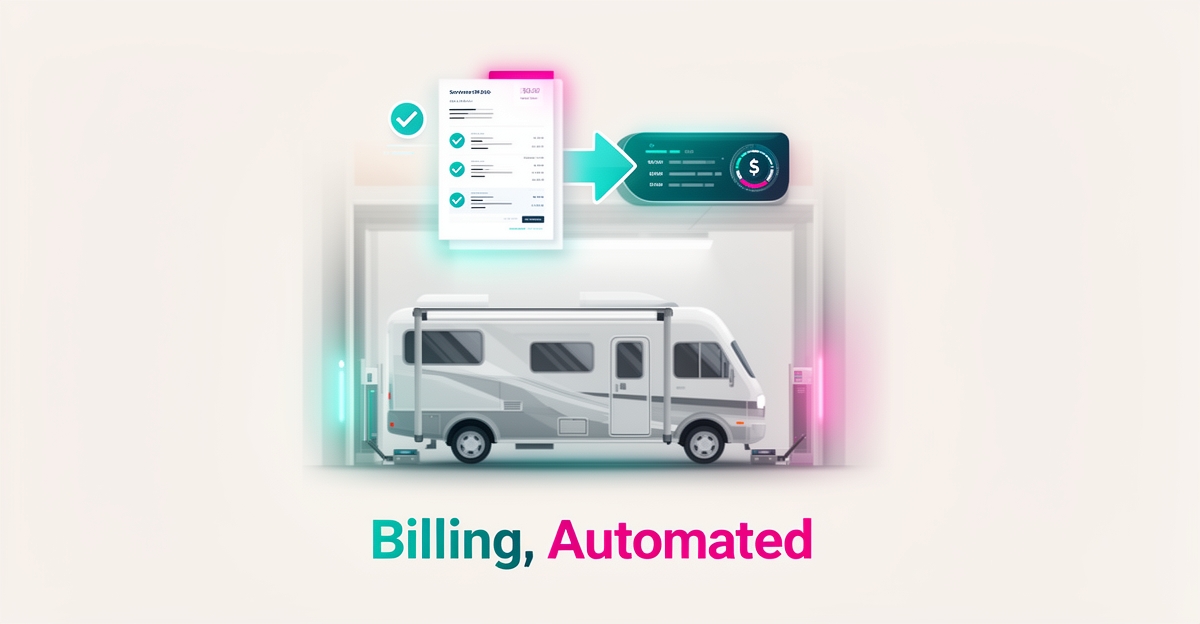
How AI Can Automate Invoicing and Billing for RV Service Centers
Key Facts
- Creating one manual invoice typically takes 20-30 minutes once you gather service details, calculate labor and parts, and format the document.
- A shop processing 20 invoices a month can lose roughly 15 hours to billing admin.
- Manual invoice processing is often estimated at $15 to $40 per invoice, with complex warranty and parts-heavy jobs at the high end.
- AI data extraction accuracy typically exceeds 99%, versus roughly 96-98% for manual entry.
- Service businesses that automate invoicing commonly report saving 10-15 hours per month.
- Well-timed automated reminders are reported to cut late payments by up to 35%.
- Automated billing is often credited with reducing collection times by 25-40%.
Hire a team member that works 24/7 — for less than a part-time wage.
AI receptionists, SDRs, dispatchers and 99+ roles. Trained on your business, fully managed.
Not sure where to start? Ask our AI planner
The Hidden Cost of Manual Invoicing in Your Service Bay
When a technician finishes a brake job on a Class A motorhome, the repair might be complete—but the billing process is just beginning. For many RV service centers, the gap between finishing work and getting paid stretches into days or weeks, not because customers are unwilling to pay, but because manual invoicing creates friction at every step.
The time drain alone is significant. Creating a single manual invoice typically takes 20 to 30 minutes once you factor in gathering service details, calculating labor and parts, and formatting the document. For a service center processing 20 invoices monthly, that translates to roughly 15 hours of unbilled administrative time—nearly two full workdays lost to paperwork instead of revenue-generating repairs.
The financial impact compounds quickly. Each manual invoice is often estimated to carry a processing cost of $15 to $40, depending on complexity. For an RV service center handling warranty claims, insurance work, or multi-day repairs with parts orders, costs tend toward the higher end of that range.
But the visible costs are only part of the problem. Three hidden drains erode profitability even further:
- Delayed invoicing: When a technician finishes work on Friday but the invoice goes out Tuesday, the payment clock starts late, extending your Days Sales Outstanding (DSO) and creating cash flow gaps that strain operations.
- Unbilled scope creep: Quick diagnostic calls, follow-up consultations, and small add-on tasks often go unbilled. Service businesses commonly report losing hundreds of dollars a month to this kind of scope creep.
- Data entry errors: Manual entry typically achieves only 96-98% accuracy, while AI-powered systems often exceed 99%. That error rate means incorrect totals, wrong tax rates, or missing line items that trigger disputes and delay payment.
The relationship damage may be the costliest consequence. When a customer receives an invoice with errors—double-billed labor, incorrect parts pricing, or a total that doesn't match the original estimate—trust erodes immediately. They question not just that invoice, but every future interaction with your service center. In an industry where repeat customers and referrals drive growth, billing mistakes become reputation risks.
AIQ Labs helps service-based businesses eliminate these bottlenecks through AI Workflow Builds that rebuild the one process costing you the most—often billing—so invoices generate themselves from service logs and customer history. The result is faster billing, fewer errors, and payment cycles that support healthy cash flow instead of undermining it.
How AI Turns Service Logs Into Invoices That Write Themselves
AI-powered invoicing transforms service logs into accurate, ready-to-send invoices through a streamlined five-stage workflow. First, the system captures data directly from time trackers, service management platforms, and CRM systems, pulling details like labor hours, parts used, and service descriptions. Next, machine learning algorithms process this raw information, extracting key fields such as client name, service type, rates, and quantities with high precision. The system then validates the extracted data against predefined business rules, contract terms, and pricing structures to catch discrepancies before invoicing occurs. Once validated, a professional invoice is automatically generated in the correct format, ready for review or immediate dispatch. Finally, the AI continuously tracks payment status and triggers smart reminders based on client behavior, ensuring timely follow-ups without manual intervention.
This end-to-end automation handles all three primary RV service billing models. For hourly labor, the system multiplies logged time by predefined rates; for fixed-price repairs, it triggers invoicing upon job completion or milestone achievement; and for recurring maintenance plans, it generates and sends invoices on a fixed schedule, such as the first of each month.
- Data capture from integrated time tracking and service systems
- ML-powered processing and validation of service data
- Auto-generation of invoices for hourly, fixed-price, and recurring models
- Smart payment tracking and automated reminder sequences
- Continuous optimization based on payment behavior and exceptions
With data extraction accuracy typically exceeding 99%, businesses eliminate most of the errors associated with manual entry. AIQ Labs builds these systems as fixed-price, phased workflow builds that integrate directly with your accounting software, turning what was once a time-consuming administrative burden into a self-running process that improves cash flow and commonly saves shops 10-15 hours of billing time per month. For RV service centers managing complex workflows across multiple service types, this means technicians can focus on repairs while the system ensures every billable hour, part, and service is accurately captured and invoiced—effectively letting the invoice write itself. The result is faster payments, fewer disputes, and a more predictable revenue stream that supports growth without increasing administrative overhead.
Smart Integrations and Payment Reminders That Accelerate Cash Flow
Smart integrations and AI-timed payment reminders transform invoicing from a manual chore into a self-driving financial process. When your invoicing system syncs with QuickBooks, Xero, your CRM, and payment processors like Stripe, data flows automatically from service logs to accounts—eliminating double entry and the errors that come with it. AI-powered systems pull time entries, parts used, and service details directly from connected tools, generating accurate invoices in seconds instead of the 20-45 minutes required for manual creation. Service businesses that automate commonly report saving 10-15 hours per month on billing tasks, freeing technicians and advisors to focus on repairs rather than paperwork.
Beyond generation, smart reminder sequences leverage AI to learn client payment patterns and deliver prompts at optimal times—significantly reducing late payments. Businesses using these timed sequences report up to a 35% reduction in late payments and collection times cut by 25-40%, turning unpredictable cash flow into a reliable stream. Automated reminders eliminate the awkward chase for overdue bills, sending professional, consistent follow-ups at 3 days before due, on the due date, and at 3, 7, and 14 days past due. This consistency builds trust while ensuring payments arrive faster.
- Syncs with QuickBooks and Xero for real-time accounting updates
- Connects to CRMs like HubSpot or Salesforce for customer history
- Integrates with Stripe or Square for instant payment processing
- Uses AI to time reminders based on client behavior
- Eliminates manual data entry and reconciliation
For RV service centers managing hourly labor, fixed-price repairs, and recurring maintenance plans, this integration creates a single source of truth—where every service logged triggers an invoice, every payment updates the ledger, and every reminder is sent without lifting a finger. The result is fewer billing disputes, faster access to working capital, and a team that spends less time on admin and more time keeping RVs road-ready. AIQ Labs builds these custom integrations directly into your existing workflow, so the system works for your shop—not the other way around.
Implementing AI Invoicing: A 7-Step Rollout for Your Service Center
Rolling out AI invoicing doesn't have to be disruptive. With a structured approach, you can move from manual chaos to automated efficiency in weeks, not months—and many service businesses see a return on their investment within the first few billing cycles.
Start by auditing your current process. For one month, track how many invoices you send, how long each takes to create, your current Days Sales Outstanding (DSO), and how many errors you catch. This baseline is critical for measuring ROI later. Businesses that automate typically save 10-15 hours per month on billing admin.
Next, choose your anchor tool—the platform your team already lives in, whether it's a project management system or time tracker. Your invoicing system should integrate seamlessly with this anchor to avoid double entry. From there, select an AI invoicing approach that fits your billing model, whether that's hourly labor, fixed-price repairs, or recurring maintenance plans.
Once you've chosen your approach, connect your systems. Link your invoicing platform to your accounting software (like QuickBooks), time tracking, CRM, and payment processor. Most integrations take 30-60 minutes each. Then configure your templates and billing rules for each service type—hourly, project-based, or recurring.
Start conservatively. For the first month, require approval on all invoices before they send. This lets you catch any configuration issues early. Set up smart payment reminders—a sequence that nudges clients 3 days before the due date, on the due date, and at 3, 7, and 14 days past due. Automated reminder systems like this are reported to reduce late payments by up to 35%.
Finally, monitor and optimize. After 30 days, compare your new metrics to your baseline. Look for improvements in DSO, hours saved, and error rates. Adjust your rules and templates based on what you learn.
- Audit current invoicing metrics for one month
- Choose an anchor tool and invoicing approach
- Connect accounting, CRM, and payment systems
- Configure templates, billing rules, and approval workflows
- Launch automated reminders and measure DSO improvements
A typical phased build takes a few weeks, and most service businesses see measurable improvements in cash flow within the first billing cycle. AIQ Labs delivers this kind of work as fixed-price, milestone-based workflow builds—you approve each phase before it proceeds, and there are no surprise costs. If you're ready to explore what automation could look like for your RV service center, start with a two-minute Fit Check to map your biggest bottleneck.
Avoiding the Pitfalls: Data Cleanup, Edge Cases, and Getting AI Invoicing Right
Before launching AI-powered invoicing, RV service centers must address foundational data issues and edge cases to avoid amplifying existing problems. Automated systems will inherit flaws like duplicate customer records or outdated service histories if these aren't cleaned up first, leading to incorrect invoices and billing disputes. Documenting complex scenarios—such as warranty claims, multi-part repairs, or customer-specific discounts—ensures the AI knows when to flag exceptions for human review rather than attempting full automation prematurely. Starting with predictable, recurring invoices like monthly maintenance plans or storage fees allows teams to validate the system's accuracy before tackling variable labor or parts-based jobs. Even with automation in place, human oversight remains critical for handling credits, refunds, and disputed charges, as AI excels at routine tasks but requires judgment for nuanced financial exceptions.
By building a custom system that integrates directly with your existing accounting software—rather than layering on another subscription—RV centers avoid tool sprawl and keep full control over their financial workflows. AIQ Labs builds these systems so you own them outright, with payment models that fit your stage: start monthly, build in milestones, or own it outright. This approach ensures the automation serves the business, not the other way around, turning invoicing from a bottleneck into a reliable, self-running process.
Still paying for 10+ subscriptions that don’t talk to each other?
We build custom AI systems you own outright. No vendor lock-in. Full control.
Not sure where to start? Ask our AI planner
Frequently Asked Questions
How much time does manual invoicing actually cost my RV service center each month?
Will AI invoicing actually reduce errors, or just automate my mistakes?
Can AI handle our mix of hourly labor, fixed-price repairs, and recurring maintenance plans?
How long does it take to set up AI invoicing, and when will we see ROI?
What happens with complex edge cases like warranty claims or customer-specific discounts?
Do I need to replace my current accounting software or CRM to use this?
Turn Service Logs Into Steady Cash Flow
Manual invoicing isn't just a time sink—it's a direct hit to your RV service center's cash flow, reputation, and ability to grow. From the hours lost each month to paperwork, to the revenue that slips through unbilled scope creep, to the trust-eroding impact of billing errors, the hidden costs compound quickly. AI-powered invoicing flips this script by turning service logs into accurate, self-generating invoices, syncing with your existing tools like QuickBooks or your CRM, and triggering smart reminders that cut late payments. The result? Faster payments, fewer disputes, and your team back where they belong—under the hood, not buried in admin. If you're ready to see what automation could unlock for your shop, start with a two-minute Fit Check to map your biggest bottleneck, then book a free 30-minute strategy call to explore a custom build that fits your workflow. You can reach the team anytime at [email protected].
Make AI your competitive advantage — not just another tool.
Strategy, implementation and ongoing optimization. One partner, end to end.
Not sure where to start? Ask our AI planner