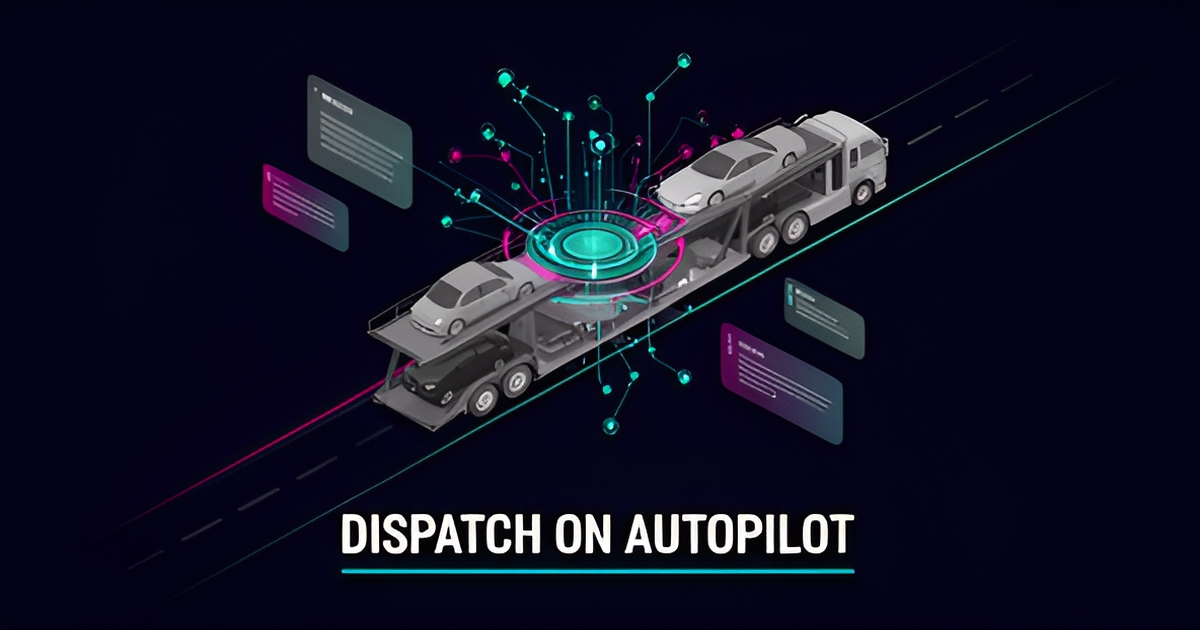
How AI Can Automate Job Ticketing and Dispatch Notifications in Auto Hauling
Key Facts
- Industry analyses of AI-assisted dispatch consistently report planning time dropping from multiple hours per day to minutes once assignment is automated
- Algorithmic routing typically reduces total miles driven by roughly 20-35% compared with intuition-based manual dispatch
- Real-time tracking and proactive status updates are widely associated with a 30-40% drop in inbound customer support calls
- A single human dispatcher typically coordinates 10-15 drivers effectively, while automated dispatch scales well beyond that without linear headcount growth
- AI adoption is now mainstream—most large organizations report using AI in at least one business function as of late 2026
Hire a team member that works 24/7 — for less than a part-time wage.
AI receptionists, SDRs, dispatchers and 99+ roles. Trained on your business, fully managed.
Not sure where to start? Ask our AI planner
The Bottleneck of Manual Dispatching
In the fast-paced world of auto hauling, the dispatch desk often becomes the operational choke point. While AI adoption is now mainstream across industries, many hauling operations still rely on manual ticketing and phone-based coordination.
This reliance creates an immediate time deficit. Manual dispatch planning typically consumes 2-4 hours daily, whereas AI-driven systems compress this to minutes. That gap represents more than lost time; it delays job assignments, slows driver notifications, and creates a ripple effect of idle trucks and missed pickup windows across the entire logistics chain.
Scalability presents another critical constraint. A human dispatcher can effectively coordinate only about 10-15 drivers before cognitive overload compromises accuracy. As fleets grow, this limitation forces companies to either hire additional dispatch staff or accept declining service quality, creating a ceiling on growth that manual processes cannot easily break through.
The error-prone nature of intuition-based routing compounds these bottlenecks. Without algorithmic optimization, manual dispatching typically results in significantly higher mileage and fuel costs. Industry analyses generally attribute 20-35% fewer total miles to AI-assisted dispatch compared with manual methods, highlighting the hidden inefficiencies of gut-feel routing decisions.
Communication gaps further erode operational efficiency. Manual systems depend on check-in calls and radio updates, leaving dispatchers with fragmented visibility into driver locations and job statuses. This information lag drives up inbound customer support calls as clients phone in seeking status updates that automated systems would provide proactively—industry reporting commonly links real-time tracking to a 30-40% reduction in these calls.
The operational costs of manual dispatching typically manifest as:
- Delayed job assignments and driver notifications
- Excessive fuel consumption from suboptimal routing
- Limited scalability requiring linear staff increases
- High volumes of inbound customer service inquiries
- Inconsistent service quality dependent on individual dispatcher experience
These challenges underscore why integration gaps become impossible to ignore at scale. When AI meets legacy dispatch tools, the seams between systems—scheduling, telematics, customer records—become the failure points. For auto haulers, these gaps manifest daily as missed connections, frustrated drivers, and dissatisfied customers.
Addressing these bottlenecks requires more than incremental improvements; it demands a fundamental shift in how dispatch operations function. AIQ Labs rebuilds the dispatch workflow itself—automating job creation, assignment, and driver notification based on real-time location and availability data—through AI Workflow Builds that connect directly to your existing dispatch tools. The result transforms dispatch from a daily bottleneck into a competitive advantage.
AI-Powered Dispatch: Benefits and Capabilities
Manual job ticketing creates delays and errors that compound across every pickup and delivery. AI changes the workflow by automatically creating, assigning, and notifying drivers of hauling jobs based on pickup locations and vehicle availability.
AI dispatch systems analyze numerous variables in real-time, including driver location, equipment type, vehicle inventory, traffic conditions, job priority, and customer availability, to optimize routes, resource allocation, and job sequencing. This automation frees dispatchers from routine tasks and shifts their focus to exceptions and customer relationships.
Efficiency gains are immediate and measurable. Planning that once took hours daily collapses to minutes with AI dispatch. Industry analyses of AI-assisted routing typically show 20-35% fewer total miles driven, directly reducing fuel consumption and vehicle wear.
Cost reduction follows from smarter routing and less manual handling. Fewer miles and faster planning lower labor hours per job, while consistent algorithmic assignment reduces errors that cause missed pickups and redispatches. The result is a leaner operation that scales without adding headcount.
Customer satisfaction improves when visibility becomes continuous. Real-time updates and accurate ETAs replace check-in calls, and industry reporting commonly links real-time tracking to a 30-40% reduction in customer support calls. Live GPS dashboards give customers confidence and reduce inbound inquiries.
Scalability is another clear advantage. Manual dispatch typically supports 10-15 drivers per dispatcher, while AI dispatch scales from a handful of trucks to hundreds with consistent performance. That scalability matters for seasonal surges and multi-region growth.
AI-powered dispatch delivers benefits across the operation:
- Automated job creation and driver notification from ticket intake
- Dynamic route optimization using live traffic and vehicle availability
- Real-time visibility with live GPS dashboards for customers and dispatch
- Reduced human error through consistent algorithmic assignment
Integration with existing tools is critical for auto hauling. AIQ Labs builds custom systems that sync with your current dispatch software rather than forcing a rip-and-replace. Custom integration preserves data history and dispatcher workflows while adding intelligent automation—built in milestones, at a fixed price, so you know exactly what you're paying for at each phase.
With the right architecture, AI dispatch becomes a competitive advantage rather than just a cost saving. It delivers faster planning, lower miles, and better customer experience at the same time.
Implementing AI Dispatch: A Step-by-Step Guide
Adopting AI dispatch doesn't happen overnight, but the path from manual ticketing to automated assignment is shorter than most hauling operators expect. The key is treating implementation as a structured project rather than a software purchase—because the difference between a stalled pilot and a working system usually comes down to preparation.
Step 1: Assess Your Current Dispatch Process
Start by documenting how jobs flow today: how tickets are created, how drivers are assigned, and where delays and errors occur. Manual planning typically consumes 2-4 hours of a dispatcher's day, and most operations cap out at 10-15 drivers per dispatcher. Understanding these bottlenecks tells you exactly what the AI system needs to solve.
This is also the time to evaluate your data quality. AI dispatch tools analyze variables like driver location, vehicle availability, traffic conditions, and job priority in real time—but they can only do that if your records are accurate and current. Decide what must be standardized before AI is scaled; that discipline matters more than the speed of adoption.
Step 2: Choose a Build That Integrates With Your Existing Tools
Not all AI dispatch solutions are built alike. The right approach should sync with your current dispatch tools rather than force a rip-and-replace, since integration with existing systems is one of the most commonly cited challenges in AI adoption. When evaluating options, look for:
- Two-way integration with your existing scheduling and dispatch software
- Automatic job creation and assignment based on pickup locations and vehicle availability
- Real-time driver notifications with accurate ETAs
- Scalability beyond a single dispatcher—strong systems grow with your fleet
Custom-built systems are often the strongest option here. AIQ Labs rebuilds the one workflow that costs you the most—dispatch—through a fixed-price, phased Workflow Build that connects directly to your existing tools, avoiding the data gaps that emerge when platforms don't communicate. You start monthly, build in milestones, and can own the system outright.
Step 3: Implement and Train Your Team
Roll out the system with dispatchers involved from day one. Their job shifts from manual planning—which AI completes in minutes—to oversight and exception handling. Frame the change as removing tedious work, not removing people, and invest in training so the team trusts the algorithm's assignments.
Step 4: Monitor Performance and Adjust
Once live, track the metrics that matter: planning time, miles per job, missed pickups, and inbound status calls. Operations using AI-assisted dispatch typically report 20-35% fewer total miles driven, and real-time tracking is commonly associated with a 30-40% reduction in customer support calls. Review these numbers weekly at first, flag misassignments, and refine your rules. AI dispatch improves with feedback—the system's error rate stays consistent precisely because it learns from every correction.
Overcoming Challenges and Ensuring Success
AI dispatch promises faster job ticketing, but the road to reliable automation is rarely smooth. Integration gaps and data quality issues surface quickly when AI meets legacy dispatch tools.
Integration with existing systems is the most cited barrier. AI requires connection to dispatch tools, routing systems, and vehicle telematics to function effectively. AI doesn't make integration intelligent by design—it just makes the gaps harder to ignore. Without standardized data flows, automated job creation stalls and manual workarounds return.
Data quality determines whether AI can automatically create, assign, and notify drivers based on pickup locations and vehicle availability. Poor data management leads to bad assignments, missed pickups, and eroded trust in the system. The task is not to slow AI adoption; it is to decide what must be standardized before AI is scaled.
Governance and change management also matter. Most large organizations now use AI in at least one business function as of late 2026, yet many lack the structures to deploy it responsibly in operations. Clear ownership, validation layers, and human-in-the-loop controls prevent errors from propagating across the fleet.
Success comes from treating integration and data as part of the build, not an afterthought. AIQ Labs approaches auto hauling automation by architecting custom systems that sync with existing dispatch tools and reduce human error—built in phases so you can verify each milestone before committing to the next, and owned outright when complete.
Practical strategies that reduce risk include:
- Map and standardize core data before training models, including vehicle availability, driver skill sets, and pickup locations
- Build deep two-way API integrations with current dispatch and telematics platforms to ensure real-time visibility
- Pilot on a single lane or region, monitor performance, and adjust routing logic before scaling fleet-wide
- Establish governance for data updates, exception handling, and dispatcher oversight
When integration is done well, the operational gains are measurable: AI-assisted dispatch typically drives 20-35% fewer total miles, and real-time tracking commonly delivers a 30-40% reduction in customer support calls.
Planning speed improves from hours daily with manual dispatch to minutes with AI, while scalability expands from 10-15 drivers per dispatcher to hundreds of drivers on one system. These shifts free dispatchers to focus on exceptions and customer relationships instead of repetitive ticketing.
Start with standardization, then automate. Clean data and seamless system connections are the foundation for reliable job ticketing and dispatch notifications. With the right architecture, AI becomes a dependable co-pilot for auto hauling operations.
Still paying for 10+ subscriptions that don’t talk to each other?
We build custom AI systems you own outright. No vendor lock-in. Full control.
Not sure where to start? Ask our AI planner
Frequently Asked Questions
How much time can AI dispatch save compared to manual planning?
Will AI dispatch reduce fuel costs in auto hauling operations?
Can AI dispatch handle larger fleets without hiring more dispatchers?
How does AI dispatch improve customer satisfaction and reduce support calls?
What are the biggest challenges when implementing AI dispatch in auto hauling?
Do I need to replace my current dispatch software to use AI dispatch?
From Bottleneck to Breakthrough: Turning Dispatch into Your Competitive Edge
Auto hauling operations stuck in manual dispatching face a daily time sink of hours, limited scalability beyond 10-15 drivers per dispatcher, and avoidable costs from inefficient routing—all while customer inquiries spike due to poor visibility. AI-powered dispatch flips this script: compressing planning to minutes, typically cutting mileage by 20-35%, reducing support calls by 30-40%, and scaling seamlessly as your fleet grows. The real win isn't just efficiency—it's freeing your team to focus on exceptions and relationships instead of repetitive ticketing. AIQ Labs builds custom AI dispatch systems that integrate with your existing tools, delivered in phases at a fixed price, and owned outright when complete—no rip-and-replace disruption. Ready to see where your biggest bottleneck hides? Start with a free two-minute Fit Check, then book a no-obligation 30-minute strategy call to map your highest-ROI opportunity—no pitch, just clarity on your path forward. Dispatch doesn't have to be the desk where growth stalls. With the right automation, it becomes the system that powers it.
Make AI your competitive advantage — not just another tool.
Strategy, implementation and ongoing optimization. One partner, end to end.
Not sure where to start? Ask our AI planner