Back to Blog

How AI Can Automate Landscape Design Process Workflows for Smaller Firms

AI Business Process Automation > AI Workflow & Task Automation14 min read

How AI Can Automate Landscape Design Process Workflows for Smaller Firms

Key Facts

  • AI reduces design turnaround from 2–4 weeks to under 60 seconds, enabling faster bidding.
  • Contractors using 3D renders cut job closure time from 25 hours to just 5 hours.
  • AI-driven 3D renders drive close rates above 60 percent by improving client visualization.
  • AI renders start at $12, compared to traditional landscape architect fees of $1,500–$5,000.
  • One AI pipeline delivers 22 photorealistic renders per project in under 60 seconds.
  • AI tools support over 48 distinct landscape design styles for varied client preferences.
  • AI platforms claim $50 million in saved gardening costs through accurate plant selection.
AI Employees

What if you could hire a team member that works 24/7 for $599/month?

AI Receptionists, SDRs, Dispatchers, and 99+ roles. Fully trained. Fully managed. Zero sick days.

The New Efficiency Standard: From Visualization to Documentation

For years, landscape design automation was stuck in a bottleneck: generating pretty pictures that contractors couldn’t build. Today, the industry is shifting from generic image generation to purpose-built, data-driven ecosystems that produce contractor-ready outputs immediately. This evolution transforms the designer’s role from artistic illustrator to strategic project architect, enabling firms to scale without scaling headcount.

The old model required weeks of manual drafting to create documents that were often disconnected from the visual concept. Now, AI pipelines can generate Bills of Quantities (BOQ) and planting schedules alongside photorealistic renders. This integration ensures that what the client sees is exactly what the crew installs, eliminating the costly friction between design intent and construction reality.

According to industry data, AI tools can now generate complete design packages in under 60 seconds that traditionally take a professional landscape architect 2–4 weeks to complete. This drastic reduction in turnaround time allows smaller firms to bid on significantly more projects without increasing their design team size.

  • Speed: Designs generated in <60 seconds vs. weeks
  • Accuracy: Climate-verified plant selection via Biological Engines
  • Utility: Automatic generation of contractor-ready blueprints

This shift addresses a critical gap where generic AI tools produced visually appealing but horticulturally inaccurate images. Purpose-built systems now cross-reference designs with real-world data, such as USDA hardiness zones and regional rainfall patterns. This ensures that every plant recommendation is viable for the specific geographic location, reducing liability and client dissatisfaction.

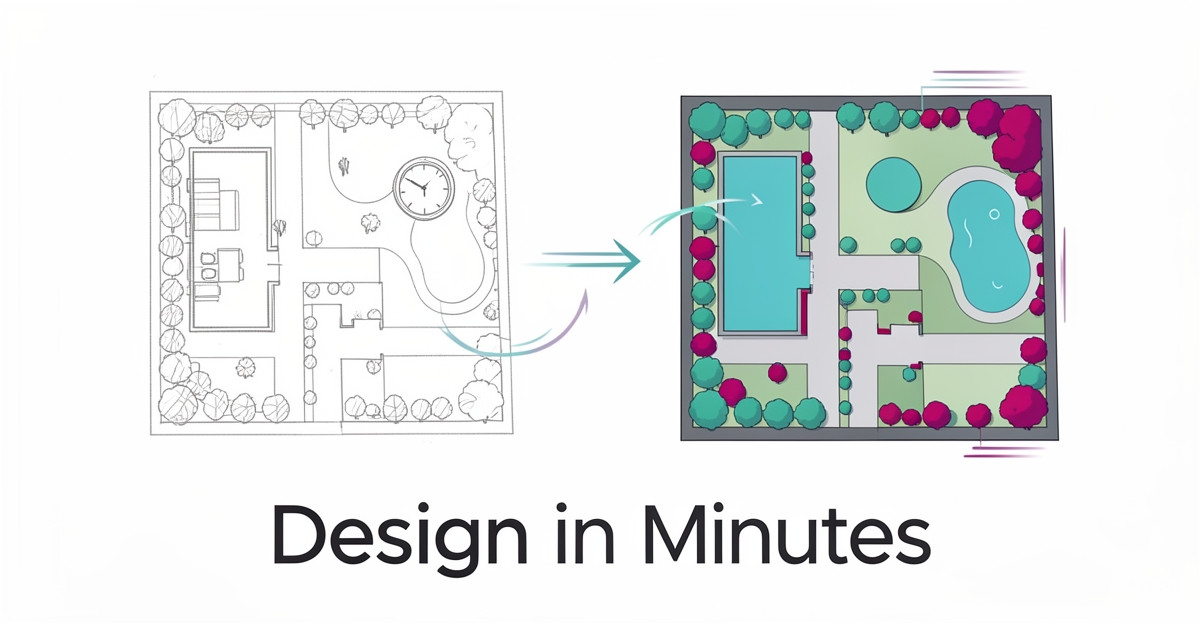
For example, a small landscape firm can now use an AI pipeline to convert a client’s sketch into 22 photorealistic renders, complete with a material takeoff and BOQ, in under a minute. This capability allows the firm to present a comprehensive, professional proposal that answers both aesthetic and logistical questions instantly.

The business impact of this efficiency is measurable. Contractors using advanced 3D renders and automated documentation reported reducing the time to close a job from 25 hours to just 5 hours. Furthermore, these enhanced visual workflows resulted in close rates above 60 percent, proving that speed and accuracy directly drive revenue.

  • Time to Close: Reduced from 25 hours to 5 hours
  • Conversion Rate: Increased to above 60 percent
  • Cost Savings: Up to $50M claimed in gardening costs via accurate plant selection

Traditional professional landscape architect fees range from $1,500 to $5,000 per project, whereas AI-driven tools offer a pay-per-project model starting at $12 for a single render. This disparity creates a massive opportunity for smaller firms to compete with larger competitors by offering enterprise-grade visualization at a fraction of the cost.

However, technology alone is not enough. Industry experts emphasize that AI has not fundamentally changed how landscapes are designed; the process remains driven by contractor expertise and creativity. AI serves as a productivity enhancer that lowers the barrier to entry and accelerates the production of ideas, rather than replacing the human designer.

The greatest ROI comes from aligning people, processes, and technology around a unified digital workflow. By integrating AI design tools with broader business operations like CRM and accounting, firms can create a seamless flow from initial concept to final invoice.

This transition from visualization to documentation is not just about faster drawings; it is about building a scalable, data-backed business model. By automating the "boring" aspects of documentation, smaller firms can focus on high-value creative work and client relationships, securing a sustainable competitive advantage in a rapidly evolving market.

Solving the Horticultural Accuracy Gap

Generic AI image generators like Midjourney are visually stunning but practically useless for landscape construction. They frequently hallucinate plant species that cannot survive in your local climate, leading to costly failures and client dissatisfaction.

This is why purpose-built systems are essential. By integrating a "Biological Engine" that references USDA hardiness zones and regional rainfall data, designers ensure every plant recommendation is viable.

When you rely on generic tools, you risk designing landscapes that die within months. These systems lack domain-specific knowledge, often placing tropical species in cold zones or ignoring soil requirements.

This inaccuracy creates significant liability for smaller firms. A design that looks beautiful but fails ecologically damages your reputation and increases waste.

Specialized AI platforms solve this by cross-referencing designs with real-world environmental data. This ensures plant selections are climate-accurate and structurally sound for the specific site.

Key capabilities include:

  • Climate Verification: Automatic checks against USDA hardiness zones for every plant.
  • Data-Driven Objects: Real-time updates to plant schedules as designs evolve.
  • Contractor-Ready Outputs: Generation of Bills of Quantities (BOQ) alongside renders.

By prioritizing these tools, firms eliminate the guesswork from plant selection. This approach reduces the risk of project failure and ensures long-term landscape viability.

The shift to accurate, data-driven AI delivers measurable business results. Faster, more reliable designs allow firms to handle more bids without adding staff.

Consider these industry benchmarks:

  • Time Reduction: AI generates designs in under 60 seconds that traditionally take 2–4 weeks (https://hadaa.app/).
  • Cost Savings: Platforms claim to have saved $50 million in gardening costs through accurate plant selection (https://hadaa.app/).
  • Faster Closings: Contractors using 3D renders reduce time to close jobs from 25 hours to just 5 (https://www.greenindustrypros.com/design-installation/design/article/22965489/landscape-design-software-ai-efficiency-gains).

These metrics highlight the power of combining speed with accuracy. You no longer have to choose between rapid turnaround and professional reliability.

While design accuracy is critical, it must connect to your broader workflow. AIQ Labs builds custom systems that integrate these specialized design tools with your CRM, accounting, and scheduling software.

This creates a seamless pipeline from concept to construction documentation. Your team can focus on creativity while AI handles the data-heavy validation and documentation tasks.

This approach ensures that every project is not only beautiful but also executable and profitable.

Automating the 'Boring' Work: Documentation and Feedback

For smaller landscape firms, the most significant barrier to growth isn’t creativity—it’s the administrative burden that drains profitability. By automating manual drafting, material takeoffs, and client feedback loops, businesses can reclaim hours previously lost to repetitive tasks. This shift allows designers to focus on high-value creative work while AI handles the heavy lifting of documentation and approval workflows.

Traditional design reviews often stall due to static 2D plans that clients struggle to visualize. Modern AI tools solve this by generating contractor-ready blueprints and Bills of Quantities (BOQ) alongside photorealistic renders. This shift from simple visualization to actionable documentation ensures that every design element is structurally sound and horticulturally accurate.

  • Real-Time Updates: Data-driven objects automatically update plant schedules and material takeoffs as the design evolves.
  • Virtual Pre-Build: Owners and crews can visualize circulation and sightlines at full scale before breaking ground.
  • Seamless Collaboration: Cloud-based platforms allow project managers to sync redlines directly from client feedback to working files.

The efficiency gains are measurable. Contractors utilizing 3D renders have reported reducing the time to close a job from 25 hours to just 5 hours according to industry data. Furthermore, these visual tools have driven close rates above 60 percent by helping clients visualize the final outcome clearly as reported by Green Industry Pros.

Manual counting for material takeoffs is a primary source of costly errors and budget overruns. Purpose-built AI systems integrate domain-specific data, such as USDA hardiness zones, to ensure every plant recommendation is viable for the specific geographic location. This prevents the common pitfall of generic AI generators producing horticulturally inaccurate images.

By working with data-driven objects, contractors can automatically generate planting schedules and grading plans that update in real time. This eliminates manual counting and significantly reduces the risk of errors during construction. Tony Kostreski, Lead Product Specialist at Vectorworks, notes that the greatest ROI comes from aligning people, processes, and technology around a unified digital workflow according to Vectorworks.

For small to mid-sized firms, the ability to handle more opportunities without adding headcount is a competitive moat. AI tools reduce design turnaround times from weeks to minutes, allowing firms to bid on more projects with minimal overhead. This scalability is crucial for growth without the risk of expanding payroll too quickly.

  • Speed: Generate designs in under 60 seconds that traditionally take 2–4 weeks.
  • Cost Efficiency: Shift from high fixed costs to low variable costs per project.
  • Accuracy: Ensure climate-accurate plant selection to reduce liability.

Megan Pratt, Vice President of Product at Oldcastle APG, emphasizes that contractors using technology to enhance their process are the ones who will prevail according to Oldcastle APG. This approach positively impacts project profitability by handling more opportunities efficiently.

The key to success is integrating these specialized design workflows with broader business operations like CRM, accounting, and scheduling. AIQ Labs helps build custom AI systems tailored to these specific workflows, giving firms full ownership and control over their automation. By moving beyond off-the-shelf tools, firms can create a true competitive advantage that is uniquely theirs.

This integration transforms the "boring" work into a streamlined engine for growth. With automated documentation and faster approvals, your team can focus on what they do best: designing beautiful, functional landscapes.

Beyond Off-the-Shelf: Building Owned AI Workflows

Generic SaaS subscriptions often leave landscape firms with disconnected tools that fail to communicate, creating data silos that stifle growth. In contrast, custom-built, owned systems integrate design outputs directly into your CRM, accounting, and scheduling platforms for a unified operational workflow.

This approach eliminates the "subscription chaos" of managing multiple vendor logins and ensures your firm retains full intellectual property. By architecting systems that you own, you avoid vendor lock-in and gain the flexibility to adapt automation as your business evolves.

The true power of AI in landscape architecture lies in connecting creative design with back-office efficiency. When design software automatically feeds data into project management and accounting tools, manual data entry disappears.

Key benefits of integrated workflows include:

  • Elimination of Manual Entry: Remove 20+ hours weekly of redundant data transcription between design and billing software.
  • Real-Time Cost Accuracy: Update material takeoffs and planting schedules instantly as designs evolve, preventing costly estimation errors.
  • Unified Project Visibility: Provide stakeholders with a single source of truth for project status, budgets, and timelines.

According to industry experts, the greatest ROI comes from aligning people, processes, and technology around a unified digital workflow rather than relying on disconnected applications.

Speed to bid is a critical competitive advantage for smaller firms. Traditional design processes can take weeks, but AI-driven pipelines can generate comprehensive design packages in under 60 seconds. This rapid turnaround allows firms to pursue significantly more opportunities without increasing headcount.

Consider the impact on your bottom line: contractors using 3D renders reported reducing the time to close a job from 25 hours to just 5 hours. Furthermore, the use of high-quality 3D visualization has been shown to drive close rates above 60 percent.

By automating the generation of contractor-ready blueprints and Bills of Quantities (BOQ), you remove the administrative bottleneck that typically slows down sales cycles.

Scaling a landscape business traditionally requires hiring more designers or administrative staff, which increases fixed costs and management overhead. AI automation offers a different path to growth by handling repetitive tasks that do not require human creativity.

Industry leaders note that AI tools help firms handle more opportunities without adding staff, positively impacting project profitability. For example, AI can automate the initial rendering, material counting, and client feedback collection, allowing your human team to focus on high-value design decisions and client relationships.

This strategy transforms your firm from a labor-intensive service provider into a technology-enabled enterprise. You can scale your output volume while maintaining high margins, ensuring that growth is sustainable and efficient.

Off-the-shelf tools often impose rigid workflows that force your business to adapt to their limitations. Owned systems, however, are built to mirror your unique operational processes.

When you own your AI infrastructure, you can:

  1. Customize Integrations: Connect specific design outputs to your preferred accounting or CRM platforms.
  2. Iterate Rapidly: Update workflows as your service offerings expand without waiting for vendor updates.
  3. Protect Data: Keep proprietary design methods and client data within your secure environment.

As one industry executive noted, firms that use technology to enhance their process, rather than replace it, are the ones who will prevail. By building owned AI workflows, you secure a sustainable competitive advantage that grows with your business.

This foundation of owned, integrated automation sets the stage for deploying specialized AI employees that can manage daily operations, further amplifying your firm's capacity.

AI Development

Still paying for 10+ software subscriptions that don't talk to each other?

We build custom AI systems you own. No vendor lock-in. Full control. Starting at $2,000.

Frequently Asked Questions

How much money can a small landscape firm actually save by switching from traditional architects to AI design tools?
Traditional professional fees range from $1,500 to $5,000 per project, whereas AI-driven tools offer a pay-per-project model starting at just $12 for a single render. This massive cost reduction allows smaller firms to offer enterprise-grade visualization without the high overhead.
Will using AI design tools replace my landscape architect's creative expertise?
No, industry experts emphasize that AI serves as a productivity enhancer rather than a replacement for human creativity. The design process remains driven by contractor expertise, with AI handling repetitive tasks like rendering to free up designers for high-value creative work.
Does AI-generated landscape design actually work for construction, or is it just pretty pictures?
Modern AI tools generate contractor-ready outputs like Bills of Quantities (BOQ) and planting schedules alongside renders. This prevents the common issue of generic AI tools producing horticulturally inaccurate images, ensuring designs are structurally and biologically viable.
How does AI help ensure plants I design will actually survive in my local climate?
Purpose-built AI systems use a 'Biological Engine' that cross-references designs with real-world data like USDA hardiness zones and regional rainfall. This ensures every plant recommendation is climate-accurate for your specific geographic location, reducing liability and project failure.
Can AI integration help us close more jobs and win more bids?
Yes, data shows that contractors using 3D renders report reducing the time to close a job from 25 hours to just 5 hours. Additionally, these enhanced visual workflows have resulted in close rates above 60 percent by helping clients visualize the final outcome clearly.
What is the real difference between AIQ Labs' approach and off-the-shelf AI subscriptions?
AIQ Labs builds custom, owned AI systems that integrate design outputs directly into your CRM and accounting software, eliminating data silos. Unlike generic SaaS subscriptions, this creates a unified digital workflow where you retain full intellectual property and control without vendor lock-in.

From Sketch to Site: Owning Your Design Automation

The landscape design industry is undergoing a fundamental shift, moving beyond generic image generation to data-driven ecosystems that produce contractor-ready outputs immediately. By integrating Bills of Quantities and climate-verified plant selections with photorealistic renders, smaller firms can eliminate the friction between design intent and construction reality. This evolution allows designers to scale operations without increasing headcount, turning weeks of manual drafting into seconds of automated precision. However, off-the-shelf tools often lack the specific integrations and ownership control needed for true operational excellence. AIQ Labs helps firms build custom AI systems tailored to these unique design workflows, ensuring full ownership and control over automation. Instead of relying on fragmented subscriptions, you can architect a unified system that streamlines design reviews, client feedback loops, and project scheduling. Take the next step in your AI journey by scheduling a free AI Audit & Strategy Session to identify high-ROI automation opportunities and build a competitive advantage that is truly yours.

AI Transformation Partner

Ready to make AI your competitive advantage—not just another tool?

Strategic consulting + implementation + ongoing optimization. One partner. Complete AI transformation.

Join The Newsletter

Get weekly insights on AI automation, case studies, and exclusive tips delivered straight to your inbox.

Ready to Increase Your ROI & Save Time?

Book a free 15-minute AI strategy call. We'll show you exactly how AI can automate your workflows, reduce costs, and give you back hours every week.

P.S. Still skeptical? Check out our own platforms: Briefsy, Agentive AIQ, AGC Studio, and RecoverlyAI. We build what we preach.