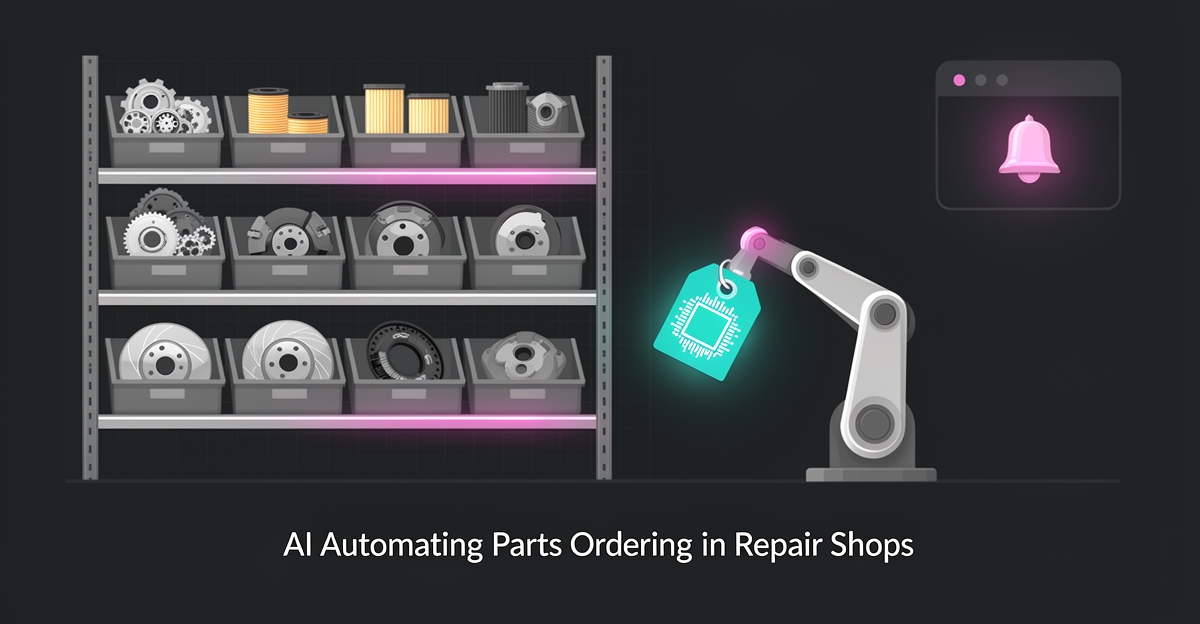
How AI Can Automate Parts Ordering and Inventory Alerts in Repair Shops
Key Facts
- Industry comparisons report AI parts identification reaching 95-99% accuracy in roughly 60 seconds versus 20 minutes or more manually per Heavy Vehicle Inspection
- Manual parts cataloguing is typically cited at 70-80% accuracy according to Heavy Vehicle Inspection
- AI-driven data processing is reported to reach 99%+ accuracy versus 5-8% error rates in manual methods per AutomaSnap
- Analyses of AI versus manual order processing report processing time reductions around 92% and error reductions around 90% based on Turian analysis
- AIQ Labs has deployed 200+ multi-agent systems and runs 4 live SaaS products daily, demonstrating production-grade capability
- AI Employees typically cost around 80% less than a human hire while working around the clock
Hire a team member that works 24/7 — for less than a part-time wage.
AI receptionists, SDRs, dispatchers and 99+ roles. Trained on your business, fully managed.
Not sure where to start? Ask our AI planner
The Stockout Cost Trap in Repair Shops
The hidden cost of stockouts in repair shops runs deeper than just delayed jobs. When technicians can't find the right part on the shelf, every minute spent searching or waiting for a delivery eats into billable hours and frustrates customers waiting for their vehicles. Manual parts cataloguing, which industry comparisons typically place at 70-80% accuracy, creates a foundation of unreliable inventory data that leads to constant demand guessing. This guesswork, combined with delayed reorder triggers, means shops frequently run out of critical components precisely when they're needed most. The financial impact compounds quickly: overtime pay for technicians idling waiting for parts, emergency shipping fees for rush orders, and worst of all, lost jobs when customers take their business elsewhere due to repeated delays. Even small inefficiencies add up—manual data processing is often cited with error rates around 5-8%, meaning roughly one in twenty inventory entries can be wrong, distorting stock levels and triggering false shortages or dangerous overstocking. These errors aren't just administrative; they directly translate to stalled bays, missed service windows, and eroded trust with clients who expect timely, reliable repairs. Without a system that continuously monitors usage patterns and predicts demand based on actual service history, repair shops remain trapped in a reactive cycle where stockouts aren't occasional setbacks—they're a predictable drain on profitability and reputation. AIQ Labs helps shops break this cycle with AI Workflow Builds that rebuild the inventory workflow that costs you the most, turning guesswork into predictive accuracy so the right parts are on the shelf before the job even starts. To see how this applies to your shop's specific workflow, complete the two-minute Fit Check at https://aiqlabs.ai/apply, then book a free 30-minute strategy call at https://aiqlabs.ai/book.
AI-Powered Demand Prediction and Automated Reorder Alerts
AI-powered demand prediction transforms how repair shops manage parts inventory by turning reactive restocking into proactive planning. By continuously analyzing service history, supplier lead times, and external market signals, AI systems forecast which components will be needed and when—ensuring shelves stay stocked without overordering. This approach leverages historical repair patterns to anticipate demand spikes, such as seasonal increases in brake pads or battery replacements, while adjusting for real-world variables like shipping delays or regional weather events. AI-driven data processing is reported to reach 99%+ accuracy, far surpassing manual methods that typically see 5-8% error rates, enabling reliable predictions that directly inform inventory decisions.
These predictive models integrate with existing procurement tools to generate automated reorder alerts precisely when stock levels approach predefined thresholds. Rather than relying on static minimum/maximum settings, AI dynamically adjusts reorder points based on predicted consumption rates, lead time variability, and even technician workload forecasts. For example, if data shows a rise in alternator failures during winter months, the system automatically raises reorder triggers for those parts ahead of the cold season—preventing stockouts during peak demand. AI is reported to identify parts with 95-99% accuracy in roughly 60 seconds, compared to 20 minutes manually, ensuring the data feeding these predictions is both fast and highly reliable.
The result is a self-optimizing inventory system that reduces carrying costs while minimizing the risk of critical part shortages. AI continuously learns from actual usage versus predictions, refining its models over time to improve forecast precision—a capability reflected in real-world analyses reporting around 90% error reduction compared to manual processes. Shops using such systems typically report fewer emergency orders, less expedited shipping expense, and improved cash flow from optimized stock levels.
- Analyzes historical service data to identify recurring part demand patterns
- Adjusts forecasts using supplier lead times and external factors like weather or economic indicators
- Triggers automated reorder alerts based on dynamic, AI-calculated thresholds
- Cuts manual inventory review time substantially through continuous monitoring
- Improves forecast accuracy by learning from actual vs. predicted usage over time
From Data to Action: Integration and Accuracy Gains
Manual parts ordering and inventory tracking in repair shops often leads to delays and costly mistakes. AI transforms this process by delivering measurable gains in accuracy, speed, and reliability. Industry analyses report AI-driven data processing reaching 99%+ accuracy compared to 5-8% error rates in manual methods, with error reductions around 90% according to AutomaSnap. Processing time is reported to drop by around 92% when AI automates tasks like parts identification and reorder alerts per AutomaSnap.
These improvements stem from AI's ability to analyze service history, predict demand, and trigger timely reorder alerts without human intervention. When integrated with existing procurement and inventory tools, AI systems create a seamless flow from diagnosis to parts availability. This eliminates manual data entry, reduces stockouts, and keeps technicians focused on repairs rather than administrative tasks.
- AI identifies parts in roughly 60 seconds versus 20 minutes manually based on Heavy Vehicle Inspection data
- AI reaches 95-99% accuracy in parts identification versus a typical 70-80% for manual cataloguing per Heavy Vehicle Inspection
- Automated reorder alerts prevent overstocking and stockouts by optimizing inventory levels
For repair shops, the real value lies in turning data into action. AI doesn't just report inventory levels—it anticipates needs based on repair trends, seasonal demand, and lead times. However, these benefits depend on high-quality data and proper integration with current systems. AIQ Labs builds custom inventory AI solutions that connect directly with existing procurement and inventory tools, ensuring shops gain accuracy and efficiency without disrupting workflows. This approach turns inventory management from a reactive chore into a proactive advantage.
Implementing AI Inventory Automation in Your Shop
Stockouts stall bays and erode trust. Repair shops that automate parts ordering with AI move from reactive scavenging to predictive readiness.
Implementation starts with a clear need assessment. Shops audit service history, repeat part usage, lead times, and stockout costs to define what automation will solve. High-quality data is required for AI to function effectively, so cleaning parts catalogs and sales records comes first.
Choosing a custom AI system beats generic tools for shop workflows. Industry research reports AI can identify parts with 95-99% accuracy versus 70-80% for manual cataloguing, and do it in roughly 60 seconds compared to 20 minutes manually. A custom build ensures the model learns your specific makes, models, and supplier catalogs.
Integration connects predictions to action. The AI monitors service history and predicts parts demand to automate reorder alerts and prevent stockouts. Integration with existing procurement and inventory tools is essential, with two-way sync to ERP, POS, and supplier portals so alerts trigger actual purchase orders.
Training staff turns data into habit. Teams need to understand alert thresholds, override rules, and exception handling. When staff trust the system, they stop double-checking every suggestion and start focusing on repairs.
Monitoring proves value and refines the model. Track stockouts avoided, fill rate, inventory carrying cost, and order lead time. Analysis of ERP data processing reports AI-driven processing reaching 99%+ accuracy with roughly 90% fewer errors and 92% less processing time versus manual methods.
A practical rollout roadmap looks like this:
- Assess need and data readiness by mapping top-moving parts, service history, and current stockout pain points
- Choose a custom AI system built for ownership, with integration to existing procurement and inventory tools
- Integrate the AI with ERP, inventory management, and supplier systems for automated reorder alerts
- Train staff on alert interpretation, exception handling, and daily workflows
- Monitor effectiveness with KPIs such as stockouts avoided, accuracy, and cost per order
AIQ Labs offers three ways to get there. An AI Workflow Build rebuilds the one workflow that costs you the most—like parts ordering—at a fixed price, in phases. An AI Operating System connects inventory, procurement, and scheduling into one operating layer you own outright, built in phases. And AI Employees can handle the surrounding admin—supplier emails, order confirmations, dispatch coordination—typically at around 80% less cost than a human hire. Payment models are straightforward: start monthly, build in milestones, or own it outright. No fake prices, no lock-in.
The result is predictive inventory that keeps bays moving, reduces excess stock, and frees technicians to do the work only humans can do.
Still paying for 10+ subscriptions that don’t talk to each other?
We build custom AI systems you own outright. No vendor lock-in. Full control.
Not sure where to start? Ask our AI planner
Frequently Asked Questions
How much time can AI save in parts identification compared to manual cataloguing?
What accuracy improvement does AI offer over manual parts cataloguing?
How much does AI reduce errors in inventory data processing?
Can AI help prevent stockouts in repair shops?
What kind of data does AI use to forecast parts demand?
Is it necessary to replace existing systems to implement AI inventory automation?
Your Parts Shelf Should Never Be the Bottleneck
Stockouts don't just delay repairs—they drain billable hours, inflate emergency shipping costs, and quietly send customers to competitors. The shift from reactive scrambling to predictive readiness isn't about working harder; it's about letting AI handle what it does best: high-accuracy data processing while your technicians focus on the bay. The shops that win aren't necessarily the ones with the biggest budgets—they're the ones whose inventory systems know what's needed before the job ticket prints. If your parts room still runs on guesswork and gut feel, the gap between you and automated competitors widens with every delayed repair. AIQ Labs builds custom inventory intelligence—whether as a single Workflow Build or a full AI Operating System—that integrates directly with your existing procurement tools, so you gain predictive accuracy without ripping out what already works. With 200+ multi-agent systems deployed and 4 live SaaS products running daily, the capability is proven in production, not on paper. Ready to see what that looks like for your shop? Start with the two-minute Fit Check at https://aiqlabs.ai/apply, then book a free 30-minute strategy call at https://aiqlabs.ai/book. No pitch—just a clear-eyed look at whether automation makes sense for your operation.
Make AI your competitive advantage — not just another tool.
Strategy, implementation and ongoing optimization. One partner, end to end.
Not sure where to start? Ask our AI planner