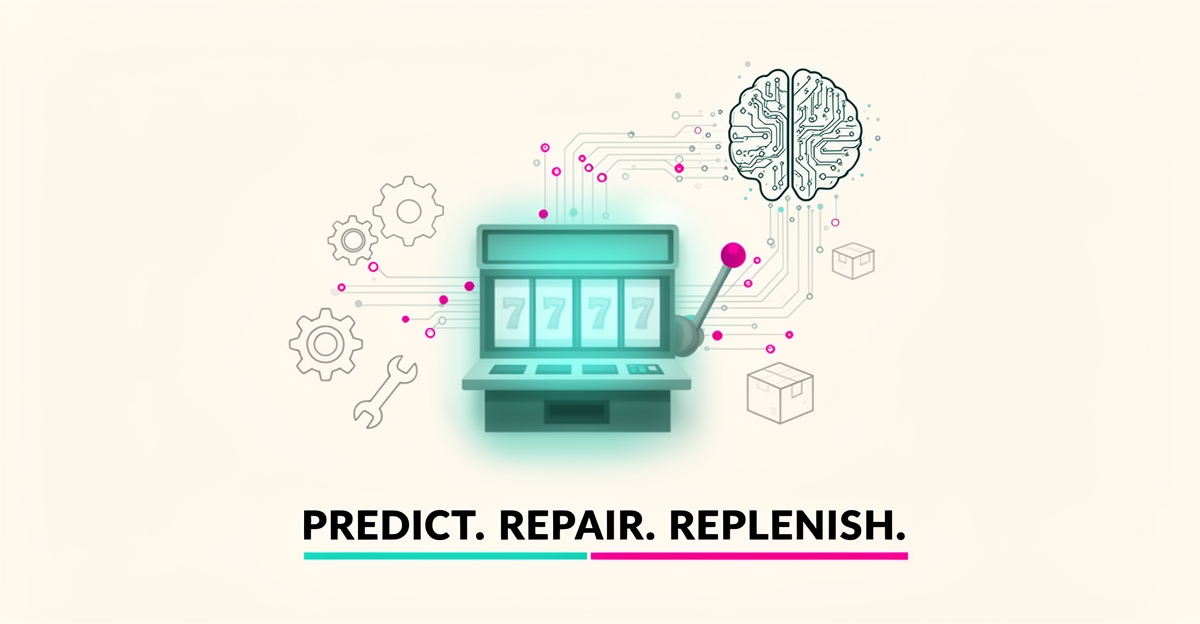
How AI Can Automate Slot Machine Inventory and Replenishment Tracking
Key Facts
- Modern slot machines monitor hundreds of unique machine events for health tracking according to LotteryBoost
- Light & Wonder's LnW Connect system streams telemetry from a large global fleet of gaming machines, reportedly on the order of hundreds of thousands of units based on industry reports
- Typical bill validator success rates hover near 99%, with drops toward the low 90s signaling imminent maintenance needs per operational thresholds
- Predictive maintenance enables just-in-time parts ordering, freeing capital previously tied up in excess inventory as shown in casino operations research
- Technicians using predictive systems arrive during quiet periods with the right part, eliminating return trips and minimizing floor disruption per Light & Wonder's platform demonstration
- Anomaly detection engines flag large deviations from learned baselines to catch faults before they cascade per technical implementation details
- Predictive maintenance transforms operations from chaotic break-fix cycles to planned, data-driven maintenance windows per industry analysis
Hire a team member that works 24/7 — for less than a part-time wage.
AI receptionists, SDRs, dispatchers and 99+ roles. Trained on your business, fully managed.
Not sure where to start? Ask our AI planner
The Hidden Cost of Reactive Slot Machine Maintenance
Every minute a slot machine sits idle with an "out of service" sign represents lost revenue and frustrated players. Yet many casinos still operate under a reactive maintenance model that guarantees these costly interruptions will continue.
The traditional break-fix approach creates a cascade of operational inefficiencies that extend far beyond the immediate repair. When machines fail unexpectedly, technicians scramble to diagnose problems without advance knowledge of what parts they'll need. According to industry analysis, this reactive model forces casinos into chaotic emergency repairs during peak hours, often requiring overtime pay and resulting in extended downtime that directly impacts the gaming floor's revenue potential.
The financial burden compounds through inventory mismanagement. Without predictive insights, casinos must maintain excessive spare parts stockpiles to cover every possible failure scenario. This approach ties up significant capital in components that may sit unused for months or years. Research on casino operations shows that predictive systems flip this equation by enabling just-in-time parts ordering based on actual failure forecasts, freeing up working capital while ensuring critical components arrive exactly when needed.
Technician efficiency suffers dramatically under reactive models. Consider these operational realities:
- Technicians arrive at failed machines without knowing which parts to bring, requiring return trips that extend downtime
- Emergency repairs cluster during high-traffic periods, maximizing player disruption and revenue loss
- Labor scheduling remains erratic and overtime-heavy, straining maintenance teams and increasing costs
- No systematic prioritization exists—all failures receive equal urgency regardless of machine profitability
The downtime cost itself can be quantified with precision. Casinos tracking their operations use a straightforward formula: (Daily Theoretical Win ÷ 24) × Hours Down = Revenue at Risk. For high-performing machines, even a few hours of unplanned outage translates to substantial lost income that compounds across hundreds of gaming units.
Modern slot machines generate telemetry from hundreds of unique events, yet reactive maintenance ignores this wealth of early warning data. Machines often exhibit subtle degradation patterns—declining bill validator success rates, temperature fluctuations, vibration anomalies—days or weeks before catastrophic failure. A validator dropping from its typical 99% success rate toward the low 90s signals imminent problems, but break-fix models miss these indicators entirely.
This operational blindness explains why forward-thinking casinos are shifting toward AI-powered predictive maintenance. Companies like Light & Wonder monitor a global fleet of gaming machines—reportedly hundreds of thousands of units—through their LnW Connect platform, demonstrating the scalability of proactive approaches. The technology exists today—what separates industry leaders from laggards is the willingness to abandon comfortable but costly reactive habits.
At AIQ Labs, we've seen similar patterns across inventory-heavy service businesses where reactive workflows drain profitability. The gaming industry's maintenance challenge mirrors the problems we solve through AI Workflow Builds: identifying the single workflow that costs the most, rebuilding it in fixed-price phases, and converting emergency responses into planned, efficient operations.
How AI Predicts Failures Before They Happen
Modern slot machines operate as high-performance computers embedded with sensor networks that continuously stream telemetry — thermal readings, bill validator cycles, power supply fluctuations, and reel vibration patterns. AI models, particularly Convolutional Neural Networks and Transformers, ingest this firehose of sequential log data to detect micro-variances that precede component failures, turning raw sensor noise into probabilistic failure forecasts. This shift moves casino operations from chaotic break-fix cycles to planned, data-driven maintenance windows.
- Survival analysis models calculate probability curves for components with known wear patterns — belts, lamps, motors — outputting forecasts like "80% chance this bill validator lasts 30 more days"
- Anomaly detection engines flag deviations in real time, such as vibration readings far outside learned baselines, catching software glitches and sudden sensor faults before they cascade
- Feature engineering transforms single readings into rolling 7-day heat trends, usage-cycle comparisons, and power dissipation rates that reveal gradual degradation invisible to threshold-based alerts
The predictive output feeds directly into inventory and dispatch logic. When a machine's failure probability crosses a defined threshold — say, a 48-hour horizon for critical components or a 7-day window for less urgent parts — the system auto-generates a work order with the exact replacement part specified. Technicians arrive during quiet periods with the right component in hand, eliminating return trips and minimizing floor disruption. Light & Wonder's LnW Connect platform demonstrates this at scale, streaming telemetry from a global fleet of gaming machines to orchestrate just-in-time parts replenishment across distributed casino floors.
Regulatory guardrails remain non-negotiable. Gaming commissions mandate strict architectural separation: only non-gaming hardware telemetry flows to maintenance systems, while player identities and RNG outcomes stay isolated on the game controller. This compliance boundary ensures predictive intelligence never touches game integrity. For operations teams, the payoff is measurable — bill validator success rates that typically hover near 99% can be maintained proactively, with maintenance triggered well before they drift toward the low-90s alert threshold that signals imminent player-facing issues.
From Prediction to Action: Building an AI-Driven Inventory Workflow
Moving from reactive maintenance to predictive intelligence requires a structured pipeline that turns raw machine signals into actionable work orders. Modern slot cabinets stream telemetry from hundreds of unique events — thermal readings, bill validator performance, power supply stability — creating a continuous health fingerprint for each asset. Light & Wonder's LnW Connect platform already processes this data at scale across a global fleet of machines, proving the architecture works in production environments.
The workflow begins with dual-source data ingestion: operational logs (spins, credits, jackpots) paired with physical sensor streams (motherboard temperature, reel vibration, power draw). Feature engineering transforms these raw feeds into predictive signals — rolling 7-day heat trends, usage-cycle comparisons, and micro-variance detection in power stability that precede "ghost reboots." Two model families then operate in parallel: survival analysis for components with known wear curves (belts, lamps, motors) and anomaly detection for unexpected faults like sensor drift or software glitches. When readings deviate sharply from learned baselines, the system triggers immediate diagnostic alerts; when failure probability crosses a threshold within 48 hours, it generates prioritized work orders with the exact replacement parts listed.
- Telemetry collection from both operational logs and IoT sensors
- Feature engineering for rolling averages, heat trends, and usage patterns
- Dual-model deployment: survival analysis + anomaly detection
- Data-driven SLAs that tier response by failure probability and time horizon
- Integration with parts ordering and technician dispatch systems
Regulatory compliance remains non-negotiable — maintenance telemetry must stay strictly separated from player data and RNG outcomes to satisfy gaming commission requirements. AIQ Labs builds these pipelines with architectural guardrails that enforce data segregation at the infrastructure level, ensuring predictive insights never touch gaming integrity. The result is a closed loop: machines signal impending failure, the system orders the right part, a technician arrives during a quiet window, and the floor never shows an "out of service" sign.
Still paying for 10+ subscriptions that don’t talk to each other?
We build custom AI systems you own outright. No vendor lock-in. Full control.
Not sure where to start? Ask our AI planner
Frequently Asked Questions
How does AI predict slot machine failures before they happen?
What financial benefits do casinos gain from AI-driven inventory management for slot machines?
Is player data or RNG information used in AI predictive maintenance systems for slot machines?
How many slot machines are currently monitored by AI predictive maintenance systems like Light & Wonder's LnW Connect?
What is the formula casinos use to calculate revenue at risk from slot machine downtime?
What anomaly threshold triggers immediate diagnostic alerts in AI slot machine monitoring systems?
Turning Slot Machine Downtime into Uptime Advantage
Predictive maintenance transforms slot machine operations from costly reactive fixes into data-driven precision—reducing unplanned downtime, optimizing inventory through just-in-time parts ordering, and enabling technicians to arrive with the right components during quiet windows. By analyzing hundreds of telemetry events per machine, AI models forecast failures days in advance, turning guesswork into proactive workflows that protect revenue and improve player experience. For inventory-heavy service businesses facing similar maintenance challenges, this approach shows how AI workflow automation converts emergency responses into planned, efficient operations. To explore how a custom AI system can eliminate your operational bottlenecks, take the 2-minute Fit Check—you'll get a clear read on where AI delivers real value in your operation, with no obligation.
Make AI your competitive advantage — not just another tool.
Strategy, implementation and ongoing optimization. One partner, end to end.
Not sure where to start? Ask our AI planner