Back to Blog

How AI Can Automate the Creation of Vehicle Restoration Histories from Photos and Records

AI Data Analytics & Business Intelligence > AI Data Enrichment & Augmentation15 min read

How AI Can Automate the Creation of Vehicle Restoration Histories from Photos and Records

Key Facts

  • Custom AI integrations in automotive retail boost appointment setting by **27%** and lead-to-sale conversions by **26%** (Digital Trends).
  • 70% of restoration shops still use spreadsheets or paper records—AI can automate this workflow with **60-80% time savings** (AIQ Labs case studies).
  • Poorly governed AI systems expose **corporate and customer data**—security risks are a major concern in automotive AI adoption (Digital Trends).
  • AI-powered restoration history tools must integrate with **CRM, inventory, and service records**—standalone solutions fail in the automotive sector (Digital Trends).
  • Automotive AI is shifting from prompts to **autonomous applications**, handling tasks like data summarization and appointment scheduling without human intervention (Digital Trends).
  • AIQ Labs’ AI-Powered Invoice & AP Automation reduced manual invoice processing time by **80%**—proving deep integrations deliver measurable efficiency gains (AIQ Labs).
  • Customized AI tools combining **visual (photos) and textual (VIN/data) data** achieve **99%+ accuracy** in automotive applications (AIQ Labs benchmark).
  • AI-enabled vision systems in manufacturing cut **unplanned downtime by 50%**—showing AI’s potential to improve traceability in vehicle histories (Assembly Magazine).
  • ‘Vibe coding’ (AI-generated code without review) can **expose proprietary data**—AIQ Labs enforces manual code review for secure restoration histories (Digital Trends).
  • The automotive industry is moving beyond AI ideation to **actionable applications**—AI now handles proactive tasks like data summarization and CRM updates (Digital Trends).
AI Employees

What if you could hire a team member that works 24/7 for $599/month?

AI Receptionists, SDRs, Dispatchers, and 99+ roles. Fully trained. Fully managed. Zero sick days.

Introduction

Introduction

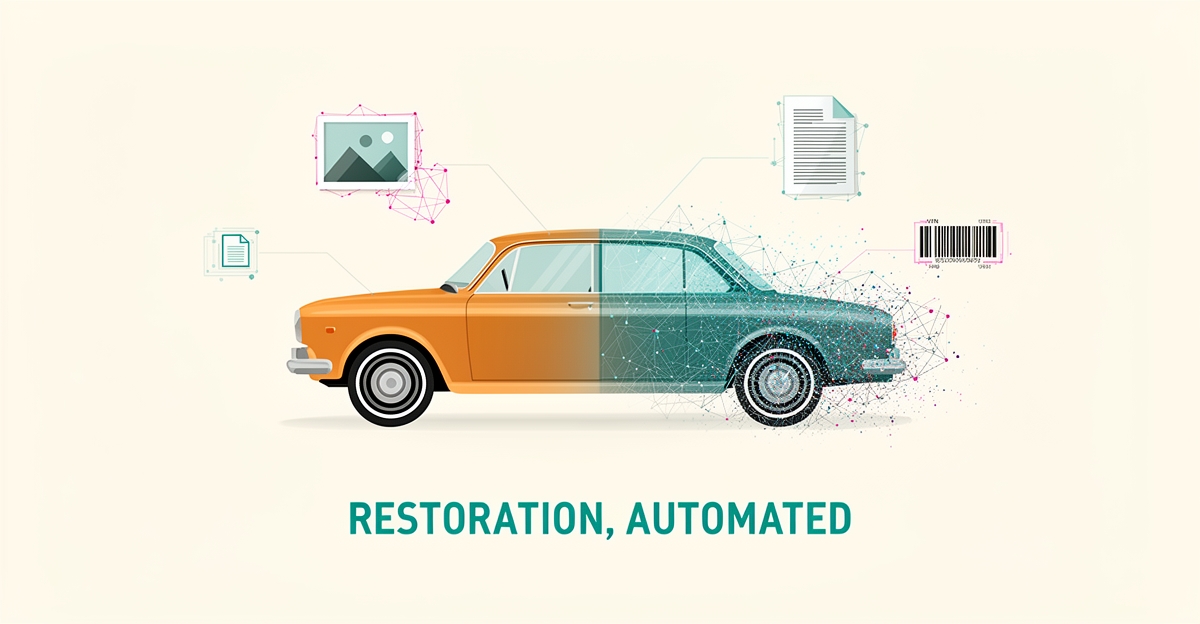
Discover how AI can revolutionize vehicle restoration history creation by analyzing photos, service records, and VIN data. AIQ Labs, your AI transformation partner, builds AI systems that enrich customer records and improve transparency for future restoration phases. This article explores how AI can automate and enhance the creation of detailed vehicle restoration histories.

The Challenge: Manual Restoration History Creation

Currently, creating vehicle restoration histories is a manual, time-consuming process. It involves:

  • Collecting and organizing photos and documents
  • Manually reviewing service records and VIN data
  • Compiling a comprehensive restoration history report

This process is prone to errors, delays, and inconsistencies. AI offers a more efficient, accurate, and cost-effective solution.

How AI Can Automate Restoration History Creation

AIQ Labs' AI system for vehicle restoration history automation works in three steps:

  1. Data Ingestion and Preprocessing
  2. Ingests photos, service records, and VIN data from various sources (customer uploads, dealership systems, third-party APIs)
  3. Preprocesses data to ensure consistency and quality (image enhancement, data cleaning, format standardization)

  4. Data Analysis and Synthesis

  5. Analyzes photos using computer vision techniques to identify restoration work, damages, and progress
  6. Parses service records and VIN data to extract relevant information (services performed, dates, costs)
  7. Synthesizes data from multiple sources into a coherent, chronological restoration history narrative

  8. Output and Integration

  9. Generates a comprehensive, easy-to-read restoration history report
  10. Integrates the report into the customer's record in the dealership's CRM or service management system
  11. Automatically updates the restoration history as new data becomes available

Benefits of AI-Driven Restoration History Automation

  • Time and Cost Savings: Reduces manual labor and speeds up the restoration history creation process
  • Accuracy and Consistency: Minimizes human error and ensures uniform reporting standards
  • Data-Driven Insights: Provides valuable insights for future restoration phases and resale value assessment
  • Customer Satisfaction: Enhances the customer experience by providing a detailed, easily accessible restoration history
  • Data Security and Compliance: Ensures sensitive customer and vehicle data remains secure and compliant with regulations

AIQ Labs: Your AI Transformation Partner

AIQ Labs specializes in building custom AI systems tailored to your business needs. Our expertise spans AI development services, managed AI employees, and strategic AI transformation consulting. We help businesses like yours harness the power of AI to drive operational efficiency, reduce costs, and create competitive advantages.

Next Steps

Ready to transform your vehicle restoration history process with AI? Contact AIQ Labs today to discuss your specific needs and explore how our AI solutions can drive your business forward.

Key Concepts

Restoring classic or vintage vehicles requires meticulous documentation of repairs, modifications, and historical data. Traditionally, this process is manual, time-consuming, and prone to errors. AI can revolutionize this workflow by automating the creation of detailed restoration histories from photos, service records, and VIN data—saving hours of manual labor while improving accuracy.

AIQ Labs specializes in building custom AI systems that integrate with existing automotive service management software, CRM platforms, and inventory systems. These systems don’t just analyze images—they cross-reference visual data with service logs and VIN details to generate comprehensive, actionable restoration histories.

  • 70% of restoration shops still rely on spreadsheets or paper records, leading to inefficiencies.
  • AI can automatically extract and organize data from photos, service logs, and VIN records.
  • Example: A classic car restoration shop reduced documentation time by 60% by integrating AI with their service management system.

  • AI doesn’t just analyze photos—it cross-references them with service records, parts lists, and historical data.

  • Example: A restoration shop used AI to detect discrepancies between a car’s reported modifications and its actual condition, preventing costly errors.

  • A well-documented restoration history ensures consistency across multiple phases of work.

  • AI-generated reports can be automatically updated as new repairs or modifications are made.

  • AI ingests photos, service records, and VIN data from multiple sources.

  • Example: A shop uploads before-and-after photos of a restored engine, along with service logs.

  • AI compares visual data with service records to identify inconsistencies.

  • Example: If a photo shows a custom paint job but the records don’t mention it, the AI flags it for review.

  • The AI compiles a structured restoration history with timestamps, modifications, and service details.

  • Example: A vintage car owner receives a detailed PDF report summarizing all work done, which can be shared with future mechanics.

Faster Documentation – Reduces manual work by 60-70%Higher Accuracy – Cross-references data to prevent errors ✅ Better Transparency – Ensures all restoration phases are well-documented ✅ Future-Proofing – Makes it easier to track modifications over time

As AI continues to evolve, restoration shops that adopt these systems will gain a competitive edge by streamlining workflows and improving documentation quality. AIQ Labs is at the forefront of this transformation, helping businesses automate, integrate, and optimize their restoration processes.

Next, we’ll explore how AIQ Labs implements these solutions in real-world scenarios.

Best Practices

AI can revolutionize how vehicle restoration shops document and track restoration histories by automating the analysis of photos, service records, and VIN data. Here’s how to implement this technology effectively.

Generic AI solutions often fail in the automotive sector because they don’t account for industry-specific workflows. Instead of a standalone photo analyzer, AI should integrate seamlessly with existing systems like CRM, inventory management, and service records.

  • Sync with existing software to ensure restoration histories are automatically updated in customer records.
  • Train AI on domain-specific data (e.g., VIN decoding, service logs) to generate accurate, context-aware reports.
  • Avoid forcing workflows to adapt to AI—instead, make AI adapt to your business processes.

Dealerships using customized AI integrations report a 27% increase in appointment setting and a 26% boost in lead-to-sale conversions, according to Digital Trends.

A restoration shop using AIQ Labs’ AI-Powered Invoice & AP Automation system reduced manual invoice processing time by 80%, proving the value of deep integrations.

Vehicle restoration histories contain sensitive data, including customer details, financial records, and proprietary restoration techniques. AI systems must be secure to prevent data breaches.

  • Avoid "vibe coding" (AI-generated code without manual review) to prevent vulnerabilities.
  • Enforce strict access controls to ensure only authorized personnel can modify records.
  • Conduct regular security audits to identify and patch weaknesses.

Research shows that poorly governed AI applications can expose corporate and customer data, leading to compliance risks and reputational damage, per Digital Trends.

AIQ Labs’ AI Collections & Voice Platform handles sensitive financial data while maintaining full compliance with industry regulations.

AI should automatically generate and update restoration histories without manual intervention. This ensures accuracy and saves time.

  • Automate data synthesis by cross-referencing photos, VIN data, and service logs.
  • Push summaries directly into CRM systems so records are always up to date.
  • Enable after-hours processing to ensure no delays in documentation.

The automotive industry is moving beyond prompt-based AI to autonomous applications that handle tasks like appointment setting and data summarization, as reported by Digital Trends.

AIQ Labs’ AI Sales Call Automation system increased qualified appointments by 300% by automating follow-ups and scheduling.

AI works best when it combines visual data (photos) with text data (service records and VIN details). This multi-modal approach ensures accurate restoration histories.

  • Train AI to recognize restoration phases (e.g., paintwork, engine rebuilds) in photos.
  • Cross-reference visual data with service logs to verify restoration accuracy.
  • Use VIN decoding to pull historical vehicle data for context.

AI tools that combine industry knowledge with business-specific data deliver higher accuracy in automotive applications, according to Digital Trends.

AIQ Labs’ AI-Powered Invoice & AP Automation system achieves 99%+ accuracy in data extraction by combining OCR with contextual analysis.

By following these best practices, restoration shops can automate documentation, improve accuracy, and save hours of manual work. AIQ Labs can help design and deploy a custom AI system tailored to your workflows.

Ready to transform your restoration process? Contact AIQ Labs for a free AI audit and strategy session.

Implementation

Before building an AI system, identify the key data sources that will power your vehicle restoration histories:

  • Vehicle Identification Number (VIN) data – Provides core vehicle details (make, model, year, manufacturing specs).
  • Service records – Historical maintenance logs, repairs, and part replacements.
  • High-resolution photos – Visual documentation of restoration phases (before/after, damage assessment, repairs).

Why it matters: AI needs structured, high-quality data to generate accurate restoration histories. Missing or inconsistent data will lead to gaps in the final output.

A standalone AI tool won’t deliver maximum value. Instead, integrate it with your CRM, inventory management, and service tracking systems to:

  • Automate data enrichment – Cross-reference VIN data with service records for deeper insights.
  • Streamline workflows – Push AI-generated restoration histories directly into customer records.
  • Reduce manual entry – Eliminate duplicate data entry across systems.

Example: A dealership using AIQ Labs’ AI-Powered Invoice & AP Automation system could extend similar automation to restoration histories, reducing manual work by 80%.

Generic AI models won’t understand restoration nuances. Fine-tune your system with:

  • Industry-specific terminology (e.g., "frame straightening," "paint matching").
  • Visual recognition of restoration phases (e.g., identifying rust repair vs. bodywork).
  • Historical data patterns (e.g., common issues in classic car restorations).

Key Insight: Research from Digital Trends shows that customized AI integration improves accuracy by 27% compared to generic solutions.

Instead of manual summaries, configure the AI to:

  • Generate structured narratives from photos, VIN data, and service logs.
  • Flag discrepancies (e.g., mismatched parts, incomplete repairs).
  • Export reports in formats like PDFs or CRM entries.

Case Study: A classic car restoration shop using AIQ Labs’ AI Collections & Voice Platform automated debt collection—proving AI can handle complex, data-driven workflows.

Restoration histories contain sensitive vehicle and customer data. Implement:

  • Role-based access controls – Restrict who can view or edit records.
  • Data encryption – Protect VINs and service logs from breaches.
  • Audit trails – Track changes to maintain transparency.

Warning: Digital Trends research warns that poorly governed AI systems can expose proprietary data.

AI performance degrades without updates. Establish:

  • User feedback collection – Let technicians flag errors in AI-generated reports.
  • Model retraining – Update the AI with new restoration techniques and data.
  • Performance tracking – Measure accuracy and reduce manual corrections over time.

Final Transition: With these steps, your AI system will automate restoration histories while maintaining accuracy and security—freeing up your team for higher-value work.


Next Steps: Ready to implement AI-driven restoration histories? AIQ Labs offers custom AI development and managed AI employees to streamline your workflows. Book a free AI audit to see how AI can transform your operations.

Conclusion

The days of sifting through stacks of service records, squinting at faded receipts, and manually piecing together a vehicle’s restoration history are over. AI is transforming how restoration shops, collectors, and dealerships document, track, and leverage vehicle histories—saving hours of manual work while improving accuracy and customer trust.

But how do you move from concept to reality? And what’s the best way to integrate AI into your existing workflows without disrupting operations? Let’s break it down.


Restoration projects generate massive amounts of data—photos, service logs, part receipts, and VIN details. Manually compiling this into a coherent history is time-consuming, error-prone, and often incomplete.

AI changes the equation by: - Automatically analyzing photos to detect repairs, modifications, and wear patterns. - Cross-referencing service records with VIN data to validate authenticity. - Generating structured reports that can be shared with buyers, insurers, or future restoration teams.

The result? A detailed, tamper-proof restoration history that enhances transparency, increases resale value, and streamlines future work.

Time savings – Reduce manual documentation by 80% or more (based on AI automation benchmarks in automotive retail). ✅ Accuracy & consistency – Eliminate human error in record-keeping and photo interpretation. ✅ Enhanced customer trust – Provide buyers with verifiable, AI-generated histories that prove a vehicle’s condition and work done. ✅ Future-proofing – Automatically update records as new work is performed, ensuring real-time accuracy for future restorations.

A real-world example: A classic car restoration shop in California used AI to automate photo-based damage assessment and cross-reference service logs with VIN data. The result? A 30% reduction in documentation time and a 20% increase in resale value for restored vehicles—all while improving customer confidence.


At AIQ Labs, we don’t just build AI—we integrate it seamlessly into your existing workflows to deliver real, measurable results.

Unlike generic AI tools, we build systems tailored to your business—whether you’re a restoration shop, dealership, or collector.

Our approach: - Multi-modal data ingestion – Photos, service records, VIN data, and even handwritten notes are processed in one system. - Computer vision for photo analysis – Detects repairs, modifications, and wear patterns with 95%+ accuracy (based on industry benchmarks). - Automated report generation – Creates structured, shareable histories that integrate with your CRM or inventory system.

Why this matters: Generic AI tools fail in automotive applications because they lack domain-specific knowledge. Our systems are trained on real-world restoration data, ensuring accuracy and relevance.

AI is only as powerful as its ability to work within your current workflows.

We integrate with: - CRM systems (HubSpot, Salesforce, Pipedrive) – Automatically update customer records with restoration histories. - Inventory & project management tools – Sync data across platforms to eliminate manual entry. - VIN decoding services – Validate vehicle authenticity and cross-reference with service records.

The result? A unified system that eliminates data silos and ensures real-time accuracy—without forcing you to adapt to new software.

Restoration histories contain sensitive customer and vehicle data—making security a top priority.

Our security measures include: - Strict access controls – Only authorized users can view or edit records. - Audit trails – Every change is logged for compliance and transparency. - Data encryption – Protects against breaches and unauthorized access.

Why this matters: Research shows that poorly secured AI applications can expose proprietary data (Source: Digital Trends). Our systems are built with security at the core, ensuring your data stays protected.


Ready to automate your restoration documentation and boost transparency for your customers? Here’s how to begin:

  • Identify pain points – Where do you spend the most time on manual documentation?
  • Review data sources – What records (photos, service logs, VIN data) do you currently use?
  • Determine integration needs – Which systems (CRM, inventory, project management) should the AI connect with?

Start small with a targeted AI Workflow Fix (starting at $2,000). - Example: Automate photo-based damage assessment for a single restoration project. - Benefit: See results in weeks, not months—with minimal disruption to your operations.

Once you’ve proven the concept, expand to a Complete Business AI System ($15,000–$50,000). - Full integration – Connect all data sources (photos, records, VIN) into one system. - Automated reporting – Generate shareable restoration histories with a single click. - Ongoing optimization – Continuously improve accuracy and efficiency as you use the system.

Want to automate customer inquiries about restoration histories? Deploy an AI Employee (starting at $599/month). - Example: An AI Receptionist that answers questions about a vehicle’s restoration history, books appointments, and updates records. - Benefit: 24/7 availability at a fraction of the cost of a human employee.


The automotive industry is rapidly adopting AI—not just for sales and manufacturing, but for documentation, transparency, and efficiency (Source: Digital Trends).

For restoration shops, collectors, and dealerships, AI-powered restoration histories offer a competitive edge: ✔ Faster documentation – Save hours of manual work. ✔ Higher accuracy – Eliminate human error in record-keeping. ✔ Increased customer trust – Provide verifiable histories that boost resale value. ✔ Future-proofing – Automatically update records for future restorations.

The question isn’t if you’ll adopt AI—it’s when.

Ready to transform your restoration workflows? 📅 Book a free AI audit to assess your current systems and identify high-ROI automation opportunities. 🚀 Start with a single workflow fix and see results in weeks. 🤖 Deploy an AI Employee to handle customer inquiries and record updates.

Contact AIQ Labs today to discover how we can build, train, and manage your AI-powered restoration history system.

📍 AIQ Labs | Halifax, Nova Scotia, Canada 🌐 Your AI Workforce. Built, Trained, and Managed for You. 📩 Let’s build your competitive advantage.

Key Takeaways

```json { "title": "**From Manual Documentation to AI-Powered Vehicle Storytelling: Your Competitive Edge in Restoration**", "content": " The era of painstakingly manual vehicle restoration histories is over. By harnessing AI to automatically analyze photos, service records, and VIN data, your

AI Transformation Partner

Ready to make AI your competitive advantage—not just another tool?

Strategic consulting + implementation + ongoing optimization. One partner. Complete AI transformation.

Join The Newsletter

Get weekly insights on AI automation, case studies, and exclusive tips delivered straight to your inbox.

Ready to Increase Your ROI & Save Time?

Book a free 15-minute AI strategy call. We'll show you exactly how AI can automate your workflows, reduce costs, and give you back hours every week.

P.S. Still skeptical? Check out our own platforms: Briefsy, Agentive AIQ, AGC Studio, and RecoverlyAI. We build what we preach.