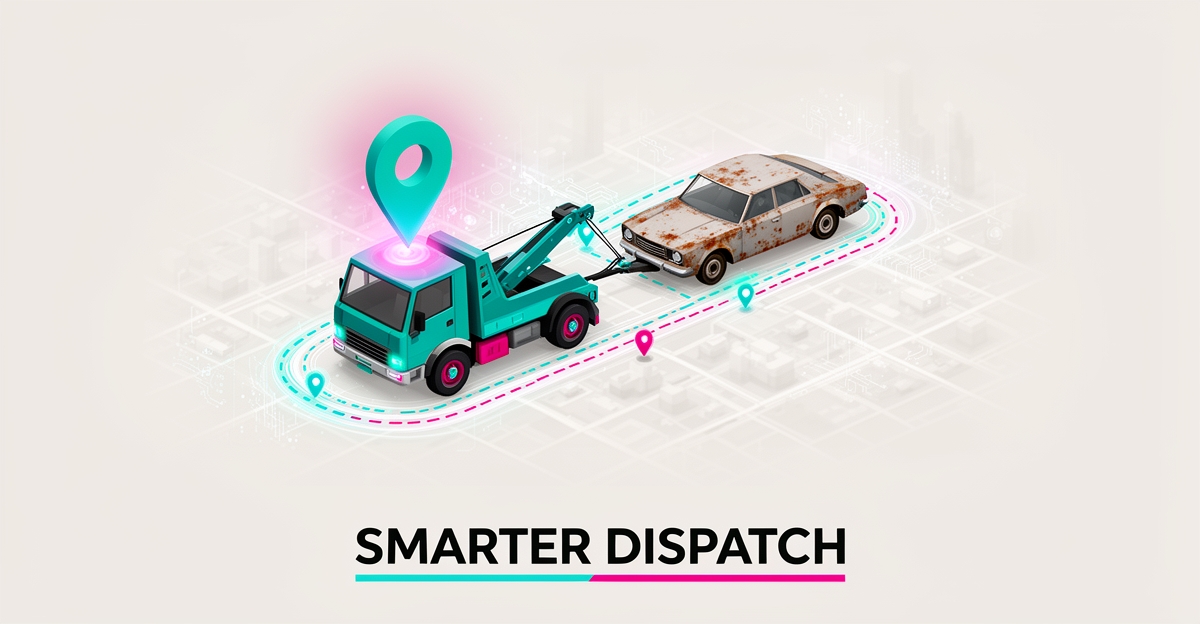
How AI Can Automate Vehicle Tracking and Dispatch for Junk Car Removal
Key Facts
- AI dispatch software typically reduces administrative overhead by automating complex scheduling tasks
- Automated intake-to-dispatch removes the manual delay — often 15–20 minutes or more in paper-and-phone operations — between a call and a truck being assigned
- Optimized routing through AI dispatch generally reduces fuel consumption and vehicle wear-and-tear
- Accurate arrival times and faster service are consistently cited as primary benefits of AI dispatch adoption in field service settings
- Many companies struggle to track ROI on AI software spend, which is why AIQ Labs builds owned systems with measurable milestones
Hire a team member that works 24/7 — for less than a part-time wage.
AI receptionists, SDRs, dispatchers and 99+ roles. Trained on your business, fully managed.
Not sure where to start? Ask our AI planner
The Dispatch Bottleneck in Junk Car Removal
Junk car removal lives and dies on how fast a truck can get from intake to driveway, and manual dispatch is where that speed breaks down. Calls sit in queues, drivers are assigned by memory, and status updates arrive late or not at all. The result is fewer jobs per day and customers who stop trusting arrival windows.
Manual intake creates a cascade of delays that compounds through the day. Dispatchers juggle phone calls, spreadsheets, and text messages while trying to match vehicle condition, location, and driver availability. Human scheduling errors mean trucks drive empty miles, crews wait on-site, and high-priority pickups slip. Poor GPS visibility makes it impossible to re-route in real time when traffic or a breakdown occurs.
AI dispatch software is designed to automate scheduling and assignment of jobs to a mobile workforce, replacing manual planning with data-driven decision-making. The software analyzes numerous variables in real time, including technician location, skill set, vehicle inventory, traffic conditions, job priority, and customer availability. That real-time optimization directly supports the benefits fleet operators seek:
- Reduced fuel consumption and vehicle wear-and-tear through optimized routing
- Increased technician productivity, allowing for more jobs per day
- Enhanced customer satisfaction due to accurate arrival times and faster service
- Decreased administrative overhead by automating complex scheduling tasks
The pressure to modernize keeps growing as AI becomes central to vehicle operations and field logistics. Rising expectations for real-time workforce optimization — set by last-mile delivery and field service leaders — are trickling down to every operator with a fleet, including junk car removal.
Visibility remains a bottleneck for many teams adopting AI. Industry analyses in recent years have repeatedly found that a minority of companies have accurate visibility into their AI software spend, and that wasted spend tends to grow as stacks get more complex. Without clear tracking, dispatch upgrades stall in pilots and ROI is hard to prove — which is why ownership and measurable milestones matter more than ever.
For junk car removal, the dispatch bottleneck shows up as lost revenue and reputation risk. Delayed assignments mean trucks idle between jobs, poor GPS visibility prevents proactive customer updates, and human scheduling errors create missed pickups. These frictions reduce jobs per day and erode customer satisfaction at the exact moment speed matters most.
AIQ Labs builds custom workflow automation systems that integrate with GPS and dispatch platforms, creating a fully transparent and efficient process from intake to pickup. By mapping manual steps into automated, owned workflows, businesses can track vehicles end-to-end, assign dispatchers with real data, and update statuses in real time while reducing human error and improving service reliability.
How AI Automates Tracking From Intake to Pickup
AI-powered workflow automation transforms vehicle tracking from intake to pickup by creating a seamless, real-time system that eliminates manual coordination. When a junk car is reported, AI immediately captures vehicle details, location, and condition through integrated intake forms or voice agents, then initiates the dispatch process without human intervention. This automation removes the manual intake-to-dispatch delay — often 15–20 minutes or more in phone-and-spreadsheet operations — accelerating the entire removal timeline. AI dispatch software decreases administrative overhead by automating complex scheduling tasks, allowing teams to focus on service delivery rather than paperwork.
The AI system continuously monitors vehicle status using GPS data and integrates with dispatch platforms to assign the optimal driver based on real-time location, skill set, and current traffic conditions. By analyzing variables like technician availability, vehicle inventory, and job priority, the software ensures each pickup is handled by the most qualified team member en route, minimizing detours and idle time. Optimized routing through AI dispatch reduces fuel consumption and vehicle wear-and-tear, directly lowering operational costs while increasing the number of jobs completed per day.
Throughout the process, customers and dispatch teams receive live status updates—from intake confirmation to driver assignment, en route progress, and successful pickup—via automated SMS or app notifications. This transparency builds trust and reduces inquiry volume, as customers no longer need to call for updates. Enhanced customer satisfaction from accurate arrival times and faster service is consistently cited as a primary benefit of AI dispatch adoption. For junk car removal businesses, this means fewer missed appointments, higher completion rates, and stronger reputation in competitive local markets. AIQ Labs' custom workflow automation systems enable this end-to-end visibility by integrating AI tracking with existing garage management tools, creating a single source of truth for every vehicle in the pipeline.
Integrating AI Dispatch With GPS and Existing Platforms
When a tow truck arrives at the wrong address or a dispatcher double-books a driver, the ripple effect hits revenue and reputation simultaneously. AI dispatch software eliminates these gaps by analyzing technician location, skill set, vehicle inventory, traffic conditions, and job priority in real time, replacing manual planning with data-driven decision-making. The result is a single source of truth that connects GPS coordinates, CRM records, and dispatch boards without human handoffs.
Custom integration layers bind these systems together so that every status change — vehicle assigned, en route, loaded, delivered — writes back to the same dashboard the office team already uses. This approach reduces fuel consumption and vehicle wear through optimized routing while increasing the number of jobs completed per day. For junk car removal operators, that means fewer empty miles and faster turnaround on each pickup.
- Real-time GPS feeds update job boards automatically
- CRM records sync with dispatch assignments instantly
- Driver mobile apps receive optimized routes without manual input
- Customer notifications trigger at each milestone
- Historical data builds smarter scheduling models over time
AIQ Labs builds these integration layers as owned assets, not rented features, so the workflow logic and data stay with the business. The same multi-agent architecture behind our production platforms — with 200+ multi-agent systems deployed and four live SaaS products we run daily — connects dispatch platforms, GPS telematics, and CRMs into a unified operating layer. That ownership model means no subscription lock-in and no vendor dependency when requirements change.
End-to-end visibility turns reactive firefighting into proactive capacity planning. When every vehicle, driver, and job shares a common data layer, dispatchers shift from chasing status updates to optimizing the next hour of work. The technology stack is proven; the competitive advantage comes from configuring it to your exact operational rhythm.
Implementation Roadmap for Junk Car Operators
Implementing AI for vehicle tracking and dispatch begins with a clear assessment of operational pain points. Junk car operators often struggle with manual scheduling, delayed pickups, and inefficient routing, which directly impact service reliability and customer satisfaction. AI dispatch software reduces administrative overhead by automating complex scheduling tasks and increases technician productivity through optimized job assignment, allowing more vehicles to be processed per day. Many operators also lack visibility into their technology investments, making it difficult to justify further automation without clear ROI tracking — which is why starting with one measurable workflow beats a broad, vague rollout.
Evaluating AI solutions requires focusing on integration capabilities with existing GPS and dispatch platforms, real-time status updates, and scalability for growing fleets. Operators should prioritize systems with transparent pricing and a clear ownership path. AIQ Labs supports this through three entry points: AI Employees for a low-risk monthly start with a managed AI dispatcher, Workflow Builds to rebuild the one workflow that costs you the most at a fixed price in phases, and AI Operating Systems for one connected operating layer you own outright. Payment follows the same logic: Start Monthly, Build in Milestones, or Own It Outright — no fake prices and no vendor lock-in.
Staff training and change management are critical to successful implementation. Dispatchers and intake teams must understand how the AI system assigns jobs based on vehicle location, condition, and pickup urgency, while still retaining oversight for exceptions. Continuous monitoring of key metrics—such as average response time, fuel consumption, and job completion rate—helps refine the system and demonstrate value. Ongoing optimization ensures investments deliver measurable improvements in efficiency and service quality rather than becoming another underutilized tool.
Still paying for 10+ subscriptions that don’t talk to each other?
We build custom AI systems you own outright. No vendor lock-in. Full control.
Not sure where to start? Ask our AI planner
Frequently Asked Questions
How does AI reduce the time between when a junk car is reported and when a truck is dispatched?
Can AI dispatch software really lower fuel costs for junk car removal trucks?
How do customers get updates on their junk car pickup without calling the company?
Is it hard to track ROI on AI software spend?
What happens if my junk car removal business already uses GPS and dispatch tools—can AI still integrate with them?
Will using AI dispatch mean I lose control over my workflows or get locked into a vendor?
From Empty Miles to Full Days: Your Next Move
The dispatch bottleneck in junk car removal isn't a people problem — it's a process problem that AI is built to solve. As we've covered, automating intake-to-dispatch cuts the manual delay, real-time GPS and CRM integration keeps every truck and status visible on a single dashboard, and optimized routing means fewer empty miles, more jobs per day, and customers who actually trust your arrival windows. The roadmap matters too: assess your pain points, prioritize integration with the platforms you already run, and track metrics like response time and completion rate so ROI stays provable. The operators who win competitive local markets will be the ones who own their automation rather than rent it. AIQ Labs builds workflow systems you own outright, with flexible entry points from a single AI dispatcher to a full operating system. Take the two-minute Fit Check at aiqlabs.ai/apply, then book a free 30-minute strategy call — a real working session to map your biggest bottleneck. If there isn't a clear win, we'll tell you that too.
Make AI your competitive advantage — not just another tool.
Strategy, implementation and ongoing optimization. One partner, end to end.
Not sure where to start? Ask our AI planner