How AI Can Automatically Update Estimates When Design Changes Occur
Key Facts
- AI-powered estimating is typically reported to reach high-90s accuracy percentages, compared with roughly 80-90% for traditional manual methods, according to industry comparisons.
- AI-powered takeoffs on small projects are often completed in a few hours versus days manually, according to vendor-reported benchmarks from tools like Togal.AI.
- AI estimating tools are commonly reported to deliver takeoffs several times faster than manual methods on construction projects.
- AI-powered model generation is reported to reduce modeling time substantially—often cited in the 60-80% range—in BIM workflows.
- AI-enhanced clash detection is reported to cut false positives significantly, often cited in the 70-80% range, according to BIM integration analyses.
- AI systems can automatically detect drawing revisions and flag changed sections of plans, a capability now offered by several estimating platforms.
- AI estimating tools can analyze real-time material pricing, labor availability, and historical data simultaneously, according to construction estimating analyses.
Hire a team member that works 24/7 — for less than a part-time wage.
AI receptionists, SDRs, dispatchers and 99+ roles. Trained on your business, fully managed.
Not sure where to start? Ask our AI planner
The Cost of Outdated Estimates in Dynamic Design Projects
A client emails a revised floor plan on Tuesday. By Friday, your crew is still pricing the original design—and the estimate in your proposal is already wrong. In dynamic design projects, this gap between change and re-estimation is where budgets quietly bleed out.
The problem compounds because traditional estimating was never built for constant revision. Manual takeoffs and spreadsheet recalculations take days to complete, while design changes can arrive daily. When estimates lag behind drawings, contractors bid on assumptions that no longer exist.
The financial consequences are predictable. Traditional estimating methods typically deliver roughly 80-90% accuracy even before a single change order enters the picture, according to industry comparisons of estimating approaches. Each design revision pushes that accuracy down further, since every altered wall, fixture, or material spec must be manually caught, re-measured, and re-priced. Miss one, and the cost overrun lands squarely on your margin—or triggers a difficult client dispute over who pays for the discrepancy.
These disputes rarely stem from bad faith. They stem from information gaps:
- Revised drawings sit unreviewed while crews work from outdated scopes
- Takeoffs must be redone from scratch after each revision cycle
- Material pricing shifts between the original estimate and the updated one
- Clients receive quotes based on superseded versions of the design
The scale of the workload explains why manual processes fail. AI-powered platforms like Togal.AI report completing takeoffs on small projects in just a few hours—a task that consumes days of an estimator's time when done by hand. When a design changes mid-project, an estimator running manual workflows faces that full time investment again, every single time. Revisions pile up faster than they can be priced.
This is precisely where modern AI systems change the equation. AI tools can now detect drawing revisions automatically and flag the sections of a plan that have changed, a capability described in research on AI-driven revision detection. Instead of an estimator hunting for differences between drawing versions, the system surfaces them—and because AI-powered estimating is typically reported to reach high-90s accuracy versus roughly 80-90% for traditional methods, the updated numbers can be trusted when presented to clients.
The broader construction technology landscape confirms the shift. According to analysis of AI in construction estimating, AI tools use machine learning to analyze historical data, real-time material pricing, and labor availability—meaning an updated estimate reflects current conditions, not stale ones. That capability turns estimates from static documents into living numbers that move with the design.
At AIQ Labs, we see this pattern across construction and trades businesses: the estimate isn't failing because estimators lack skill, but because the update process can't keep pace with real-time design changes. An AI Workflow Build that rebuilds your estimating workflow—syncing with CAD tools and adjusting quotes automatically—closes that gap, turning every design change from a potential liability into a handled process.
How AI Detects Design Changes and Recalculates Estimates in Real Time
A design change in the field used to mean a manual re-takeoff, delayed bids, and a new round of cost risk. AI changes that reaction into an automatic update.
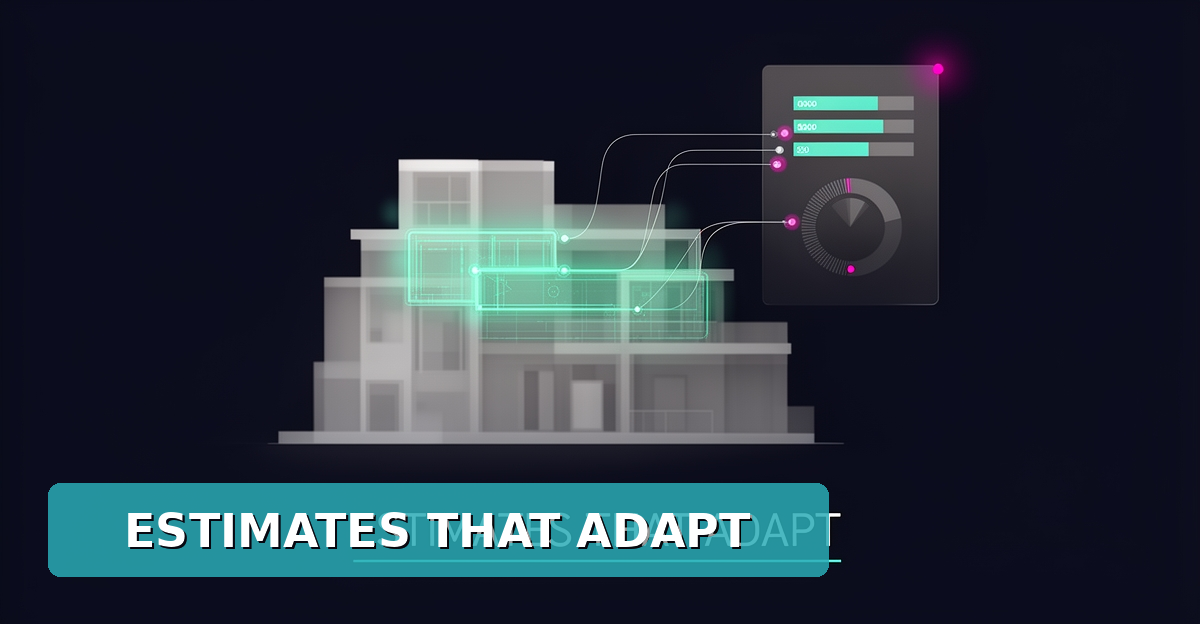
The workflow starts with CAD/BIM integration. AI agents sync directly with design files and monitor revisions in real time. When a wall moves, a room is added, or a specification changes, change detection algorithms flag the delta and map it to the estimate model. This is how AI transforms BIM from a static repository into an intelligent system that predicts impact and provides actionable recommendations.
Accuracy and speed improve together. Tools built for construction estimating report accuracy in the high-90s on floor plans while delivering takeoffs several times faster than manual methods, according to vendor benchmarks such as those published by Togal.AI. Small projects can often be completed in a few hours with AI-powered estimating, compared with days using traditional approaches.
Real-time material pricing closes the loop. The system pulls live pricing, labor availability, and market trends alongside the design delta, then recalculates quantities and costs instantly. AI-powered model generation is reported to reduce modeling time substantially—often cited in the 60-80% range—while AI-enhanced clash detection is reported to cut false positives significantly, according to BIM AI integration analyses. Fewer errors and faster validation mean estimates stay reliable as the design evolves.
The real-time update cycle typically follows this pattern:
- Design sync: CAD/BIM files are ingested and versioned continuously
- Change detection: Algorithms identify added, removed, or modified elements
- Auto-recalculation: Quantities, materials, and labor are updated against live pricing
- Estimate publish: Revised costs are pushed to stakeholders with an audit trail
This automation is a natural fit for AI workflow and task automation. When a client changes their design, outdated estimates become liabilities. AIQ Labs rebuilds the estimating workflow so intelligent agents sync with CAD tools and update quotes automatically, keeping proposals current without manual rework.
Estimators remain in control. AI-powered estimating tools are not a replacement for human expertise, but rather a supplement that helps estimators make faster and more accurate decisions. Teams review flagged changes, validate assumptions, and approve the updated bid, preserving judgment while removing tedious rework.
The result is a continuous estimating loop. Design moves, AI detects, costs recalculate, and the team responds with confidence.
Implementing AI Estimation Automation: From Pilot to Full Workflow Integration
Design changes used to mean days of rework and revised quotes. With AI, estimates can move in real time as blueprints evolve, turning a liability into a competitive edge.
Moving from pilot to full workflow integration starts with picking the right projects and proving value before scaling. Construction firms that evaluate complexity, data readiness, and integration points first avoid the data quality and interoperability issues that stall adoption.
Begin by evaluating your projects for AI impact. Large, complex, or high-stakes jobs benefit most from automation. Assess BIM consistency, CAD tool usage, and current estimate revision cycles. This baseline clarifies ROI potential and integration requirements with systems like QuickBooks or Procore.
Pilot testing proves the workflow without disrupting operations. Start small with a single project or department. Map how design revisions flow from CAD to estimate and identify where AI can detect changes and recalculate costs. A pilot also surfaces change management needs and builds trust in AI-generated outputs.
Team training is critical for adoption. Project managers and estimators need to interpret AI insights, validate outputs, and override when needed. Training should cover revision detection, pricing updates, and exception handling so AI acts as a supplement to human expertise, not a replacement.
Integration with existing systems completes the loop. AI agents sync with CAD tools and estimating platforms to update quotes automatically. Seamless data flow between BIM, accounting, and project management reduces manual entry and error.
A structured rollout typically follows these steps:
- Evaluate projects for size, complexity, and BIM data quality
- Run a limited pilot to test revision detection and estimate updates
- Train estimators and project managers on interpreting AI insights
- Integrate AI with CAD, Procore, QuickBooks and other core systems
- Scale across workflows with governance and performance monitoring
The results are measurable. AI-powered estimating tools report accuracy in the high-90s on floor plans, according to vendor benchmarks, and deliver takeoffs several times faster than manual methods. Small projects can often be completed in a few hours with AI-powered estimating.
AIQ Labs supports this journey in two ways: an AI Employee that joins your team to handle estimating workflows day to day, or a fixed-price AI Workflow Build that rebuilds the estimating process itself in phases. For firms ready to connect estimating with everything else—scheduling, procurement, invoicing—an AI Operating System ties it into one layer you own outright.
When design changes are detected, estimates update automatically, bids stay competitive, and teams collaborate with confidence.
Still paying for 10+ subscriptions that don’t talk to each other?
We build custom AI systems you own outright. No vendor lock-in. Full control.
Not sure where to start? Ask our AI planner
Frequently Asked Questions
How quickly does an AI estimate update after a client changes the design?
Is AI estimating actually more accurate than manual takeoffs?
Will AI replace our estimators?
What do I need for AI to detect design changes reliably?
Does AI estimating use current material and labor prices?
Where should we start if we want to pilot this?
Turning Design Changes into a Competitive Advantage
When design shifts mid-project, the real cost isn't just in materials or labor—it's in the delay between change and correction. AI-powered estimating closes that gap by syncing with CAD/BIM tools to detect revisions, recalculate quantities against live pricing, and update estimates automatically. This transforms estimates from static guesses into living numbers that reflect current conditions, reducing rework from days to hours and improving accuracy well beyond what manual methods deliver. For construction teams, that means fewer disputes, more confident bidding, and estimates that actually keep pace with reality. The shift isn't about replacing estimators—it's about freeing them from tedious rework so they can focus on judgment and strategy. If you're ready to see how AI can make your estimating process as dynamic as your designs, start with a free 2-minute Fit Check at aiqlabs.ai to map your biggest bottleneck, then book a free 30-minute strategy call to explore where automation delivers real ROI. No obligation—just clarity on your AI opportunity.
Make AI your competitive advantage — not just another tool.
Strategy, implementation and ongoing optimization. One partner, end to end.
Not sure where to start? Ask our AI planner