How AI Can Cut Costs in HVAC Parts Dispatching Without Losing Service Quality
Key Facts
- Emergency repairs typically cost 3-10x more than planned repairs according to industry research.
- Only about 30% of building owners schedule preventive maintenance per industry data.
- HVAC systems can account for roughly 40% of a building’s total energy use according to research.
- AI can predict compressor and coil failures 48-72 hours before breakdown per iFactory.
- Poorly maintained HVAC units can waste 15-30% more energy as reported.
- Control drift alone can waste 8-18% of building energy per LinkedIn analysis.
- One CMMS case study reports a 95% first-call fix rate and 40% faster dispatch with AI-driven assignment from a CMMS case study.
Hire a team member that works 24/7 — for less than a part-time wage.
AI receptionists, SDRs, dispatchers and 99+ roles. Trained on your business, fully managed.
Not sure where to start? Ask our AI planner
The Hidden Cost of Reactive HVAC Dispatching
The true cost of HVAC service isn’t just in the parts or labor—it’s hidden in the chaos of reactive dispatching. When systems fail unexpectedly, emergency repairs drive up expenses, strain technician availability, and disrupt operations, eroding profit margins before a single invoice is issued. This cycle is especially costly in an industry where only about 30% of building owners schedule preventive maintenance, leaving the majority vulnerable to avoidable breakdowns.
Emergency repairs don’t just inconvenience tenants—they devastate budgets. Industry data shows emergency service calls typically cost 3-10 times more than planned maintenance, turning routine upkeep into a financial liability when systems are allowed to run to failure. With Americans spending an estimated $14 billion annually on HVAC services and repairs, the financial toll of this reactive approach is significant, particularly when energy waste from poorly maintained equipment compounds the problem.
Poorly maintained HVAC units can consume 15-30% more energy than optimized systems, and since HVAC often accounts for around 40% of a building’s total energy use, inefficiencies quickly escalate operating costs. Control drift alone—where sensors, dampers, or valves fall out of calibration—can waste 8-18% of a building’s energy, representing six-figure losses annually in mid-sized commercial facilities. These inefficiencies aren’t just technical glitches; they’re margin killers that persist until a catastrophic failure forces an expensive, disruptive emergency response.
Without predictive insight, dispatch teams operate blindly, sending technicians based on availability rather than urgency or expertise. This leads to misassigned jobs, repeated trips for missing parts, and low first-call fix rates—all of which increase labor costs and customer dissatisfaction. In a market facing a shortage of roughly 110,000 HVAC technicians, every inefficient dispatch wastes a scarce resource, amplifying operational strain and reducing capacity for preventive work that could break the cycle entirely.
The result is a self-reinforcing loop: deferred maintenance leads to emergencies, emergencies drain budgets and staff, and depleted resources make preventive service even less likely. Breaking this cycle requires more than better scheduling—it demands a shift from reacting to failures to anticipating them, using data to align dispatch with actual equipment needs rather than crisis timelines. AIQ Labs’ AI Workflow Builds are designed to enable this shift, transforming dispatch from a cost center into a predictable, efficient operation.
How AI Transforms Dispatch from Reactive to Predictive
Reactive dispatch is bleeding HVAC margins. Emergency calls spike in peak season, technicians drive blind, and parts trips multiply because the failure was already in progress. Shifting to predictive operations lets teams act before the breakdown, not after the complaint.
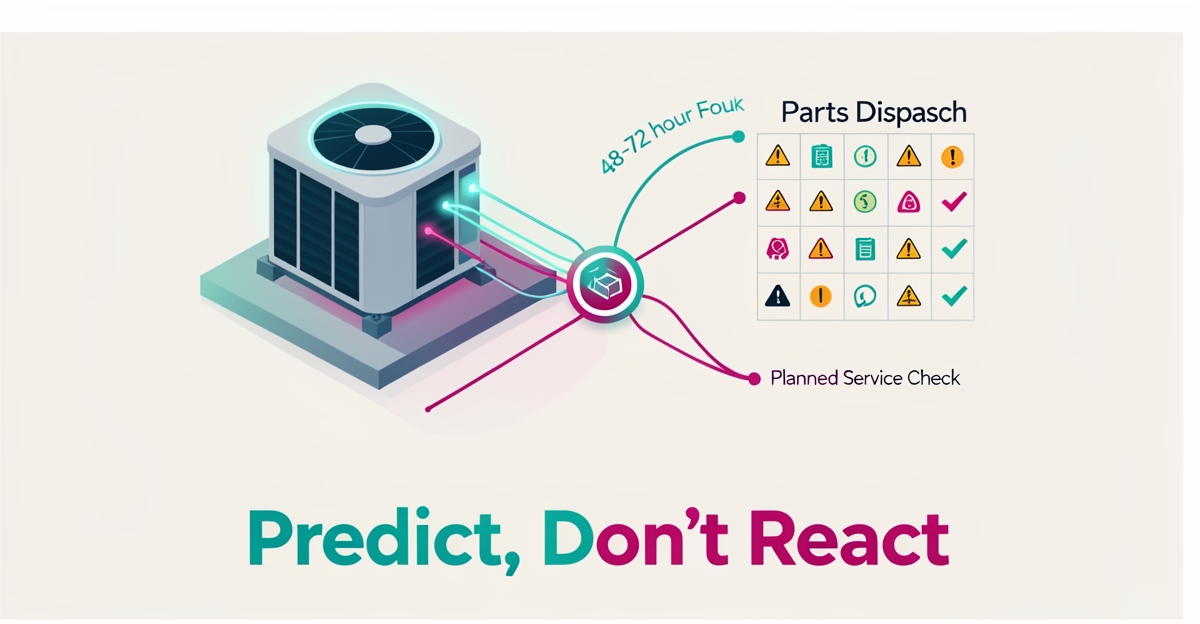
AI-powered monitoring turns sensor data into an early warning system. Models analyze vibration, pressure, temperature and refrigerant levels to spot degradation patterns for compressors, bearings and coils 48-72 hours before a breakdown. According to industry research, this window is enough to create a planned work order with the right parts and procedures, eliminating the emergency dispatch.
Predictive maintenance replaces calendar-based visits with condition-based action. That change can extend major equipment life by 3–7 years and stabilizes capital planning. It also reduces the cost penalty of reactive work, since emergency repairs typically cost 3-10x more than planned repairs.
Smart dispatch then matches the work to the right human. With a shortage of roughly 110,000 HVAC technicians, utilization matters. AI assigns jobs by skill, certification such as EPA-608, proximity and current workload, and balances routes in real time.
The result is faster, cleaner service:
- Work orders auto-generate with parts lists and SOPs when a risk score crosses threshold
- Technicians are matched by skill and GPS proximity to cut drive time
- Vans are stocked proactively, preventing second trips for missing parts
- Remote diagnostics validate alarms before dispatch, reducing unnecessary truck rolls
Field implementations show the impact. A CMMS case study reports 40% faster dispatch and a 95% first-call fix rate with AI-driven assignment. The same platform reports 45% less downtime and 25% energy saved by catching drift before failure.
Integration with Building Automation Systems amplifies the effect. Accurate visibility from sensors for temperature, pressure, flow and power is the foundation AI needs to learn and act. Closed-loop control can then adjust setpoints and fan speeds to prevent issues and recover energy lost to control drift.
This is the approach AIQ Labs applies in its AI Workflow Builds for field service operations, where AI predicts delivery windows, assigns jobs based on technician availability, and reduces idle time. For teams that want ongoing coverage without adding headcount, AI Employees can handle dispatch coordination and parts coordination roles at a fraction of the cost of a human hire. AI doesn’t replace expertise or relationships. It amplifies them by handling repetitive triage, scheduling and data tracking so technicians focus on problem-solving and customer trust.
The shift from reactive to predictive is measurable in fewer emergency calls, less overtime, and higher first-time fix rates while preserving service quality.
Implementing AI Dispatch: From Data to Dispatch in 6 Steps
Implementing AI dispatch in HVAC operations begins with building a foundation of reliable data. Instrumenting equipment with sensors for temperature, pressure, flow, and power creates the visibility needed for AI to detect degradation patterns 48-72 hours before failure, shifting maintenance from reactive to predictive. This early warning capability alone can reduce emergency repairs, which typically cost 3-10 times more than planned service, while extending major equipment life by 3–7 years through condition-based strategies.
Integrating this sensor data with a Building Management System (BMS) via protocols like BACnet or Modbus establishes a unified data stream essential for AI analysis. Without accurate visibility from a properly configured BMS—where improper setups can waste up to 18% of a building’s energy—the AI cannot learn effectively or enable closed-loop control that optimizes setpoints and prevents control drift. This integration transforms raw sensor readings into actionable intelligence for both maintenance and dispatch decisions.
The next phase involves deploying an AI-powered predictive maintenance engine that analyzes real-time data to forecast failures and automatically generate work orders with correct parts lists and required technician certifications. These work orders then feed into an AI-driven smart dispatch system that matches jobs to technicians based on skill, EPA-608 credentials, GPS proximity, and current workload—cutting drive time and improving first-call fix rates. AIQ Labs supports this workflow through AI Workflow Builds, rebuilt in phases at a fixed price so you can validate results before committing further, with seamless data synchronization between HVAC systems, BMS platforms, and dispatch logic.
To validate results before scaling, start with a single site to measure outcomes like a 35–45% reduction in cooling energy or a 40% faster dispatch time. Use this pilot to refine alert thresholds, confirm human-in-the-loop controls are functioning, and build confidence in the system’s recommendations. Only after demonstrating consistent improvements in both cost efficiency and service quality should the solution be expanded across additional buildings or service territories. This phased approach ensures that complexity is managed, not amplified, as AI capabilities grow with operational needs.
Still paying for 10+ subscriptions that don’t talk to each other?
We build custom AI systems you own outright. No vendor lock-in. Full control.
Not sure where to start? Ask our AI planner
Frequently Asked Questions
How much can AI actually save on emergency HVAC repairs?
Does AI dispatching actually improve first-time fix rates?
How far in advance can AI predict HVAC failures?
Will AI replace my technicians or make their jobs harder?
How does AI dispatching help with the HVAC technician shortage?
What's the ROI timeline for implementing AI dispatch systems?
Stop Paying the Reactive Tax: Your Dispatch Transformation Starts Now
The math is clear: reactive dispatching is bleeding your HVAC operation dry. Emergency repairs that typically cost 3-10 times more than planned service, technicians driving blind to jobs without the right parts, and equipment failing because degradation signals went unnoticed until it was too late. AI breaks this cycle by transforming dispatch from crisis response to strategic operation—predicting failures 48-72 hours ahead, matching the right technician to each job based on skill and proximity, and ensuring vans arrive stocked with exactly what's needed. The result? 40% faster dispatch times and 95% first-call fix rates in field implementations, while your team focuses on problem-solving instead of administrative chaos. This isn't about replacing expertise—it's about amplifying it. AIQ Labs builds these custom AI workflow systems for field service operations, integrating predictive maintenance with smart dispatch logic tailored to your business. Ready to stop paying the reactive tax? Start with the two-minute Fit Check at https://aiqlabs.ai/apply, then book a free 30-minute strategy call to map your highest-ROI automation opportunity. No sales pitch—just a working session with an AI engineer to identify where predictive dispatch can cut your costs first.
Make AI your competitive advantage — not just another tool.
Strategy, implementation and ongoing optimization. One partner, end to end.
Not sure where to start? Ask our AI planner