How AI Can Cut Customer Service Costs for Restaurant Equipment Distributors
Key Facts
- SMBs typically achieve ROI from customer service automation in around 13 months, roughly nine months faster than enterprises according to G2's research
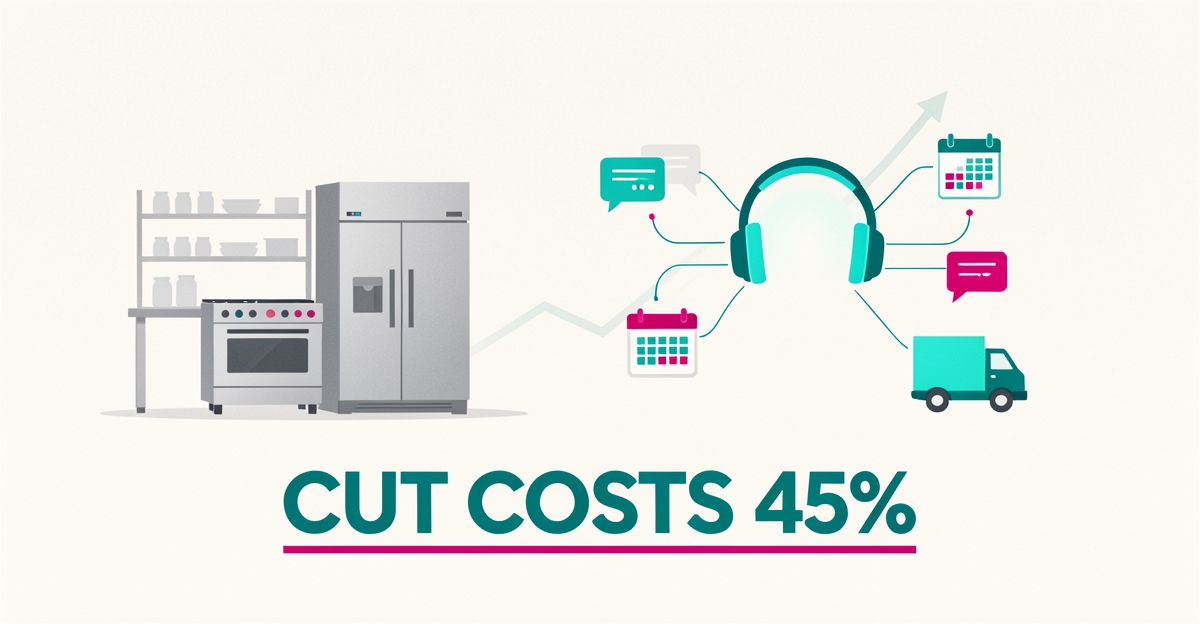
- AI-powered ticket routing has been reported to deliver up to 45% time savings on calls and 44% faster issue resolution per Sobot research
- Poor customer experiences have been estimated to cost businesses trillions of dollars annually as reported by Sobot
- The global AI for customer service market has been projected to reach roughly $117.87 billion by 2034 with a 25.6% CAGR per Polaris Market Research
- Repetitive inquiries typically consume 60-80% of customer service teams' time in restaurant equipment distribution, based on industry analysis
- A majority of SMBs list ROI within six months as a top-three consideration when adopting new software per G2's trends research
- SMBs tend to have smaller data lakes and cleaner databases with fewer redundancies, improving AI training data quality according to G2 research
Hire a team member that works 24/7 — for less than a part-time wage.
AI receptionists, SDRs, dispatchers and 99+ roles. Trained on your business, fully managed.
Not sure where to start? Ask our AI planner
The Costly Reality of Customer Service in Restaurant Equipment Distribution
Restaurant equipment distributors operate in a high-pressure environment where customer service demands directly impact operational costs and profitability. The volume of repetitive inquiries—such as equipment availability, delivery estimates, and warranty details—creates a significant drain on human resources, with these routine queries typically consuming 60-80% of customer service teams' time based on industry analysis. This constant pressure to respond quickly while managing complex technical issues strains budgets and limits the ability of staff to focus on higher-value activities like relationship building and technical problem-solving.
The financial toll of inefficient customer service extends far beyond labor costs. Poor customer experiences have been estimated to cost businesses trillions of dollars annually, a figure that underscores the need for smarter support systems. For restaurant equipment distributors, every delayed response or incorrect information risks damaging customer trust and increasing the likelihood of order cancellations or negative reviews. These inefficiencies compound during peak seasons when inquiry volumes surge, often forcing distributors to choose between overextending staff or sacrificing response quality.
- Repetitive inquiries about inventory and delivery consume the majority of customer service agent time
- Manual handling of routine queries increases labor costs and slows response during high-demand periods
- Inconsistent information delivery due to human error affects customer trust and order accuracy
- Seasonal spikes in inquiries often require costly temporary staffing that doesn't address root inefficiencies
- Agents spend excessive time on basic tasks instead of complex technical issues requiring human expertise
Breaking this cycle requires targeting the root cause: the manual processing of high-volume, low-complexity inquiries. By automating these routine interactions through intelligent inbound call management—whether through managed AI employees or a targeted workflow build—distributors can redirect human agents toward value-added tasks while maintaining consistent, accurate responses to common customer questions. This approach not only reduces immediate labor pressures but also builds a foundation for scalable, 24/7 support that grows with the business without proportional cost increases.
AI-Powered Call Management: A Proven Way to Reduce Costs and Improve Service
AI-powered inbound call management transforms how restaurant equipment distributors handle customer inquiries by automating routine calls about equipment availability, delivery times, and warranty details. According to Sobot's research, companies using AI for ticket routing have reported up to 45% time savings on calls and 44% faster issue resolution, directly reducing the labor hours required to manage high-volume inquiries. This efficiency allows human agents to focus on complex technical issues while AI handles repetitive queries that typically consume 60-80% of customer service resources.
- Automated responses to common questions eliminate hold times and manual system checks
- Intelligent call routing ensures inquiries reach the right resource without delays
- 24/7 availability captures after-hours inquiries that would otherwise go unanswered
- Consistent information delivery reduces errors from manual data lookup
- Scalable handling of inquiry spikes prevents service degradation during peak periods
These capabilities translate to measurable operational improvements for distributors managing high volumes of routine customer interactions. AIQ Labs helps businesses deploy managed AI employees—receptionists, dispatchers, and support roles that cost roughly 80% less than a human hire—or custom call routing systems that handle these inquiries without human intervention, ensuring faster service and lower operational overhead. By reducing reliance on seasonal staffing and minimizing manual ticket sorting, distributors can reallocate human expertise toward relationship-building and technical problem-solving—activities that drive long-term customer loyalty and competitive advantage in the restaurant equipment market.
Why SMBs See Faster ROI from AI in Customer Service
While enterprise organizations often struggle to see returns on AI investments for nearly two years, smaller businesses have been achieving payback in just over a year. According to G2's research, SMBs reach ROI in an average of 13 months—nine months faster than enterprise businesses, which typically require 22 months to break even.
This acceleration stems from structural advantages inherent to smaller operations. The same research identifies a positive correlation (r = 0.64) between company size and time to ROI, meaning the smaller the organization, the faster the return. For restaurant equipment distributors operating with lean teams, this creates a significant competitive window.
Simpler technology infrastructure drives much of this speed advantage. Unlike enterprises burdened by legacy systems and complex integrations, SMBs typically maintain streamlined tech stacks that allow new AI tools to connect quickly with existing inventory and customer management systems. This simplicity extends to data architecture as well.
G2 notes that SMBs maintain smaller data lakes and cleaner databases with fewer redundancies. When training AI systems to handle equipment inquiries or warranty lookups, this clean data foundation produces accurate responses faster than the messy, siloed data common in large enterprises.
Flatter organizational structures also contribute to faster returns. In smaller distributors, customer service agents often have broader access to information and decision-making authority, creating richer training data for AI systems. Additionally, these businesses can implement guided learning approaches where AI trains alongside human agents in real time, rather than relying on static historical datasets.
The urgency for rapid returns is clear: a majority of SMBs list ROI within six months as a top-three consideration when adopting new software. This focus on quick payback aligns perfectly with AI implementations that automate high-volume, routine inquiries.
For restaurant equipment distributors, this means AI-powered systems can start handling availability checks and delivery status updates while the competition is still navigating procurement approvals. AIQ Labs specializes in helping SMBs leverage these structural advantages, deploying managed AI employees that integrate with existing phone systems and inventory databases without the overhead of enterprise-scale implementations.
Key factors accelerating SMB returns include:
- Simplified integration with existing business tools
- Higher quality training data from organized databases
- Direct access between decision-makers and implementation teams
- Active, guided AI training alongside current staff
Rather than replacing human expertise, this approach allows distributors to redirect their teams toward complex technical consultations and relationship building while AI manages the routine inquiries that consume the majority of service resources.
How to Implement AI for Customer Service in Your Distribution Business
Deploying AI in a restaurant equipment distribution business starts with mapping the repetitive inbound work that consumes the most agent time. Equipment availability, delivery windows, and warranty details drive a high volume of routine calls that are ideal for automation, freeing human teams for complex technical support and relationship building.
Start by putting an AI employee on the front line for routine inquiries. The AI receptionist or support agent handles order tracking, return policies, and account updates without human intervention and provides 24/7 support coverage so customers get answers after hours without overtime pay. This is where inbound call management AI delivers immediate relief, automating questions about equipment availability, delivery times, and warranty details.
Next, layer in intelligent ticket routing. AI analyzes call content and customer history to assign inquiries to the most qualified agent instantly. According to Sobot research, companies using AI for ticket routing have reported up to 45% time savings on calls and 44% faster issue resolution. Routing also eliminates manual sorting errors and reduces back-and-forth.
Automate back-end processes that follow every interaction. AI can log calls, update CRM records, and trigger case updates automatically. This streamlines data entry and case management, ensuring accuracy while giving agents more time for strategic work.
Predictive analytics completes the stack. Historical data identifies demand patterns so staffing aligns with call volume, preventing overstaffing during slow periods and understaffing during surges. The same analytics can flag repeat issues before they escalate.
A practical rollout for distributors typically follows these steps:
- Deploy AI employees for equipment availability, delivery estimates, and warranty lookups tied to inventory and logistics systems
- Enable AI ticket routing with content analysis and agent skill matching
- Automate data entry, case updates, and follow-up messaging after each interaction
- Use predictive analytics for staffing forecasts and proactive issue detection
Smaller distributors often see faster returns. G2's trends research shows SMBs achieve ROI from customer service automation in an average of 13 months compared to nearly 22 months for enterprise businesses, helped by simpler tech stacks and cleaner data.
The market momentum supports the investment. The global AI for customer service market has been projected to grow from roughly USD 12 billion in the mid-2020s to USD 117.87 billion by 2034, according to Polaris Market Research, with a 25.60% CAGR driven by 24/7 availability and personalization.
AIQ Labs helps distributors implement these capabilities through three entry points: managed AI employees for ongoing coverage, a fixed-price workflow build to rebuild the single workflow that costs you the most, or a phased AI operating system that connects everything you own outright. The result is faster service and lower operational overhead with systems the business owns and can evolve.
Real-World Applications: AI in Action for Equipment Distributors
Restaurant equipment distributors field a constant stream of repetitive inbound calls that slow teams down and inflate labor costs. AI-powered inbound call management handles that volume automatically, giving human agents space to focus on complex technical issues and relationship-building.
AI systems check equipment availability in real time by querying inventory systems and returning model-specific stock status without hold time. Customers receive immediate answers on delivery timeframes as AI accesses shipping and logistics data to estimate arrival based on location and current inventory. Warranty details are retrieved instantly from warranty databases, with coverage terms and claim procedures delivered without human intervention.
Technical support triage is another high-impact application. AI assesses issue complexity, routes simple troubleshooting to automated solutions, and escalates complex problems to human experts. This tiered handling mirrors how distributors can automate routine queries while preserving expert time for high-value interactions.
The cost impact is measurable. Companies using AI for ticket routing have reported up to 45% time savings on calls and 44% faster issue resolution. For smaller distributors, the financial case moves quickly. G2's trends research shows SMBs achieve ROI from customer service automation in an average of 13 months, compared to nearly 22 months for enterprise businesses.
Market momentum supports adoption. The global AI for customer service market has been projected to reach USD 117.87 billion by 2034, with North America accounting for the largest regional share, reflecting strong uptake in distribution and logistics sectors.
Routine inquiries typically consume 60-80% of customer service resources in equipment distribution. Automating them creates 24/7 support coverage without overtime and reduces manual data entry and case updates across back-end teams.
Common real-world applications for distributors include:
- Instant equipment availability checks against live inventory systems
- Delivery time estimation using logistics and shipping data
- Warranty lookup and claim procedure guidance
- Technical support triage with intelligent escalation to human agents
AIQ Labs has deployed 200+ multi-agent systems, including inbound call routing setups that handle these routine interactions end-to-end, integrating with existing CRM, inventory, and support tools. The approach frees human agents for complex, high-value conversations while maintaining faster response times and lower operational overhead.
Poor customer experiences have been estimated to cost businesses trillions of dollars annually. Automating repetitive inbound queries reduces that risk while aligning with how distributors already manage high inquiry volumes during peak ordering periods.
Still paying for 10+ subscriptions that don’t talk to each other?
We build custom AI systems you own outright. No vendor lock-in. Full control.
Not sure where to start? Ask our AI planner
Frequently Asked Questions
How much time can AI actually save on customer service calls for equipment distributors?
Is AI customer service automation worth it for a small distributor?
What kinds of routine inquiries can AI handle without human agents?
Will AI replace my customer service team?
How expensive is poor customer service if we don't change?
Can AI provide support after hours without overtime?
The Competitive Edge Is Already Ringing
Restaurant equipment distributors who automate routine inquiries today aren't just cutting costs — they're reclaiming the hours their best people spend on hold music and inventory lookups. The pattern is clear: SMBs hit ROI in about 13 months, not years, because leaner tech stacks and cleaner data let AI deliver accurate answers from day one. Every call an AI employee handles for warranty terms or delivery windows is a call your technical experts can spend solving complex problems that build loyalty. The cost of poor customer experiences isn't an abstract figure — it's the sum of every delayed response and incorrect spec sheet that drives a buyer to a competitor. AIQ Labs builds inbound call management through managed AI employees, fixed-price workflow builds, or a full AI operating system you own outright — integrated with your existing inventory and CRM. Start with the two-minute Fit Check at aiqlabs.ai/apply to map your highest-volume inquiry types and see exactly where automation pays off fastest.
Make AI your competitive advantage — not just another tool.
Strategy, implementation and ongoing optimization. One partner, end to end.
Not sure where to start? Ask our AI planner