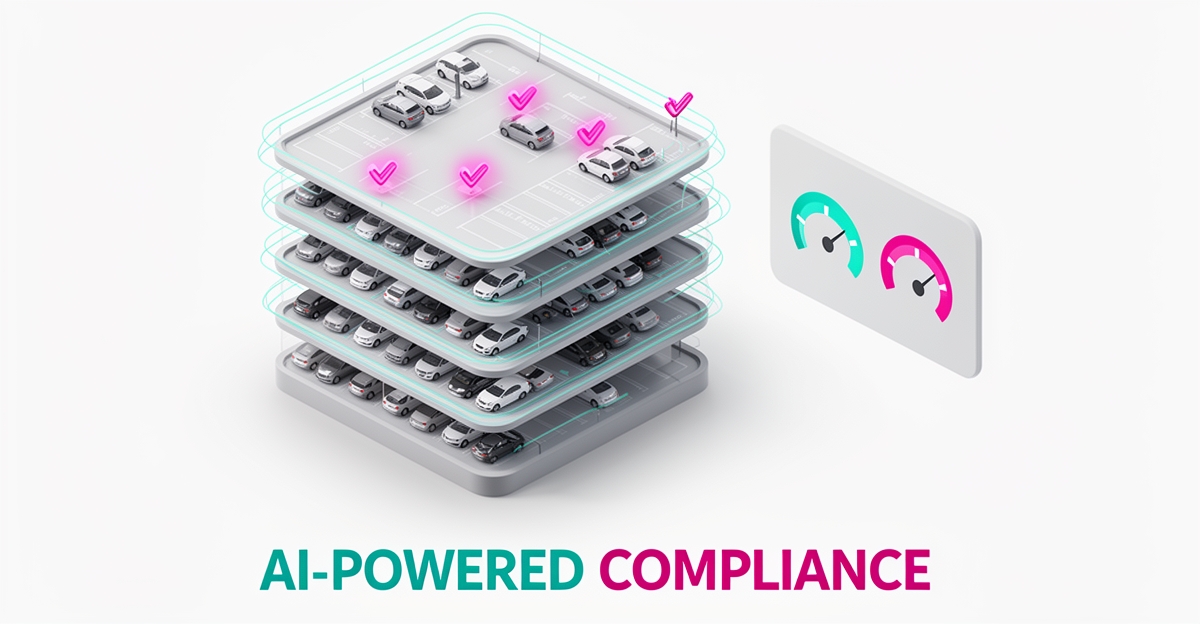
How AI Can Help Parking Garages Comply with Local and Municipal Regulations
Key Facts
- A typical attendant can effectively track only a few dozen spaces at a time, while AI monitoring systems cover thousands consistently, according to operational comparisons.
- Industry analyses suggest AI-assisted systems typically push space utilization into the 85-95% range, versus roughly 60-70% for older manual-heavy setups per cost-benefit research.
- Automated revenue collection via AI is reported to reach near-perfect accuracy, while manual processing commonly carries error rates of several percent according to industry analysis.
- Vendors such as SKIDATA report AI-enhanced platforms can cut license plate recognition false positives substantially compared to traditional image processing per vendor benchmarks.
- Computer vision platforms like FlashParking's advertise real-time space availability tracking with accuracy above 99% according to platform specifications.
- Manual payment processing errors are commonly estimated at 3-7% of transactions, with cash shrinkage adding further revenue loss per parking management analysis.
- Indirect labor costs from manual processes can add an estimated 20-30% on top of direct labor expenses according to operational research.
Hire a team member that works 24/7 — for less than a part-time wage.
AI receptionists, SDRs, dispatchers and 99+ roles. Trained on your business, fully managed.
Not sure where to start? Ask our AI planner
The Compliance Gap in Traditional Parking Enforcement
Manual enforcement was built for a smaller era, and parking garages are paying the price in missed violations and disputed tickets.
A typical attendant can effectively track only a few dozen spaces at a time, while AI systems handle thousands consistently. That capacity gap creates blind spots across floors, shifts, and entrances where violations go unseen until a complaint is filed. Operational comparisons show staff can only monitor a limited number of spaces effectively, and manual monitoring creates information delays.
Human error compounds the problem. Industry estimates suggest manual payment processing errors affect 3-7% of transactions, with cash shrinkage adding further revenue loss. Parking management analysis notes indirect labor costs from manual processes can add 20-30% to direct labor expenses. Inconsistent coverage also means inconsistent enforcement.
Evidence quality suffers when enforcement relies on paper tickets and memory. Manual enforcement often relies on inconsistent photos and manual notes, whereas AI systems provide plate events, vehicle details, and scan history that can support review. Enforcement research highlights that properties have too many vehicles to review by hand and permit lists change faster than patrol teams can track.
The compliance gap shows up in three recurring ways:
- Inconsistent monitoring across shifts and zones, with violations missed during low-staff periods
- Human error in ticketing and payment processing that fuels disputes and revenue leakage
- Limited scalability as facilities grow, making uniform rule application across multiple locations difficult
AI-powered monitoring closes these gaps by automating the core enforcement workflow. Automatic Number Plate Recognition cameras scan plates in real time and instantly cross-reference permit databases, payment records, and time limits. Parking enforcement analysis describes this as enabling consistent enforcement and fair outcomes by reducing human error.
The shift also improves operational metrics that regulators track. Industry analyses suggest AI-assisted systems push space utilization into the 85-95% range, versus roughly 60-70% for older systems. Cost-benefit research indicates automated revenue collection via AI reaches near-perfect accuracy, while manual processing is error-prone. That accuracy creates auditable digital trails for pricing, access control, and dwell-time compliance.
For operators managing strict municipal rules around access, pricing, and enforcement, consistency is a legal requirement. AIQ Labs builds AI systems that interpret local rules and apply them uniformly across all shifts — whether that starts with a single workflow rebuild or grows into a full AI operating system for your parking operation. The result is real-time compliance monitoring, automated reporting, and flagging of violations with timestamped evidence that stands up to disputes.
Manual enforcement offers flexibility for edge cases, but it cannot deliver the scale, accuracy, and auditability modern regulations demand.
AI Technologies That Ensure Regulatory Alignment
Parking garages can't afford inconsistent enforcement when municipal rules change by zone, shift, or permit type. AI replaces spot-checks with continuous, verifiable monitoring that aligns operations with local and municipal regulations in real time.
Automatic Number Plate Recognition and License Plate Recognition cameras form the backbone of automated compliance. They capture plate data day and night at entry, exit, and within the facility, then instantly cross-reference it against permit databases, payment records, and time limits. This creates a scan history that supports review and provides evidence for enforcement actions.
Computer vision platforms extend coverage beyond gates. Cameras plus AI detect occupancy and read plates across large decks, delivering broad coverage at a lower per-space cost. Vendors in this space — such as FALCON VISION and FlashParking — advertise space-detection accuracy at or above 99%, though operators should validate vendor claims against their own site conditions during a pilot.
IoT sensor networks add per-space precision where it matters most. Ultrasonic or magnetometer sensors in each bay report binary occupied/free data, ideal for premium streets and garages where per-space accuracy drives compliance with timed parking rules. Together, these layers automate the core enforcement workflow.
The consistency gains are measurable. A typical attendant can effectively track only a few dozen spaces, while AI systems handle thousands consistently. Vendors like SKIDATA report AI-enhanced platforms reduce license plate recognition false positives substantially compared to traditional image processing. Automated revenue collection via AI is likewise reported to reach near-perfect accuracy, while manual processing remains error-prone.
Key technologies that enable regulatory alignment include:
- ANPR/LPR cameras for access control, enforcement, and dwell-time analytics
- Computer vision platforms for occupancy detection and plate reading across garages
- IoT sensor networks for high-accuracy per-space monitoring
- Cloud and mobile platforms for synchronized ticketing and instant insights
- Analytics dashboards for trend monitoring and auditable compliance reporting
This automation delivers consistent enforcement and fair outcomes by reducing human error and information delays. Digital trails of plate events, vehicle details, and scan history replace inconsistent photos and manual notes, which is critical when disputes arise.
For operators managing multiple sites, scalability ensures the same rule set applies everywhere. AI systems manage thousands of spaces with the same consistency as a few dozen, making them particularly effective for large facilities or multi-location operations.
AIQ Labs builds AI systems that interpret local rules and apply them consistently across all shifts. That can start small — an AI Workflow Build that rebuilds your highest-cost enforcement or reporting workflow at a fixed price — or scale into a connected AI Operating System you own outright. The result is automated monitoring, auditable records, and real-time compliance tracking that helps parking garages meet municipal standards for revenue collection, space utilization, and enforcement.
From Pilot to Compliance: Implementing AI in Parking Operations
Parking garage operators seeking to meet evolving municipal regulations can start with a focused pilot to validate AI's impact on compliance and operational efficiency. Beginning with a single garage or zone allows teams to test technology, refine workflows, and measure results before scaling across multiple locations. This approach minimizes risk while building internal confidence in AI-driven enforcement and reporting. A commonly recommended pilot duration of 3–6 months typically provides sufficient data to assess performance against key benchmarks.
During the pilot phase, operators should track specific KPIs that directly reflect regulatory compliance and revenue integrity. Monitoring occupancy rates, enforcement incident frequency, and revenue accuracy per space offers concrete evidence of system effectiveness. Industry analyses suggest AI-assisted systems typically lift space utilization to 85-95%, well above the 60-70% common with traditional methods. Automated revenue collection via AI is likewise reported to reach near-perfect accuracy, sharply reducing the error rates common in manual processing. These metrics not only demonstrate ROI but also provide auditable data for municipal audits and dispute resolution.
Successful implementation requires thoughtful integration with existing infrastructure and strict adherence to privacy standards. Operators should prioritize vendors offering robust APIs and middleware solutions to ensure seamless data flow between AI systems and legacy parking management platforms. Equally important is establishing privacy-first policies: anonymizing license plate data where possible, enforcing strict data retention limits, securing all transmissions, and complying with local regulations on camera use and surveillance. As noted in industry guidance, proactive privacy measures are essential to reduce risks and maintain public trust while deploying AI at scale. Privacy-by-design principles help align AI deployment with both operational goals and legal obligations. AIQ Labs supports this journey with phased builds tailored to parking operations — from pilot design to full-scale deployment with compliance at the core, delivered in milestones so you only pay for what's proven.
Still paying for 10+ subscriptions that don’t talk to each other?
We build custom AI systems you own outright. No vendor lock-in. Full control.
Not sure where to start? Ask our AI planner
Frequently Asked Questions
How much can AI improve space utilization in parking garages compared to traditional systems?
What accuracy rate do AI systems achieve for revenue collection in parking operations?
Can AI systems handle monitoring thousands of parking spaces consistently like human attendants can?
How does AI reduce disputes over parking violations by improving evidence quality?
What privacy safeguards should parking garage operators consider when implementing AI monitoring systems?
Is a full-scale rollout necessary to test AI for parking compliance, or can operators start smaller?
Compliance at Scale: Turning Regulations Into Competitive Advantage
Manual enforcement can’t keep pace with municipal rules that change by zone, shift and permit type. AI closes the gap by replacing spot checks with continuous, verifiable monitoring — ANPR/LPR cameras, computer vision and IoT sensors that cross-reference plates, payments and time limits in real time, and produce timestamped evidence that stands up to disputes. The result is consistent enforcement across shifts and sites, auditable trails for pricing and dwell-time compliance, and measurable operational gains, with industry analyses suggesting space utilization rising to 85-95% compared with 60-70% for older systems with AI-assisted systems. Start with a focused 3-6 month pilot in one garage or zone, track occupancy, enforcement frequency and revenue accuracy, and build privacy-first policies from day one. AIQ Labs supports this journey with phased builds — from a single workflow rebuild to a full AI operating system you own outright. Take the two-minute Fit Check at https://aiqlabs.ai/apply to map your biggest compliance bottleneck, then book a free 30-minute strategy call to plan the fix.
Make AI your competitive advantage — not just another tool.
Strategy, implementation and ongoing optimization. One partner, end to end.
Not sure where to start? Ask our AI planner