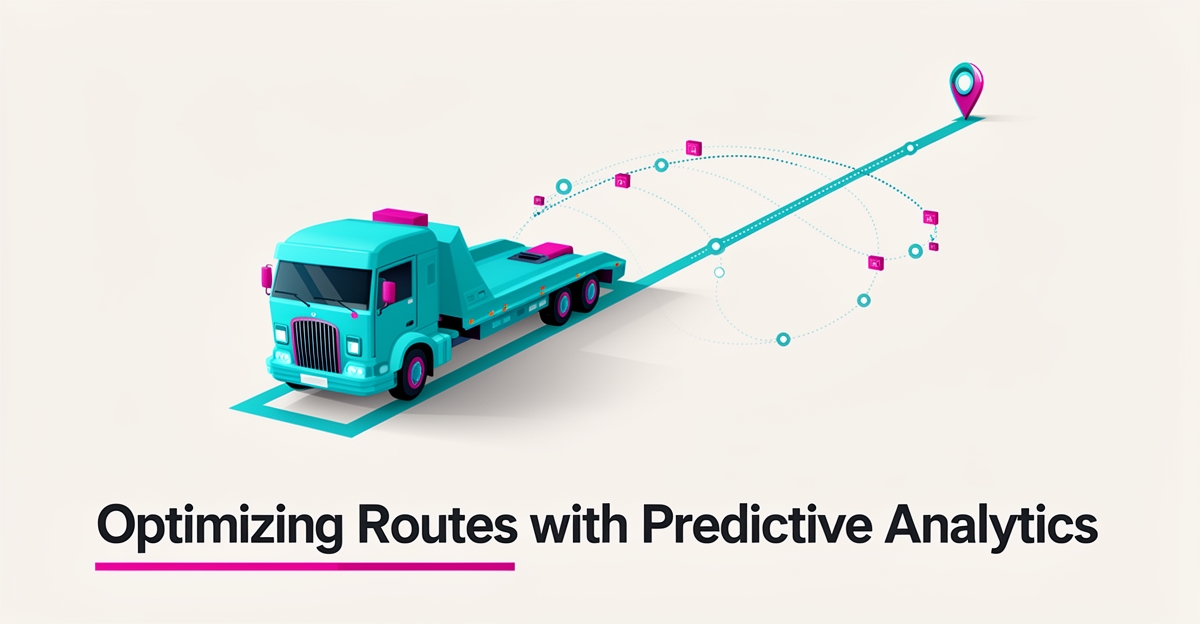
How AI Can Improve Delivery Time Predictions for Auto Hauling Companies
Key Facts
- AI-powered delivery time predictions typically improve accuracy meaningfully compared to traditional static estimation methods, especially when real-time location data is integrated
- AI-routed fleets generally achieve substantially higher on-time delivery rates than manually planned operations, with industry analyses as of late 2026 pointing to gaps of 20 percentage points or more
- Accurate ETAs reduce 'Where Is My Order' (WISMO) inquiries by providing reliable, real-time arrival estimates customers can plan around
- AI route optimization commonly delivers double-digit delivery time improvements and fuel savings in the range of 10-20%, depending on fleet size and route complexity
- AI delivery prediction systems integrate historical data, real-time traffic, weather, and vehicle specifics for continuous refinement
- Providing accurate ETAs through automated channels significantly reduces WISMO contacts while improving on-time performance
Hire a team member that works 24/7 — for less than a part-time wage.
AI receptionists, SDRs, dispatchers and 99+ roles. Trained on your business, fully managed.
Not sure where to start? Ask our AI planner
Why Delivery Time Accuracy Is Make-or-Break for Auto Haulers
In today's logistics landscape, customer expectations have shifted dramatically toward speed and transparency, making delivery time accuracy a make-or-break factor for auto haulers. When estimated arrival times are inaccurate, customers experience frustration, leading to a surge in "Where Is My Order?" (WISMO) contacts that strain support teams and erode trust. Accurate ETAs are consistently cited as a key driver of customer satisfaction, and AI-powered prediction systems show strong potential to reduce WISMO inquiries by providing reliable, real-time arrival estimates.
The impact of poor delivery time accuracy extends beyond inconvenience—it directly affects operational performance and brand reputation. Industry analyses as of late 2026 consistently show AI-routed fleets achieving substantially higher on-time delivery rates than manually planned operations, often by 20 percentage points or more. This improvement in reliability not only enhances the customer experience but also reduces costly delays and inefficiencies inherent in traditional scheduling methods. For auto haulers managing complex, time-sensitive vehicle transports, this level of precision is increasingly essential to remain competitive.
AIQ Labs supports this transformation through AI Workflow Builds that rebuild the dispatch-and-communication workflow around predictive analytics—integrating historical data, live traffic, weather, and vehicle-specific factors to continuously refine arrival estimates. These models empower haulers to proactively communicate delays, manage expectations, and strengthen customer trust through transparency. By turning uncertain ETAs into dependable commitments, AI-driven prediction becomes more than an operational upgrade—it becomes a foundation for long-term customer loyalty and service excellence in auto hauling.
How AI Models Predict Arrival Times with Real-Time Data
When a customer asks "where's my car?"—one of the most common inquiries in auto hauling—an accurate answer depends on far more than a static estimate. Modern AI models combine historical patterns with live conditions to generate arrival predictions that update continuously as circumstances change.
The foundation of any prediction system is the data feeding it. The accuracy of AI-powered prediction systems relies heavily on the quality and comprehensiveness of their training data. For auto hauling companies, that means pulling together four core data streams:
- Historical delivery data — past delivery timestamps, routes, and durations that reveal how long hauls actually take under varying conditions
- Real-time geospatial data — current traffic conditions, weather updates, and road closures affecting the route right now
- Vehicle and driver data — vehicle type, capacity, driver schedules, and performance history
- Order specifics — pickup and delivery addresses, vehicle details, and delivery window preferences
Once the data is in place, the modeling approach matters. Random Forest Regression is a commonly used machine learning algorithm for this task, evaluated with metrics like Mean Absolute Error and R² scores to measure how closely predictions match actual delivery times. Deep learning models like LSTM networks are also widely used because they capture temporal dependencies—patterns in how delays unfold over the course of a haul.
The real gains come from combining approaches. Systems that integrate AI models with real-time location data typically achieve meaningfully better accuracy—often cited in the 20-40% range—compared to traditional estimation methods. Ensemble methods that blend multiple models, paired with continuous ingestion of real-time data streams, keep predictions reliable even when conditions shift mid-route.
For auto hauling companies, this shift from static averages to dynamic prediction changes the customer experience fundamentally. Instead of a vague "5-7 business days," customers receive ETAs that reflect actual road conditions and adjust as the haul progresses. This transparency reduces "where is my order" inquiries and builds trust—accurate ETAs are a key factor in customer satisfaction, and AI-routed fleets consistently outperform manual planning on on-time delivery.
The final step is delivering these predictions where customers actually see them. AIQ Labs builds predictive analytics systems that integrate directly into customer communication channels—so the AI's arrival estimates reach customers automatically through the channels they already use, without dispatchers fielding calls or sending manual updates. When prediction and communication work together, accurate ETAs become a competitive advantage rather than an operational headache.
Business Impact: Efficiency, Cost Savings and Customer Trust
The true measure of any technology investment lies in its impact on the bottom line. For auto hauling companies, the shift from manual planning to AI-powered predictions translates directly into measurable gains across efficiency, cost, and customer relationships.
Consider the numbers. Fleets implementing AI route optimization commonly report delivery time improvements in the 25-30% range and fuel savings of 10-20%, depending on fleet size and route density. For a mid-sized operation, those fuel savings alone can reach tens of thousands of dollars annually—before factoring in reduced overtime, fewer missed delivery windows, and lower vehicle maintenance costs.
The reliability gap between AI and manual methods is equally striking. Industry analyses consistently show AI-routed fleets achieving on-time delivery rates in the mid-90s or better, compared to roughly 70-80% for manual planning. That consistency transforms how customers perceive your business.
Here is where the impact compounds:
- Reduced customer service burden: Accurate ETAs dramatically cut "Where Is My Order" (WISMO) inquiries, freeing your team from repetitive status calls
- Lower operational costs: Optimized routes mean less fuel burned, fewer overtime hours, and reduced wear on vehicles
- Improved asset utilization: Better predictions allow tighter scheduling, so each truck and driver generates more revenue per day
- Enhanced reputation: Consistent on-time performance builds the trust that wins repeat business and referrals
The customer experience dimension deserves particular attention. When your ETAs are reliable, buyers can plan around vehicle arrivals with confidence. When they are not, every missed window triggers phone calls, frustration, and doubt about your professionalism. AI-driven predictions address this at the source by giving customers accurate information before they need to ask for it.
At AIQ Labs, we build predictive analytics systems that integrate directly into your existing customer communication channels. Rather than forcing your team to learn new dashboards, we connect accurate arrival estimates to the tools your customers already use—whether that is automated SMS updates, email notifications, or your customer portal. An AI dispatcher can handle those proactive updates end to end, at a fraction of the cost of adding headcount.
The financial case becomes even clearer when you consider the cumulative effect. Mid-sized fleets that adopt AI-driven prediction and routing typically see substantial annual savings, with benefits scaling as operations grow. These are not theoretical projections—they represent real operational improvements that compound quarter after quarter.
For auto hauling companies operating on thin margins, the difference between a 75% and a 97% on-time delivery rate is not just a service metric. It is the difference between reactive firefighting and proactive growth, between customer churn and loyalty, between surviving and thriving in an increasingly competitive market.
From Prediction to Customer Communication: Implementation for Auto Hauling
Turning delivery time predictions into actionable customer communication requires a structured implementation approach that connects data science with real-world operations. Auto hauling companies can build end-to-end systems that transform raw data into reliable arrival estimates shared directly with customers through preferred channels like SMS, email, or portals.
The process begins with collecting and preparing the right data inputs. Historical delivery records provide the foundation, capturing past transit times, route patterns, and delay frequencies. This is enriched with real-time geospatial data including live traffic conditions, weather updates, and road closure alerts from trusted sources. Vehicle-specific attributes like carrier type, load configuration, and driver availability, combined with order details such as pickup/drop-off locations and special handling requirements, create a comprehensive feature set for accurate modeling.
AI models trained on this multi-source data typically improve prediction accuracy meaningfully compared to traditional static methods, directly reducing customer uncertainty. Feature engineering converts raw inputs into meaningful variables—time of day, day of week, seasonal patterns, distance metrics, and real-time traffic indices—enabling algorithms like Random Forest Regression to identify complex patterns affecting delivery timelines.
Once trained, the model is deployed as a scalable API, allowing sub-second prediction responses for new delivery requests. This API integrates with dispatch systems and customer communication platforms. When a vehicle departs for pickup, the system generates an initial ETA; as transit progresses, real-time data triggers continuous updates that refine the estimate based on actual conditions encountered.
Providing accurate ETAs through automated channels can significantly reduce WISMO (Where Is My Order) contacts while improving on-time delivery rates. AIQ Labs' predictive analytics systems are designed to embed directly into these communication workflows, ensuring predictions flow naturally into customer touchpoints without requiring manual intervention or disparate tools. Over time, this can grow into a full AI Operating System that connects dispatch, prediction, and communication in one layer your company owns outright.
The implementation culminates in a closed-loop system where prediction accuracy is continuously monitored, models are retrained with new delivery data, and communication templates are optimized based on customer engagement metrics. This creates a self-improving cycle that enhances both operational reliability and customer trust over time.
Still paying for 10+ subscriptions that don’t talk to each other?
We build custom AI systems you own outright. No vendor lock-in. Full control.
Not sure where to start? Ask our AI planner
Frequently Asked Questions
How much more accurate are AI delivery time predictions compared to traditional estimates?
Will AI actually improve my on-time delivery rate for auto hauling?
Can AI predictions reduce the constant 'where is my car' calls?
What kind of cost savings can auto haulers expect from AI route optimization?
What data does an AI delivery prediction system need to work well?
Is AI delivery prediction complicated to implement for a small fleet?
From Estimates to Expectations You Can Keep
Accurate delivery time predictions are no longer a nice-to-have for auto haulers; they are the foundation of trust, efficiency, and margin. By combining historical delivery data with real-time traffic, weather, vehicle and driver inputs, AI models move ETAs from static averages to dynamic, continuously refined commitments that reduce WISMO contacts and lift on-time performance well above what manual planning typically achieves. That reliability translates into lower fuel and overtime costs, tighter asset utilization, and customers who can plan with confidence instead of calling for updates. AIQ Labs builds predictive analytics systems that turn those predictions into automated communication through the channels your customers already use, so transparency happens without adding dispatcher workload. If you want to see where your current estimates are leaking trust and cost, start with the 2-minute Fit Check at https://aiqlabs.ai/apply—it leads to a free 30-minute strategy call where we map your highest-ROI automation opportunity. Systems that meaningfully outperform traditional estimation methods are already running in production—the next step is making them yours.
Make AI your competitive advantage — not just another tool.
Strategy, implementation and ongoing optimization. One partner, end to end.
Not sure where to start? Ask our AI planner