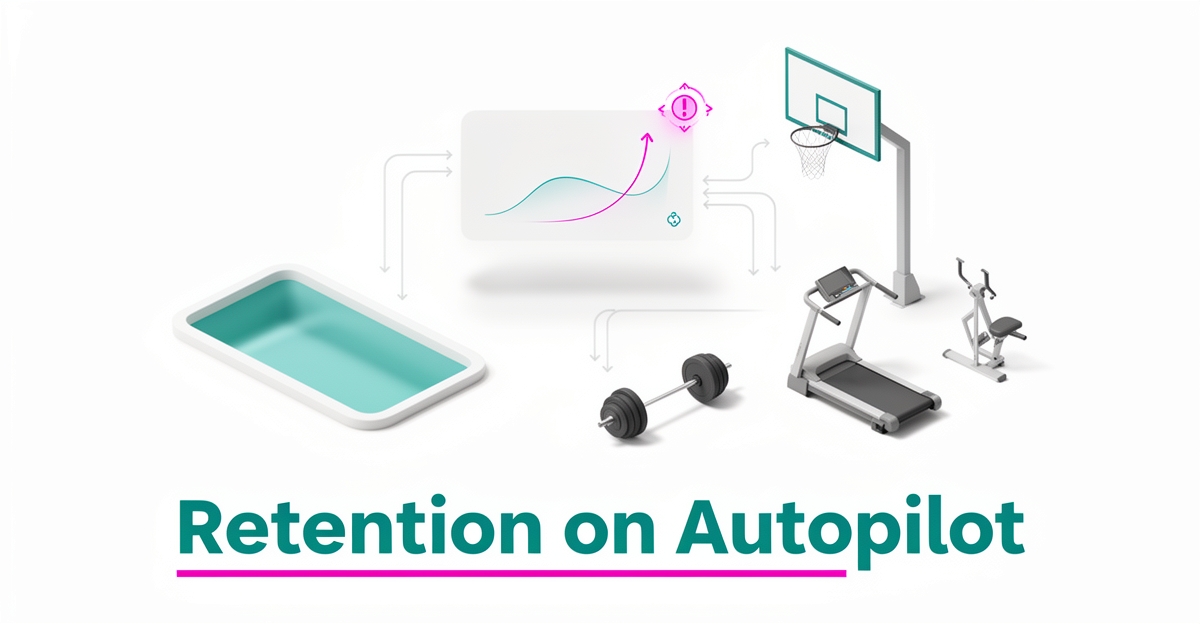
How AI Can Improve Member Retention at a Community Recreation Center
Key Facts
- A drop in weekly activity typically predicts cancellations days to weeks in advance, giving staff a window to intervene before the decision is final
- Industry reporting on AI-driven membership programs suggests renewals can rise meaningfully when benefits are aligned with what members actually use
- Automated, behavior-triggered outreach consistently outperforms calendar-based campaigns because it arrives while the member is still reachable
- Organizations that follow a structured AI implementation approach are far more likely to see positive ROI in year one than those that adopt tools ad hoc
- Automated re-engagement helps contain the program dropout rates that manual follow-up struggles to keep up with
- AIQ Labs has deployed 200+ multi-agent systems and runs four live SaaS products daily — retention workflows are a core build pattern
Hire a team member that works 24/7 — for less than a part-time wage.
AI receptionists, SDRs, dispatchers and 99+ roles. Trained on your business, fully managed.
Not sure where to start? Ask our AI planner
Why Members Leave: The Retention Challenge Facing Recreation Centers
Member cancellations rarely happen out of the blue. By the time a recreation center receives a resignation letter or a lapsed renewal notice, the member has usually been disengaging quietly for weeks or months — skipping classes, visiting less often, and drifting away from the community that once brought them through the doors.
The most telling warning signs follow a consistent pattern. Reduced participation in programs, declining event attendance, and dropping off from community activities all correlate strongly with eventual defection. Membership organizations that have adopted AI-powered predictive analytics report exactly this: patterns of disengagement, such as reduced community activity and declining event attendance, reliably signal which members are unlikely to renew.
Recreation centers see the same behavioral arc play out in their own way:
- Class attendance slips from weekly to occasional, then stops entirely
- Facility visits become shorter and less frequent
- Members stop responding to newsletters and program emails
- Family or household add-ons quietly drop off the membership
The problem is that traditional retention tactics are built to react, not predict. Renewal reminders, win-back offers, and post-lapse outreach all arrive after the decision to leave has largely been made. By then, the member has already formed the habit of life without the center — and no discount can rebuild a routine that dissolved months earlier.
The data shows how much earlier intervention matters. Fitness membership operations using behavioral analytics have found that a drop in weekly activity can predict cancellations days to weeks in advance — and by pairing automated notifications with personal outreach, some operators have reported meaningful churn reductions within a single quarter. That early-warning window represents the entire period in which a relationship can still be saved.
Timing, however, is only half the challenge. The other half is scale. A small front-desk team cannot realistically monitor every member's visit history, notice every missed class, and follow up personally with each at-risk individual. Manual outreach is limited by staffing levels, and inconsistent follow-up means some slipping members get attention while others fall through the cracks entirely. Programs facing similar dropout problems — from chronic care to fitness — consistently find that automated re-engagement campaigns outperform manual follow-up, which simply cannot keep pace at scale.
This is where AI-driven retention systems change the equation. By continuously tracking check-ins, class registrations, and communication engagement, these systems flag at-risk members early and trigger personalized follow-ups — the kind of proactive approach AIQ Labs builds through AI Workflow Builds centered on personalized activity alerts and automated re-engagement. Instead of learning about a cancellation at renewal time, recreation centers can reach the member while there is still time to bring them back.
How AI Predicts and Prevents Member Churn Before It Happens
AI-powered predictive analytics is changing how community recreation centers anticipate and prevent member churn. By continuously analyzing behavioral patterns—such as declining class attendance, reduced facility usage, or lower engagement with digital communications—AI systems identify at-risk members well before they consider cancellation. Fitness operators using behavioral analytics have found that drops in weekly activity can predict cancellations days to weeks ahead, enabling timely interventions. This shift from reactive to proactive retention allows centers to address disengagement early, preserving member relationships and stabilizing revenue.
These predictive insights trigger automated, personalized outreach designed to re-engage members before they lapse. For example, AI can flag members who haven't booked a class in two weeks or who've stopped opening center newsletters, then initiate tailored follow-ups such as activity recommendations, instructor check-ins, or special program invites. Membership organizations that have integrated similar AI-powered automation into their platforms report substantially higher email engagement and event attendance, with members perceiving greater value in their experience. Such targeted communication not only rekindles interest but also reinforces the center's relevance to individual lifestyles and goals.
AIQ Labs supports this proactive approach through custom systems that analyze member behavior and trigger context-aware interventions aligned with a recreation center's mission. By combining predictive modeling with personalized engagement strategies—like automated class alerts or wellness tips based on past participation—centers can meaningfully improve renewal outcomes. Industry reporting on AI simulations for retention suggests renewals can rise substantially without raising costs, simply by aligning offerings with what members truly value. This data-driven, anticipatory model turns retention from a cost center into a strategic advantage.
Personalized Engagement at Scale: From Generic Emails to Individual Connections
Generic email blasts fail to build real connections with recreation center members, often getting lost in crowded inboxes or ignored due to lack of relevance. AI transforms this dynamic by enabling hyper-personalized engagement at scale—delivering activity recommendations, program alerts, and communications tailored to each member's unique interests and behavior patterns without requiring additional staff.
Membership organizations have demonstrated this by integrating AI-powered automation into their management platforms, analyzing member interactions across emails, event attendance, and website activity to deliver real-time personalization. Members receiving regulatory updates get policy alerts, while those interested in leadership development are invited to executive roundtables — an approach that has produced substantially higher email engagement, increased event attendance, and members reporting they find more value in their experience.
This level of scalable personalization eliminates the guesswork of traditional segmentation. Instead of broad, one-size-fits-all messaging, AI systems continuously monitor behavior—such as class attendance, facility usage, and content engagement—to trigger timely, relevant outreach. For example, a member who consistently attends youth swim lessons might receive personalized alerts about new family aquatics programs, while someone using the weight room regularly gets strength-training workshop recommendations.
- Analyze individual behavior patterns across multiple touchpoints
- Deliver customized activity and program recommendations
- Trigger automated re-engagement when activity drops
- Personalize communication timing and channel preferences
- Maintain consistent, high-touch engagement without added staff
AIQ Labs designs retention-focused AI systems that align with community values—turning data into meaningful connections that keep members engaged, informed, and committed to returning. This approach doesn't just improve metrics; it fosters the sense of belonging that makes recreation centers true community hubs.
Automated Re-engagement: Bringing Inactive Members Back Through Timely Outreach
Inactive members rarely announce their departure — they simply show up less. AI-driven re-engagement catches the fade early and responds before the decision to cancel becomes final.
Reduced activity is a reliable early warning signal. Fitness membership analyses using behavioral tracking have found that drops in weekly activity can predict cancellations days to weeks in advance, and targeted notifications paired with personal outreach have produced meaningful churn reductions within a quarter. The same pattern holds across membership models: automated re-engagement campaigns consistently outperform manual follow-up, which struggles to contain program dropout at scale.
Timely outreach works because it is triggered by behavior, not by a calendar. Systems monitor check-ins, class bookings, app logins, and facility visits in real time. When usage falls below a member's personal baseline, an automated playbook fires immediately with a relevant nudge. This shifts retention from reactive win-back to proactive care.
Personalization makes the outreach feel human, not automated. Instead of generic "we miss you" messages, AI selects the right channel, timing, and offer based on past preferences. Members who respond to coaching receive a direct message, while others get a personalized class recommendation or a quick survey about barriers to attendance.
Effective re-engagement sequences typically include:
- Behavior trigger detection for declining visits or app usage
- Channel-specific nudges such as push notifications, SMS, or email
- Personalized content tied to past interests and program history
- Human handoff prompts for high-value members showing sustained disengagement
The result is scalable, consistent contact that manual teams cannot replicate. AI-powered automation ensures every member receives consistent, high-quality outreach regardless of staffing levels. For community recreation centers, that means preserving relationships while keeping staff focused on in-person support.
AIQ Labs applies these patterns through its current service lineup — from AI Employees that handle outreach and front-desk follow-up at a fraction of the cost of a human hire, to AI Workflow Builds that rebuild the one retention workflow costing you the most members. Every build is priced transparently: start monthly, build in milestones, or own it outright — details on the pricing page.
When re-engagement is timely, relevant, and respectful, members feel seen rather than chased. That perception difference is what turns a potential lapse into renewed participation, and it compounds over quarters into stronger membership health.
Implementing AI Retention Systems: A Practical Roadmap for Recreation Centers
Most retention initiatives fail because they start with technology instead of strategy. You need a systematic approach that aligns AI capabilities with your specific member engagement patterns.
Begin by mapping your retention metrics. Successful implementations start by identifying critical metrics such as churn rate, lifetime value, and active days to establish baseline measurements. Fitness operators using behavioral analytics have found that drops in weekly activity can predict cancellations days to weeks in advance, enabling targeted outreach that moves the needle within a quarter.
Next, instrument your systems to capture reliable behavioral signals. Set up tracking across all member touchpoints—website visits, class bookings, facility check-ins, and email engagement—to feed your AI models the data they need for accurate predictions.
Start with a simple churn model rather than attempting complex AI immediately. Focus on identifying your top three at-risk member segments, then build automated playbooks for each. These intervention workflows should trigger personalized communications when members show early signs of disengagement.
Your implementation roadmap should include:
- Map retention metrics including churn rate, lifetime value, and engagement frequency
- Instrument behavioral tracking across all member touchpoints and interactions
- Deploy targeted playbooks for your highest-risk member segments
- Measure lift through A/B testing to validate intervention effectiveness
Membership organizations that have followed this structured approach report substantially higher email engagement and increased event attendance after integrating AI-powered automation into their member management platforms. Their systems deliver personalized content based on individual preferences while automatically triggering re-engagement campaigns when activity declines.
Remember that technology alone won't solve retention challenges. Organizations that follow a structured AI implementation strategy — establishing stakeholder buy-in, creating internal champions, and ensuring transparent AI outputs staff can trust — are consistently more likely to see positive ROI within the first year than those adopting tools ad hoc.
AIQ Labs approaches recreation center retention through custom builds that align with your community's specific values and operational workflows. Rather than forcing your center into a generic software box, we can start with a single retention workflow rebuilt at a fixed price, or connect everything — outreach, scheduling, follow-up, reporting — into one operating layer you own outright via an AI Operating System built in phases. With 200+ multi-agent systems deployed and four live SaaS products we run daily, the patterns are proven.
Still paying for 10+ subscriptions that don’t talk to each other?
We build custom AI systems you own outright. No vendor lock-in. Full control.
Not sure where to start? Ask our AI planner
Frequently Asked Questions
How can AI help us identify members who are likely to cancel before they actually do?
Will using AI for member retention require hiring more staff or overloading our current team?
What kind of results have other organizations seen from using AI to improve member engagement?
Is AI-driven retention only useful for large organizations, or can small community centers benefit too?
What's the first step we should take if we want to implement AI for member retention at our recreation center?
Can AI really make our communications feel personal, or will members notice it's automated and ignore it?
Turning Insight into Action: How AI Strengthens Community Ties
AI doesn't just predict when members might leave—it gives recreation centers the power to act before disengagement becomes irreversible. By tracking real-time behavior, delivering personalized outreach, and automating re-engagement at scale, AI transforms retention from a reactive scramble into a proactive, relationship-driven strategy. The result is stronger member connections, stabilized revenue, and staff freed to focus on what matters most: in-person support and community building. For centers ready to move beyond guesswork and generic messaging, the next step is clear. Take the two-minute Fit Check to see where AI can make the biggest impact in your member retention strategy, then book a free 30-minute strategy call with AIQ Labs to map your path forward. Prefer email? Reach the team at [email protected].
Make AI your competitive advantage — not just another tool.
Strategy, implementation and ongoing optimization. One partner, end to end.
Not sure where to start? Ask our AI planner