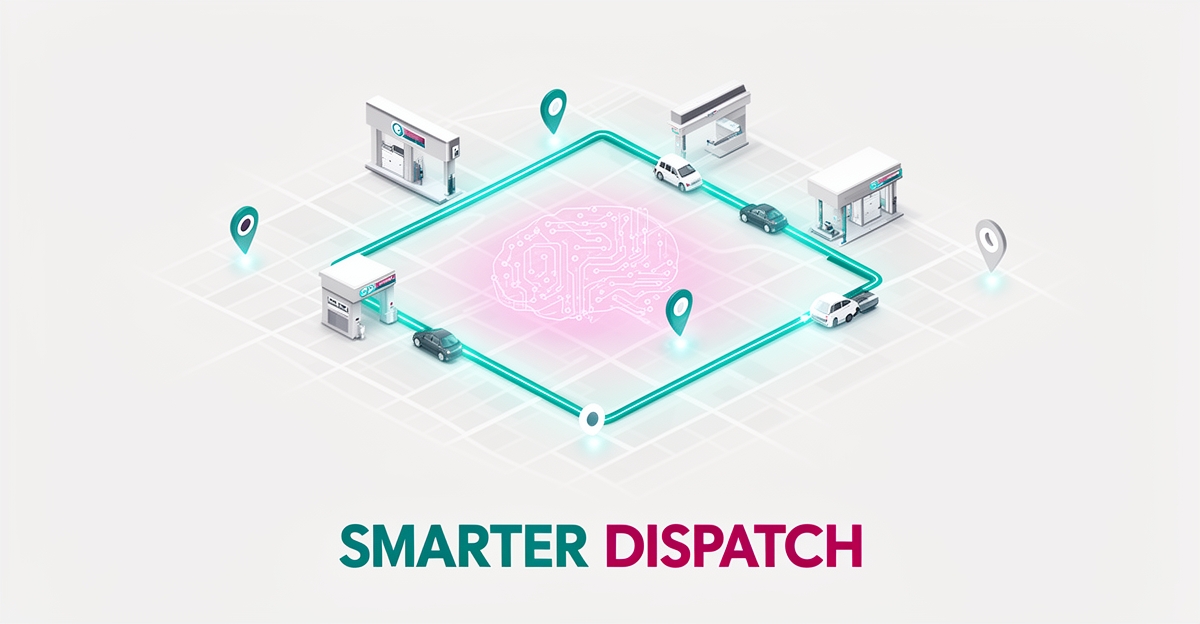
How AI Can Improve Technician Dispatch Efficiency in Quick Lube Chains
Key Facts
- Manual dispatch costs fleets roughly 25% more in operating expenses than AI-optimized alternatives, fleet management research shows
- AI-powered dispatch can cut response times by about 40% when replacing manual technician assignment, according to industry analysis
- Skill-mismatched manual dispatch assignments are linked to a 34% higher rework rate, machine learning research reveals
- AI enables one dispatcher to manage 35-50 vehicles versus a manual ratio of 10-12, dispatch efficiency studies show
- AI fleet management analyses report strong first-year ROI with break-even within 1-3 months, financial analysis indicates
- Shops with poor qualification run 45-50% technician utilization versus the 60-80% considered strong, smart dispatch analysis notes
- AI dispatch can reduce daily planning time by 80-95%, from 2-4 hours to under 5 minutes, route optimization research finds
Hire a team member that works 24/7 — for less than a part-time wage.
AI receptionists, SDRs, dispatchers and 99+ roles. Trained on your business, fully managed.
Not sure where to start? Ask our AI planner
The Hidden Cost of Manual Dispatch in Quick Lube Operations
A packed dispatch board looks busy. In quick lube operations it often signals profit leaking out the door.
Manual coordination rewards speed over fit. Dispatchers under time pressure match the nearest available technician to the next call, creating skill mismatches and idle gaps that compound through the day. Machine learning analysis of maintenance dispatch links skill-mismatched assignments made under time pressure to a 34% higher rework rate.
The cost premium is structural. Fleet management research finds manual dispatching costs fleets roughly 25% more in total operating expenses than AI-optimized alternatives. That premium shows up as fuel, overtime, and administrative overhead that never appears on a single invoice.
Utilization stalls because qualification happens too late. Shops running 45-50% utilization due to poor qualification send technicians out on calls that were never likely to close. Smart dispatch analysis notes technician utilization ranges between 60 and 80 percent are considered strong, but many quick lube chains sit at 45-50% because they're not qualifying before dispatching.
The math is brutal per bay. Send a tech to five unqualified calls per day at $75/hour loaded cost and you've burned $375 on non-buying leads. That is a full day of labor spent driving, diagnosing, and quoting prospects who are shopping, under-budget, or lack decision authority.
Manual dispatch creates three compounding drains:
- Idle time between assignments keeps utilization stuck at 45-50% instead of the 70-80% range achievable with qualification-first routing.
- Skill mismatches force callbacks and rework, eroding first-time fix rates and customer satisfaction.
- Unqualified leads consume high-cost technician time, turning dispatch into expensive theater rather than revenue generation.
The problem is not effort. It is visibility. Human coordinators cannot simultaneously weigh technician location, vehicle type, service demand, certifications, parts availability, and customer readiness in real time. AI-powered dispatch systems can optimize technician routing based on location, vehicle type, and service demand — cutting response times and reducing idle time.
AIQ Labs builds this as a workflow build: we rebuild the one dispatch workflow that costs you the most, at a fixed price and in phases, or staff the function with an AI dispatcher that runs at a fraction of the cost of a human hire. Either way, dispatch shifts from reactive coordination to revenue optimization — the board stops being a queue of calls and becomes a pipeline of qualified, winnable work.
Without that shift, quick lube chains keep paying a 25% cost premium for the illusion of activity.
How AI Transforms Technician Routing and Assignment
Effective technician dispatch begins with intelligent routing that considers multiple variables simultaneously. Modern AI dispatch systems evaluate location, vehicle type, bay availability, technician certifications, and real-time demand, moving beyond simple proximity-based matching to multi-variable optimization. This approach enables dispatchers to make optimal assignment decisions that account for both operational constraints and service requirements.
According to industry research, AI-powered dispatch systems can cut response times by roughly 40% when replacing manual technician assignment methods. These systems also reduce travel distances by an estimated 15-35% through dynamic route optimization that accounts for traffic patterns, job clustering, and technician availability. For quick lube chains managing fleets of service vehicles, this translates to meaningful fuel savings and reduced vehicle wear while maintaining or improving service levels.
The impact on dispatcher productivity is equally significant. AI enables a single dispatcher to effectively manage 35-50 vehicles compared to a manual ratio of 10-12 vehicles per dispatcher. This 3-5x increase in management capacity allows quick lube chains to scale operations without proportional increases in dispatch staff. The system continuously rebalances workloads based on real-time conditions, preventing technician overload while minimizing idle time between assignments.
Key optimization factors include:
- Matching technician certifications to specific vehicle service requirements
- Balancing real-time workload distribution across available technicians
- Prioritizing jobs based on asset criticality and customer urgency
- Incorporating historical performance data to predict job completion accuracy
- Dynamically reoptimizing routes when disruptions occur
This multi-variable approach fundamentally changes dispatch from a reactive coordination function to a proactive optimization tool. By evaluating thousands of possible assignment combinations simultaneously, AI systems identify the optimal match between technician capabilities and job requirements — reducing the skill mismatches that lead to rework and customer dissatisfaction. The result is higher first-time fix rates, improved technician utilization, and more efficient use of both human and capital resources across the service network.
The Qualification-First Approach: Dispatching for Revenue, Not Just Availability
A busy dispatch board is often a vanity metric. It feels productive while technicians burn hours on calls that will never close, driving utilization down and cost up.
The qualification-first approach flips the model. Instead of routing every inbound request to a technician, AI evaluates budget authority, urgency, decision-making capacity, and service fit during the initial contact. Only high-probability customers reach the dispatch board.
This shift protects technician time. Smart dispatch analysis shows shops running 45-50% utilization due to poor qualification, while technician utilization ranges between 60-80% are considered strong. Moving from 45-50% to 70-80% utilization transforms dispatch from a coordination task into a revenue engine.
The waste is measurable. Sending a tech to five unqualified calls per day at $75/hour loaded cost equals $375 burned on non-buying leads. AI qualification eliminates that theater by screening before the truck rolls.
Qualification happens through natural conversation, not forms. The AI asks qualifying questions in the first interaction:
- Budget Authority: Can they afford the typical repair range?
- Decision Authority: Can they say yes without consulting others?
- Urgency: Do they need it fixed now or eventually?
- Fit: Is this within service area and expertise?
Leads scoring high across criteria get dispatched immediately with notes attached to the work order. Marginal leads route to inside sales. Clear no-gos get politely declined or referred.
The result is a healthier funnel. Industry guidance points to 75%+ qualified dispatch rates and 65%+ dispatch-to-close rates as signs of healthy dispatch operations. Pre-qualified leads close faster because the selling work is already done.
AI-powered dispatch systems support this by evaluating thousands of assignment combinations simultaneously, considering skills, certifications, workload, proximity, and parts availability. Research on AI maintenance dispatchers documents a 28% improvement in technician utilization when AI scheduling eliminates idle time between assignments.
For quick lube chains, this means real-time integration with franchise management tools and routing based on location, vehicle type, and service demand. AIQ Labs can staff this as an AI employee — a managed AI dispatcher among 99+ roles, at roughly 80% less cost than a human hire — or rebuild the full dispatch workflow as a fixed-price workflow build that qualifies inbound demand before it hits the board.
Dispatchers stop building routes and start managing operations. They see which calls are pre-qualified and why, prioritize high-value opportunities, and handle exceptions with human judgment. Technicians arrive at jobs more likely to convert, with the right parts and context.
That is qualification-first dispatch: fewer trucks, more revenue, and utilization that reflects actual business health.
Real-Time Reoptimization and Emergency Response
No matter how well you plan the morning schedule, quick lube operations live in a world of constant disruption — a technician calls out sick, a fleet of delivery vans shows up unannounced, or a job runs long and cascades delays across the entire day. This is where AI dispatch systems prove their value most, because they treat disruption not as an exception but as a normal operating condition.
Traditional manual dispatch buckles under these moments. An emergency dispatch analysis puts it bluntly: emergency dispatch is the moment your daily plan stops working, and these disruptions aren't exceptions — they are part of real field operations. When a human dispatcher is juggling a call-out and a priority customer at the same time, quality slips. Research on AI maintenance dispatchers found that skill-mismatched assignments made by manual dispatchers under time pressure produce a 34% higher rework rate.
AI systems handle these breaks in the plan through dynamic rebalancing. The same research identifies this as a core capability: when technicians call in sick, emergencies arrive, or tasks run over their estimated duration, the system instantly rebalances the schedule. Job overruns automatically adjust downstream appointments, cancellations open windows for the highest-priority pending requests, and emergencies trigger immediate reassignment — often without any dispatcher involvement at all.
The workflow behind an emergency reassignment is systematic rather than improvised. When the plan breaks, the AI collects job details, SLA tiers, technician load, real-time location, and certifications, then checks real-time parts and inventory visibility — van stock, warehouse availability, and substitutes — before deciding who goes, with which parts, and what gets delayed. This matters in a quick lube context, where a missing filter or oil grade can stall a bay just as easily as a missing technician.
Predictive analytics push this from reactive to proactive. By analyzing historical service request volumes and regional patterns, dispatch platforms can anticipate demand surges before they hit — the way an HVAC platform pre-positions contractor coverage ahead of a forecasted heat wave. For quick lube chains, that means staffing and scheduling aligned to predictable volume spikes rather than scrambling after the waiting lot fills up.
The results of this real-time responsiveness are measurable. One roadside-assistance provider reported a 95% auto-scheduling rate, resolving nearly all assignments without human touch, and organizations using AI for service work report roughly 39% faster resolution times. AIQ Labs builds dispatch automation that layers onto the systems quick lube chains already run — preserving current investments while adding always-on responsiveness. The dispatcher's role shifts accordingly, from firefighting route conflicts to managing operations by exception, with human judgment reserved for the situations that genuinely need it.
Implementing AI Dispatch: Integration, Metrics, and ROI
The difference between a successful AI dispatch deployment and a stalled pilot usually comes down to one thing: starting with an honest baseline. Before any technology decision, quick lube chains need to know exactly what their current dispatch process is costing them.
Step one is the qualification audit. Track your numbers for a full month: daily dispatch board volume, closed-job percentage, technician utilization, and "no sale" callbacks. Many shops discover they're dispatching a large share of unqualified leads, and that packed board often masks utilization running at just 45-50% instead of the 60-80% considered strong, according to Tradesly's dispatch qualification analysis. That baseline becomes your proof of improvement later.
Step two is configuration. Set specific qualification criteria — budget thresholds per service type, geographic boundaries, urgency requirements, and decision-maker questions. "Can afford an oil change package" is too vague; clear dollar ranges give the AI unambiguous parameters.
Step three is integration, and this is where chains get cautious. Field service research shows 42% of buyers cite system compatibility as their primary purchasing concern, and rightly so. The most successful implementations layer AI on top of existing FSM platforms rather than replacing them. Whether a chain runs ServiceTitan, Housecall Pro, or Jobber, the AI feeds qualified leads directly into the dispatch board with qualification notes attached — preserving prior investments while dispatchers retain human judgment for exceptions and escalations.
Step four is team training. Dispatchers need to learn to prioritize pre-qualified calls, and technicians need to handle warm prospects differently than cold visits. Expect 1-2 weeks of adaptation, with some resistance from veteran dispatchers whose expertise was built around manual processes.
The metrics that prove the system works include:
- Qualified dispatch rates of 75%+ and dispatch-to-close rates of 65%+, the benchmarks of healthy dispatch operations
- Daily planning time, which should collapse from 2-4 hours to under 5 minutes — an 80-95% reduction
- Technician utilization climbing toward 70-80% as unqualified calls leave the board
- Travel time and mileage, which typically drop 15-35% under AI-optimized assignment
The ROI timeline is faster than most operators expect. Research on AI fleet implementations points to break-even within 1-3 months, a 280% first-year ROI, and tens of thousands of dollars in annual savings versus manual dispatch. For context, a 25-vehicle operation can lose over $72,000 annually to fuel inefficiency, overtime, and administrative overhead under manual coordination.
This is the deployment model AIQ Labs follows: AI dispatch agents with real-time, two-way integration into the tools you already run. You can start monthly with an AI employee, build the workflow in milestones at a fixed price, or — for chains that want the full connected layer — an AI Operating System built in phases and owned outright. With 200+ multi-agent systems deployed and four live SaaS products we run daily, we don't quote invented savings numbers; we scope your actual workflow and tell you what it's worth. Payment models and current signals are laid out plainly at aiqlabs.ai/pricing.
Over half of businesses see full ROI within 12 months of automation deployment, per workflow automation research. The chains that hit those numbers share a pattern: they audited first, integrated rather than replaced, and tracked qualified dispatch rates from day one. If you're unsure whether the win is there for your operation, take the 2-minute Fit Check — and if there isn't a clear win, you'll hear that too.
Still paying for 10+ subscriptions that don’t talk to each other?
We build custom AI systems you own outright. No vendor lock-in. Full control.
Not sure where to start? Ask our AI planner
Frequently Asked Questions
How much more does manual dispatch cost compared to AI-optimized dispatch?
What technician utilization should a quick lube chain be aiming for?
Can AI really cut response times for quick lube service calls?
Will AI dispatch work with the franchise management tools we already use?
What is qualification-first dispatch and why does it matter?
How fast does AI dispatch pay for itself?
From Busy Boards to Real Results: Turning Dispatch Into Revenue
Quick lube chains lose real money when dispatch becomes a coordination task instead of a revenue engine — burning technician time on unqualified leads, creating skill mismatches that trigger rework, and letting utilization stagnate at 45-50% while stronger operations hit 70-80%. AI-powered dispatch flips that script by qualifying leads before they hit the board, matching the right technician to the right job in real time, and dynamically rebalancing when disruptions hit. The result isn't just fewer idle miles or faster response times — it's higher first-time fix rates, better customer satisfaction, and savings that show up fast. For chains ready to stop paying a 25% premium for the illusion of activity, the path forward starts with clarity: audit your current qualification gap, see where AI can plug the leaks, and let the data guide the next move. Take the 2-minute Fit Check, then book a free 30-minute strategy call to map your biggest bottleneck — and if there isn't a clear win, you'll hear that too. Prefer email? Reach the team at [email protected].
Make AI your competitive advantage — not just another tool.
Strategy, implementation and ongoing optimization. One partner, end to end.
Not sure where to start? Ask our AI planner