How AI Can Improve Technician Utilization in Mobile Fleet Services
Key Facts
- 66% of frontline employees say they don't have enough time to finish tasks on the job according to Microsoft's Work Trend Index research
- AI-optimized technician dispatching has been shown to reduce drive time for mobile repair fleets by roughly 18% per industry statistics
- AI-powered scheduling tools have been reported to improve shop floor utilization by around 15% in the same analysis
- Computer vision tools can identify most external vehicle damage in under 3 minutes according to industry research
- AI-enhanced AR headsets have been reported to cut engine assembly errors dramatically in industrial settings per recent studies
- The average repair shop saves several hours per week using AI for parts ordering from industry data
- A majority of customers expect a repair within 24 hours when air conditioning fails notes a field service software guide
Hire a team member that works 24/7 — for less than a part-time wage.
AI receptionists, SDRs, dispatchers and 99+ roles. Trained on your business, fully managed.
Not sure where to start? Ask our AI planner
The Hidden Cost of Idle Technicians: Why Utilization Is Killing Your Margins
Every wasted hour on the road is a direct hit to margin. In mobile fleet services, technicians are the revenue engine, yet most of their day is spent on non-billable work that erodes utilization.
Microsoft's Work Trend Index research finds 66% of frontline employees say they don't have enough time to finish tasks on the job, and roughly half report being burned out at work. The pressure intensifies when the workforce is shrinking.
The HVAC industry, for example, has faced a persistent technician shortage, with tens of thousands leaving the workforce in recent years per field service industry reporting. With fewer people to cover demand, every idle hour costs more than ever.
Idle time hides in four predictable leaks. Technicians lose billable hours to:
- Travel between dispersed jobs without route grouping
- Paperwork, manual work orders, and end-of-day data entry
- Waiting for parts or clarifying diagnostics by phone
- Misassigned jobs based on availability instead of skill and proximity
These frictions compound. A technician dispatched to a complex system they've never seen spends time learning on site. A morning job runs long and the rest of the day cascades. Customers expect speed—many expect a repair within 24 hours when air conditioning fails according to field service research—yet the team is stuck in traffic or chasing paperwork.
The result is lower first-time fix rates, missed revenue, and rising technician churn. When frontline workers feel constantly behind, morale drops and mistakes increase. Utilization stalls not because technicians aren't working hard, but because the system around them creates waste.
This is where AI workflow automation changes the equation. AI can optimize technician routes, assign tasks based on proximity and skill, and balance workloads in real time so billable time expands without adding headcount.
AIQ Labs builds these systems as [AI Workflow Builds](/workflow-builds)—rebuilding the one workflow that costs you the most, at a fixed price, in phases—not off-the-shelf scheduling widgets. By integrating dispatch, service history, and live traffic, the system continuously reallocates work to keep technicians productive and customers moving.
The hidden cost of idle technicians is not a staffing problem. It is a coordination problem that AI is built to solve.
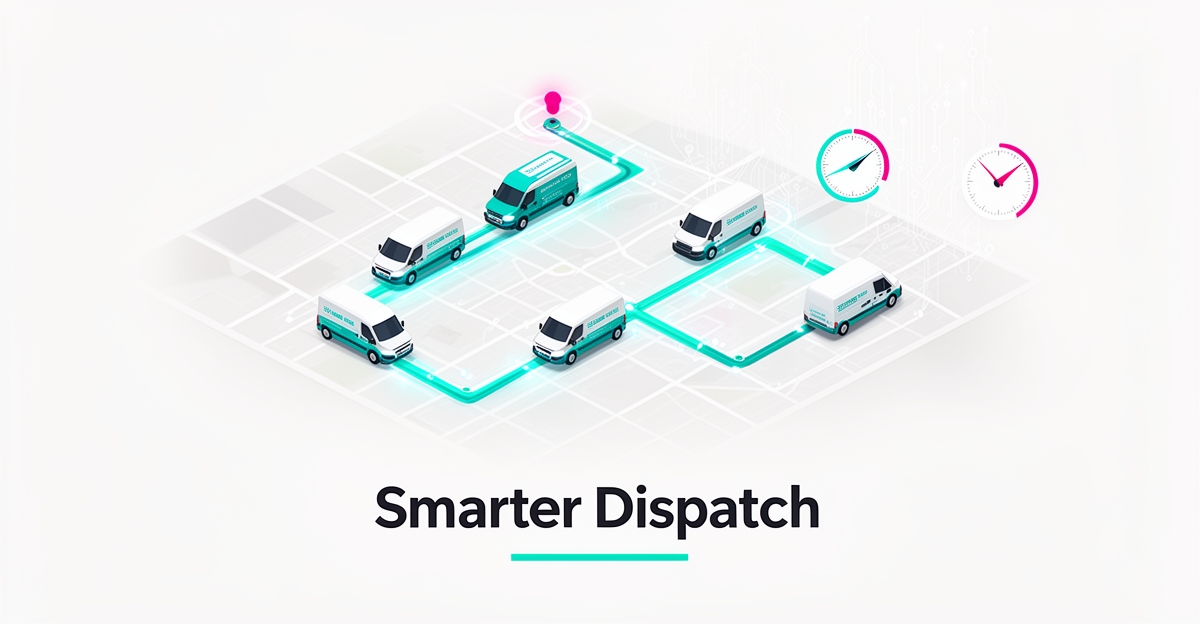
Smarter Dispatch: AI-Powered Scheduling, Routing, and Workload Balancing
Idle time is the silent profit leak in mobile fleet services. Technicians spend hours driving between jobs, waiting for assignments, or arriving unprepared for the work ahead.
AI replaces availability-first dispatch with intelligent matching that weighs proximity, skill set, complexity, and real-time conditions. Systems like Microsoft's Resource Scheduling Optimization automatically suggest the best technician, equipment, and facilities for a job by weighing factors like skill level, location, and job complexity per industry research. That right-technician-for-the-job logic prevents complex repairs from landing with someone trained only on residential units.
The efficiency gains can be substantial. AI-optimized technician dispatching has been reported to reduce drive time for mobile repair fleets by around 18% according to industry data, while AI-powered scheduling tools have been reported to improve shop floor utilization by roughly 15% in the same analysis. Route optimization has also been linked to fuel savings on the order of 12% from AI-driven route optimization, which matters when grouping nearby jobs cuts drive time and adds billable hours.
Dynamic routing is not just about shortest distance. Smart scheduling systems take into account job urgency, location, real-time traffic, and weather to create efficient routes from field service workflow analysis. If a morning job runs long, the system automatically adjusts the rest of the day's schedule and notifies affected customers.
Customer expectations make this flexibility essential. A field service software guide notes that most customers expect a repair within 24 hours when their air conditioning fails, with a meaningful share wanting same-day service. A good system can slot an urgent job into an existing route without manually rebuilding the day's schedule.
Workload balancing also protects technicians from burnout. With 66% of frontline employees saying they don't have enough time to finish tasks on the job in Microsoft's Work Trend Index research, AI distributes jobs to even out peaks and valleys instead of overloading the nearest available person.
In practice, smarter dispatch includes:
- Proximity and skill matching that pairs certified techs with the right job complexity
- Real-time route recalculation for traffic, weather, and job overruns
- Automatic emergency insertion for same-day and 24-hour demands
- Load balancing across crews to maximize billable hours and reduce idle time
This is AI workflow automation in action. AIQ Labs builds these systems as custom [AI Workflow Builds](/workflow-builds), ensuring every technician is used efficiently through dispatch logic that integrates with your existing CRMs, scheduling tools, and field apps.
Closing the Knowledge Gap: AI Diagnostics, AR Assistance, and First-Time Fixes
The knowledge gap remains one of the most persistent barriers to technician efficiency, especially when less-experienced staff encounter complex or unfamiliar equipment. AI-powered diagnostics and augmented reality (AR) tools are directly addressing this challenge by providing real-time, visual guidance that accelerates problem identification and resolution. Computer vision systems, for instance, can identify the vast majority of external vehicle damage in under 3 minutes, drastically reducing the time technicians spend on initial assessments according to industry research. This rapid diagnosis allows technicians to move faster into repair phases, minimizing idle time and improving first-time fix rates.
Beyond initial diagnostics, AR remote assistance enables technicians to overlay digital guidance onto physical equipment, effectively bringing expert knowledge to the point of need. Using hands-free devices like Microsoft HoloLens 2, AI can project step-by-step instructions directly into the technician's field of view—such as "open this door, pull this lever, add this part"—to guide complex procedures as explained by Microsoft's Senior Director of Product Marketing. This approach has proven highly effective, with AI-enhanced AR headsets reported to reduce engine assembly errors by as much as 90% in industrial settings per recent studies. By minimizing mistakes and rework, these tools not only save time but also increase the likelihood of resolving issues on the first visit.
For mobile fleet services, this translates into fewer unnecessary truck rolls and lower operational costs. When technicians can diagnose and fix problems correctly the first time—supported by AI-driven visual guidance—companies avoid the expense and inefficiency of return visits. AIQ Labs integrates these capabilities into custom workflow automation systems that equip field teams with intelligent, on-demand support. Whether through computer vision for rapid damage assessment or AR for guided repairs, AI is closing the knowledge gap and turning technician utilization into a measurable competitive advantage.
Automating the Paperwork: Freeing Technicians From Non-Billable Work
A technician's most valuable asset is their time on the tools, yet too much of it is consumed by clipboards and callbacks. When skilled labor is already scarce, every minute spent on paperwork is a direct hit to your bottom line.
According to Microsoft's Work Trend Index research, 66% of frontline employees say they don't have enough time to finish tasks on the job. This pressure contributes to burnout, with roughly half of the workforce reporting feeling overwhelmed. AI directly targets this administrative drag, shifting hours from data entry back to billable repair work.
Generative AI now drafts work orders automatically from customer emails before a technician even arrives. Once on-site, computer vision transforms documentation: technicians snap photos of the completed work, and image-to-text algorithms generate detailed job summaries instantly, eliminating the end-of-day paperwork pileup that plagues traditional shops.
Inventory management represents another massive time sink that AI eliminates. Modern systems track parts down to the individual truck level, updating records automatically when items are used and triggering reorders without human intervention. This automation saves the average repair shop several hours per week on parts ordering alone.
The financial impact extends beyond time savings. By maintaining optimal stock levels, AI helps prevent the lost sales commonly caused by out-of-stock items per industry data. When a technician has the right part on the truck, they complete the job on the first visit rather than scheduling a return trip.
Key automation areas that return technicians to revenue-generating work include:
- Automated work order generation from customer communications
- Image-to-text job summaries using computer vision
- Truck-level inventory tracking with automatic reordering
- Digital checklists with voice-to-text data entry
Beyond daily tasks, AI smooths the feast-or-famine cycle of emergency calls. IoT sensors detect equipment anomalies before failures occur, allowing the system to schedule preventive maintenance during natural lulls rather than dispatching emergency trucks. This predictive approach converts chaotic breakdowns into planned, efficient visits.
Implementing these systems requires expertise in both AI architecture and field service workflows. AIQ Labs builds custom automation platforms that handle everything from intelligent dispatching to inventory forecasting, ensuring technicians spend their time fixing problems, not filling out forms. The result is a leaner operation where technician utilization climbs because the paperwork simply disappears.
Implementing AI in Your Fleet: A Practical Rollout Roadmap
Rolling out AI for mobile fleets works best when you prove value on one crew before scaling to the whole operation. A focused pilot surfaces workflow friction early and builds the buy-in needed for adoption.
Start with a single crew and a narrow use case. Run intelligent scheduling and dispatch for that team first, then refine. According to field service guidance, starting with one crew helps catch problems early and creates internal advocates before a company-wide push.
Equip technicians with mobile tools built for real field conditions. The app must deliver job details, service history and repair guides, and function when connectivity drops. Mobile interface research emphasizes offline capability, because a technician who can keep working offline then sync once back in range won't lose half a day to a dead zone.
Verify integration with your existing systems before you expand. Confirm two-way connections to CRM, accounting, payment processing and dispatch software so data flows without manual re-entry. A clunky isolated system creates more admin work, not less.
Use the data you collect to drive continuous improvement. Track utilization, drive time and first-time fix rates, then adjust rules for proximity, skill matching and route grouping.
Common pitfalls to plan for:
- Connectivity dead zones in basements and rural routes requiring robust offline sync
- Hidden implementation costs beyond subscription fees, including training and per-technician pricing
- Change management resistance if technicians perceive AI as added workload rather than relief
The payoff is measurable. Industry statistics suggest AI-powered scheduling tools can improve shop floor utilization by around 15% and AI-optimized dispatching can reduce drive time for mobile repair fleets by roughly 18%.
This is where ownership matters. AIQ Labs builds owned, custom dispatch and scheduling systems—delivered through [AI Workflow Builds](/workflow-builds) or a phased [AI Operating System](/ai-operating-systems)—that integrate with your existing stack and are tailored to your service rules, not a generic SaaS template. That approach avoids vendor lock-in and lets you iterate on routing logic as your fleet grows.
Technician burnout is real. Microsoft's Work Trend Index research notes 66% of frontline employees say they don't have enough time to finish tasks on the job. A well-designed rollout reduces non-revenue work and lets crews focus on billable service.
Ready to map your highest-ROI automation opportunity? Start the 2-minute Fit Check at https://aiqlabs.ai/apply for a free 30-minute strategy call with an AI engineer. If there isn't a clear win, we'll tell you.
Still paying for 10+ subscriptions that don’t talk to each other?
We build custom AI systems you own outright. No vendor lock-in. Full control.
Not sure where to start? Ask our AI planner
Frequently Asked Questions
How much can AI reduce drive time for mobile repair fleets?
What percentage of frontline employees say they don't have enough time to finish tasks on the job?
How does AI help reduce paperwork for technicians?
Can AI improve first-time fix rates for complex repairs?
What are the main causes of idle time for technicians in mobile fleet services?
How does AI handle emergency service requests without disrupting the schedule?
Turning Technician Time Into Tangible Gains
The path to higher technician utilization isn't about working harder—it's about working smarter with the right AI-powered systems in place. By optimizing dispatch, closing knowledge gaps, and eliminating non-billable work, AI transforms idle hours into revenue-generating time without adding headcount. The result is improved first-time fix rates, lower operational costs, and a more sustainable workload for your team. If you're ready to see where AI can make the biggest impact in your fleet, start with a free Fit Check to map your highest-ROI automation opportunity. AIQ Labs will help you identify the win—or tell you if there isn't one. Begin your strategy call at https://aiqlabs.ai/book.
Make AI your competitive advantage — not just another tool.
Strategy, implementation and ongoing optimization. One partner, end to end.
Not sure where to start? Ask our AI planner