How AI Can Optimize Delivery Routes for Generator Rentals in Urban Areas
Key Facts
- AI optimization engines have delivered fleet efficiency gains of roughly 25% in published industry case studies, as of late 2026
- AI route optimization reduces empty miles and fuel costs while improving delivery reliability
- Dynamic replanning lets engines rebalance routes in real time when traffic or delivery windows change—no manual dispatcher rework
- AI logistics tools can produce optimized routes, load plans, and ETAs in seconds from uploaded order data
- Agentic commerce—AI agents initiating orders on customers' behalf—is a small but fast-growing channel that rental companies should prepare for with machine-readable data
Hire a team member that works 24/7 — for less than a part-time wage.
AI receptionists, SDRs, dispatchers and 99+ roles. Trained on your business, fully managed.
Not sure where to start? Ask our AI planner
The Urban Generator Rental Delivery Problem
Urban generator rental companies face a logistical challenge that traditional planning tools simply cannot solve. Dense city centers create a perfect storm of congestion, strict delivery windows, and equipment variability that renders manual route planning slow and expensive.
The core difficulty lies in managing complex, real-time variables that static spreadsheets and human intuition cannot process efficiently. Delivery vehicles must navigate unpredictable traffic patterns while adhering to rigid time windows—often as narrow as two hours—to serve construction sites, events, and emergency backup scenarios. When a 25 kVA towable unit requires different handling than a 500 kVA industrial standby generator, load planning becomes a multidimensional puzzle that changes with every order.
These inefficiencies compound quickly into measurable financial drains. Published fleet case studies suggest operators using AI-driven optimization can achieve efficiency improvements in the 20–25% range by solving exactly these positioning and routing challenges. Without such systems, urban rental fleets lose money through empty miles, missed delivery windows, and underutilized vehicle capacity.
The environmental toll is equally significant. Traditional routing methods generate unnecessary carbon emissions through circuitous paths and idling in congestion, while failing to provide the CO2 metrics needed for sustainability reporting. As cities implement stricter emissions regulations, rental companies lacking data-driven logistics face both regulatory risk and reputational damage.
Modern urban delivery requires processing constraints that overwhelm human dispatchers:
- Real-time traffic-aware ETAs that account for rush hour bottlenecks and road closures
- Variable equipment dimensions that demand specific vehicle matching and load balancing
- Strict time windows for construction site access and event setup deadlines
- Territory splits that prevent driver overlap while maximizing coverage density
- Last-mile navigation challenges in pedestrian zones and low-emission districts
Industry analysis of AI logistics platforms confirms that manual planning cannot compete with algorithms capable of instantly processing vehicle capacities, service times, and delivery windows simultaneously. The result is a widening gap between companies using data-driven routing and those relying on legacy methods.
The cost of inefficiency is no longer sustainable. Fuel expenses, driver overtime, and missed delivery penalties erode margins, while customer expectations for precise arrival windows continue to tighten. AIQ Labs helps rental businesses bridge this gap—typically through a Workflow Build that rebuilds the one routing and dispatch workflow that costs the most.
The transition from reactive dispatching to predictive logistics represents the difference between surviving and thriving in dense urban markets. As commerce increasingly shifts toward automated systems, the infrastructure supporting physical deliveries must evolve with equal sophistication.
How AI Route Optimization Solves Urban Logistics Complexity
Urban generator rentals live or die on the last mile. Tight delivery windows, oversized equipment, and unpredictable city traffic turn simple dispatch into a daily puzzle that human planners can't solve fast enough.
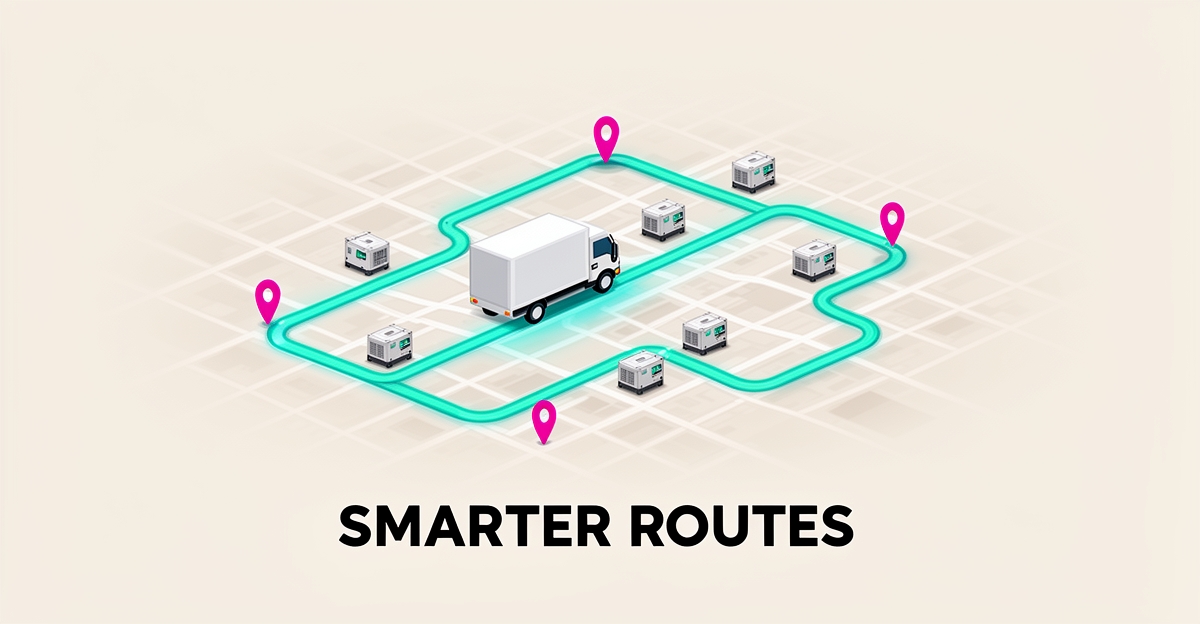
AI route optimization engines ingest real-time variables that static plans ignore. Traffic patterns, service times, vehicle capacities, and equipment dimensions are analyzed together to produce actionable routes, load plans, and ETAs in seconds. Modern AI logistics tools turn simple order data into optimized routes, load plans, and warehouse tasks, with maps and CO2 metrics for operations and reporting.
The result is measurable fleet improvement, not theoretical efficiency. In published case studies, fleets using AI routing platforms have reported gains of roughly 25% in fleet performance, with fewer uncovered zones and improved productivity through reliable demand forecasting and task automation. Those gains came from positioning generators where they were needed and optimizing pickups, drop-offs, and swaps.
Dynamic replanning is what separates AI from traditional routing. When a delivery window shifts or a road closes, the engine rebalances territory splits, reduces empty miles, and maximizes vehicle utilization without manual rework. AIQ Labs deploys AI-powered routing engines that consider traffic, time windows, and equipment size to maximize efficiency—work that fits naturally into a broader AI Operating System as your logistics automation matures.
Optimization also surfaces sustainability benefits. Routes are evaluated for carbon impact and green lane choices, while load balancing cuts unnecessary trips. For generator rentals, this means fewer empty miles and lower fuel costs alongside faster service.
Core capabilities enabled by AI routing include:
- Real-time traffic-aware ETAs and dynamic replanning for last-mile delivery
- Load balancing and territory splits to maximize vehicle utilization
- Constraint handling for equipment dimensions, time windows, and service times
- CO2 metrics and sustainability reporting per shipment
Businesses that adopt these engines move from reactive dispatch to predictive operations. Orders are fulfilled faster, crews spend less time idling, and customers receive reliable delivery windows. In dense urban areas, that operational edge compounds into lower costs, higher utilization, and a smaller environmental footprint.
Preparing for Agentic Commerce and Machine-Readiness
The rise of agentic commerce means AI agents are no longer just assisting human shoppers—they are beginning to initiate rental orders autonomously. This shift demands that generator rental businesses structure their data for machine readability, ensuring pricing, availability, and operational rules are accessible via APIs in standardized formats. Without this foundation, even the most advanced routing optimization cannot be triggered by AI-driven demand.
To capture this emerging channel, companies should modernize their fraud detection systems to distinguish between legitimate AI agent traffic and malicious bots. Agent-driven orders remain a small fraction of all transactions today, but growth in orders referred by AI assistants has been rapid, creating a need for updated identity verification protocols. Logistics providers must shift from asking "Is this user real?" to verifying "Is this agent authorized to act for this user right now?" to avoid blocking legitimate transactions.
Preparing for agentic commerce involves auditing data structures for machine readability, verifying the identity of the initiating AI platform, confirming shopper authorization with clear limits and categories, and extending trust controls to handle agent-driven order modifications or returns. Industry projections suggest agentic shoppers could drive hundreds of billions of dollars in U.S. ecommerce spending by 2030, so updating these systems is not optional—it's essential for visibility and revenue in an AI-mediated marketplace. For businesses navigating this transition, AIQ Labs offers strategic guidance to align data, systems, and fraud models with the demands of autonomous commerce. Readiness for agentic logic directly enables scalable, efficient urban logistics.
Implementation: From AI Pilot to Sustainable Operations
The transition from AI pilot to sustainable operations requires a structured approach that turns initial insights into lasting efficiency gains. For generator rental companies navigating urban complexity, this begins with feeding order data—including delivery addresses, time windows, and equipment specifications—into an AI routing system. The system processes these inputs to produce optimized routes, balanced load plans, and accurate ETAs, factoring in real-time traffic and vehicle constraints to minimize empty miles and maximize utilization. This foundational step ensures that automation aligns with operational realities from day one.
Once routes are generated, the next phase involves refining outputs for practical dispatch use. Teams can review AI-produced maps and schedules, adjust priorities such as locking critical stops or adding driver breaks, and enable multimodal routing where appropriate. After validation, results are exported for seamless integration with dispatch tools and driver apps. This export capability supports immediate field execution while maintaining data integrity for reporting. Fleets using similar AI routing platforms have reported improvements in fleet performance—often in the 20–25% range—by reducing uncovered zones and enhancing productivity through better demand forecasting and task automation.
To sustain these gains, establishing feedback loops is essential. Dispatchers and drivers should report discrepancies between predicted and actual ETAs, load challenges, or unforeseen traffic impacts, which are then fed back into the AI model for retraining. Over time, this continuous improvement cycle sharpens route accuracy, adapts to seasonal demand shifts, and supports sustainability goals by lowering fuel consumption and carbon emissions. AIQ Labs enables this progression through flexible payment models—Start Monthly, Build in Milestones, or Own It Outright—so businesses scale AI adoption at their pace and keep full ownership of their logistics intelligence. By anchoring each step in measurable outcomes, such as reducing missed delivery windows or cutting operational costs, companies transform pilot experiments into enduring competitive advantages. This disciplined implementation ensures AI doesn't just optimize routes—it reshapes how urban generator rentals operate, delivering reliability, efficiency, and environmental responsibility at scale.
Still paying for 10+ subscriptions that don’t talk to each other?
We build custom AI systems you own outright. No vendor lock-in. Full control.
Not sure where to start? Ask our AI planner
Frequently Asked Questions
How much can AI route optimization actually improve fleet efficiency for generator rentals?
Can AI handle the specific constraints of generator deliveries, like tight time windows and oversized equipment?
What happens when traffic or a delivery window changes mid-route?
Does AI route optimization help with sustainability reporting and emissions compliance?
How do I get started with AI routing for my rental fleet?
What is agentic commerce, and why should generator rental companies care?
From Urban Chaos to Predictable Performance
Urban generator rental companies face mounting pressure from traffic congestion, tight delivery windows, and the rising complexity of agentic commerce—all of which erode margins and customer trust when managed with legacy tools. AI route optimization directly addresses these challenges by processing real-time variables like traffic patterns, equipment dimensions, and time windows to reduce empty miles, improve fleet utilization (published case studies point to gains around 25%), and enable reliable, sustainable operations. Beyond routing, preparing data for machine readability ensures businesses can capture orders from AI agents as that channel grows. The path forward begins with assessing your current logistics workflow and data structure to identify where AI can deliver immediate, measurable gains. To explore how AIQ Labs can help you build owned, production-ready systems that transform urban delivery from a cost center into a competitive advantage, start with the two-minute Fit Check at aiqlabs.ai/apply and book a free 30-minute strategy call.
Make AI your competitive advantage — not just another tool.
Strategy, implementation and ongoing optimization. One partner, end to end.
Not sure where to start? Ask our AI planner