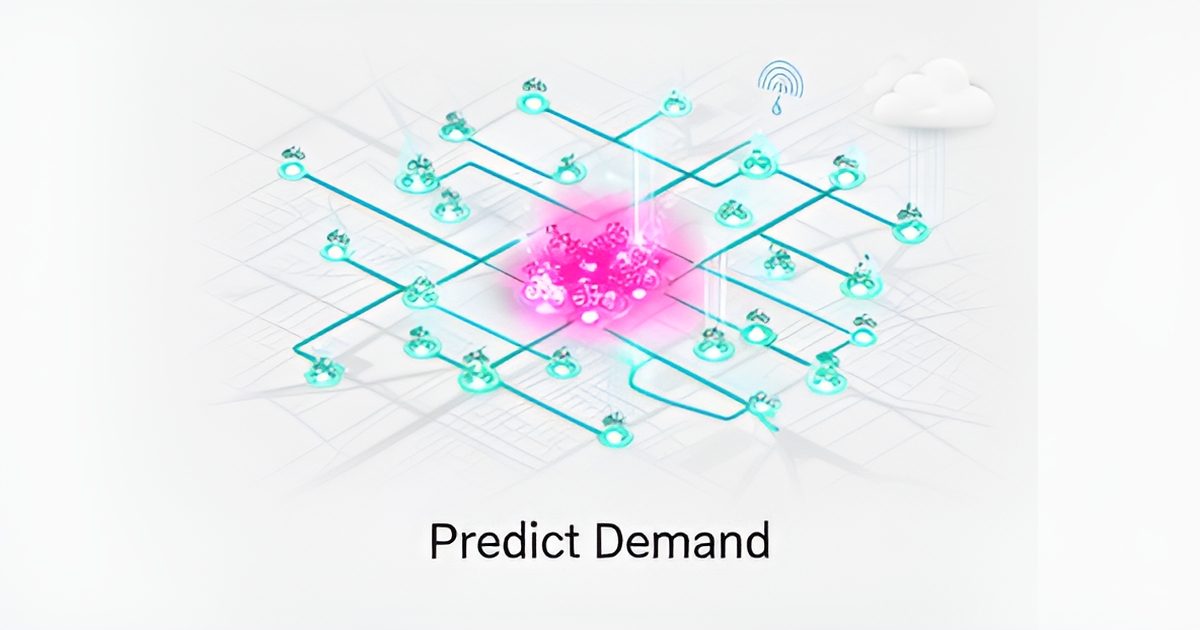
How AI Can Optimize E-Bike Availability in High-Demand Areas
Key Facts
- SmartFlow cuts network imbalance by over 95% using DQN agents trained on Citi Bike data in recent research.
- DRL rebalancing achieves significant availability failure reductions with minimal fleet size per arXiv study.
- AutoML pipeline uses Barcelona bike-sharing history to forecast demand per station in Springer research.
- OpenStreetMap travel times feed Minimum Cost Flow Problem for optimal bike redistribution per Springer study.
- Single truck routes in real time executing pick-up, drop-off and charging by spatiotemporal criticality scores according to DRL research.
- Rebalancing is modeled as Markov decision process using graph-based simulator in the DRL paper.
Hire a team member that works 24/7 — for less than a part-time wage.
AI receptionists, SDRs, dispatchers and 99+ roles. Trained on your business, fully managed.
Not sure where to start? Ask our AI planner
The Core Challenge: Why Static Rebalancing Fails E-Bike Operators
Most e-bike operators still rely on scheduled, system-wide rebalancing—trucks dispatched on fixed routes at fixed times, regardless of what's actually happening on the ground. This approach fundamentally misunderstands how urban micromobility demand behaves.
The core problem is that bike-sharing demand is inherently dynamic and spatiotemporal. Traffic congestion, sudden weather changes, and local events create demand spikes that shift by the hour and by the neighborhood. A static schedule cannot anticipate that a concert will empty a station's docks at 9 PM, or that a rainstorm will strand bikes at transit hubs while residential areas sit empty.
Research on dockless bike-sharing systems explicitly identifies these "periodic, system-wide interventions" as a limitation that modern AI must overcome. When operators wait for scheduled rebalancing windows, they inevitably miss critical moments when availability failures cascade across the network.
This mismatch creates three distinct operational failures:
- Availability failures: Users arrive to find no bikes or no open docks, directly impacting revenue and customer trust
- Spatial inequality: Wealthier, high-traffic areas receive disproportionate service while peripheral neighborhoods become "mobility deserts"
- Inflated fleet costs: Operators compensate for poor distribution by purchasing more bikes, increasing capital expenditure without solving the underlying logistics problem
The consequences are measurable. SmartFlow's analysis of New York's Citi Bike network demonstrates that traditional approaches leave networks imbalanced, while AI-driven methods can reduce that imbalance by over 95%. The study notes that dynamic systems specifically target "limiting spatial inequality and mobility deserts"—a direct acknowledgment that static rebalancing perpetuates geographic service gaps.
Static routes also ignore the compounding complexity of e-bikes. Unlike traditional bikes, e-bikes require charging, adding a battery-management layer to the availability equation. A truck following a fixed schedule might relocate bikes that don't need charging while missing depleted bikes in high-demand zones.
This is precisely the operational gap that AIQ Labs addresses through real-time AI systems. By analyzing traffic patterns, weather forecasts, and local event data, AI can predict demand fluctuations before they occur and optimize truck routes dynamically—rather than forcing operations into predetermined windows that bear little relation to actual user needs. For operators, this is typically a [workflow rebuild](/workflow-builds): identify the one rebalancing workflow that costs the most, and rebuild it as a fixed-price, phased AI project.
The shift from periodic to dynamic rebalancing isn't merely an incremental improvement. It represents a fundamental rethinking of how shared mobility systems match supply to demand in complex urban environments.
Three AI Approaches That Solve Dynamic Rebalancing
Dynamic rebalancing moves from a reactive challenge to a proactive advantage through three interconnected AI paradigms. Deep Reinforcement Learning enables real-time truck routing that responds instantly to shifting demand patterns, with research showing agents can execute localized pick-up, drop-off, and charging actions guided by spatiotemporal criticality scores to maintain optimal bike availability. This approach significantly reduces availability failures while operating with minimal fleet size, directly addressing the core pain point of e-bike shortages in high-demand zones without requiring proportional increases in operational resources.
The SmartFlow framework builds upon this foundation with a multi-layered Agentic AI architecture that bridges strategic decision-making and human execution. Its Deep Q-Network agent, trained on high-fidelity simulations of urban networks like New York's Citi Bike system, achieves over 95% reduction in network imbalance across multiple seeded runs while minimizing travel distance and maximizing truck utilization. A deterministic tactical module then optimizes multi-leg journeys for just-in-time dispatches, and an LLM-powered communication layer translates these plans into clear, actionable instructions for field teams—ensuring interpretability and eliminating the "black box" problem that often hinders AI adoption in operational settings.
Complementing these real-time systems, AutoML pipelines deliver precise demand forecasting that feeds into Minimum Cost Flow optimization for strategic redistribution. By analyzing historical usage patterns—such as those from Barcelona's public bike-sharing system—and integrating OpenStreetMap data for accurate travel time estimation, this two-staged pipeline generates feasible redistribution strategies that maximize user satisfaction. The approach demonstrates promising results in forecasting accuracy and reduced computation time, providing operators with an end-to-end framework that anticipates demand spikes before they occur. Together, these three approaches create a self-optimizing ecosystem where predictive insights inform real-time actions, and human operators execute AI-guided plans with confidence—turning fleet management from a cost center into a competitive advantage for micromobility providers operating in complex urban environments.
From Simulation to Streets: How These Systems Work in Production
The gap between a promising AI model and a working fleet of e-bikes comes down to architecture. The most effective systems treat the entire city network as a graph, where each station is a node and each trip is an edge, then cast the rebalancing challenge as a Markov decision process so the AI can learn optimal strategies through simulation.
Before any truck rolls, engineers train Deep Q-Network agents inside high-fidelity simulators built from real trip data. One framework trained on New York's Citi Bike network reduced network imbalance by over 95% across multiple seeded runs, proving that lessons learned in simulation can transfer to complex urban demand patterns.
This architecture works because it separates intelligence into three specialized layers:
- Strategic layer: The DQN agent learns long-term rebalancing policies by predicting how demand will shift across the graph
- Tactical layer: A deterministic module optimizes multi-leg journeys and schedules just-in-time dispatches to minimize fleet travel
- Communication layer: An LLM-powered agent translates routing decisions into plain-language instructions for drivers and field staff
In production, the system routes a single truck in real-time, executing localized pick-up, drop-off, and charging actions guided by spatiotemporal criticality scores. This dynamic approach achieves significant reductions in availability failures while maintaining a minimal fleet size, a crucial advantage for operators managing expensive e-bike batteries.
The tactical layer handles the math of multi-stop journeys, calculating the most efficient sequence of pickups and drop-offs. Meanwhile, the LLM-powered communication layer ensures that human operators understand exactly why the AI recommends specific actions, bridging the gap between machine optimization and street-level execution.
AIQ Labs builds these real-time operational systems for rental companies, integrating traffic patterns, weather data, and local events into the predictive models. The result is a dispatch operation where [AI employees](/ai-employees) handle the complex routing decisions—dispatchers and coordinators at a fraction of the cost of a human hire—while human staff receive clear, actionable instructions through their existing workflows.
When these components work together, operators shift from reactive scrambling to proactive positioning. E-bikes appear where riders need them before the morning rush begins, and availability failures drop even as fleet sizes stay lean.
Implementation Roadmap: Data, Training, and Continuous Optimization
Implementing AI-driven e-bike optimization requires a structured, eight-step process grounded in proven research methodologies. It begins with integrating historical usage patterns and OpenStreetMap travel time data to establish a reliable foundation for forecasting and routing decisions. Automated Machine Learning then analyzes this combined dataset to predict station-level demand with high accuracy, reducing forecasting time while improving reliability—key insights demonstrated in real-world applications like Barcelona’s bike-sharing system.
Next, the rebalancing challenge is modeled as a Markov decision process using a graph-based simulator, enabling the system to frame operational decisions within a dynamic environment. A Deep Reinforcement Learning agent is trained in this simulation through multiple seeded runs, learning policies that minimize availability failures and spatial inequality. Once trained, the agent executes real-time routing for a single truck, performing localized pick-up, drop-off, and charging actions based on spatiotemporal criticality scores.
Tactical optimization follows, where deterministic modules refine multi-leg journeys and schedule just-in-time dispatches to reduce unnecessary travel. The Minimum Cost Flow Problem is then solved using demand forecasts and network constraints to compute optimal bike redistribution strategies. Finally, an Agentic AI layer powered by a Large Language Model translates these plans into clear, actionable instructions for field teams, ensuring interpretability and execution readiness. This entire framework operates within a continuous iteration loop, where real-world performance metrics—such as network imbalance reduction and truck utilization—are fed back to refine models and improve outcomes over time. AIQ Labs applies this end-to-end methodology as a phased [AI workflow build](/workflow-builds), helping rental companies shift from reactive to proactive e-bike availability management one milestone at a time.
What This Means for Rental Operators: ROI and Competitive Edge
For e-bike rental operators, the true value of AI-driven availability optimization lies in its direct impact on the bottom line and market positioning. By shifting from reactive stocking to predictive, real-time rebalancing, operators can eliminate costly stockouts without resorting to expensive overstocking that ties up capital and increases maintenance burdens. Research shows that AI frameworks like SmartFlow can reduce network imbalance by over 95% through precise, just-in-time bike redistribution, directly translating to higher utilization rates and fewer missed revenue opportunities from unavailable bikes. This level of imbalance reduction means bikes are consistently where demand exists, turning potential lost rides into reliable service.
Operationally, the savings compound through minimized truck travel and smarter resource allocation. The DRL approach demonstrates how a single truck, guided by spatiotemporal criticality scores, can execute localized pick-up, drop-off, and charging actions in real-time—eliminating the inefficiencies of blanket, scheduled rebalancing runs. This not only cuts fuel and labor costs but also reduces fleet wear and tear. When combined with the tactical optimization layer in multi-agent systems that schedules just-in-time dispatches to shorten multi-leg journeys, operators see measurable drops in operational expenditure while maintaining or improving service coverage. These real-time routing capabilities ensure resources are deployed only where and when needed, avoiding wasteful deadheading.
Perhaps most strategically, AI enables operators to eradicate mobility deserts—areas chronically underserved due to unpredictable demand spikes or logistical complexity—without expanding fleet size. The DRL research explicitly notes that rebalancing achieves "significant reductions in availability failures with a minimal fleet size, while limiting spatial inequality and mobility deserts." This means rental companies can equitably serve high-demand zones, transit hubs, event venues, and even lower-density neighborhoods using the same assets, enhancing brand reputation and capturing market share in areas competitors overlook. The scalability of frameworks like SmartFlow, designed with clear strategic, tactical, and communication layers, ensures these benefits extend seamlessly as operators expand into new cities or districts. Such end-to-end frameworks provide the adaptability to ingest local data—like OpenStreetMap travel times or regional event calendars—and continuously refine redistribution strategies.
Critically, these outcomes are achievable not through generic subscription platforms but via custom-built AI systems that operators own outright. AIQ Labs builds production-ready, owned AI architectures—delivered as an [AI Operating System](/ai-operating-systems) built in phases—that integrate deep reinforcement learning for real-time routing, AutoML for hyperlocal demand forecasting, and agentic communication layers to guide ground teams, all tailored to the operator’s specific fleet, terrain, and service patterns. Unlike point solutions that require ongoing fees and offer limited customization, this approach delivers a sustainable competitive advantage: a proprietary AI engine that improves with use, reduces long-term costs, and positions the operator as an innovator in urban mobility. Because you own the system outright, you avoid vendor lock-in, retain full IP rights, and gain the flexibility to evolve your AI capabilities as technology advances—turning availability optimization into a core, defendable asset rather than a rented utility. See how the pricing and ownership models work on the [pricing page](/pricing).
Still paying for 10+ subscriptions that don’t talk to each other?
We build custom AI systems you own outright. No vendor lock-in. Full control.
Not sure where to start? Ask our AI planner
Frequently Asked Questions
How does AI improve e-bike availability compared to traditional rebalancing methods?
Can AI-driven rebalancing work with a minimal fleet size, or do I need more bikes and trucks?
What data does AI use to predict e-bike demand and optimize rebalancing in real time?
How does the AI explain its rebalancing decisions to human operators so they can trust and act on the recommendations?
Is AI-driven e-bike optimization only for large cities like New York, or can it work in smaller urban areas?
Does AI rebalancing account for e-bike-specific needs like battery charging, or does it treat them like regular bikes?
From Static Schedules to Dynamic Advantage: The Future of E-Bike Operations
The shift from static, scheduled rebalancing to AI-driven dynamic optimization isn't just about fixing availability gaps—it's about transforming micromobility operations into a proactive, cost-efficient advantage. By leveraging Deep Reinforcement Learning for real-time routing, AutoML for precise demand forecasting, and Agentic AI for clear human-AI collaboration, operators can reduce network imbalance by over 95% while minimizing fleet size and eliminating mobility deserts. This approach turns fleet management from a reactive cost center into a strategic asset that boosts utilization, cuts operational waste, and enhances service equity across urban networks. For rental companies ready to move beyond guesswork and into predictive, just-in-time bike redistribution, the path forward starts with understanding where AI can deliver the highest impact in your specific operations. Start with the [2-minute Fit Check](/apply) to see whether your operation is a fit, then take a free 30-minute strategy call to map your biggest bottleneck—because the future of e-bike availability isn't scheduled; it's intelligent.
Make AI your competitive advantage — not just another tool.
Strategy, implementation and ongoing optimization. One partner, end to end.
Not sure where to start? Ask our AI planner