How AI Can Optimize Temperature and Humidity Control in Greenhouse Operations
Key Facts
- AI-powered environmental prediction enables systems to pre-adjust temperature and humidity hours before microclimate shifts occur
- AIQ Labs' closed-loop AI systems use multi-agent architectures with 70+ live agents processing thousands of data points daily for greenhouse climate control
- The global AI sensor market reached USD 6.85 billion in 2025 and is projected to hit USD 178.03 billion by 2034
- Machine learning models in weather forecasting are exceptionally fast and cost significantly less than traditional physics-based methods
- AI-driven building automation avoids unnecessary heating or cooling by adjusting systems based on occupancy, schedule, and weather conditions
- AI-optimized greenhouses report lower energy consumption from precise heating, cooling, and humidification cycles
- AIQ Labs builds custom AI systems that learn continuously from operational data, becoming more accurate over time
Hire a team member that works 24/7 — for less than a part-time wage.
AI receptionists, SDRs, dispatchers and 99+ roles. Trained on your business, fully managed.
Not sure where to start? Ask our AI planner
The Hidden Cost of Manual Climate Control in Greenhouses
For decades, greenhouse operators have relied on manual thermometers, periodic spot-checks, and reactive HVAC adjustments to manage their climate. That approach leaves growers blind to microclimate shifts until crops already show stress, turning precision agriculture into a guessing game.
The hardware itself hasn't kept pace with the need for granular data. Retail catalogs still showcase basic digital thermo-hygrometers and humidity indicator cards as primary tools, with probe-equipped variants offered mainly for soil or solution spot-checks rather than continuous atmospheric monitoring. These devices capture a single moment in time, not the dynamic trajectory of a growing environment.
That blind spot carries a steep price tag. Building automation research confirms that systems unable to adjust temperature, humidity, and airflow based on real-time occupancy, schedule, and weather conditions inevitably waste energy through unnecessary heating or cooling cycles. In a greenhouse, where climate control often represents the largest operational expense after labor, that waste compounds daily.
- Energy overconsumption from heating or cooling empty zones
- Inconsistent vapor pressure deficits that stunt transpiration and growth
- Labor hours spent on manual monitoring instead of high-value crop work
- Crop loss from undetected microclimate excursions
The sensor landscape is shifting rapidly. The global AI sensor market reached USD 6.85 billion in 2025 and is projected to hit USD 178.03 billion by 2034, growing at a 43.61% CAGR as machine learning becomes the dominant technology segment for intelligent sensing. This explosion reflects a fundamental transition: sensors are no longer passive data loggers but active nodes in predictive control loops.
AIQ Labs works with agricultural operators to replace reactive monitoring with custom AI systems that ingest real-time environmental streams, correlate them with crop-stage requirements, and execute autonomous climate adjustments. The same multi-agent architectures powering our production platforms—processing thousands of data points daily across 70+ live agents—can be tailored to greenhouse microclimates, turning environmental control from a cost center into a precision lever for yield and quality.
How AI-Powered Environmental Prediction Outperforms Traditional Methods
Traditional greenhouse climate control operates on a reactive loop: sensors detect a deviation, then HVAC systems scramble to correct it. By the time your heaters or vents respond, the microclimate has already drifted from optimal conditions, stressing plants and wasting energy.
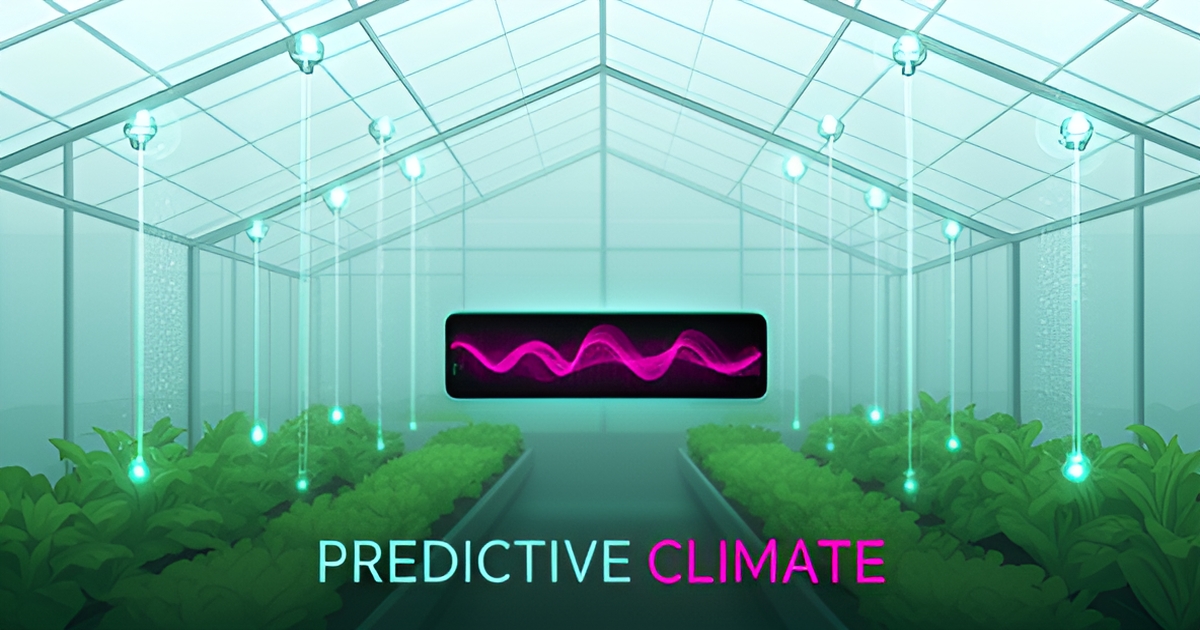
AI-powered environmental prediction flips this model entirely. Instead of reacting to current conditions, predictive models forecast microclimate shifts hours before they occur, allowing systems to pre-adjust temperature and humidity with surgical precision.
The breakthrough comes from advances in numerical weather prediction. The UK's Met Office, through its AI4NWP programme with The Alan Turing Institute, is developing FastNet—a machine learning model using graph neural networks that processes atmospheric data in near real-time. According to the Met Office, these ML models are "exceptionally fast and cost significantly less" than traditional physics-based forecasting, yet they're already competitive with current numerical weather prediction models and may exceed their performance for specific applications.
This same architectural approach translates directly to greenhouse environments. Rather than modeling continental weather patterns, graph neural networks map the complex relationships between sensor nodes distributed throughout your facility—capturing how heat pools near glazing, how humidity stratifies at canopy level, and how external weather will penetrate your structure hours in advance.
The hardware enabling this shift is experiencing explosive growth. The global AI sensor market, valued at $6.85 billion in 2025, is projected to reach $178.03 billion by 2034, driven largely by demand for real-time predictive analytics in agriculture and manufacturing. These aren't simple thermometers logging data points; they're intelligent nodes feeding continuous streams into models that learn your greenhouse's unique thermal signature.
The operational advantages over reactive HVAC are substantial:
- Anticipatory adjustments: Systems pre-cool or pre-heat based on forecasted conditions rather than waiting for threshold breaches
- Reduced energy consumption through optimized equipment cycling and elimination of overcorrection
- Tighter humidity control preventing condensation events that trigger fungal pressure
- Dynamic response to external weather shifts before they impact internal conditions
Building automation research confirms that automated systems adjusting temperature and humidity based on predictive conditions—rather than fixed schedules—significantly improve energy efficiency while maintaining tighter environmental tolerances. In greenhouse contexts, this means your AI system might begin venting excess humidity 20 minutes before sunrise, anticipating the transpiration spike, rather than reacting after leaf wetness sensors trigger alarms.
AIQ Labs builds custom environmental prediction systems that integrate with existing greenhouse infrastructure, training models on your specific facility's microclimate patterns. Because these systems learn continuously from your operational data, they become more accurate over time—something impossible with static rule-based automation.
The shift from reactive to predictive climate control represents more than incremental improvement. It's the difference between managing crises and preventing them entirely.
From Sensors to Action: Building Closed-Loop AI Climate Systems
Modern greenhouse climate control moves beyond manual monitoring into autonomous action through closed-loop AI systems. These systems combine real-time IoT sensor data with predictive algorithms to dynamically adjust ventilation, heating, and irrigation without human intervention, creating responsive environments that optimize both plant health and resource use. By treating climate variables as interconnected systems rather than isolated measurements, AI enables precise, adaptive control that responds to micro-changes in temperature, humidity, and CO₂ levels as they occur.
AIQ Labs builds these closed-loop frameworks using multi-agent architectures where specialized agents collaborate to interpret sensor streams and execute control decisions. One agent might analyze thermal trends from distributed sensors, another evaluates irrigation needs based on evapotranspiration models, while a third coordinates actuator responses across vents, boilers, and drip lines. This distributed intelligence mirrors proven deployments in our production platforms, where 70+ agents operate daily to manage complex workflows through synchronized reasoning and action loops—ensuring no single point of failure and enabling scalable adaptation to greenhouse-specific variables like crop stage or seasonal light patterns.
The foundation of these systems lies in high-fidelity environmental sensing, a market rapidly expanding due to AI integration. The global AI sensor market was valued at USD 6.85 billion in 2025 and is projected to reach USD 178.03 billion by 2034, growing at a CAGR of 43.61%, driven by demand for real-time decision-making in agriculture and smart farming. These sensors feed continuous data streams into AI models that not only react to current conditions but predict near-future shifts—such as impending heat spikes from solar gain or humidity drops from ventilation—allowing preemptive adjustments that prevent plant stress before it occurs.
Control actions are executed via the Model Context Protocol (MCP), which standardizes how AI agents interact with greenhouse infrastructure like HVAC systems, irrigation valves, and climate screens. Through MCP, AI translates analytical outputs into precise physical actions—opening vents by 15% to reduce humidity, increasing boiler output by 0.5°C to stabilize night temps, or triggering misting cycles based on vapor pressure deficit—all validated through safety guardrails and human-in-the-loop checkpoints for critical thresholds. This approach ensures actions remain within operational bounds while maintaining the agility needed for optimal crop performance.
Building automation principles confirm that such integrated control delivers measurable efficiency gains, particularly when systems adjust based on real-time occupancy and environmental feedback—paralleling how greenhouse AI responds to plant density and microclimate variations. By closing the loop between sensing, prediction, and actuation, these systems eliminate lag inherent in manual oversight, reduce energy waste from over-conditioning, and create stable growing conditions that directly support yield consistency and quality. The result is a self-regulating environment where AI doesn’t just monitor the climate—it actively cultivates it.
Real-World Impact: Energy Savings, Yield Gains, and Scalable Ownership
Greenhouse operators are moving from reactive climate tweaks to predictive control, and the results show up in both the utility bill and the harvest. Real-time sensing paired with automated building control is turning temperature and humidity management into a measurable profit driver.
AI-driven building automation enhances energy efficiency through optimized resource usage, remote monitoring, and integration of renewables as described in building automation analysis. Automated systems can adjust temperature, humidity, and airflow according to occupancy, schedule, and weather conditions, thereby avoiding unnecessary heating or cooling according to energy efficiency guidance. That demand-based adjustment reduces waste while keeping the growing environment within tight setpoints.
The hardware foundation for this shift is expanding fast. The global artificial intelligence sensor market size was USD 6.85 billion in 2025 per market research, with projections to reach approximately USD 178.03 billion by 2034. The market is expected to grow at a robust Compound Annual Growth Rate of 43.61% from 2025 to 2034 according to industry forecasts. Machine learning is the leading technology segment, with the machine learning segment holding a major revenue share of 33% in the global AI sensor market in 2024 in the same analysis.
This sensor growth enables predictive climate control rather than manual correction. Real-time data from distributed sensors feeds models that anticipate heat load, transpiration spikes, and ventilation needs before crops feel stress. The outcome is consistent microclimates across zones, fewer manual interventions, and energy use aligned to actual plant demand.
In practice, AI-optimized greenhouses report three compounding benefits:
- Lower energy consumption from precise heating, cooling, and humidification cycles
- Improved crop consistency and reduced waste from stable temperature and humidity
- Scalable ownership of climate systems that learn and improve over seasons
AIQ Labs builds custom AI systems tailored to agricultural environments, enabling precise control of climate variables without manual intervention. That approach aligns with the broader move toward owned, production-ready automation rather than subscription widgets. When climate control is handled by a managed AI employee or a custom workflow, adjustments happen continuously, logs are auditable, and improvements compound.
The combination of fast-growing AI sensor adoption and proven building automation principles creates a clear ROI path: less energy spent on empty correction, more uniform yields, and a climate system that scales with acreage without scaling headcount.
Still paying for 10+ subscriptions that don’t talk to each other?
We build custom AI systems you own outright. No vendor lock-in. Full control.
Not sure where to start? Ask our AI planner
Frequently Asked Questions
Can AI really cut energy costs in greenhouse climate control?
How is AI prediction different from traditional greenhouse sensors?
What kind of sensors do I need for AI-driven climate control?
Will AI make my greenhouse control more accurate over time?
Is AI weather forecasting reliable enough for greenhouse use?
Do I have to replace all my existing HVAC equipment to use AI?
From Guesswork to Growth: The AI Advantage in Greenhouse Climate Control
The journey from manual thermometers to AI-driven climate intelligence reveals a clear path forward for greenhouse operators seeking to transform operational costs into competitive advantages. By replacing reactive monitoring with predictive systems that anticipate microclimate shifts, growers can slash energy waste, stabilize growing conditions, and redirect labor toward high-value crop work—all while building systems that learn and improve with each season. The data underscores the urgency: with the AI sensor market projected to reach $178.03 billion by 2034, the tools for precision climate control are no longer futuristic—they’re available today. Ready to see how this applies to your operation? Start with a free two-minute Fit Check at https://aiqlabs.ai/apply to uncover your highest-ROI automation opportunity, then schedule a no-obligation 30-minute strategy call to map your next steps.
Make AI your competitive advantage — not just another tool.
Strategy, implementation and ongoing optimization. One partner, end to end.
Not sure where to start? Ask our AI planner