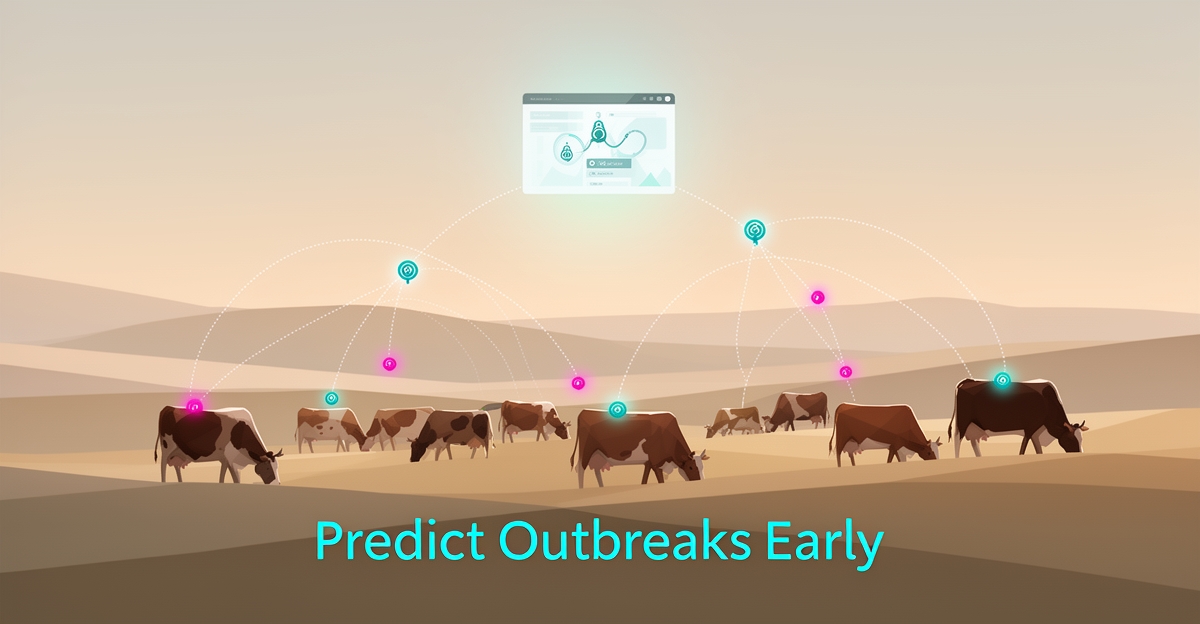
How AI Can Predict Disease Outbreaks on a Cattle Ranch
Hire a team member that works 24/7 — for less than a part-time wage.
AI receptionists, SDRs, dispatchers and 99+ roles. Trained on your business, fully managed.
Not sure where to start? Ask our AI planner
Why Traditional Disease Monitoring Fails on Cattle Ranches
Traditional reactive monitoring waits for visible symptoms, and by then the outbreak is already spreading across the herd. Ranch managers rely on visual checks, sporadic vet visits, and paper logs, which creates blind spots between observations.
Delayed detection drives costly losses because treatment starts late and containment fails. Across agricultural AI projects, a consistent pattern shows up: these systems rarely fail because the algorithms are bad. They fail because the data is incomplete, inconsistent, or irrelevant.
Data quality, not volume, is the core bottleneck. Agricultural AI deployments typically draw on three input types—image-based datasets, sensor data, and farmer logs and notes. Without consistent collection across those sources, models cannot learn reliable patterns.
Ranches face three persistent gaps that keep monitoring reactive:
- Fragmented records where health notes, behavior observations, and environmental readings live in separate systems
- Inconsistent data capture with single-season, poorly labeled imagery instead of multi-season, multi-location datasets
- Lack of real-time integration between animal behavior, environmental conditions, and historical health records
Field validation matters more than data volume. Research on AI adoption in agriculture consistently emphasizes that data consistency beats data volume, and that fixing the data collection pipeline resolves the majority of AI problems before a single model is tuned.
Wireless sensor networks highlight the technical challenge. Cattle farming environments pose unique challenges for wireless sensor networks due to their dynamic nature and large-scale spatial requirements. Published research on integrated localization and proactive disease forecasting systems has reported mean localization errors in the low single digits for both anchor and sensor nodes.
When localization is reliable, prediction improves dramatically. Systems using exploration-enhanced multi-agent learning on precise location data have reported disease prediction accuracy as high as 98% in research settings—well above what reactive inspection-based approaches can achieve.
This is why predictive systems start with ranch-specific data foundations. AIQ Labs builds custom AI models trained on ranch-specific data to provide proactive alerts, focusing first on building consistent multi-modal inputs before scaling complexity. For operations that want a single workflow rebuilt end to end, a phased AI Workflow Build is often the fastest entry point.
Practical adoption requires simple, targeted tools that integrate into existing operations. Adoption guidance shows successful implementation moves from simple tools to complex systems, with training and trust building along the way.
Without that foundation, even advanced algorithms remain blind. Proactive disease forecasting depends on continuous, high-quality data streams rather than occasional inspections.
The shift from reactive to predictive is a data problem first, and an AI problem second.
How AI Integrates Multi-Source Data for Early Disease Prediction
Early warning on a cattle ranch starts long before a veterinarian sees fever. AI connects the dots between what animals do, what the environment measures, and what the records say.
Multi-source data integration is the foundation. Effective agricultural AI combines three primary data sources in a consistent pipeline: image-based datasets, sensor data, and farmer logs and notes. Image-based inputs tend to dominate by volume because they are continuous and non-invasive, but all three streams matter.
Images capture behavior and physical signs. Cameras and drones record posture, feeding patterns, social grouping, and coughing or nasal discharge. These visual signals are typically the largest input stream. Sensor data adds the environmental context. Wearables, ear tags, and wireless sensor networks track temperature, respiration rate, activity levels, and location. Environmental sensors monitor barn humidity, temperature, and air quality.
Historical health records provide the baseline. Farmer logs and notes, though the smallest input by volume, anchor predictions in ranch-specific history. Vaccination dates, previous outbreaks, treatment responses, and breeding cycles make the model ranch-aware rather than generic.
Published research frameworks demonstrate how integration works in practice. Systems combining anchor node localization with exploration-enhanced multi-agent reinforcement learning have reported localization errors in the low single digits and disease prediction accuracy reaching 98% in evaluation—outperforming methods that rely on location data alone or on periodic observation.
Data consistency beats volume. Agricultural AI research consistently finds that these systems fail because data is incomplete or inconsistent, not because algorithms are weak. Multi-season, multi-location datasets rank as most valuable for training.
For ranch operators, this means building a pipeline that is simple, targeted, and maintained. AIQ Labs builds custom models trained on ranch-specific data to provide proactive alerts and reduce loss, focusing on data quality over complexity.
A practical multi-modal setup typically includes:
- Image streams from barn cameras and pasture drones for behavior and visual symptom detection
- Wearable and environmental sensors for real-time physiological and climate data
- Digitized health logs and treatment records for historical context and validation
When these streams are fused, the system can localize animals with high precision and forecast risk before clinical signs spread. Localization enables forecasting, and forecasting enables intervention.
The result is earlier containment, fewer treatments, and less disruption to herd productivity.
Implementing AI Disease Prediction: A Rancher’s Step-by-Step Guide
Starting small with focused data collection builds the foundation for reliable AI disease prediction on cattle ranches. Experience across agricultural AI deployments shows that data quality—not algorithm complexity—determines success, with inconsistent or incomplete data causing most failures. Ranchers should begin by establishing consistent protocols for capturing the three core data streams: visual observations from regular herd checks, environmental sensor readings, and standardized health log entries.
A practical implementation follows a phased approach. First, deploy simple monitoring tools targeting specific disease indicators like changes in feeding behavior, movement patterns, or social interactions. Second, integrate these data streams into a unified pipeline that maintains consistency across seasons and locations—critical for model accuracy. Third, validate predictions through field observations before scaling the system, ensuring alerts correspond to real-world health events.
AIQ Labs supports this progression in two ways. AI Employees act as managed digital staff that process incoming data streams around the clock, apply predictive models trained on your specific herd history, and deliver proactive alerts through the communication channels you already use—at a fraction of the cost of adding human monitoring staff. For ranches ready to connect monitoring, records, and alerting into one system, a phased AI Operating System ties the pieces together into a single layer you own outright.
By focusing on targeted problem-solving rather than complex system overhauls, ranchers achieve measurable improvements in disease prevention while building confidence in AI-driven decision-making. Start with the 2-minute Fit Check, and if there’s a fit, book a free 30-minute strategy call to assess your ranch’s readiness for AI-powered disease prediction.
Still paying for 10+ subscriptions that don’t talk to each other?
We build custom AI systems you own outright. No vendor lock-in. Full control.
Not sure where to start? Ask our AI planner
Frequently Asked Questions
Why does traditional disease monitoring fail on cattle ranches?
What is the main bottleneck for AI implementation in agriculture?
What data sources are most important for AI disease prediction on cattle ranches?
How accurate can AI be at predicting disease outbreaks when data is properly integrated?
What is the recommended first step for ranchers wanting to implement AI disease prediction?
How does AIQ Labs support ranchers in adopting AI for disease prediction?
Turning Data Into Early Warning on the Ranch
AI disease prediction on cattle ranches isn’t about chasing the latest algorithm—it’s about building a reliable data foundation. Success starts with consistent, multi-modal inputs: image streams capturing behavior, sensor data tracking physiology and environment, and digitized health logs providing historical context. When these streams are fused with precision localization, research systems have demonstrated early warnings reaching up to 98% accuracy, enabling intervention before clinical signs spread. For ranchers, this means fewer outbreaks, reduced treatment costs, and more stable herd productivity—all rooted in better data collection, not more complex AI. The path forward is practical: begin with targeted tools that fit existing routines, validate predictions in the field, and scale only when the data pipeline is trustworthy. To see how this approach applies to your operation, start the 2-minute Fit Check and book a free 30-minute strategy call with the AIQ Labs team.
Make AI your competitive advantage — not just another tool.
Strategy, implementation and ongoing optimization. One partner, end to end.
Not sure where to start? Ask our AI planner