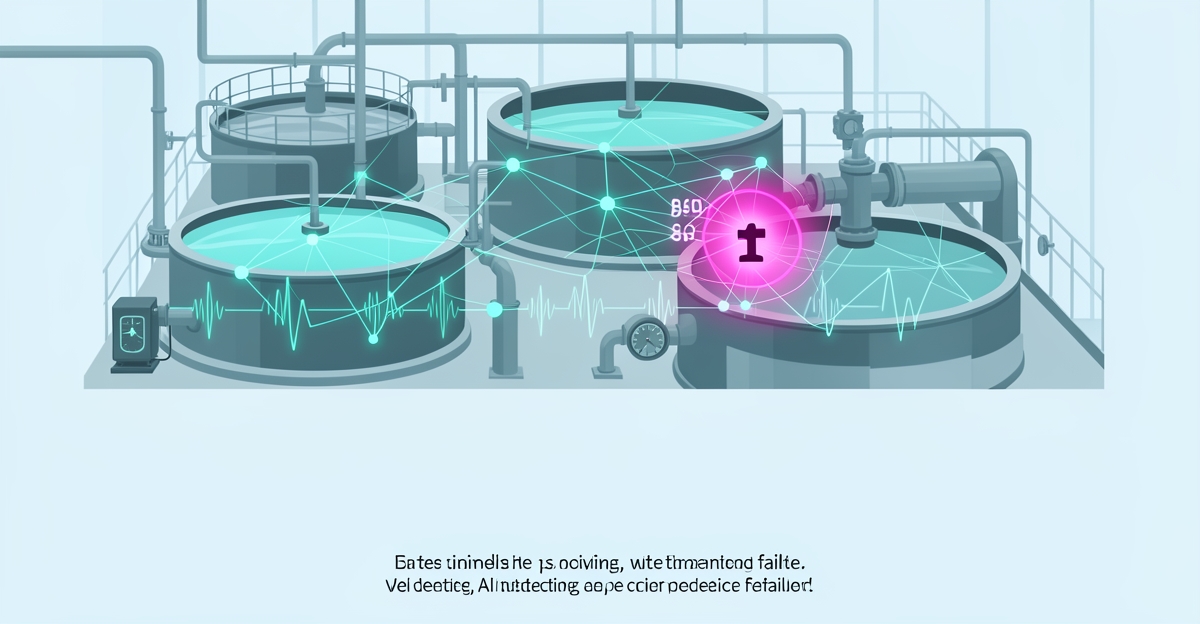
How AI Can Predict Equipment Failure in Water Treatment Plants
Key Facts
- AI-driven failure prediction systems can reduce unplanned downtime by 50-70%, according to industry research.
- A wastewater treatment facility reported roughly $45,000 in savings through AI-driven failure prediction, a documented case study shows.
- One program shifting 200 critical assets to ML-driven predictive maintenance reported a 69% cost reduction, a practical guide notes.
- Machine learning models can predict equipment failures with high accuracy in the majority of well-instrumented cases, according to a practical guide.
- Utilities typically need 1-2 years to achieve high-confidence prediction systems, industry research notes.
- Initial false alarm rates can run 30-50% during system learning phases, utility studies show.
- Most utilities require 6-12 months of data gathering just to establish baseline equipment behavior, analysis confirms.
Hire a team member that works 24/7 — for less than a part-time wage.
AI receptionists, SDRs, dispatchers and 99+ roles. Trained on your business, fully managed.
Not sure where to start? Ask our AI planner
The High Cost of Reactive Maintenance in Water Treatment
Unplanned equipment failures in water treatment don’t just stop pumps, they stop service. When critical assets fail without warning, operators are forced into emergency response mode with limited visibility and rising risk.
Reactive maintenance remains the default for many plants because it feels controllable. In practice, it creates a cycle of disruption that is expensive to break. Industry research indicates AI-driven failure prediction systems can reduce unplanned downtime by 50-70%, underscoring how much downtime is preventable with foresight.
The financial impact compounds quickly. Emergency repairs carry premium labor rates, expedited parts, and overtime. A wastewater treatment facility case study documented roughly $45,000 saved through AI-driven failure prediction, a direct result of avoiding unplanned events. A program shifting 200 critical assets to ML-driven predictive maintenance reported a 69% cost reduction.
Beyond cost, reactive models create operational and compliance exposure. Service disruptions can affect public health and regulatory reporting. Unplanned downtime forces crews to triage, often deferring preventive work and accelerating asset degradation.
Typical consequences of a reactive approach include:
- Emergency repair costs and overtime labor that exceed planned maintenance budgets
- Service interruptions and reduced treatment capacity during peak demand
- Compliance risk from missed discharge limits or reporting failures
- Shortened asset life from repeated shock loading and deferred care
The problem is also cultural. Teams become accustomed to “run-to-failure” because historical data is sparse and sensor coverage is uneven. Analysis of water utilities notes the adage “garbage in, garbage out” applies forcefully to AI prediction systems, which is why data readiness matters before any model is deployed.
This is where predictive analytics changes the equation. AI models analyze sensor data to forecast equipment failures before they happen, reducing downtime and repair costs. AIQ Labs builds predictive systems that integrate with existing plant monitoring tools to provide proactive alerts and maintenance recommendations, typically as an AI Workflow Build targeting the maintenance workflow that costs you the most. This supports a shift from firefighting to planned intervention.
Without that shift, plants remain exposed to the high cost of waiting for failure.
How AI Translates Sensor Data into Actionable Forewarnings
A pump doesn't fail without warning, it whispers first through rising vibration, drifting temperatures, and subtle pressure changes that human operators can't monitor across hundreds of assets simultaneously. AI models listen to those whispers, turning streams of raw sensor data into forewarnings that arrive days or weeks before a breakdown.
According to research on AI-driven failure predictions for water systems, these systems analyze data from sensors on critical equipment to identify patterns that precede breakdowns. But how does that pattern recognition actually work? Current approaches rely on three primary machine learning methods, each suited to different data conditions and failure modes.
- Anomaly detection learns what "normal" looks like for each asset, then flags deviations, like a motor drawing slightly more current than usual, that signal something is changing.
- Supervised learning trains on historical examples of past failures, recognizing the specific sensor signatures that appeared before breakdowns so it can spot them again.
- Trend analytics with dynamic thresholds tracks gradual degradation over time, adjusting alert thresholds to account for normal operating variability instead of relying on fixed alarm limits.
These methods deliver real results when applied well. One practical guide to machine learning for equipment failure prediction reports that shifting 200 critical assets to ML-driven predictive maintenance achieved a 69% cost reduction, and that machine learning models can predict equipment failures with high accuracy in the majority of well-instrumented cases. A wastewater treatment facility, meanwhile, reported roughly $45,000 saved through AI-driven failure prediction alone.
The catch is that these models aren't magic, they're pattern matchers, and their accuracy depends entirely on the data feeding them. Water and wastewater systems operate under highly variable conditions, which can confound predictive models. One wastewater case study found it "extremely difficult" to get a clear indication for cleaning aeration equipment because so many variables, pH, temperature, time of day, influence the readings.
That's why implementation matters as much as the algorithm. Most utilities report needing a minimum of six to 12 months of data gathering just to establish baseline equipment behavior, and full deployment typically takes 1-2 years to reach high-confidence predictions. During the learning phase, initial false alarm rates can run 30-50% as models calibrate against real-world conditions.
This is also where integration architecture makes or breaks the project. Predictive AI systems need to connect with a plant's existing monitoring tools, SCADA data, sensor networks, maintenance logs, rather than replace them, delivering proactive alerts and maintenance recommendations through channels operators already use. AIQ Labs focuses on exactly this: building predictive analytics that integrates with current plant infrastructure so sensor data flows into actionable forecasts without disrupting operations.
The takeaway: the three ML approaches are proven, but the real work lies in clean data, realistic timelines, and integration that turns model output into decisions operators can act on.
The Reality Check: Overcoming Data and Implementation Hurdles
The promise of AI predicting equipment failures in water treatment plants often overlooks a fundamental truth: the quality of the prediction is only as good as the data feeding it. Many utilities grapple with historical sensor data that is incomplete, inconsistently recorded, or lacks the granularity needed for reliable model training, directly invoking the "garbage in, garbage out" principle. This data deficiency is a primary reason why achieving accurate predictions requires significant upfront effort rather than instant deployment.
Compounding this data challenge is the inherent complexity of water systems themselves. Equipment behavior is influenced by a multitude of fluctuating variables, such as flow rate, chemical composition, temperature, and time of day, which can obscure the subtle signals predictive models seek to detect. As noted in utility case studies, isolating failure precursors amidst this noise can be "extremely difficult," demanding sophisticated modeling approaches that go beyond simple pattern recognition. This complexity necessitates a tailored, iterative process rather than a one-size-fits-all solution.
Furthermore, organizations must confront the reality of implementation timelines and initial system performance. Deploying a trustworthy predictive maintenance system typically requires 1-2 years of data collection, integration, and model refinement to reach high confidence, far exceeding the "set it and forget it" expectations sometimes marketed. During the initial learning phases, it is common to experience 30-50% false alarm rates as the system calibrates to distinguish true failure precursors from normal operational variance. Navigating these hurdles successfully demands a partner with deep expertise in both AI modeling and the specific operational realities of water treatment infrastructure. AIQ Labs approaches these challenges as inherent parts of the journey, focusing on robust data preparation, context-aware model development, and realistic expectation-setting to build systems that deliver sustained value over time. Industry research confirms that addressing these factors head-on is critical for long-term success. Practical guides show that overcoming initial false alarms and data gaps is where true predictive capability is forged. Real-world implementations underscore that patience and precision in the early stages yield the most reliable outcomes.
A Phased Blueprint for Deploying Predictive Maintenance
The journey to reliable AI-driven failure prediction begins long before the first alert fires. It requires a disciplined, phased approach that respects the timeline realities of data gathering, model training, and system validation, especially in complex environments like water treatment plants where equipment behavior is influenced by countless variables.
Most utilities report needing a minimum of six to 12 months of data gathering just to establish baseline equipment behavior, as sensor readings must capture normal operational patterns across seasonal shifts, flow variations, and maintenance cycles. This foundational phase is not optional; without clean, consistent, and sufficiently historical data, even the most advanced models will produce unreliable predictions. AIQ Labs supports this critical start by assessing existing sensor infrastructure, identifying data gaps, and designing integration strategies that work with legacy systems, ensuring the data pipeline is robust before any model is built.
Once baseline data is secured, the next phase involves selecting and training the appropriate machine learning approach, whether anomaly detection, supervised learning, or trend analytics with dynamic thresholds, based on the specific failure modes of critical assets like pumps, blowers, or valves. During this stage, it's common to see initial false alarm rates of 30-50% as the model learns to distinguish true precursors from normal operational noise. Rather than treating these as failures, AIQ Labs treats them as essential feedback, refining thresholds and feature engineering to improve precision without sacrificing sensitivity. This iterative tuning is where domain expertise meets data science, transforming raw alerts into actionable insights.
Achieving a high-confidence, reliable prediction system typically takes 1-2 years, but the payoff is substantial: utilities that persist through this journey have reported unplanned downtime reductions of 50-70% and savings like the roughly $45,000 realized by one wastewater facility through timely interventions. The key is not speed, but steadiness, building trust in the system through transparency, continuous validation, and close collaboration between AI engineers and plant operators who know the equipment best. When done right, predictive maintenance doesn’t just forecast failures; it transforms maintenance from a reactive cost center into a strategic advantage. AI-Driven Asset Failure Prediction in Water Utilities reports that shifting to ML-driven predictive maintenance can yield a 69% cost reduction on critical assets, evidence that patience and precision in implementation deliver real, measurable value.
From Prediction to Profit: The ROI of AI-Driven Maintenance
AI-driven failure prediction transforms maintenance from a cost center into a strategic advantage by preventing breakdowns before they disrupt operations. According to industry research, these systems can reduce unplanned downtime by 50-70%, directly protecting production schedules and service reliability. One wastewater treatment facility documented roughly $45,000 in savings through early intervention enabled by predictive analytics.
Beyond immediate cost avoidance, shifting to predictive maintenance extends asset life and optimizes resource allocation. A practical guide to ML failure prediction highlights a 69% cost reduction when 200 critical assets were transitioned to machine learning-driven maintenance, demonstrating substantial long-term financial impact. These savings stem from fewer emergency repairs, optimized labor deployment, and minimized premature equipment replacement.
- Reported unplanned downtime reductions of 50-70%
- Roughly $45,000 in documented savings at one facility
- A reported 69% maintenance cost reduction through ML-driven asset management
- Extended equipment lifespan through timely interventions
- Optimized maintenance scheduling and parts inventory
While implementation requires careful data preparation and typically 1-2 years to achieve high-confidence predictions, as noted in utility sector studies, the ROI trajectory becomes clear once systems mature. AIQ Labs helps water treatment facilities navigate this journey through fixed-price, milestone-based builds that integrate with existing SCADA and sensor infrastructure, turning failure prediction into measurable profit. To explore how AI-driven maintenance can deliver specific financial benefits for your operation, start the 2-minute Fit Check to assess your readiness and identify high-ROI automation opportunities.
Still paying for 10+ subscriptions that don’t talk to each other?
We build custom AI systems you own outright. No vendor lock-in. Full control.
Not sure where to start? Ask our AI planner
Frequently Asked Questions
How much can AI-driven failure prediction reduce unplanned downtime in water treatment plants?
What kind of cost savings have water treatment facilities seen from using AI for equipment failure prediction?
How long does it typically take to deploy a reliable AI-based predictive maintenance system in a water treatment plant?
What are the initial false alarm rates when deploying AI failure prediction systems, and why do they happen?
What are the three main machine learning methods used in AI-driven equipment failure prediction for water systems?
Why is data quality so important for AI prediction systems in water treatment plants?
Key Takeaways
The Shift from Firefighting to Foresight. Water treatment plants don't need more alarms, they need earlier ones. The reported results are consistent: AI-driven failure prediction can cut unplanned downtime by 50-70% and deliver measurable savings, but only when built on clean sensor data, realistic timelines, and integration with the systems operators already trust. If a failing pump or blower is your single most expensive workflow, a phased build is the fastest path from prediction to profit. Start with the free Fit Check to see where your plant stands.
Make AI your competitive advantage — not just another tool.
Strategy, implementation and ongoing optimization. One partner, end to end.
Not sure where to start? Ask our AI planner