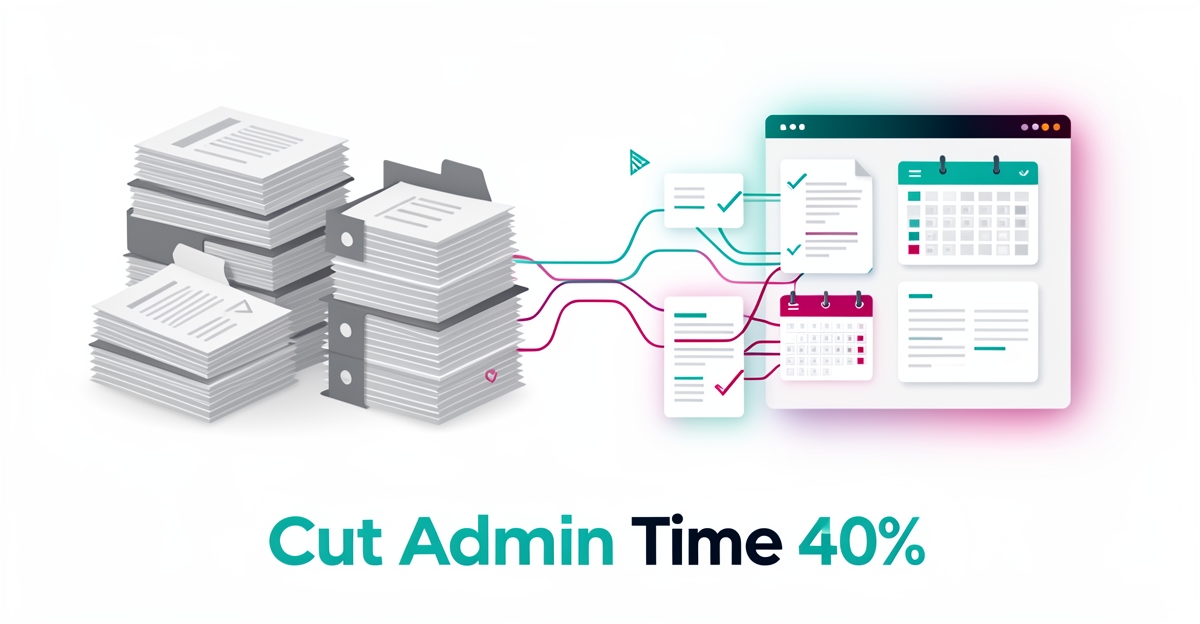
How AI Can Reduce Administrative Burden in GLP-1 Clinic Operations
Key Facts
- Physicians commonly spend close to half of their workday on administrative tasks rather than patient care, according to industry research
- AI-powered automation can typically reduce administrative time requirements by 40-60% in GLP-1 clinic settings per medical administrative automation research
- AI-powered claims processing can often reduce claim denials by 30-40% through cleaner data at intake and automated claims scrubbing per revenue cycle automation findings
- In a five-provider GLP-1 practice, a 40-60% administrative time reduction is roughly equivalent to eliminating 2-3 full-time positions worth of routine work per industry analysis
- AI-powered clinical documentation automation can reduce charting time by 50-75% through intelligent note generation per research on clinical documentation automation
- Automated insurance verification reduces manual eligibility checks and denial risk while improving front-office efficiency per front office automation guidance
- Smart intake forms pre-populate charts and flag missing data before patient arrival to streamline clinical workflows per operational findings on AI intake automation
Hire a team member that works 24/7 — for less than a part-time wage.
AI receptionists, SDRs, dispatchers and 99+ roles. Trained on your business, fully managed.
Not sure where to start? Ask our AI planner
The Hidden Cost of GLP-1 Administrative Overload
GLP-1 clinics are hitting an operational ceiling, and the bottleneck isn't clinical capacity, it's paperwork. Physicians commonly spend close to half of their workday on administrative tasks rather than patient care, according to industry research. In a typical five-provider practice, that burden consumes the equivalent of two to three full-time employees just to keep up with verification, authorizations, and form processing.
Insurance verification alone creates a daily logjam. Staff must navigate payer portals, confirm coverage criteria, and document medical necessity for every prescription, often repeating the process when denials trigger appeals. Prior authorizations add another layer of friction, with each request typically consuming 15–20 minutes of phone time and follow-up. Multiply that by dozens of patients weekly, and the administrative load crowds out appointments, delays treatment starts, and drives overtime costs.
- Insurance verification across multiple payer portals with shifting formularies
- Prior authorization submissions, appeals, and peer-to-peer scheduling
- Patient intake forms, consent documentation, and compliance tracking
- Appointment confirmations, reminder sequences, and no-show management
- Claims submission, denial management, and revenue reconciliation
The financial impact compounds quickly. Claim denials tied to administrative errors or incomplete documentation cost practices thousands monthly, while research suggests AI-powered automation can often reduce denials by 30–40%. Staff burnout follows the same curve, turnover in front-office roles spikes when workloads exceed sustainable thresholds, forcing clinics into expensive recruiting cycles.
AIQ Labs works with healthcare operators to map these exact workflows and identify where AI-driven automation can eliminate manual handoffs without disrupting clinical protocols. The goal isn't to replace staff, it's to redirect their time toward the work that actually moves patient outcomes forward.
Automating the Front Office: Intake, Verification, and Scheduling
The front desk is where GLP-1 clinic capacity is won or lost. Every manual insurance check, paper intake form, and phone tag for confirmations pulls staff away from patient care and creates delays that ripple through the day.
AI-powered front office automation directly targets those repetitive touchpoints. By automating insurance verification, intake forms, and appointment confirmation, clinics can free clinical staff to focus on patient success. Medical administrative automation research suggests AI can reduce administrative time requirements by 40-60% in practice settings.
That reduction matters because industry analysis finds roughly half of physicians' workday is spent on administrative tasks rather than patient care. In a 5-provider GLP-1 practice, a 40-60% cut is roughly equivalent to eliminating 2-3 full-time positions worth of routine work without reducing coverage.
Intelligent document processing is the engine. AI extracts data from insurance cards, prior authorizations, and medical forms with high accuracy, then validates coverage in real time. Conversational AI handles the human side: scheduling, rescheduling, and reminders via phone, SMS, and chat without human intervention.
Front office automation delivers measurable operational gains:
- Automated insurance verification reduces manual eligibility checks and denial risk
- Smart intake forms pre-populate charts and flag missing data before arrival
- Conversational scheduling and reminders cut no-shows and phone volume
- Document processing extracts key fields from cards and forms for clean records
The impact extends beyond time saved. Front office automation guidance notes AI can improve patient satisfaction through automated appointment scheduling and reminders, while revenue cycle benefits often include a 30-40% reduction in claim denials through cleaner data at intake.
For GLP-1 clinics managing high patient volume and complex prior authorization workflows, intelligent automation of intake and scheduling removes the repetitive burden that drives staff burnout. AIQ Labs tackles this through AI Workflow Builds, rebuilding the one workflow that costs your clinic the most, at a fixed price and in phases, and through AI Employees that handle front-office tasks like scheduling and verification at a fraction of the cost of a human hire.
Clinics that automate verification, forms, and confirmations gain faster access, fewer errors, and staff who can stay focused on clinical care rather than paperwork.
Streamlining Revenue Cycle and Clinical Documentation
Revenue cycle management and clinical documentation represent two of the most significant administrative drains on GLP-1 clinic operations, directly impacting both financial health and provider satisfaction. AI-powered automation is transforming these areas by reducing claim denials and cutting charting time through intelligent, end-to-end workflow optimization.
Automated claims scrubbing and denial management systems can often reduce claim denials by 30-40%, directly improving cash flow and reducing the administrative burden of rework and appeals. This improvement stems from AI's ability to identify coding errors, missing documentation, and payer-specific rules before submission, ensuring cleaner claims and faster reimbursement cycles. Clinics using these tools typically report fewer delays in payment and stronger financial predictability.
AI-powered clinical documentation automation can reduce charting time by 50-75% through intelligent note generation and automated coding, freeing providers to focus on patient care rather than paperwork. This efficiency gain not only improves provider satisfaction but also increases clinical capacity without adding staff. By integrating with electronic health records and billing systems, these tools create a seamless flow from encounter to reimbursement.
- Automated insurance verification reduces front-office workload and minimizes eligibility-related denials
- Real-time claim status tracking enables proactive follow-up and faster resolution of payment issues
- AI-driven coding assistance improves accuracy and reduces audit risk through contextual documentation support
- Automated patient statements and payment reminders decrease days in accounts receivable
- Predictive denial analytics identify trends before they impact revenue, enabling preventive action
AIQ Labs helps GLP-1 clinics implement these capabilities through custom AI Workflow Builds that connect clinical, administrative, and financial systems into a unified operational backbone, built in milestones, priced upfront, and owned outright once complete. By eliminating manual handoffs and reducing errors across the revenue cycle, clinics can achieve faster reimbursement, lower administrative costs, and improved experiences for both patients and providers. This foundation of efficiency supports sustainable growth and allows clinical teams to dedicate more time to what matters most: patient success.
Implementing AI Automation: A Phased Approach for GLP-1 Clinics
The biggest mistake clinics make with AI is trying to automate everything at once. The clinics that succeed start small, prove value quickly, and scale deliberately, a phased approach that minimizes risk while building staff confidence.
Phase 1: Start with high-impact, low-risk workflows. Appointment reminders and confirmations are the ideal entry point. They touch no clinical decisions, require minimal integration, and deliver immediate relief, especially when you consider that physicians commonly spend close to half of their workday on administrative tasks rather than patient care, according to medical administrative automation research. Insurance verification is the natural second step, since it directly reduces claim denials and front-desk phone volume.
Phase 2: Expand into form processing and intake. Once reminders and verification are running smoothly, automated patient intake and document handling can cut administrative time requirements by 40-60%, roughly the equivalent of freeing up two to three full-time roles in a five-provider practice, per the same 2026 guide on reducing staff burden. At this stage, clinics typically begin seeing measurable ROI and staff buy-in strengthens.
Phase 3: Scale to complex workflows like prior authorization. Prior authorization is the highest-value but highest-complexity target for GLP-1 clinics, involving payer-specific rules, documentation requirements, and denial management. Automated claims processing at this level can often reduce claim denials by 30-40%, according to revenue cycle automation findings. Tackle this only after your data pipelines and staff workflows are proven.
Before any phase launches, three foundational requirements must be in place:
- HIPAA compliance, every AI workflow handling patient data must meet regulatory requirements, with audit trails and human-in-the-loop controls for critical decisions.
- Data quality, AI automation only performs as well as the data feeding it, so cleaning up patient records and payer information comes first.
- Cybersecurity safeguards, new AI systems introduce potential vulnerabilities that require validation layers, access controls, and fallback procedures.
This is where implementation partner selection matters. AIQ Labs builds custom, production-ready workflows with compliance-first architecture, validation on every action, configurable escalation to human staff, and complete audit logging, so clinics can automate confidently rather than experimentally. Every build is delivered in milestones with clear pricing upfront. Starting with a single high-impact workflow and expanding from there keeps risk low while the administrative time savings compound across each phase.
Still paying for 10+ subscriptions that don’t talk to each other?
We build custom AI systems you own outright. No vendor lock-in. Full control.
Not sure where to start? Ask our AI planner
Frequently Asked Questions
How much administrative time can AI actually save a GLP-1 clinic?
Why are GLP-1 clinics so buried in paperwork compared to other practices?
Can AI really reduce claim denials, or is that just a vendor promise?
Is it safe to automate tasks that involve patient data?
What's the best way to start with AI automation without disrupting our clinic?
Will AI replace our front-desk and admin staff?
Turn Paperwork Into Patient Time
GLP-1 clinics are losing valuable clinical hours to administrative overload, but AI-powered automation offers a clear path forward. By targeting high-impact areas like insurance verification, intake forms, and appointment reminders, clinics can typically reduce administrative time by 40-60%, freeing up the equivalent of two to three full-time roles in a five-provider practice. These gains directly improve cash flow through fewer claim denials, reduce staff burnout, and let providers focus on what matters most: patient success. The key is starting small with proven workflows, building confidence, and scaling deliberately. If you're ready to map your biggest bottlenecks and explore where AI can deliver real ROI, start with the 2-minute Fit Check or book a free 30-minute strategy call to see how AIQ Labs can help you automate with confidence.
Make AI your competitive advantage — not just another tool.
Strategy, implementation and ongoing optimization. One partner, end to end.
Not sure where to start? Ask our AI planner